
Penny Dreadfuls, 1866 · page 68 of 395
Black Bess; or, the Knight of the Road — page 68: what you’re looking at
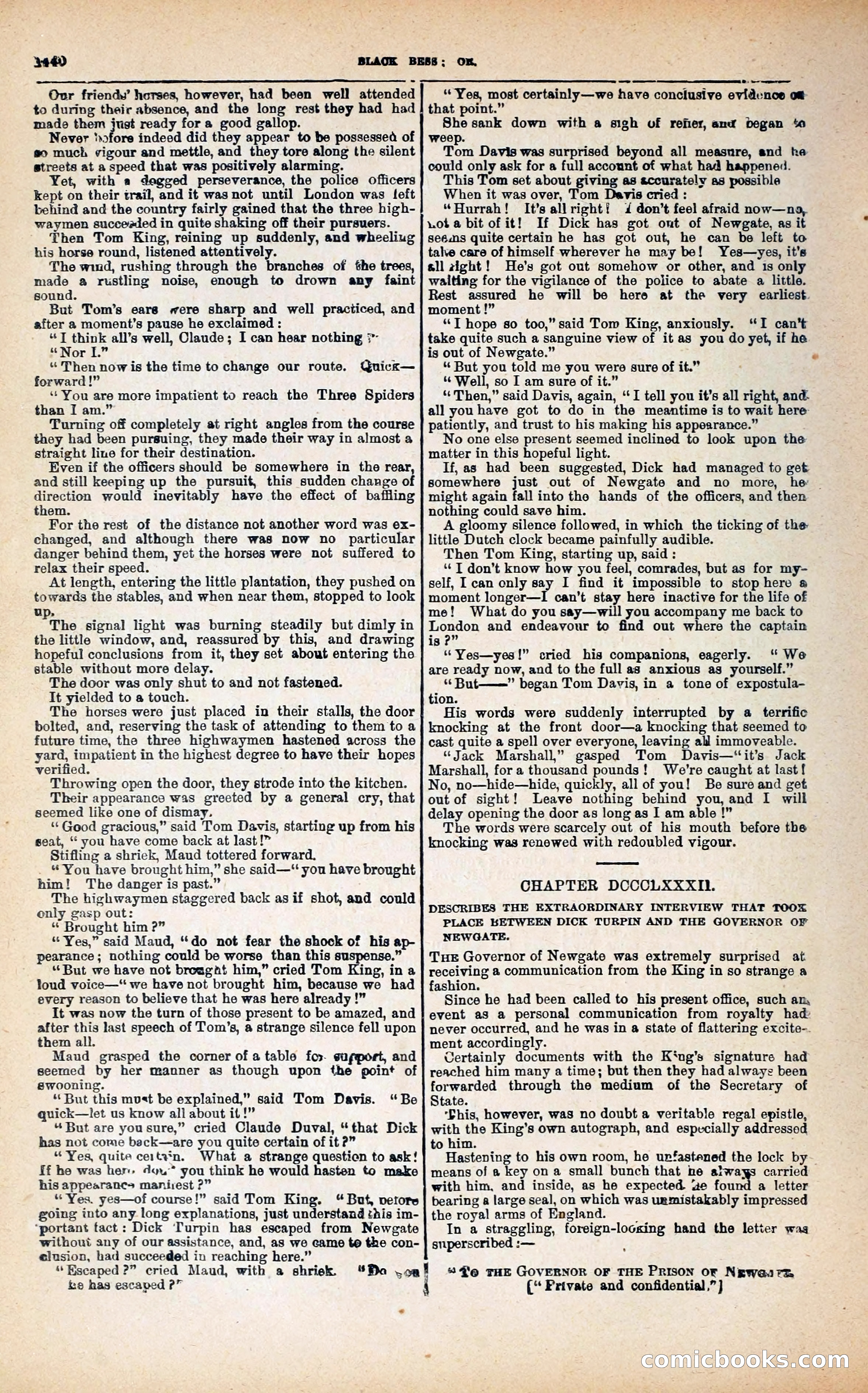
A restored page from Penny Dreadfuls, 1866. Page through the whole issue in the reader above.
📄 Transcribed text from this page (OCR, searchable)
Machine-transcribed from the original scan — historical spelling and the odd misread are preserved.
3440 Ovr friendu’ horses, however, had been well attended to during their absence, and the long rest they had had made them just ready for a good gallop. Never ‘fore indeed did they appear to be possessed of so much vigour and mettle, and they tore along the silent streets at a speed that was positively alarming. Yet, with a dagged perseverance, the police officers kept on their trail, and it was not until London was feft behind and the country fairly gained that the three high- waymen succeaded in quite shaking off their pursuers. Then Tom King, reining up suddenly, and wheeliug his horse round, listened attentively. The wind, rushing through the branches of the trees, made a rustling noise, enough to drown any faint sound. But Tom’s eare were sharp and well practiced, and after a moment’s pause he exclaimed : “T think all’s well, Claude; I can hear nothing ; Nor 1.” “ Then now is the time to change our route. Quicc— forward !” “You are more impatient to reach the Three Spiders than I am.” Turning off completely at right angles from the course they had been pursuing, they made their way in almost a straight line for their destination. Even if the officers should be somewhere in the rear, and still keeping up the pursuit, this sudden change of direction would inevitably have the effect of baffling them. For the rest of the distance not another word was ex- changed, and although there was now no particular danger behind them, yet the horses were not suffered to relax their speed. At length, entering the little plantation, they pushed on towards the stables, and when near them, stopped to look u » "The signal light was burning steadily but dimly in the little window, and, reassured by this, and drawing hopeful conclusions from it, they set about entering the stable without more delay. The door was only shut to and not fastened. It yielded to a touch. The horses were just placed in their stalls, the door bolted, and, reserving the task of attending to them to a future time, the three highwaymen hastened across the yard, impatient in the highest degree to have their hopes verified. Throwing open the door, they strode into the kitchen. Their appearance was greeted by a general cry, that seemed like one of dismay. “Good gracious,” said Tom Davis, starting up from his seat, “ you have come back at last!” Stifling a shrick, Maud tottered forward. “You have brought him,” she said—“ you have brought him! The danger is past.” The highwaymen staggered back as if shot, and could only gasp out: “ Brought him 2?” “Yes,” said Maud, “do not fear the shock of his ap- pearance; nothing could be worse than this suspense.” “But we have not broagat him,” cried Tom King, in a loud voice—“ we have not brought him, because we had every reason to believe that he was here already !” It was now the turn of those present to be amazed, and after this last speech of Tom’s, a strange silence fell upon them all. Maud grasped the corner of a table fos. sugport, and seemed by her manner as though upon the point of swooning. ‘But this must be explained,” said Tom Davis. “Be quick—let us know all about it !” “But are yousure,” cried Claude Duval, “that Dick has not come bsack—are you quite certain of it ?” “Yes, quite ceitvin. What a strange questien to ask! ff he was her» dow * you think he would hasten to make his appearances manirest ?” ** Yes. yes—of course!” said Tom King. “But, vetore going into any long explanations, just understand this im- ‘portant tact: Dick Turpin has escaped from Newgate without any of our assistance, and, as we came te the con- elusion, had succeeded in reaching here.” “Escaped ?” cried Maud, with a shriek “Da io &e has escaped ?” | BLAOK BESS; On, ‘Yes, most certainly—we have conclusive evidence of i ‘ : (E(0) that point.” She sank down with a sigh of refier, and began 4 weep. Tom Davis was surprised beyond all measnre, and he could only ask for a full account of what had happened. This Tom set about giving as accurately as possible When it was over, Tom Davis cried : “Hurrah! It’s allrighti i don’t feel afraid now—no, ..0¢ a bit of it! If Dick has got ont of Newgate, as it sees quite certain he has got out, he can be left to talve care of himself wherever he may be! Yes—yes, it’s sll zight! He’s got out somehow or other, and 1s only waiting for the vigilance of the police to abate a little. Rest assured he will be here at the very earliest. moment !” ““T hope so too,” said Tom King, anxiously. “I can’t take quite such a sanguine view of it as you do yet, if he is out of Newgate.” “ But you told me you were sure of it.” ‘Well, so I am sure of it.” “Then,” said Davis, again, ‘I tell you it’s all right, and- all you have got to do in the meantime is to wait here patiently, and trust to his making his appearance.” No one else present seemed inclined to look upon the matter in this hopeful light. If, as had been suggested, Dick had managed to get somewhere just out of Newgate and no more, he — might again fall into the hands of the officers, and then nothing could save him. A gloomy silence followed, in which the ticking of the little Dutch clock became painfully audible. Then Tom King, starting up, said : ‘‘T don’t know how you feel, comrades, but as for my- self, I can only say I find it impossible to stop here @ moment longer—I can’t stay here inactive for the life of me! What do you say—will you accompany me back to London and endeavour to find out where the captain is ?” ‘‘ Yes—yes!” cried his companions, eagerly. ‘“ We are ready now, and to the full as anxious as yourself.” ‘“ But——” began Tom Davis, in a tone of expostula- tion. His words were suddenly interrupted by a terrific knocking at the front door—a knocking that seemed to cast quite a spell over everyone, leaving all immoveable. “ Jack Marshall,” gasped Tom Davis—‘it’s Jack Marshall, fora thousand pounds! We're caught at last! No, no—hide—hide, quickly, all of you! Be sure and get out of sight! Leave nothing behind you,and I will delay opening the door as long as I am able !” The words were scarcely out of his mouth before the knocking was renewed with redoubled vigour. CHAPTER DCCCLXXXII. DESCRIBES THE EXTRAORDINARY INTERVIEW THAT TOOX PLACE BETWEEN DICK TURPIN AND THE GOVERNOR OF NEWGATE. THE Governor of Newgate was extremely surprised at receiving a communication from the King in so strange a fashion. : Since he had been called to his present office, such an, event as a personal communication from royalty had never occurred, and he was in a state of flattering excite-. ment accordingly. Certainly documents with the K*ng’s signature had reached him many a time; but then they had always been forwarded through the medium of the Secretary of State. ‘This, however, was no doubt a veritable regal epistle, with the King’s own autograph, and especially addressed to him. | Hastening to his own room, he urfastened the lock by~ means of a key on a small bunch that he always carried with him, and inside, as he expected we found a letter bearing a large seal, on which was urmistakably impressed the royal arms of England. In a straggling, foreign-locsing hand the letter waa superscribed :— * #@ THE GOVERNOR OF THE PRISON OF Newari (‘Private and confidential,” ] JOOKS