
Penny Dreadfuls, 1866 · page 200 of 395
Black Bess; or, the Knight of the Road — page 200: what you’re looking at
A restored page from Penny Dreadfuls, 1866. Page through the whole issue in the reader above.
📄 Transcribed text from this page (OCR, searchable)
Machine-transcribed from the original scan — historical spelling and the odd misread are preserved.
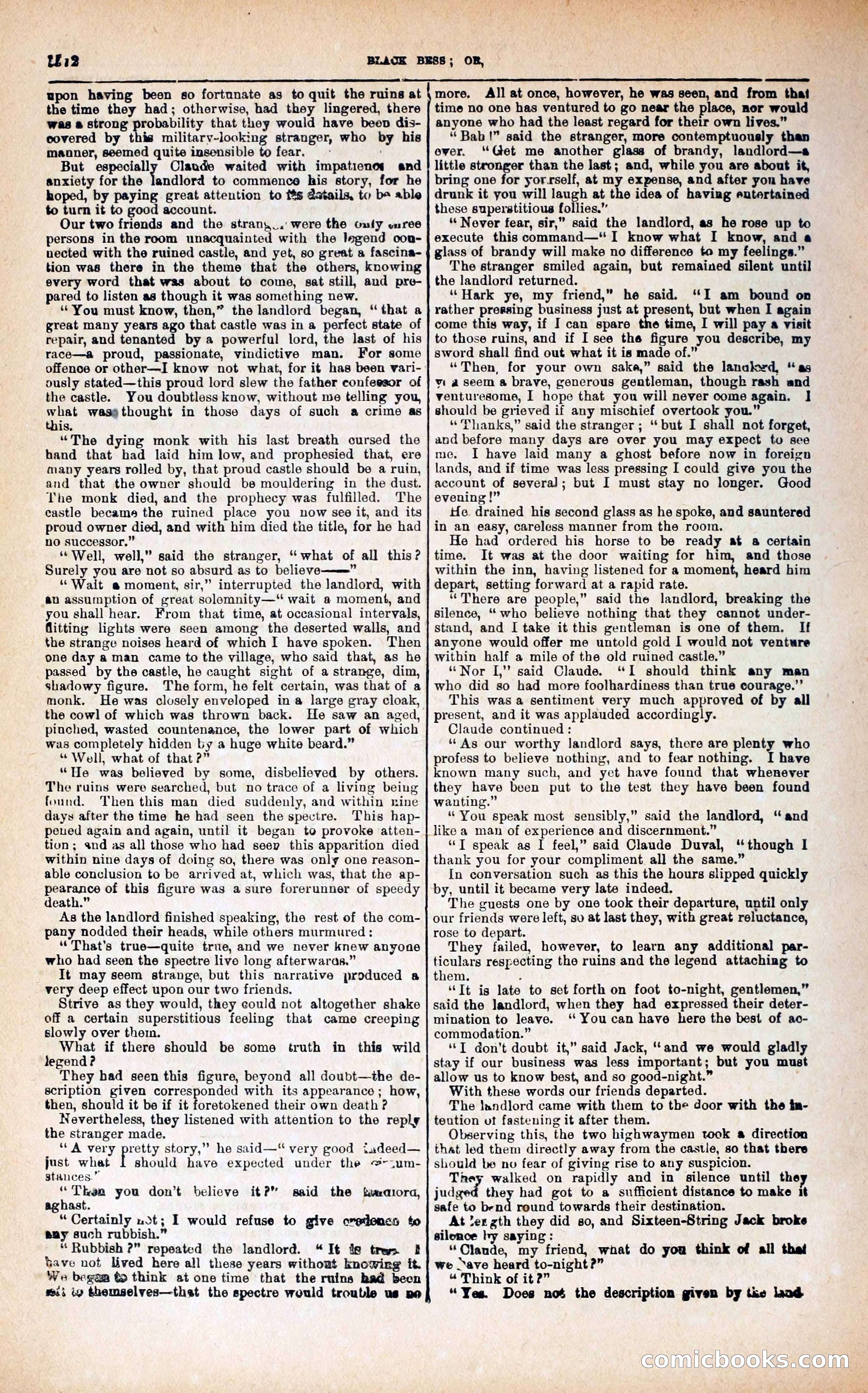
t£12 upon having been so fortunate as to quit the ruins at the time they had; otherwise, had they lingered, there was a strong probability that they would have been dis- covered by this militarv-looking stranger, who by his manner, seemed quite insensible to fear. - But especially Claude waited with impatienos and anxiety for the landlord to commence his story, for he hoped, by paying great attention to fs aatails, to be able to turn it to good account. Our two friends and the strany_. were the only umree persons in the room unacquainted with the legend oon- nected with the ruined castle, and yet, so great a fascina- tion was there in the theme that the others, knowing every word that was about to come, sat still, and pre- pared to listen as though it was something new. ‘You must know, then,” the landlord began, “that a great many years ago that castle was in a perfect state of repair, and tenanted by a powerful lord, the last of his race—a proud, passionate, vindictive man. For some offence or other—I know not what, for it has been vari- ously stated—this proud lord slew the father confessor of the castle. You doubtless know, without me telling you, what wasethought in those days of such a crime as this. “The dying monk with his last breath cursed the hand that had laid him low, and prophesied that, ere many years rolled by, that proud castle should be a ruin, and that the owner should be mouldering in the dust. The monk died, and the prophecy was fulfilled. The castle became the ruined place you now see it, and its proud owner died, and with him died the title, for he had no successor.” ‘‘ Well, well,” said the stranger, “what of all this? Surely you are not so absurd as to believe——” “Wait # moment, sir,” interrupted the landlord, with an assumption of great solomnity—" wait a moment, and you shall hear. From that time, at occasional intervals, flitting lights were seen among the deserted walls, and the strange noises heard of which I have spoken. Then one day aman came to the village, who said that, as he passed by the castle, he caught sight of a strange, dim, shadowy figure. The form, he felt certain, was that of a monk. He was closely enveloped in a large gray cloak, the cowl of which was thrown back. He saw an aged, pinched, wasted countenance, the lower part of which was completely hidden by a huge white beard.” “ Well, what of that ?” “THe was believed by some, disbelieved by others. The ruins were searched, but no trace of a living being found. Then this man died suddenly, and within nine days after the time he had seen the spectre. This hap- peued again and again, until it began to provoke atten- tiun; and as all those who had seep this apparition died within nine days of doing so, there was only one reason- able conclusion to be arrived at, which was, that the ap- pee of this figure was a sure forerunner of speedy eath.” As the landlord finished speaking, the rest of the com- pany nodded their heads, while others murmured: “That's true—quite true, and we never knew anyone who had seen the spectre live long afterwaras.” It may seem strange, but this narrative produced a very deep effect upon our two friends. Strive as they would, they could not altogether shake off a certain superstitious feeling that came creeping slowly over ther. What if there should be some truth legend? They bad seen this figure, beyond all doubt—the de- scription given corresponded with its appearance; how, then, should it be if it foretokened their own death ? Nevertheless, they listened with attention to the reply the stranger made. in this wild ‘‘ A very pretty story,” he said—“ very good iudeed— just what I should have expected under the @-jum- stances.” “Thea you don’t believe it?” said the tsaraiora, aghast. “ Certainly not; I would refuse to give credencs to aay such rubbish.” “Rubbish ?” repeated the landlord. “I¢ ie tras 1 Gave not lived here all these years without knowing ft. We begaa ts think at one time that the rnins had been sii iy themselves—that the spectre would trouble us ne BLACK BESS; OR, tC AE more. All at once, however, he was seen, and from that time no one has ventured to go near the place, nor would anyone who had the least regard for their own lives.” “ Bab!” said the stranger, more contemptuously than ever. “Get me another glass of brandy, landlord—a little stronger than the last; and, while you are about it, bring one for yor.rself, at my expense, and after yon have drunk it you will laugh at the idea of having entertained these superstitious follies.” ‘“‘ Never fear, sir,” said the landlord, as he rose up to execute this command—" I know what I know, and e glass of brandy will make no difference to my feelings.” The stranger smiled again, but remained silent until the landlord returned. “Hark ye, my friend,” he said. “I am bound on rather pressing business just at present, but when I again come this way, if I can spare the time, I will pay a visit to those ruins, and if I see the figure you describe, my sword shall find out what it is made of.” “Then, for your own sake,” said the lanaked, “as vi a seem a brave, generous gentleman, though rash and venturesome, I hope that you will never come again. | should be grieved if any mischief overtook you.” “hanks,” said the stranger; “but I shall not forget, and before many days are over you may expect to see me. I have laid many a ghost before now in foreign lands, and if time was less pressing I could give you the account of several; but I must stay no longer. Good evening!” He. drained his second glass as he spoke, and sauntered in an easy, careless manner from the room. He had ordered his horse to be ready at & certain time. It was at the door waiting for him, and those within the inn, having listened for a moment, heard him depart, setting forward at a rapid rate. “There are people,” said the landlord, breaking the silence, “who believe nothing that they cannot under- stand, and I take it this gentleman is one of them. If anyone would offer me untold gold I would not venture within half a mile of the old ruined castle.” “Nor I,’ said Claude. “I should think any man who did so had more foolhardiness than true courage.”’ This was a sentiment very much approved of by all present, and it was applauded accordingly. Claude continued : ‘‘ As our worthy landlord says, there are plenty who profess to believe nothing, and to fear nothing. I have known many such, and yet have found that whenever they have been put to the test they have been found wanting.” ‘You speak most sensibly,” said the landlord, “ and like a man of experience and discernment.” “T speak as I feel,” said Claude Duval, “though I thank you for your compliment. all the same.” In conversation such as this the hours slipped quickly by, until it became very late indeed. The guests one by one took their departure, until only our friends were left, so at last they, with great reluctance, rose to depart. They failed, however, to learn any additional par- ticulars respecting the ruins and the legend attaching to them. “Tt is late to set forth on foot to-night, gentlemen,” said the landlord, when they had expressed their deter- mination to leave. ‘ You can have here the best of ac- commodation.” ‘‘T don’t doubt it,” said Jack, ‘‘and we would gladly stay if our business was less important; but you must allow us to know best, and so good-night.” With these words our friends departed. The landlord came with them to the door with the in- teution ut fastening it after them. Observing this, the two highwaymen took a direction that led them directly away from the castle, so that there should be no fear of giving rise to any suspicion. Trey walked on rapidly and in silence until they sudawd, they had got to a sufficient distance to make it safe to bend round towards their destination. At er zth they did so, and Sixteen-String Jack broke silence ly saying : “Olande, my friend, what do you think of all thal we ave heard to-night ?” “Think of it 2” “Yes. Does not the description given by tie laad Gomicbooks (E(@)