
Penny Dreadfuls, 1866 · page 282 of 395
Black Bess; or, the Knight of the Road — page 282: what you’re looking at
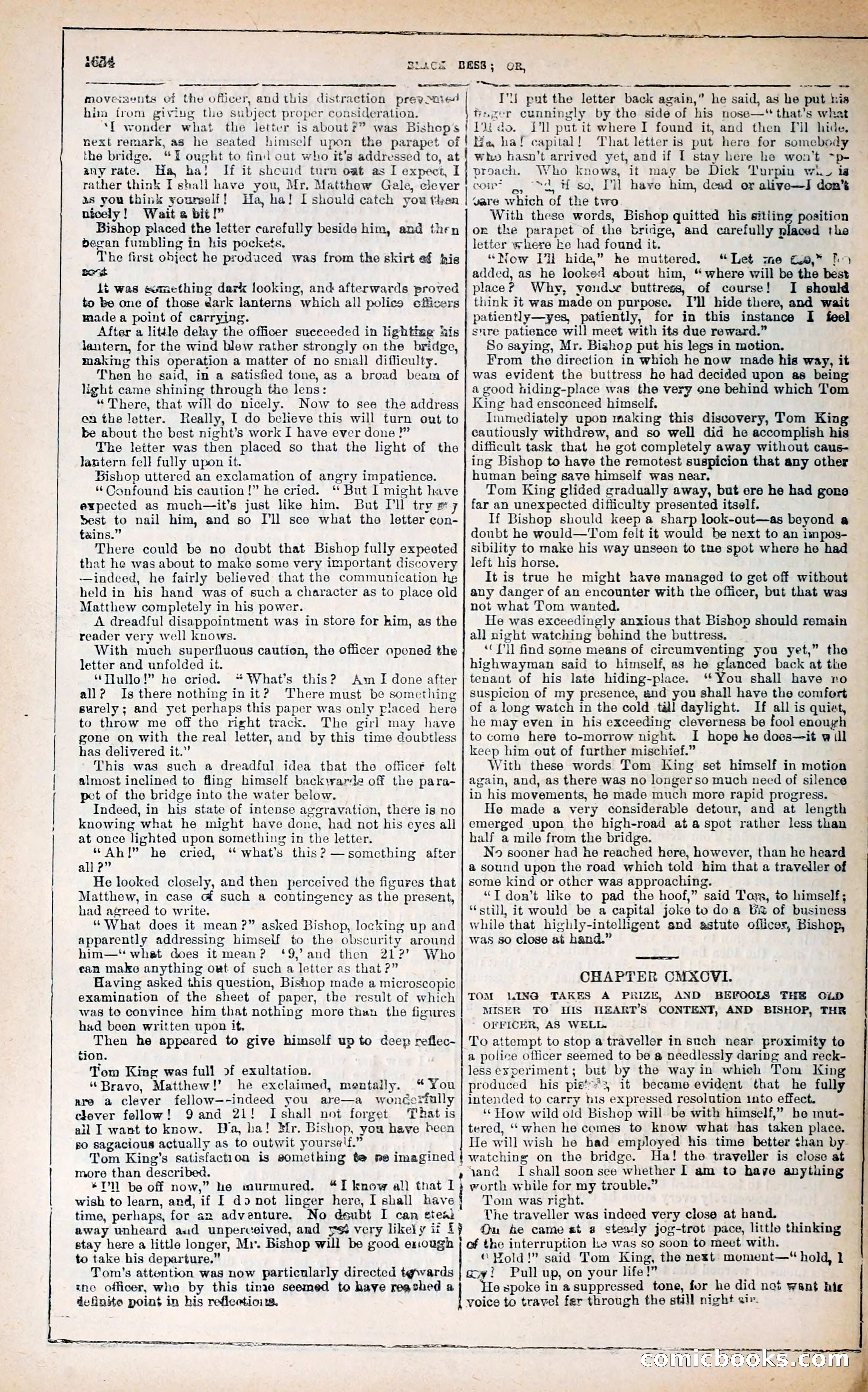
A restored page from Penny Dreadfuls, 1866. Page through the whole issue in the reader above.
📄 Transcribed text from this page (OCR, searchable)
Machine-transcribed from the original scan — historical spelling and the odd misread are preserved.
a ced s638 moversents of the officer, and this distraction preyanied hua from giving the subject proper consideration. SLACE BSS; OB, ee: cf eee Iti put the letter back again,” he said, as he put his» tejzer cunningly by the side of his nose—‘ that’s what ‘IT wonder what the letter is about?” was Bishops | I'ido. I'll put it where I found it, and then Ill hide. next remark, as he seated himsclf upon the parapet of |! Ha, ha! capital! the bridge. “I ought to find out who it’s addressed to, at any rate. Ha, ha! If it should turn oat as I expect, I rather think I shall have you, Mr. Matthow Gale, clever | coir* Ha, ha! I should catch you then | vare which of the two 28 you think yourself! nicely! Wait a bit!” Bishop placed the letter carefully beside him, and then becan fumbling in his pockets, The first object he produced was from the skirt ef hig sort Lt was something dark looking, and afterwards proved to be one of those eark lanterns which all polics efiicers made a point of carrying. After a little delay the officer suceceded in lighting his lantern, for the wind blew rather strongly on the bridge, makmeg this operation a matter of no sniall difficulty. Then he said, in a satisfied tone, as a broad beam of light came shining through the lens: “There, that will do nicely. Now to see the address en the letter. Really, I do beheve this will turn out to be about the best night’s work I have ever done ?” The letter was then placed so that the light of the lantern fell fully upon it. Bishop uttered an exclamation of angry impatience. “‘Confound his caution!” he cried. ‘“ But I might have expected as much—it’s just like him. But I'll try best to nail him, and so I'll see what the letter con- tains.” There could be no doubt that Bishop fully expected that he was about to make some very important discovery —indeed, he fairly believed that the communication he held in his hand was of such a character as to place old Matthew completely in his power. A dreadful disappointment was in store for him, as the reader very well knows. With much superfluous caution, the officer opened the letter and unfolded it. “Tullo!” he cried. “* What’s this? Am I done after all? Is there nothing init? There must be something surely; and yet perhaps this paper was only placed here to throw me off the right track. The girl may have gone on with the real letter, and by this time doubtless has delivered it.” This was such a dreadful idea that the officer felt almost inclined to fling himself backwards off the para- pet of the bridge into the water below. Indeed, in his state of intense aggravation, there is no knowing what he might have done, had not his eyes all at once lighted upon something in the letter. “Ah!” he cried, ‘“ what’s this? —something after all ?” He looked closely, and then perceived the figures that Matthew, in case of such a contingency as the present, had agreed to write. “What does it mean?” asked Bishop, locking up and apparently addressing himself to the obscurity around him—" what does it mean? ‘9,’ and then 21?’ Who can make anything owt of such a letter as that ?” Having asked this question, Bishop made a microscopic examination of the sheet of paper, the result of which was to convince him that nothing more thun the figures had been written upon it. Then he appeared to give himself upto deep reflec- tion. Tom King was full 2f exultation. “Bravo, Matthew!’ he exclaimed, mextally. “ You are a clever fellow—-indeed you are—a wonéertully clover fellow! Qand 21! Ishall not forget That is ail I want to know. Ba, ha! Mr. Bishop, you have been so sagacious actually as to outwit yourself.” Tom King’s satisfaction is something te pe imagined more than described. *T'll be off now,” he murmured. “I know al) that I wish to learn, and, if I do not linger here, I shall have time, perhaps, for an adventure. No deubt I can eteal away unheard aud unperveived, and 93 very likely if 4) stay here a little longer, Mr. Bishop will be good ex:ough to take his departure.” Tom’s attention was now particularly directed tg@wards tne officer, whe by this time seemed to haye regshed a definite poins in his refleetioiw. — a TT ce I Oe A, eee That letter is put here for somebody whos hasn’t arrived yet, and if I stay here he won’t ~p- proach. Who knows, it may be Dick Turpin wiJ is « “2, so, I'll have him, dead or alive—J don’t With these words, Bishop quitted his sitiing position on the parapet of the bridge, and carefully placed the letter where ke had found it. “Now Vii hide” he muttered. “Let me ca,* fh added, as he looked about him, “where will be the best place? Why, yonder buttress, of course! I should think it was made on purpose. I'll hide there, and wait patiently—yes, patiently, for in this instance I feel sure patience will meet with its due reward.” So saying, Mr. Bishop put his legs in motion. From the direction in which he now made his way, it was evident the buttress he had decided upon as being a good hiding-place was the very one behind which Tom King had ensconced himself. Immediately upon making this discovery, Tom King cautiously withdrew, and so well did he accomplish his difficult task that he got completely away without caus- ing Bishop to have the remotest suspicion that any other human being save himself was near. Tom King glided gradually away, but ere he had gone far an unexpected difficulty presented itself. If Bishop should keep a sharp look-out—as beyond a doubt he would—Tom felt it would be next to an impos- sibility to make his way unseen to the spot where he had left his horse. It is true he might have managed to get off without any danger of an encounter with the officer, but that was not what Tom wanted. He was exceedingly anxious that Bishop should remain all night watching behind the buttress. ‘(ll find some means of circumventing you yet,” the highwayman said to himself, as he glanced back at the tenant of his late hiding-place. ‘You shall have no suspicion of my presence, and you shall have the comfort of a long watch in the cold tail daylight. If all is quiet, he may even in his exceeding cleverness be fool enough to come here to-morrow night. I hope ke does—it q ill keep him out of further mischief.” With these words Tom King set himself in motion again, and, as there was no longerso much necd of silenee in his movements, he made much more rapid progress. He made a very considerable detour, and at length emerged upon the high-road ata spot rather less than half a mile from the bridge. N> sooner had he reached here, however, than he heard @ sound upon the road which told him that a traveller of some kind or other was approaching. “T don’t like to pad the hoof,” said Tore, to himself; ‘still, it would be a capital joke to doa bi of business while that highly-intelligent and astute officer, Bishop, was so close at hand.” CHAPTER CMXOVI. TOM LING TAKES A PRIZE, AND BEFOOLS THE OLD MISER TO HIS HEZART’S CONTENT, AND BISHOP, THR OFFICER, AS WELL. To attempt to stop a traveller in such near proximity to a police officer seemed to be @ needlessly daring and reck- less experiment; but by the way in which Tom King produced his pie’*3 it became evident that he fully intended to carry his expressed resolution into effect. ‘‘ How wild old Bishop will be with himself,” he mut- tered, ‘‘when he comes to know what has taken place. He will wish he had employed his time better than by watching on the bridge. Ha! the traveller is close at yana I shall soon see whether 1 am to have anything worth while for my trouble.” Tom was right. The traveller was indeed very close at hand. Ou he came at a steady jog-trot pace, littl thinking of the interruption he was so soon to meet with. « Yold!” said Tom King, the next moment—“ hold, 1 gov! Pull up, on your life!” i e spoke in a suppressed tone, for he did not want hig voice to travel fer through the still night giv. Gomichooksn é ee