
Penny Dreadfuls, 1866 · page 40 of 395
Black Bess; or, the Knight of the Road — page 40: what you’re looking at
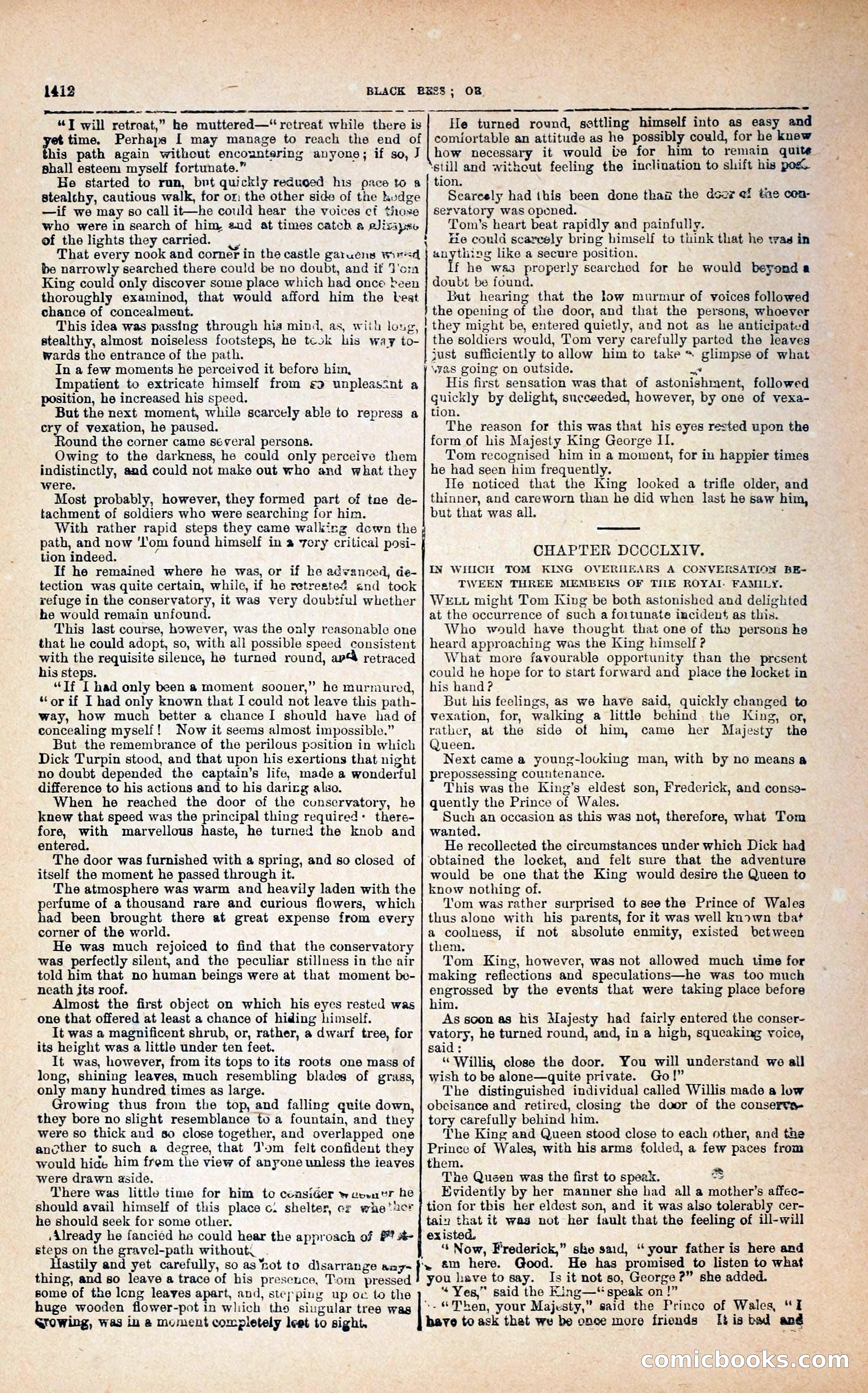
A restored page from Penny Dreadfuls, 1866. Page through the whole issue in the reader above.
📄 Transcribed text from this page (OCR, searchable)
Machine-transcribed from the original scan — historical spelling and the odd misread are preserved.
1412 * “T will retroat,” he muttered— retreat while there is et time. Perhaps | may manage to reach the end of his path again without encountering anyone; if so, J shall esteem myself fortunate.” He started to run, but quickly reduoed his pace to a stealchy, cautious walk, for or the other side of the hudge —if we may so call it—he could hear the voices ct those who were in search of him end at times catch a eJixapae of the lights they carried. — That every nook and corner in the castle garuens wird be narrowly searched there could be no doubt, and if J'ora King could only discover some place which had once been thoroughly examinod, that would afford him the beat chance of concealment. This idea was passing through his mind, as, with long, stealthy, almost noiseless footsteps, he teok his way to- wards the entrance of the path. In a few moments he perceived it before him, Impatient to extricate himself from £9 unpleasint a position, he increased his speed. But the next moment, while scarcely able to repress a cry of vexation, he paused. Round the corner came several persons. Owing to the darkness, he could only perceive them indistinctly, and could not make out who and what they were. Most probably, however, they formed part of toe de- tachment of soldiers who were searching for him. With rather rapid steps they came walking dcwn the path, and now '‘l’om found himself in a 7ory critical posi- tion indeed. : If he remained where he was, or if he advanced, de- tection was quite certain, while, if he retreete? end tock refuge in the conservatory, it was very doubtiul whether he would remain unfound. This last course, however, was the only reasonable one that he could adopt, so, with all possible speed consistent with the requisite silence, he turned round, ap& retraced his steps. “Tf I had only been a moment sooner,” he murmured, “or if I had only known that I could not leave this path- way, how much better a chance I should have had of concealing myself! Now it seems almost impossible.” But the remembrance of the perilous position in which Dick Turpin stood, and that upon his exertions that night no doubt depended the captain’s life, made a wonderful difference to his actions and to his darirg also. When he reached the door of the cunservatory, he knew that speed was the principal thing required: there- fore, with marvellous haste, he turned the knob and entered. The door was furnished with a spring, and so closed of itself the moment he passed through it. The atmosphere was warm and heavily laden with the perfume of a thousand rare and curious flowers, which had been brought there at great expense from every corner of the world. He was much rejoiced to find that the conservatory was perfectly silent, and the peculiar stillness in the air told him that no human beings were at that moment be- neath its roof. _ Almost the first object on which his eyes rested was one that offered at least a chance of hiding himself. It was a magnificent shrub, or, rather, a dwarf tree, for its height was a little under ten feet. It was, however, from its tops to its roots one mass of long, shining leaves, much resembling blades of grass, only many hundred times as large. Growing thus from the top, and falling quite down, they bore no slight resemblance to a fountain, and they were so thick and so close together, and overlapped one ancther to such a degree, that T'2sm felt confident they would hide him frem the view of anyone unless the ieaves were drawn aside. There was little time for him to censiter we utr be should avail himself of this place ci shelter, er whe*2¢r he should seek for some other. Already he fancied he could hear the approach of F* #& steps on the gravel-path without, . Hastily and yet carefully, so as ‘not to disarrange aay- thing, and so leave a trace of his presence, Tom pressed some of the long leaves apart, and, ste; ping up oc to the huge wooden flower-pot in which tho siugular tree was Growing, was in a moment completely lest to sight, | He turned round, settling himself into as easy an BLACK BESS; OB comfortable an attitude as he possibly could, for he knew how necessary it would be for him to remain quite ‘still and without feeling the inclination to shift his post tion. Seareely had this been done thaz the doer ef tae con- servatory was oponed. Tom’s heart beat rapidly and painfully. He could scarcely bring himself to think that he was in uuything like a secure position. f he was properly searched for he would beyond a doubt be found. But hearing that the low murmur of voices followed the opening of the door, and that the persons, whoever they might be, entered quietly, and not as he anticipated the soldiers would, Tom very carefully parted the leaves just sufficiently to allow him to take * glimpse of what Was going on outside. - His first sensation was that of astonishment, followed Guickly by delight, succeeded, however, by one of vexa- tion. The reason for this was that his eyes rested upon the form of his Majesty King George II. Tom recognised him in a moment, for in happier times he had seen him frequently. Iie noticed that the King looked a trifle older, and thinner, and careworn than he did when last he saw him, but that was all. CHAPTER DCCCLXAIV. IN WILICH TOM KING OVERILEARS A CONVERSATION BE- TWEEN THREE MEMBERS OF TIIE ROYAI-. FAMILY. WELL might Tom King be both astonished and delighted at the occurrence of such a foitunate incident as this. Who would have thought that one of th» persons he heard approaching was the King himself ? What more favourable opportunity than the present could he hope for to start forward and place the locket in his hand? But his feelings, as we have said, quickly changed te vexation, for, walking a little behind the King, or, rather, at the side of him, came her Majesty the Queen. Next came a young-lovking man, with by no meansa prepossessing countenance. This was the King’s eldest son, Frederick, and conse- quently the Prince of Wales. Such an occasion as this was not, therefore, what Tom wanted. He recollected the circumstances under which Dick had obtained the locket, and felt sure that the adventure would be one that the King would desire the Queen to know nothing of. ‘l'om was rather surprised to see the Prince of Wales thus alone with his parents, for it was well known tbat a coolness, if not absolute enmity, existed between them. Tom King, however, was not allowed much time for making reflections and speculations—he was too much engrossed by the events that were taking place before him. As soon as his Alajesty had fairly entered the conser- vatory, he turned round, and, in a high, squeaking voice, said : “Willis, close the door. You will understand we all wish to be alone—quite private. Go!” The distinguished individual] called Willis made a low obcisance and retired, closing the door of the conserta- tory carefully behind him. The King and Queen stood close to each other, and the Prince of Wales, with his arms folded, a few paces from them. The Queen was the first to speak. e Evidently by her manner she had all a mother’s affec- tion for this her eldest son, and it was also tolerably cer- tain that it was not her fault that the feeling of ill-will existed. ‘‘ Now, Frederick,” she said, ‘your father is here and ~ #m here. Good. He has promised to listen to what you have to say. Is it not so, George ?” she added. “Yes,” said the King—“ speak on !” .¢Phen, your Majesty,” said the Princo of Wales, “I havo to ask that we be once more friends [% is bad and Gomicbooks:co