
Penny Dreadfuls, 1866 · page 60 of 395
Black Bess; or, the Knight of the Road — page 60: what you’re looking at
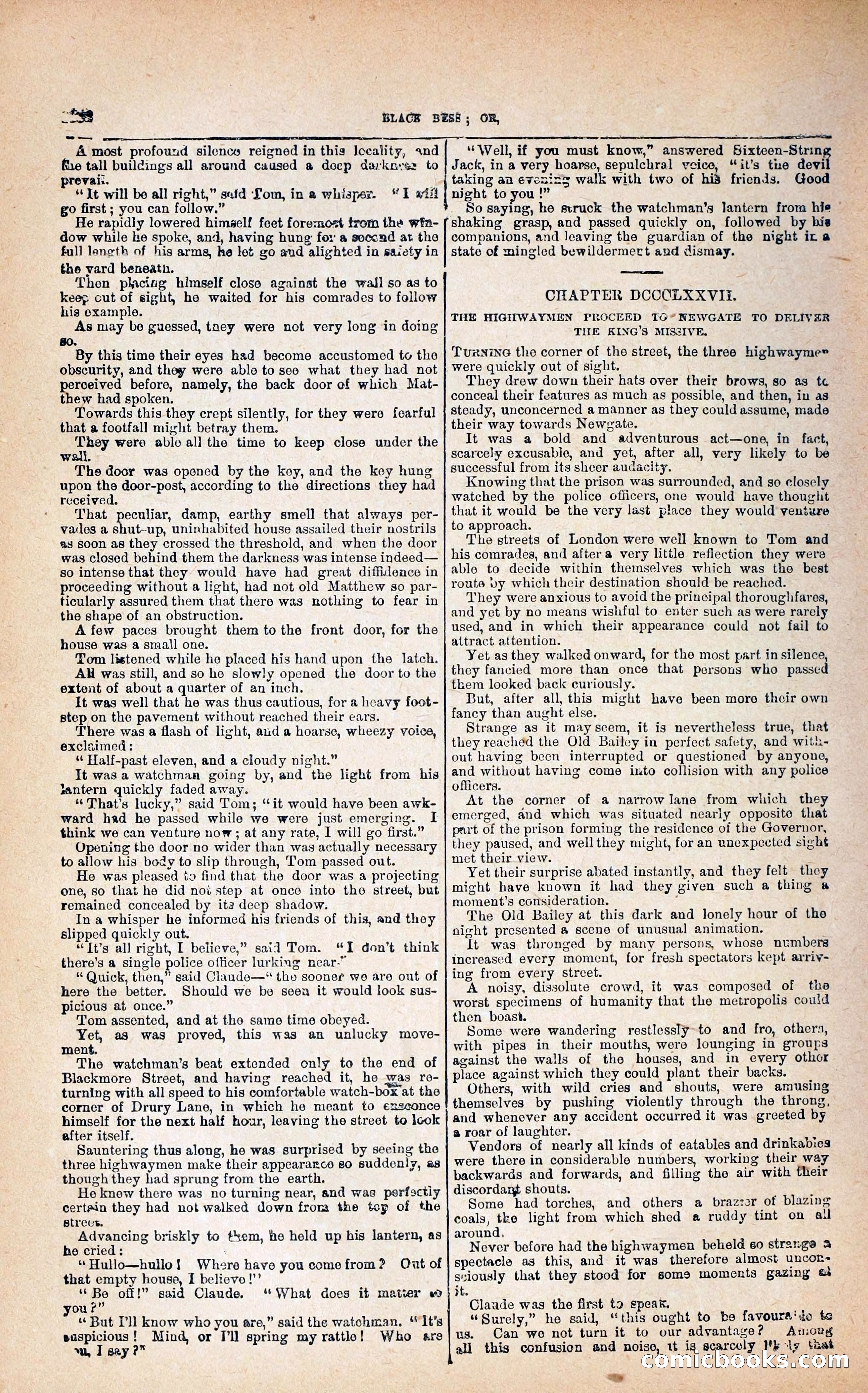
A restored page from Penny Dreadfuls, 1866. Page through the whole issue in the reader above.
📄 Transcribed text from this page (OCR, searchable)
Machine-transcribed from the original scan — historical spelling and the odd misread are preserved.
33 & most profound silence reigned in this locality, and fie tall buildings all around caused a doep darknesz to prevai:. “Jt will be all right,” safd Lom, in a whisper. “1 wii go first ; you can follow.” He rapidly lowered himself feet foreznost trom the win- dow while he spoke, and, having hung’ fox a socend at the full lencth of his armg, he let go and alighted in sacety in the vard beneath. Then placing himself close against the wall so as to keep out of sight, he waited for his comrades to follow his example. As may be guessed, tney were not very long in doing By this time their eyes had become accustomed to the obscurity, and they were able to see what they had not bereaved before, namely, the back door ef which Mat- thew had spoken. Towards this they crept silently, for they were fearful that a footfall might betray them. ged were able all the time to keep close under the wall. The door was opened by the key, and the key hung upon the door-post, according to the directions they had received. That peculiar, damp, earthy smell that always per- vades a shut-up, uninhabited house assailed their nostrils as soon as they crossed the threshold, and when the door was closed behind them the darkness was intense indeed— so intense that they would have had great diffidence in proceeding without a light, had not old Matthew so par- ticularly assured them that there was nothing to fear in the shape of an obstruction. A few paces brought them to the front door, for the house was a small one. Tom listened while he placed his hand upon the latch. AH was still, and so he slowly opened the door to the extent of about a quarter of an inch. It was well that he was thus cautious, for a heavy foot- step on the pavement without reached their ears. There was a flash of light, aud a hoarse, wheezy voice, exclaimed : Walf-past eleven, and a cloudy night.” It was a watchman going by, and the light from his xantern quickly faded away. “ That’s lucky,” said Tom; “it would have been awk- ward had he passed while we were just emerging. I think we can venture now; at any rate, I will go first.” Opening the door no wider than was actually necessary to allow his body to slip through, Tom passed out. He was pleased ta find that the door was a projecting one, so that he did noi step at once into the street, but remained concealed by its decp shadow. In a whisper he informed his friends of this, and thoy slipped quickly out. “Tt’s all richt, L believe,” said Tom. “I don’t think there’s a single police officer lurking near.” “ Quick, then,” said Claude—“ thy sooner we are out of here the better. Should we bo seen it would look sus- picious at once.” Tom assented, and at the same time obeyed. Yet, as was proved, this was an unlucky move- ment. The watchman’s beat extended only to the end of Blackmore Street, and having reached it, he was ro- turning with all speed to his comfortable watch-box at the corner of Drury Lane, in which he meant to exseonce himself for the next half hour, leaving the street to look after itself. Sauntering thus along, he was surprised by seeing the three highwaymen make their appearance so suddenly, as though they had sprung from the earth. He knew there was no turning near, and was perfsctiy certain they had not walked down from the tcp of the strecs. Advancing briskly to them, he held up his lantern, as he cried: “Hullo—hullo! Where have youcome from? Out of that empty houses, I believo!’’ ““ Be off!” said Claude. ou?” “ But [ll know who you are,” said the watchman, "It’s suspicious! Mind, or Ill spring my rattle! Who sre vu, I say ?” ‘What does it matter w BLACK BSS; OR, “Well, if you must know,” answered Sixteen-Strin Jack, in a very hoarse, sepulchral veice, “it’s tne devi taking an evcuize walk with two of his friends. Good night to you !” So saying, he struck the watchman’s lantern from hie — shaking grasp, and passed quickly on, followed by his companions, and leaving the guardian of the night ir a state of mingled bewildermert and dismay. CHAPTER DCCCLXXVIi. THE HIGIIWAYMEN PROCEED TO*“NIXWGATE TO DELIVER TIIE KING’S MISSIVE. TuxNinG the corner of the street, the three highwayme» were quickly out of sight. They drew down their hats over their brows, so as te conceal their features as much as possible, and then, in as steady, unconcerned a manner as they could assume, made their way towards Newgate. It was a bold and adventurous act—one, in fact, scarcely excusabie, and yet, after all, very likely to be successful from its sheer audacity. Knowing that the prison was surrounded, and so closely watched by the police officers, one would have thought that it would be the very last place they would venture to approach. The streets of London were well known to Tom and his comrades, and aftera very little reflection they were able to decide within themselves which was the best route vy which their destination should be reached. They were anxious to avoid the principal thoroughfares, and yet by no means wishful to enter such as were rarely used, and in which their appearance could not fail to attract attention. Yet as they walked onward, for the most part in silence they fancied more than once that persons who passed them looked back curiously. But, after all, this might have been more thcir own fancy than aught else. Strange as it mayseem, it is nevertheless true, that they reached the Old Bailey in perfect safety, and with- out having been interrupted or questioned by anyone, and without having come into collision with any police officers. At the corner of a narrow lane from which they emerged, and which was situated nearly opposite that part of the prison forming the residence of the Governor, they paused, and wellthey might, for an unexpected sight met their view. Yet their surprise abated instantly, and they felt they might have known it had they given such a thing @ moment’s consideration. The Old Bailey at this dark and lonely hour of the night presented a scene of unusual animation. It was thronged by many persons, whose numbers increased every moment, for fresh spectators kept arrivy- ing from every strcet. A noisy, dissolute crowd, it was composed of the worst specimens of humanity that the metropolis could then boast. Some were wandering restlessly to and fro, others, with pipes in their mouths, were lounging in groups against the walls of the houses, and in every othor place against which they could plant their backs. _ Others, with wild cries and shouts, were amusing themselves by pushing violently through the throng, and whenever any accident occurred it was greeted by a roar of laughter. Vendors of nearly all kinds of eatables and drinkabies were there in considerable numbers, working their way backwards and forwards, and filling the air with their discordant shouts. Some had torches, and others a brazror of blazing coals, tke light from which shed a ruddy tint on all around, Never before had the highwaymen beheld go strangs a spectacle as this, and it was therefore almost uncor- sciously that they stood for some moments gazing et it. Claude was the first ta speak, “Surely,” he said, “this ought to be favoura‘ido te us. Can we not turn it to our advantage? Anozg ali this confusion and noise, tt is, scarcely le ‘ly that GOMIIEGRDOOKS:-GOom