
Penny Dreadfuls, 1866 · page 152 of 395
Black Bess; or, the Knight of the Road — page 152: what you’re looking at
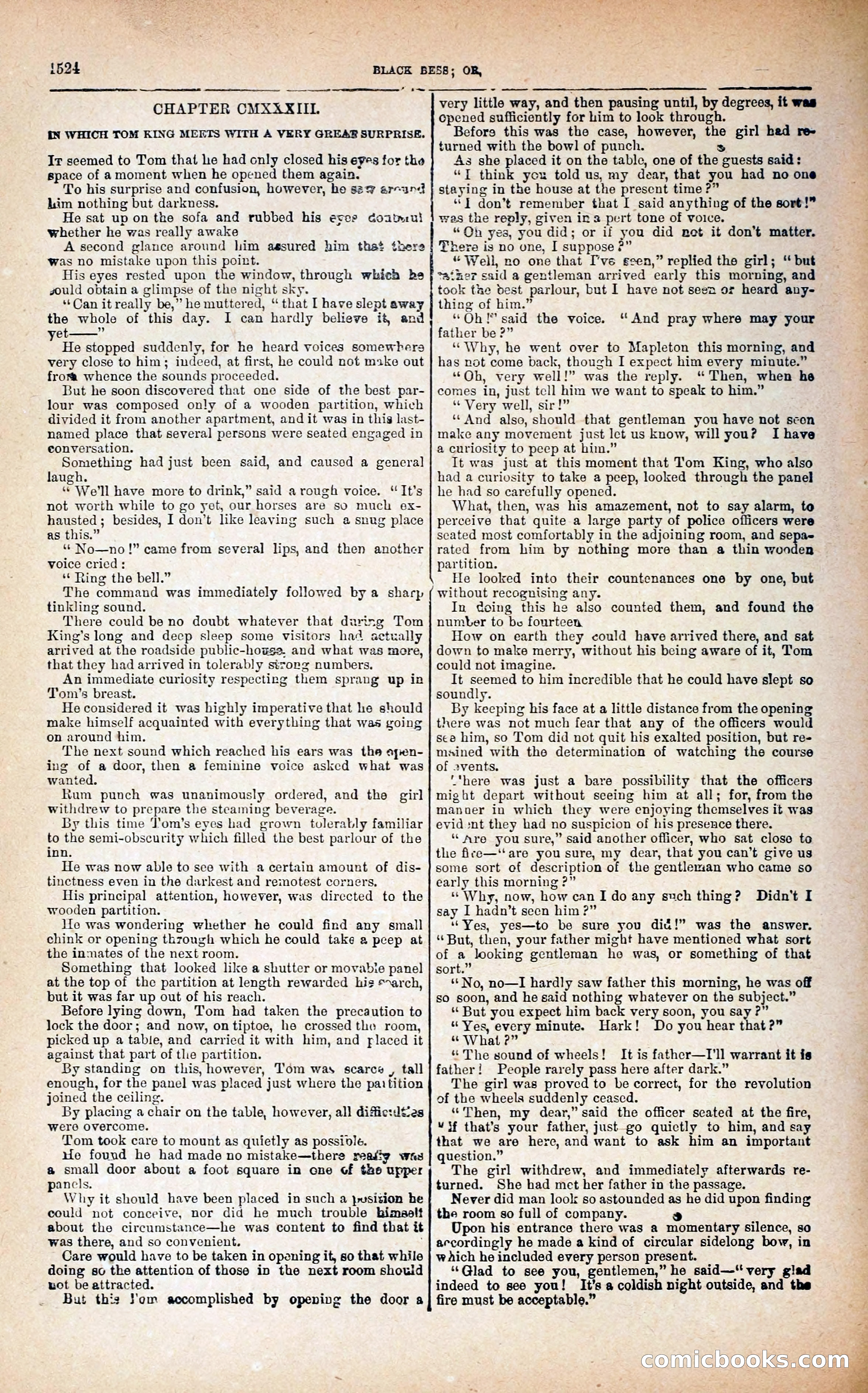
A restored page from Penny Dreadfuls, 1866. Page through the whole issue in the reader above.
📄 Transcribed text from this page (OCR, searchable)
Machine-transcribed from the original scan — historical spelling and the odd misread are preserved.
{524 _-——- eer? CHAPTER CMXXXIIL IN WHICH TOM KING MEETS WITH A VERY GREARB SURPRISE. Ir seemed to Tom that he had only closed his eyes for the space of amoment when he opened them again, To his surprise and confusion, however, he sé arcand him nothing but darkness. He sat up on the sofa and rubbed his eres coatmrul whether he was really awake A second glance around him assured him that there was no mistake upon this poirt. His eyes rested upon the window, through which he gould obtain a glimpse of the night sky. ‘Can it really be,” he muttered, “that [ have slept away the whole of this day. I can hardly believe it, and eee y He stopped suddenly, for he heard voices somewhers very close to him; indeed, at first, he could not make out froma whence the sounds proceeded. But he soon discovered that one side of the best par- lour was composed only of a wooden partition, which divided it from another apartment, and it was in this last- named place that several persons were seated engaged in conversation. Something had just been said, and caused a general laugh. ‘“ We'll have more to drink,” said a rough voice. “It’s not worth while to go yet, our horses are so much ex- hausted ; besides, I don’t like leaving such a snug place as this.” “‘ No—no!” came from several lips, and then another voice cried: ‘* Ring the bell.” The command was immediately followed by a sharp tinkling sound. There could be no doubt whatever that during Tom King’s long and decp sleep some visitors had actually arrived at the roadside public-howgs. and what was mere, that they had arrived in tolerably strong numbers. An immediate curiosity respecting them sprang up in T’om’s breast. He considered it was highly imperative that he should make himself acquainted with everything that was going on around him. The next sound which reached his ears was the epen- ing of a door, then a feminine voice asked what was wanted. Kum punch was unanimously ordered, and the girl withdrew to prepare the steaming beverage. By this time T’om’s eyes had grown tolerably familiar to the semi-obscurity which filled the best parlour of the inn. He was now able to see with a certain amount of dis- tinctness even in the darkest and remotest corners, His principal attention, however, was dirccted to the wooden partition. l{e was wondering whether he could find any small chink or opening through which he could take a peep at the inmates of the next room. Something that looked like a shutter or movabie panel at the top of the partition at length rewarded his ™arch, but it was far up out of his reach. Before lying down, Tom had taken the precaution to lock the door; and now, on tiptoe, he crossed the room, picked up a table, and carried it with him, and placed it against that part of tlie partition. By standing on this, however, Tom was scarce , tall enough, for the panel was placed just where the partition joined the ceiling. By placing a chair on the table, however, all didic:dtes were overcome. Tom took care to mount as quietly as possiole. ue found he had made no mistake—there readiy was a@ small door about a foot square in one Gf the upper ancls, 5 Why it should have been placed in such a yusition he could not conceive, nor did he much trouble bimsaslt about the circumstance—he was content to find that it was there, and so convenient. : Care would have to be taken in opening it, so that while doing so the attention of those in the next room shouid uot be attracted. But this }'}om accomplished by opening the door a BLACK BESS; OR, very little way, and then pausing until, by degrees, it was opened sufficiently for him to look through. Befors this was the case, however, the girl hed re- turned with the bowl of punch. > As she placed it on the table, one of the guests said: “T think you told us, my dear, that you had no one staying in the house at the present time ?” “} don’t remember that I said anything of the sort!” was the renly, given ina pert tone of voice. “Oh yes, you did; or if you did net it don’t matter. There is no one, I suppose ?” “ Well, no one that I've seen,” replied the girl; “ but *ather said a gentleman arrived early this morning, and took the best parlour, but I have not seen or heard any- thing of him.” “Oh! said the voice. father be ?” “Why, he went over to Mapleton this morning, and has not come back, though I expect him every minute.” “Qh, very well!” was the reply. “Then, when he comes in, just tell him we want to speak to him.” “Very well, sir!” ‘And also, should that gentleman you have not scon make any movement just Ict us know, will you? Ihave a curiosity to peep at him.” It was just at this moment that Tom King, who also had a curivsity to take a peep, looked through the panel he had so carefully opened. | What, then, was his amazement, not to say alarm, to perceive that quite a large party of police officers were seated most comfortably in the adjoining room, and se rated from him by nothing more than a thin wooden partition. He looked into their countenances one by one, but without recognising any. In doing this he also counted them, and found the number to be fourteen How on earth they could have arrived there, and sat down to make merry, without his being aware of it, Tom could not imagine. It seemed to him incredible that he could have slept so soundly. By keeping his face at a little distance from the opening there was not much fear that any of the officers would sce him, so Tom did not quit his exalted position, but re- mained with the determination of watching the course of avents. ‘‘here was just a bare possibility that the officers might depart without seeing him at all; for, from the manoer in which they were enjoying themselves it was evid :nt they had no suspicion of his presence there. ‘“ Are you sure,” said another oflicer, who sat close to the fice—‘‘are you sure, my dear, that you can’t give us some sort of description of the gentleman who came so early this morning ?” ‘Why, now, how can I do any such thing? Didn't I say I hadn’t secn him ?” “Yes, yes—to be sure you diu!” was the answer. “But, then, your father might have mentioned what sort of a looking gentleman he was, or something of that sort.” ‘No, no—I hardly saw father this morning, he was off so soon, and he said nothing whatever on the subject.” ‘But you expect him back very soon, you aye : “Yes, every minute. Hark! Do you hear that?” “ What ?” “ The sound of wheels! It is father—I'll warrant it is father! People rarely pass here after dark.” The girl was proved to be correct, for the revolution of the wheels suddenly ceascd. “Then, my dear,” said the officer seated at the fire, “ }f that’s your father, just-go quictly to him, and say that we are here, and want to ask him an important question.” The girl withdrew, and immediately afterwards re- turned. She had met her father in the passage. Never did man look so astounded as he did upon finding the room so full of company. 3 Upon his entrance there was a momentary silence, so accordingly he made a kind of circular sidelong bow, in which he included every person present. “Glad to see you, gentlemen,” he said—very giad indeed to see you! It’s a coldish night outside, and the fire must be acceptable.” “And pray where may your Comicbooks