
Penny Dreadfuls, 1866 · page 322 of 395
Black Bess; or, the Knight of the Road — page 322: what you’re looking at
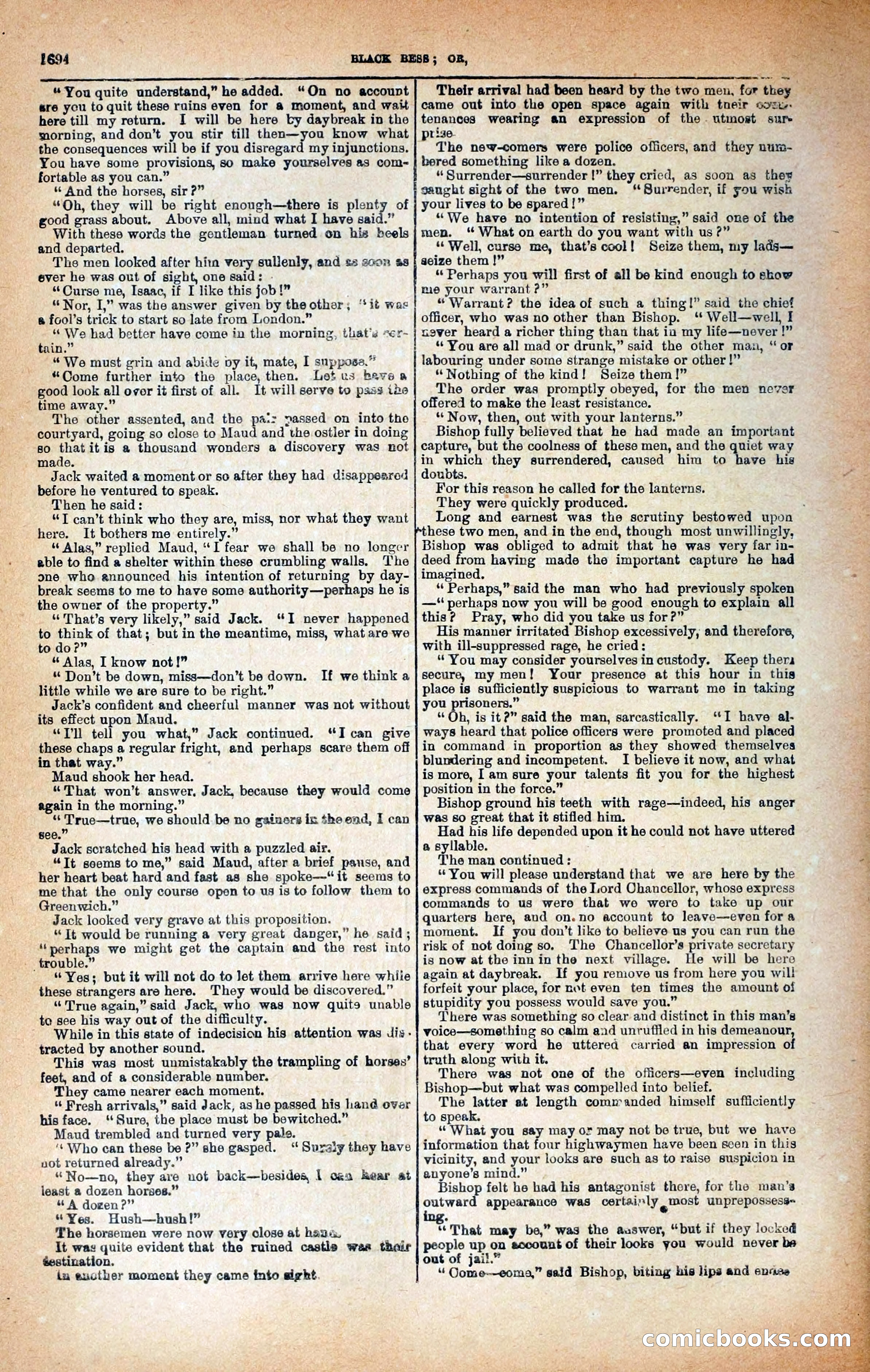
A restored page from Penny Dreadfuls, 1866. Page through the whole issue in the reader above.
📄 Transcribed text from this page (OCR, searchable)
Machine-transcribed from the original scan — historical spelling and the odd misread are preserved.
WE reek a ec AOS ~ Ph eel adt i ee tes 7 ; cat MX: _ gre you to quit these rains even for a moment, and wait here till my return. I will be here by daybreak in the morning, and don’t you stir till then—you know what -_ “AN the consequences will be if you disregard my injunctions. | You have some provisions, so make yourselves as com-~ fortable as you can.” “ And the horses, sir ?” “Oh, they will be right enough—there is plenf good grass about. Above all, mind what I have said.” With these words the gentleman turned on his heels and departed. The men looked after hitn very sullenly, and ss scon as ever he was out of sight, one said: . ‘‘Curse me, Isaac, if I like this job!” | “Nor, I,” was the answer given by theother; ‘it was @ fool’s trick to start so late from London.” “ We had better have come in the morning, that’s *er- tain.” “We must grin and abide py it, mate, I suppose.” “Come further into the place, then. Let us bave a good look all over it first of all. It will serve to pass ibe time away.” The other assented, and the pai: passed on into the courtyard, going so close to Maud and the osiler in doing so thatitis a thousand wonders a discovery was not of - made. Jack waited a moment or so after they had disappeared before he ventured to speak. Then he said: “T can’t think who they are, miss, nor what they want here. It bothers me entirely.” “ Alas,” replied Maud, “I fear we shall be no longer eble to find a shelter within these crumbling walls. The one who ennounced his intention of returning by day- break seems to me to have some authority—perhaps he is the owner of the property.” ‘“‘ That’s very likely,” said Jack. “I never happened to think of that; but in the meantime, miss, what are we to do?” “ Alas, I know not!” “ Don’t be down, miss—don’t be down. little while we are sure to be right.” Jack’s confident and cheerful manner was not without If we think a its effect upon Maud. “T'll tell you what,” Jack continued. “I can give these chaps a regular fright, and perhaps scare them off in that way.” Maud shook her head. “That won’t answer, Jack, because they would come again in the morning.” “ True—true, we should be no gainers ix the end, I can see.” Jack scratched his head with a puzzled air. “Tt soems to me,” said Maud, after a brief pause, and her heart beat hard and fast as she spoke—“it seems to me that the only course open to us is to follow them to Greenwich.” Jack looked very grave at this proposition. “It would be running a very great danger,” he said; “perhaps we might get the captain and the rest into _. trouble.” “Yes; but it will not do to Jet them arrive here while these strangers are here. They would be discovered.” “True again,” said Jack, who was now quits unable te see his way out of the difficulty. While in this state of indecision his attention was dis - tracted by another sound. This was most unmistakably the trampling of horses’ feet, and of a considerable number. They came nearer each moment. Fresh arrivals,” said Jack, as he passed his hand over his face. ‘Sure, the place must be bewitched.” Maud trembled and turned very pale. ‘Who can these be ?” she gasped. ‘“Suraly they have not returned already.” “ No—no, they are uot back—besides, | cea Rear si least a dozen horses.” “A dozen ?”’ “Yes. Hush—hush!” The horsemen were now very close at haga, It was quite evident that the ruined castle waa thair éestination. iu eucther moment they came into sight. saught sight of the two men. men. aeize them !” | over heard a richer thing than that ian my life—never !” capture, but the coolness of these men, and the quiet way in which they surrendered, caused him to have his A ag AISIINY 27 ots ae % its sane te 1694 BLACK BESS; OB, neers a TERE Medi Fae? LESS as “You quite understand,” he added. “On no account| Their arrival had been heard by the two men, for they = came out into the open space again with tneir com. tenances wearing an expression of the utmost sum = = rise. 5 The new-comers were police officers, and they nurm- bered something like a dozen. “ Surrender—surrender !” they cried, as soon as ther a “ Surrender, if you wish t your lives to be spared!” “We have no intention of resisting,” said one of the “¢ What on earth do you want with us ?” ‘“‘ Well, curse me, that’s cool! Seize them, my lads— ““ Perhaps you will first of all be kind enough to show me your warrant ?” “ Warrant? the idea of such a thing!” said the chief officer, who was no other than Bishop. ‘ Well—well, I “‘ You are all mad or drunk,” said the other man, “ or ars labouring under some strange mistake or other!” | “Nothing of the kind! Seize them!” : poe The order was promptly obeyed, for the men nevar ~ ee offered to make the least resistance. ie ** Now, then, out with your lanterns.” si SSa yb Bishop fully believed that he had made an important Bis. -* —%, = doubts. Foc For this reason he called for the lanterns. cones They were quickly produced. Se Long and earnest was the scrutiny bestowed upon ag hese two men, and in the end, though most unwillingly, Ss Bishop was obliged to admit that he was very far in- sy deed from having made the important capture he had a imagined. 3 ‘¢ Perhaps,” said the man who had previously spoken ae —“ perhaps now you will be good enough to explain all > this? Pray, who did you take us for?” i His manner irritated Bishop excessively, and therefore, i with ill-suppressed rage, he cried: 4 ‘You may consider yourselves in custody. Keep thera | secure, my men! Your presence at this hour in this place is sufliciently suspicious to warrant me in taking you prisoners.” “Oh, is it?” said the man, sarcastically. ‘‘I have al- ways heard that police officers were promoted and placed in command in proportion as they showed themselves blundering and incompetent. I believe it now, and what is more, I am sure your talents fit you for the highest position in the force.” Bishop ground his teeth with rage—indeed, his anger was so great that it stifled him. Had his life depended upon it he could not have uttered a syllable. The man continued : “You will please understand that we are here by the express commands of the lord Chancellor, whose express commands to us were that we were to take up our quarters here, and on. no account to leave—even for a moment. If you don’t like to believe us you can run the risk of not doing so, The Chancellor’s private secretary is now at the inn in the next village. He will be here again at daybreak. If you remove us from here you will forfeit your place, for net even ten times the amount of stupidity you possess would save you.” There was something so clear and distinct in this man’s voice—something so calm and unruffled in his demeanour, of that every word he uttered carried an impression of * truth along with it. =a There was not one of the oflficers—even including ~¥ Bishop—but what was compelled into belief. es The latter at length commanded himself sufficiently : to speak. “What you say may or may not be true, but we have information that four highwaymen have been seen in this vicinity, and your looks are such as to raise suspicion in eauyone’s mind.” Bishop felt be had his antagonist there, for the man’s outward appearance was certainly most unprepossess= “That may be,” was the auswer, “but if they locked people up on sccount of their looks you would never be out of jail.” “ Come--eoma,” sald Bishop, biting his lips and enase