
Penny Dreadfuls, 1866 · page 144 of 395
Black Bess; or, the Knight of the Road — page 144: what you’re looking at
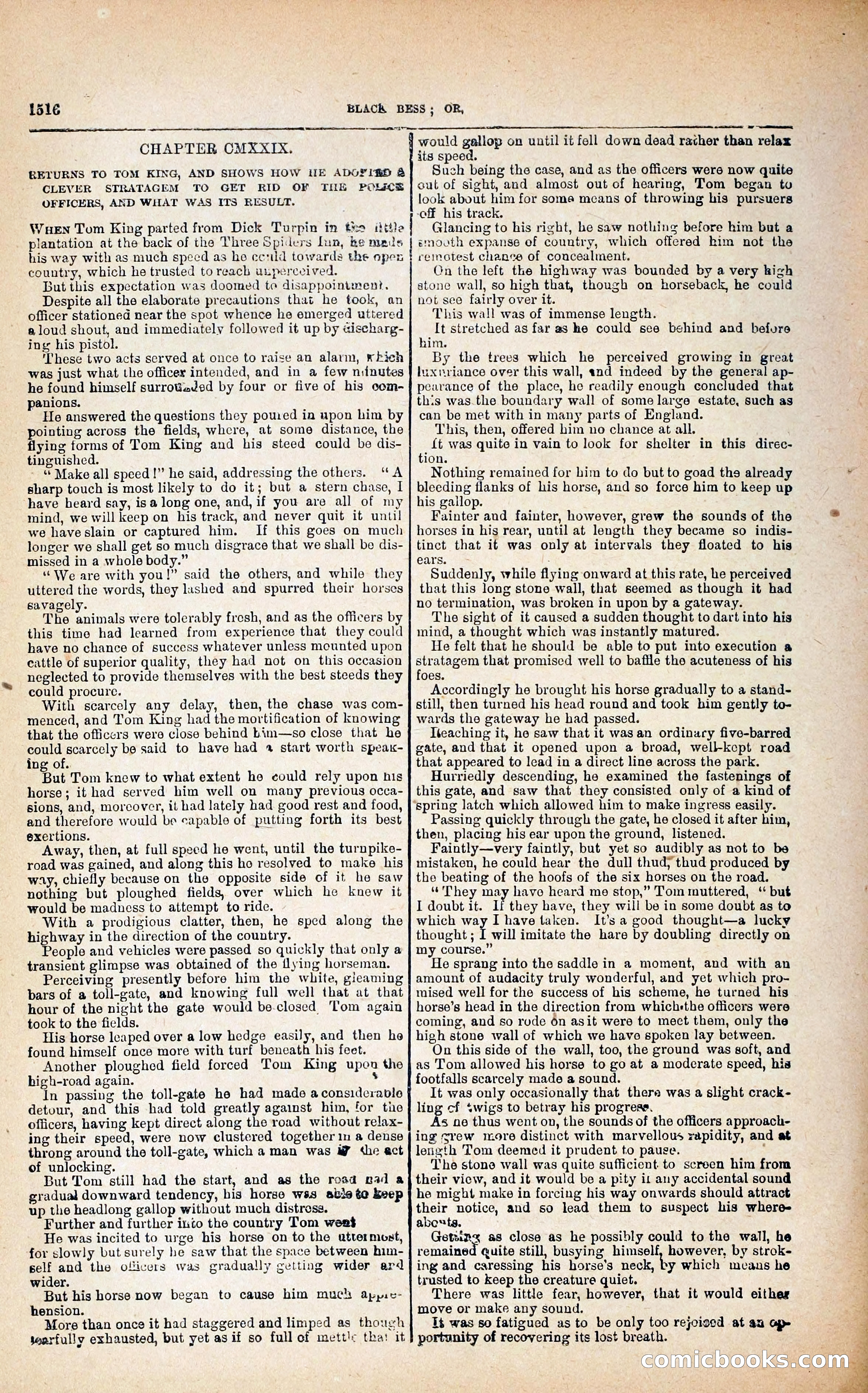
A restored page from Penny Dreadfuls, 1866. Page through the whole issue in the reader above.
📄 Transcribed text from this page (OCR, searchable)
Machine-transcribed from the original scan — historical spelling and the odd misread are preserved.
151é CHAPTER CMXXIX. RETURNS TO TOM KING, AND SHOWS HOW HE ADOPTRE & BLACK BESS; OR, ee ss ee eed would gallop on until it fell down dead rather than relax its speed. Such being the case, and as the officers were now quite CLEVER STRATAGEM TO GET RID OF THE Pouce | cul of sight, and almost out of hearing, Tom began to OFFICERS, AND WHAT WAS ITS RESULT. Wen Tom King parted from Dick Turpin in to ilttle | plantation at the back of the Three Spiders Ina, ke maids his way with as much speed as he eculd towards the open country, which he trusted to reach uuperceived. But this expectation was doomed to disappointment, Despite all the elaborate precautions that he took, an officer stationed near the spot whence he emerged uttered aloud shout, and immediately followed it up by cischarg- ing his pistol. These two acts served at once to raise an alarm, rEich was just what the officer intended, and in a few ninutes he found himself surroWaded by four or five of his com- panions. He answered the questions they powed in upon him by pointing across the fields, where, at some distance, the flying forms of Tom King and his steed could be dis- tinguished. : - Make all speed!” he said, addressing the others. “A sharp touch is most likely to do it; but a stern chase, I have beard say, isa long one, and, if you are all of my mind, we will keep on his track, and never quit it until we haveslain or captured him. If this goes on much longer we shall get so much disgrace that we shall be dis- missed in a whole body.” “We are with you!” said the others, and while they uttered the words, they lashed and spurred their horses savagely. The animals were tolerably fresh, and as the officers by this time had learned from experience that they could have no chance of success whatever unless meunted upon cattle of superior quality, they had not on this occasion neglected to provide themselves with the best steeds they could procure. With scarcely any delay, then, the chase was com- menced, and Tom King had the mortification of knowing that the officers were close behind Lhim—so close that he could scarcely be said to have had 4 start worth speax- ing of. ‘But Tom knew to what extent he could rely upon his horse; it had served him well on many previous occa- sions, and, morcover, it had lately had good rest and food, and therefore would be capable of putting forth its best exertions. Away, then, at full speed he went, until the turnupike- road was gained, and along this ho resolved to make his way, chiefly because on the opposite side of it he saw nothing but ploughed fields, over which he knew it would be madness to attempt to ride. With a prodigious clatter, then, he sped along the highway in the direction of the country. | People and vehicles were passed so quickly that only a transient glimpse was obtained of the flying horseman. Perceiving presently before him the white, gieaming bars of a toll-gate, and knowing full well that at that hour of the night the gate would be.closed Tom again took to the fields. His horse leaped over a low hedge easily, and then he found himself once more with turf beneath his feet. Another ploughed field forced Tom King upen the high-road again. tg In passing the toll-gate he had made aconsideraple detour, and this had told greatly against him, for tie officers, having kept direct along the road without relax- ing their speed, were now clustered together in a dense throng around the toll-gate, which a man was W@W he act of unlocking. But Tom still had the start, and as the road nad a gradual downward tendency, his horse was stis te keep up the headlong gallop without much distress. Further and further into the country Tom weat He was incited to urge his horse on to the uttermost, for slowly but surely he saw that the space between him- self and the officers was gradually getting wider ard wider. But his horse now began to cause him much apyie- hension. More than once it had staggered and limped as though soarfully exhausted, but yet asif so full of mettle tha: it look about him for soma means of throwing his pursuers off his track. Glancing to his right, he saw nothing before him but a smooth expanse ef country, which offered kim not the reinotest chance of concealment. On the left the highway was bounded by a very kigh atone wall, so high that, though on horseback, he could not see fairly over it. This wall was of immense length. It stretched as far as he could see behind and befure him. By the trees which he perceived growing in great luxnriance over this wall, and indeed by the general ap- pearance of the place, he readily enough concluded that this was.the boundary wall of some large estate, such as can be met with in many parts of England. This, then, offered him no chance at all. {t was quite in vain to look for shelter in this direc- tion. Nothing remained for him to do but to goad ths already bleeding flanks of his horse, and so force him to keep up his gallop. Fainter and fainter, however, grew the sounds of the horses in his rear, until at length they became so indis- tinct that it was only at intervals they floated to his ears. Suddenly, while flying onward at this rate, he perceived that this long stone wall, that seemed as though it had no termination, was broken in upon by a gateway. The sight of it caused a sudden thought to dart into his mind, a thought which was instantly matured. He felt that he should be able to put into execution a stratagem that promised well to bafile the acuteness of his foes. Accordingly he brought his horse gradually to a stand- still, then turned his head round and took him gently to- wards the gateway he had passed. Iteaching it, he saw that it was an ordinary five-barred cate, and that it opened upon a broad, well-kcpt road that appeared to lead in a direct line across the park. Hurriedly descending, he examined the fastenings of this gate, and saw that they consisted only of a kind of ‘spring latch which allowed him to make ingress easily. Passing quickly through the gate, he closed it after him, then, placing his ear upon the ground, listened. Faintly—very faintly, but yet so audibly as not to be mistaken, he could hear the dull thud; thud produced by the beating of the hoofs of the six horses on the road. ‘They may have heard me stop,” Tom muttered, ‘ but I doubt it. i? they have, they will be in some doubt as to which way I have taken. It’s a good thought—a lucky thought ; i will imitate the hare by doubling directly on my course.” He sprang into the saddle in a moment, and with an amount of audacity truly wonderful, and yet which pro- mised well for the success of his scheme, he turned his horse’s head in the direction from whichrthe officers were coming, and so rude 6n asit were to mect them, only the high stone wall of which we have spoken lay between. On this side of the wall, too, the ground was soft, and as Tom allowed his horse to go at a moderate speed, his footfalls scarcely made a sound. It was only occasionally that there was a slight crack- ling cf ‘wigs to betray his progress, s oe thus went on, the sounds of the officers approach- ing <rew more distinct with marvellous rapidity, and at leieth Tom deemed it prudent to pause. The stone wall was quite sufficient to screen him from their view, and it would be a pity it any accidental sound he might make in forcing his way onwards should attract their notice, and so lead them to suspect his wheres abosts. Getung as close as he possibly could to the wall, he remained quite still, busying himself, however, by strok- ing and caressing his horse's neck, by which meaus he trusted to keep the creature quiet. There was little fear, however, that it would eithes move or make any sound. it was so fatigued as to be only too rejoiced at au ap portunity of recovering its lost breath. Eomichoo G SS com