
Penny Dreadfuls, 1866 · page 174 of 395
Black Bess; or, the Knight of the Road — page 174: what you’re looking at
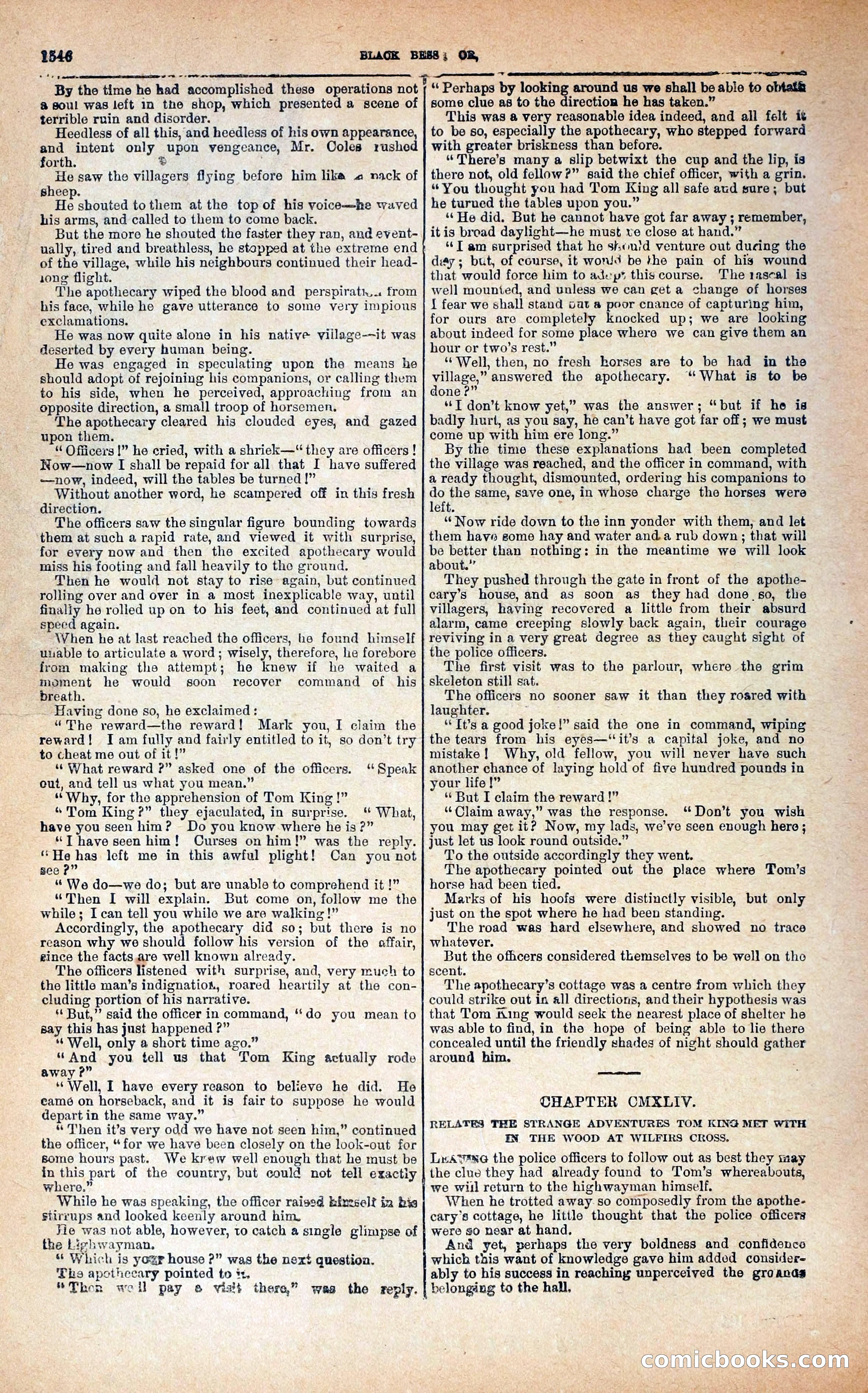
A restored page from Penny Dreadfuls, 1866. Page through the whole issue in the reader above.
📄 Transcribed text from this page (OCR, searchable)
Machine-transcribed from the original scan — historical spelling and the odd misread are preserved.
1546 By the time he had accomplished these operations not & soul was left in the shop, which presented a scene of terrible ruin and disorder. Heedless of all this, and heedless of his own appearance, and intent only upon vengeance, Mr. Coles rushed forth. ® | He saw the villagers flying before him lika « nack of sheep. He shouted tothem at the top of his voice—he waved his arms, and called to them to come back. But the more he shouted the faster they ran, and event- wre - ow ually, tired and breathless, he stepped at the extreme end of the village, while his neighbours continued their head- 1ong flight. The apothecary wiped the blood and perspirati. from his face, while he gave utterance to some very impious exclamations. He was now quite alone in his native viilage-—it was deserted by every human being. He was engaged in speculating upon the means he should adopt of rejoining his companions, or calling them to his side, when he perceived, approaching from an opposite direction, a small troop of horsemen. The apothecary cleared his clouded eyes, and gazed upon them. “ Officers |” he cried, with a shriek—“ they are officers ! Now—now I shall be repaid for all that I have suffered —now, indeed, will the tables be turned |” Without another word, he scampered off in this fresh direction. The officers saw the singular figure bounding towards them at such a rapid rate, and viewed it with surprise, for every now and then the excited apothecary would miss his footing and fall heavily to the ground, Then he would not stay to rise again, but continued rolling over and over in a most inexplicable way, until finaliy he rolled up on to his feet, and continued at full speed again. When he at last reached the officers, he found himself unable to articulate a word; wisely, therefore, he forebore from making the attempt; he knew if he waited a moment he would soon recover command of his breath. Having done so, he exclaimed : “The reward—the reward! Mark you, I claim the reward! Iam fully and fairly entitled to it, so don’t try to cheat me out of it!” “What reward ?” asked one of the officers. ‘Speak eut, and tell us what you mean.” ‘Why, for the apprehension of Tom King !” “Tom King?” they ejaculated, in surprise. ‘ What, have you seen him? Do you know where he is ?” ‘T have seen him! Curses on him!” was the reply. “He has left me in this awful plight! Can you not see ?” “We do—we do; but are unable to comprehend it !” “Then I will explain. But come on, follow me the while; I can tell you while we are walking!” Accordingly, the apothecary did so; but there is no reason why we should follow his version of the offair, gince the facts. are well known already. The officers listened with surprise, and, very much to the little man’s indignation, roared heartily at the con- cluding portion of his narrative. * But,’’ said the officer in command, ‘do you mean to say this has just happened ?” ‘Well, only a short time ago.” “And you tell us that Tom King actually rode away ?” ‘Well, I have every reason to believe he did. He eamé on horseback, and it is fair to suppose he would depart in the same way.” : “ Then it’s very odd we have not seen him,” continued the officer, “for we have been closely on the look-out for some hours past. We krew well enough that he must be in this part of the country, but could not tell exactiy where.” While he was speaking, the officer raised bineself in bis sitrrups and looked keenly around him. Jie was not able, however, to catch a single glimpse of the Lighwayman. * Which is your house ?” was the next question. Tho apothecary pointed to +, "Thon weil pay © visi} there,” was the reply. BLAGK BESS; OR, Fa Perhaps by lookin ~~ ewww ~ oye some clue as to the direction he has taken.” This was a very reasonable idea indeed, and all felt it to be so, especially the apothecary, who stepped forward with greater briskness than before. ‘“There’s many a slip betwixt the cup and the lip, is there not, old fellow?” said the chief officer, with a grin. “You thought you had Tom King all safe aud sare; but he turned the tables upon you.” ‘‘He did. But he cannot have got far away ; remember, itis broad daylight—he must ve close at hand.” ‘‘T am surprised that he siou/d venture out ducing the diay ; but, of course, it word’ be the pain of his wound that would force him to adep* this course. The rascal is well mounted, and unless we can get a change of horses { fear we shall stand oat a poor cnance of capturing hin, for ours are completely knocked up; we are looking about indeed for some place where we can give them an hour or two’s rest.” ‘‘ Well, then, no fresh horses are to be had in the village,” answered the apothecary. ‘“‘What is to be done ?” **T don’t know yet,” was the answer; “but if he is badly hurt, as you say, he can’t have got far off; we must come up with him ere long.” By the time these explanations had been completed the village was reached, and the officer in command, with a ready thought, dismounted, ordering his companions to do the same, save one, in whose charge the horses were left. ‘Now ride down to the inn yonder with them, and let them have gome hay and water anda rub down; that will be better than nothing: in the meantime we will look about.” They pushed through the gate in front of the apothe- cary’s house, and as soon as they had done _s0, the villagers, having recovered a little from their absurd alarm, came creeping slowly back again, their courage reviving in a very great degree as they caught sight of the police officers. The first visit was to the parlour, where the grim skeleton still sat. The officers no sooner saw it than they roared with laughter. | ‘It’s a good joke!” said the one in command, wiping the tears from his eyes—“it’s a capital joke, and no mistake! Why, old fellow, you will never have such another chance of laying hold of five hundred pounds in your life !” “ But I claim the reward !” “Claim away,” was the response. ‘Don’t you wish you may get it? Now, my lads, we’ve seen enough here ; just let us look round outside.” To the outside accordingly they went. The apothecary pointed out the place where Tom’s horse had been tied. Marks of his hoofs were distinctly visible, but only just on the spot where he had been standing. The road was hard elsewhere, and showed no trace whatever. But the ofhcers considered themselves to be well on tho scent. The apothecary’s cottage was a centre from which they could strike out in all directions, and their hypothesis was that Tom King would seek the nearest place of shelter he was able to find, in tha hope of being able to lie there concealed until the friendly shades of night should gather around him. CHAPTER OCMXLIV. RELATES THE STRANGE ADVENTURES TOM KING MET WiTH IN THE WOOD AT WILFIRS CROSS. LuAvene the police officers to follow out as best they may the clue they had already found to Tom’s whereabouts, we wiil return to the highwayman himself. When he trotted away so composedly from the apothe- cary’s cottage, he little thought that the police officers were so near at hand, And yet, perhaps the very boldness and confidence which this want of knowledge gave him added consider- ably to his success in reaching unperceived the groands belonging to the hall, © Eomicboo cS'¢ tL é ‘ “-.* ~~“ oO é - nee i, * a * o forte. SS i aiien * ee ae : — e. a, around us we shall beable to obtaf&®