
Penny Dreadfuls, 1866 · page 33 of 395
Black Bess; or, the Knight of the Road — page 33: what you’re looking at
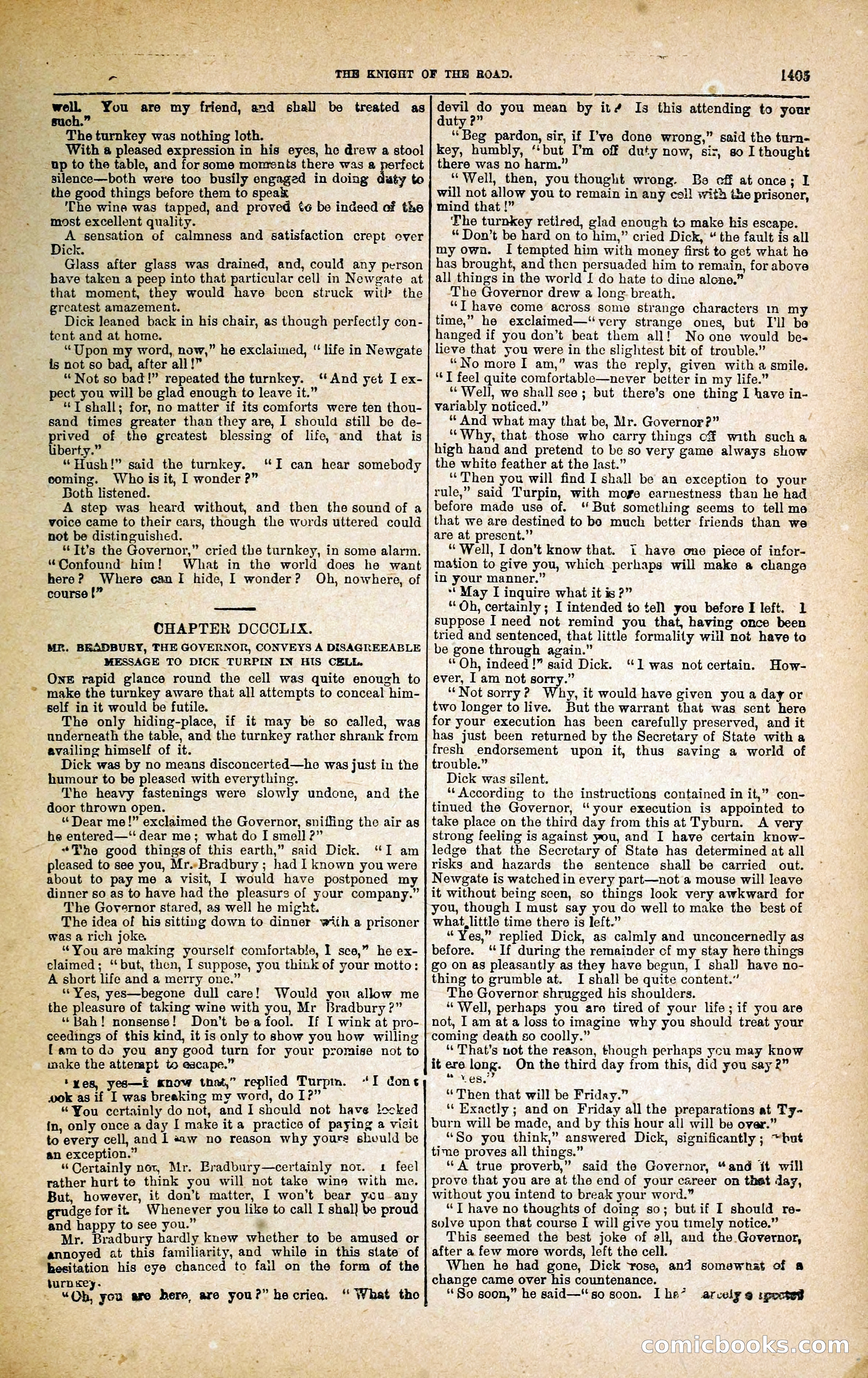
A restored page from Penny Dreadfuls, 1866. Page through the whole issue in the reader above.
📄 Transcribed text from this page (OCR, searchable)
Machine-transcribed from the original scan — historical spelling and the odd misread are preserved.
“-- oF well, You are my friend, and shall be treated as wire: such.” Fon wre ¥\ yr _ he entered—“ dear me; what do I smell 2” _ Theturnkey was nothing loth. _ With a pleased expression in his eyes, he drew a stool -up to the table, and for some monrenis there was a perfect silence—both were too busily engaged in doing the good things before them to speak _ 'The wine was tapped, and proved to be indecd of the most excellent quality. A sensation of calmness and satisfaction crept over Dick. Glass after glass was drained, and, could any person have taken a peep into that particular cell in Newgate at that moment, they would have been struck witP the greatest amazement. Dick leaned back in his chair, as though perfectly con- tent and at home. “Upon my word, now,” he exclaimed, “ life in Newgate is not so bad, after all!” “Not so bad!” repeated the turnkey. “And yet I ex- pect you will be glad enough to leave it.” “T shall; for, no matter if its comforts were ten thou- sand times greater than they are, I should still be de- prived of the greatest blessing of life, and that is liberty.” “ Hush!” said the turnkey. coming. Who is it, I wonder 2?” Both listened. A step was heard without, and then the sound of a voice came to their ears, though the words uttered could not be distinguished. “It’s the Governor,” cried the turnkey, in some alarm. “OConfound him! What in the world does he want here? Where canI hide, I wonder? Oh, nowhere, of course {” uty to 7] can hear somebody = CHAPTER DCCCLIX. MR. BRADBURY, THE GOVERNOR, CONVEYS A DISAGREEABLE ; MESSAGE TO DICK TURPIN IN HIS CELL. OnE rapid glance round the cell was quite enough to make the turnkey aware that all attempts to conceal him- self in it would be futile. The only hiding-place, if it may be so called, was underneath the table, and the turnkey rather shrank from availing himself of it. Dick was by no means disconcerted—he was just in the humour to be pleased with everything. The heavy fastenings were slowly undone, and the door thrown open. “Dear me!” exclaimed the Governor, sniffing the air as “The good thingsof this earth,” said Dick. “I am pleased to see you, Mr..Bradbury ; had I known you were about to pay me a visit, I would have postponed my dinner so as to have had the pleasurs of your company.” The Governor stared, as well he might. The idea of his sitting down to dinner with a prisoner was a rich joke “You are making yourself comfortabie, I sce,” he ex- claimed; “but, then, I suppose, you think of your motto: A short life and a merry one.” “Yes, yes—begone dull care! Would yon allow me the pleasure of taking wine with you, Mr Bradbury?” ‘Bah! nonsense! Don’t beafool. If I wink at pro- ceedings of this kind, it is only to show you how willing {am todo you any good turn for your promise not to make the attempt to escape.” ‘yes, yes—i gnow tha,” replied Turpm. ok as if I was breaking my word, do 1?” “Wou certainly do not, and I should not have locked in, only once a day I make ita practice of paying a visit to every cell, and I saw no reason why yours sheuld be an exception.” “ Certainly not, Mr. EBradbury—certainly not. 1 feel rather hurt te think you will not take wine with me. But, however, it don’t matter, 1 won’t bear you any grudge for it, Whenever you like to call I shal) be proud and happy to see you.” * Mr. Bradbury hardly knew whether to be amused or annoyed at this familiarity, and while in this state of ‘hesitation his eye chanced to fail on the form of the turn Key. “T done + “Ob, you are bere, are you?” hecrieq. ‘“ What tho THE KNIGHT OF THE ROAD. 1465 & LE TL I I I devil do you mean by it¢ Is this attending to your duty ?” “Beg pardon, sir, if I’ve done wrong,” said the turn- Key, humbly, ‘‘but I’m off duty now, siz, so I thought there was no harm.” | “Well, then, you thought wrong. Be cff at once; I will not allow you to remain in any coll with the prisoner, mind that !” The turnkey retired, glad enough to make his escape. “Don’t be hard on to him,” cried Dick, “ the fault is all my own. I tempted him with money first to get what he has brought, and then persuaded him to remain, for above all things in the world I do hate to dine alone,” ‘The Governor drew a long: breath. “IT have come across some strange characters In my time,” he exclaimed—“ very strange ones, but I'll be hanged if you don’t beat them all! Noone would be- lieve that you were in the slightest bit of trouble.” “No more I am,” was the reply, given with a smile. “I feel quite comfortable—never better in my life.” ‘Well, we shall see; but there’s one thing I have in- variably noticed.” “And what may that be, Mr. Governor?” ‘Why, that those who carry things cf with sucha high hand and pretend to be so very game always show the white feather at the last.” “Then you will find I shall be an exception to your rule,” said Turpin, with moge earnestness than he had before made use of. ‘ But something seems to tell ma that we are destined to bo much better friends than we are at prescnt.” “Well, I don’t know that. 1 have one piece of infor- mation to give you, which perhaps will make a change in your manner.” *' May I inquire what it is ?” “Oh, certainly; I intended to tell you before I left. 1 suppose I need not remind you that, having once been tried and sentenced, that little formality will not have to be gone through again.” ‘Oh, indeed !” said Dick. ever, [ am not sorry.” ‘““Not sorry? Why, it would have given you a day or two longer to live. But the warrant that was sent here for your execution has been carefully preserved, and it has just been returned by the Secretary of State with a fresh endorsement upon it, thus saving a world of trouble.” Dick was silent. “‘According to the instructions contained in it,” con- tinued the Governor, “your execution is appointed to take place on the third day from this at Tyburn. <A very strong feeling is against you, and I have certain know- ledge that the Secretary of State has determined at all risks and hazards the sentence shall be carried out. Newgate is watched in every part—not a mouse will leave if without being scen, so things look very awkward for you, though I must say you do well to make the kest of what, little time there is left.” “Yes,” replied Dick, as calmly and unconcernedly as before. “If during the remainder cf my stay here things go on as pleasantly as they have begun, I shal] have no- thing to grumble at. I shall be quite content.” The Governor shrugged his shoulders. ‘Well, perhaps you are tired of your life; if you are not, I am at a loss to imagine why you should treat your ‘“] was not certain. How- “coming death so coolly.” ‘“ That’s not the reason, though perhaps ycu may know it ere long. On the third day from this, did you say 2” re = (eS “Then that will be Friday.” ‘‘ Exactly ; and on Friday all the preparations at Ty- burn will be made, and by this hour all will be over.” “So you think,” answered Dick, significantly; “but time proves all things.” ‘‘A true proverb,” said the Governor, “and it will prove that you are at the end of your career on that day, | without you intend to break your word.” “T have no thoughts of doing so; butif I should re- solve upon that course I will give you timely notice.” This seemed the best joke of all, and the Governor, after a few more words, left the cell. When he had gone, Dick rose, and somewhat of a change came over his countenance. “So soon,” he said—“so soon. Ihe’ arvely 9 tected Eomichbooks (E()