
Penny Dreadfuls, 1866 · page 192 of 395
Black Bess; or, the Knight of the Road — page 192: what you’re looking at
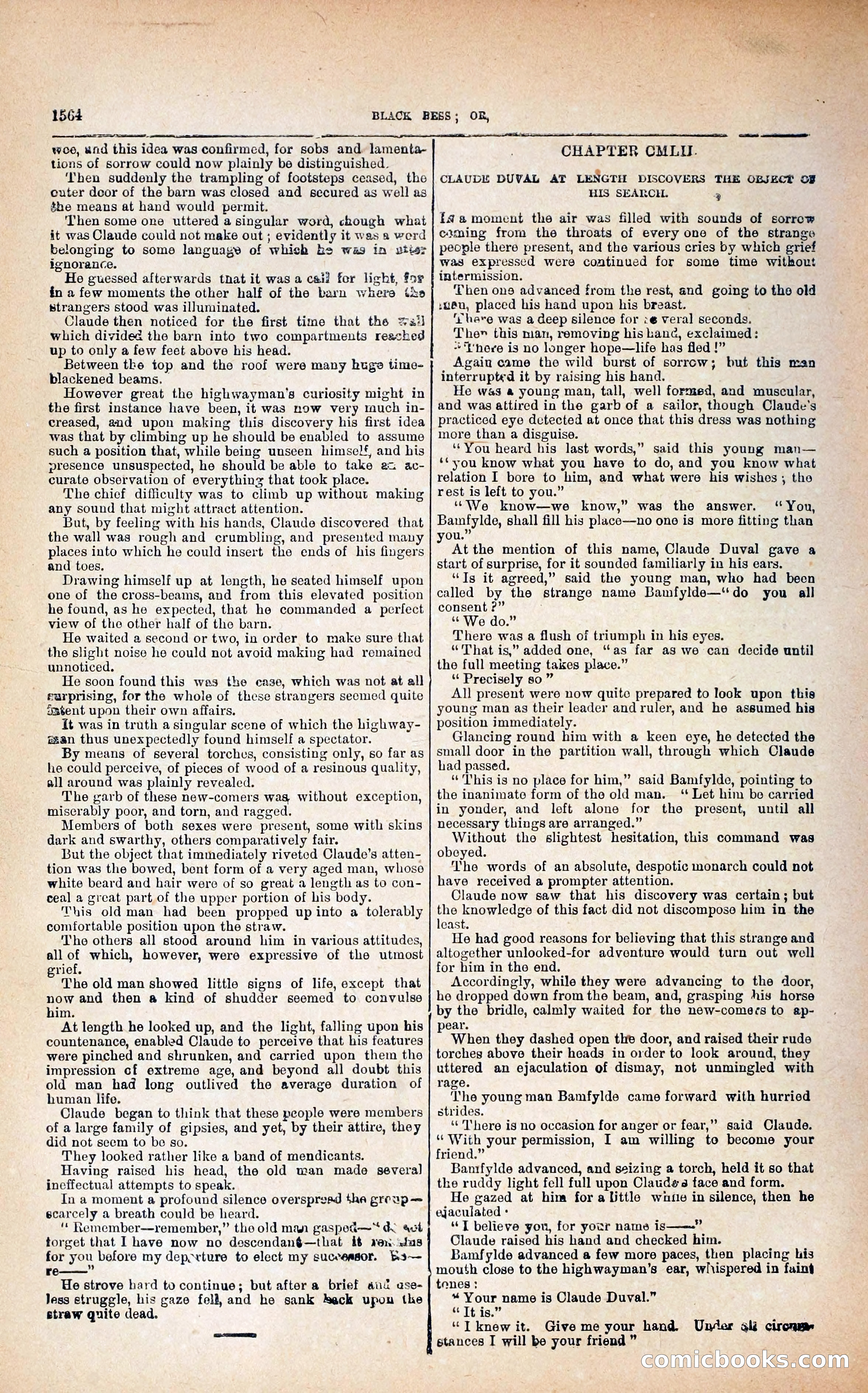
A restored page from Penny Dreadfuls, 1866. Page through the whole issue in the reader above.
📄 Transcribed text from this page (OCR, searchable)
Machine-transcribed from the original scan — historical spelling and the odd misread are preserved.
1564 woo, und this idea was confirmed, for sobs and. lamenta- tions of sorrow could now plainly be distinguished. ‘hen suddenly the trampling of footsteps ceased, the cuter deor of the barn was closed and secured as well as the means at hand would permit. Then some one uttered a singular word, chough what it was Claude could not make out ; evidently it was a word belonging to some language of which ke was In niisr tonorance. He guessed afterwards that it was a cail for light, for in a few moments the other half of the barn where tds strangers stood was illuminated. Claude then noticed for the first time that the zai) which divide the barn into two compartments reached up to only a few feet above his head. Between the top and the roof were many huge time- blackened beams. However great the highwayman’s curiosity might in the first instance have been, it was now very much in- creased, and upon making this discovery his first idea was that by climbing up he should be enabled to assume such a position that, while being unseen himself, and his presence unsuspected, he should be able to take a= ac- curate observation of everything that took place. The chicf difficulty was to climb up without making any sound that might attract attention. But, by feeling with his hands, Claude discovered that the wall was rough and crumbling, and presented many places into which he could insert the ends of his fingers and toes. Drawing himself up at length, he seated himself upon one of the cross-beams, and from this elevated position he found, as he expected, that he commanded a perfect view of the other half of the barn. He waited a second or two, in order to make sure that the slight noise he could not avoid making had remained unnoticed. He soon found this was the case, which was not at all eurprising, for the whole of these strangers seemed quite datent upon their own affairs. {t was in truth a singular scene of which the highway- gtan thus unexpectedly found himself a spectator. By means of several torches, consisting only, so far as he could perceive, of pieces of wood of a resinous quality, all around was plainly revealed. The garb of these new-comers was, without exception, miserably poor, and torn, and ragged. Members of both sexes were present, some with skins dark and swarthy, others comparatively fair. But the object that immediately riveted Claude’s atten- tion was the bowed, bent form of a very aged man, whose white beard and hair were of so great a length as to con- cea] a great part of the upper portion of his body. This old man had been propped up into a tolerably comfortable position upon the straw. The others all stood around him in various attitudes, allof which, however, were expressive of the utmost rief. ; The old man showed little signs of life, except that now and then a kind of shudder seemed to convulse him. At length he looked up, and the light, falling upon his countenance, enabled Claude to perceive that his features were pinched and shrunken, and carried upon them the impression of extreme age, and beyond all doubt this old man had long outlived the average duration of human life. Claude began to think that these people were members of a large family of gipsies, and yet, by their attire, they did not seem to be so. They looked rather like a band of mendicants. Having raised his head, the old man made several ineffectual attempts to speak. In a moment a profound silence overspresd tha group— ecarcely a breath could be heard. ‘' Remember—remember,” the old man gasped—~* de aut torget that Ihave now no descendané—that it wen.sdas for you before my deporture to elect my successor. B3— re——' He strove hard to continue; but after a brief aud ase- Jess etruggle, his gaze fell, and he sank Meck upon the straw quite dead. BLACK BESS; OR, CHAPTER CMLU. CLAUDE DUVAL AT LENGTIT DISCOVERS THE OBJECT OF HIS SEARCH. x faamoment the air was filled with sounds of sorrow caming from the throats of every one of the strange people there present, and the various cries by which grief was expressed were continued for some time without intermission. Then ons advanced from the rest, and going to the old :g@u, placed his hand upon his breast. ‘yy have was a deep silence for :¢ veral seconds. The» this man, removing his Land, exclaimed: - there is no longer hope—life has fled !” Again came the wild burst of sorrow; but this man interrupted it by raising his hand. He was a young man, tall, well formed, and muscular, and was attired in the garb of a sailor, though Claude's practiced eye detected at once that this dress was nothing more than a disguise. ‘You heard his last words,” said this young man— ‘*you know what you have to do, and you know what relation I bore to him, and what were his wishes , the rest is left to you.” ‘We know—we know,” was the answer. ‘You, Bamfylde, shall fill his place—no one is more fitting than ou.” Z At the mention of this name, Claude Duval gave a start of surprise, for it sounded familiarly in his ears, ‘Ts it agreed,” said the young man, who had been called by the strange name Bamfylde—‘‘do you all consent ?” “We do.” There was a flush of triumph In his eyes. “That is,” added one, “as far as we can decide until the full meeting takes place.” “ Precisely so” All present were now quite prepared to look upon this young man as their leader and ruler, and he assumed his position immediately. Glancing round him with a keen eye, he detected the small door in the partition wall, through which Claude had passed. ‘his ig no place for him,” said Bamfylde, pointing to the inanimate form of the old man. ‘ Let him be carried in yonder, and left alone for the present, until all necessary things are arranged.” Without the slightest hesitation, this command was obeyed. The words of an absolute, despotic monarch could not have received a prompter attention. Claude now saw that his discovery was certain; but the knowledge of this fact did not discompose him in the least. He had good reasons for believing that this strange and altogether unlooked-for adventure would turn out well for him in the end. Accordingly, while they were advancing to the door, he dropped down from the beam, and, grasping jis horse by the bridle, calmly waited for the new-comers to ap- ear. " When they dashed open the door, and raised their rude torches above their heads in order to look around, they uttered an ejaculation of dismay, not unmingled with rage. The young man Bamfylde came forward with hurried strides. ‘‘'l‘here ig no occasion for anger or fear,” said Claude. ‘With your permission, I am willing to become your friend.” Bantfylde advanced, and seizing a torch, held it so that the ruddy light fell full upon Claudes face and form. He gazed at him for alittle wnue in silence, then he ejaculated « “T believe you, for yocr name is——’ Claude raised his hand and checked him. Bamfylde advanced a few more paces, then placing his mouth close to the highwayman’s ear, wliispered in fuint tones ; “ Your name is Claude Duval.” It is,” ‘I knew it. Give me your hand. Under ali cironm ’ GOMmMiIc KS (E(@) stances I will be your friend ” 100 p> see