
Penny Dreadfuls, 1866 · page 26 of 395
Black Bess; or, the Knight of the Road — page 26: what you’re looking at
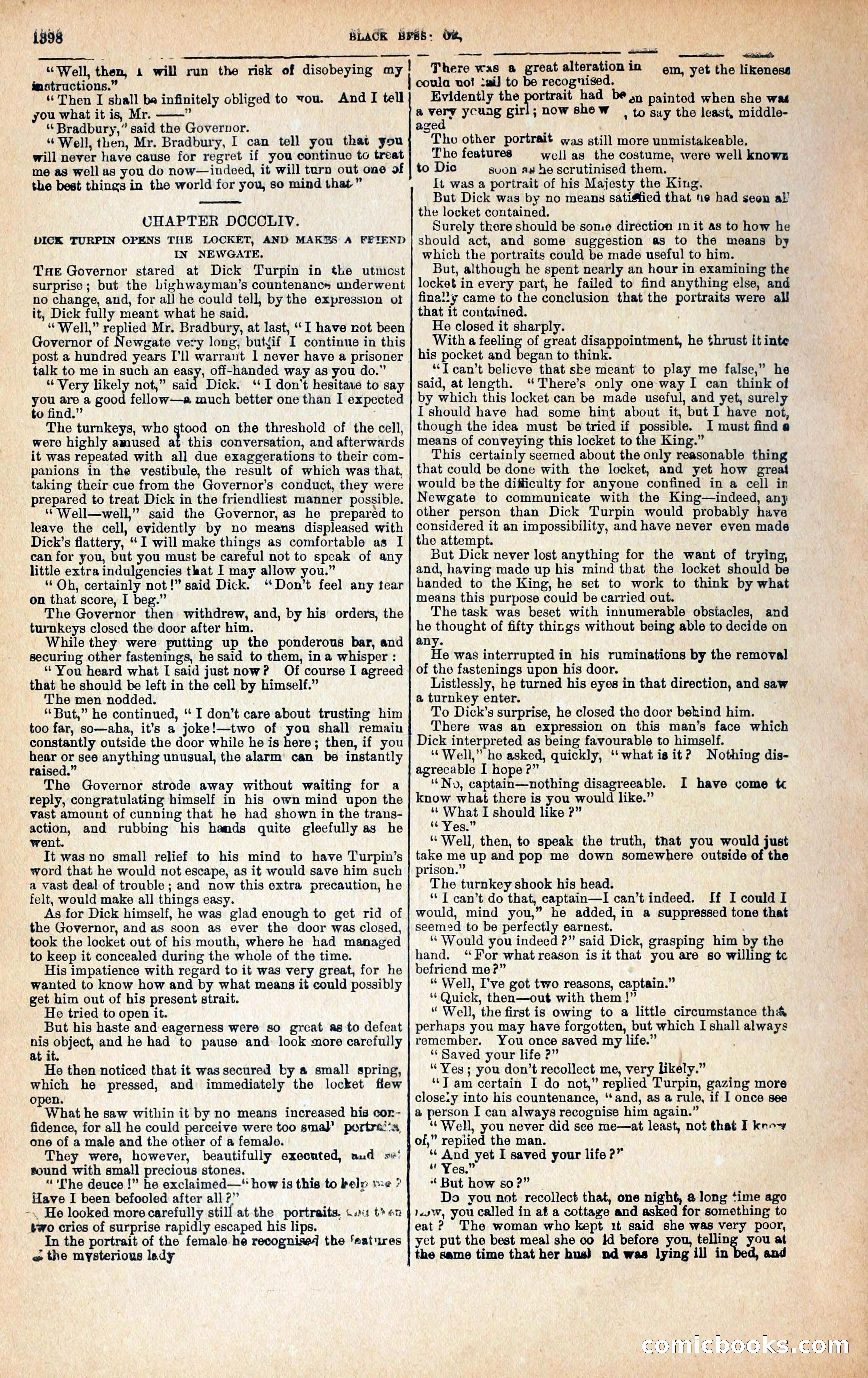
A restored page from Penny Dreadfuls, 1866. Page through the whole issue in the reader above.
📄 Transcribed text from this page (OCR, searchable)
Machine-transcribed from the original scan — historical spelling and the odd misread are preserved.
i898 om fs oe en “ Well, then, rt will run the risk of disobeying my ! There was a great alteration in em, yet the likeness imstructions.” ‘Then I shall ba infinitely obliged to vou. And I tell you what it is, Mr. ——” “Bradbury,” said the Governor. | “ Well, then, Mr. Bradbury, I can tell you that you will never have cause for regret if you continue to treat me as well as you do now— indeed, it will turn out one of the best things in the world for you, so mind that” CHAPTER DCCCLIV. VICK TURPIN OPENS THE LOCKET, AND MAK®S A FETEND IN NEWGATE, Tae Governor stared at Dick Turpin in the utmost surprise; but the highwayman’s countenance underwent no change, and, for all he could tell, by the expression of it, Dick fully meant what he said. “Well,” replied Mr. Bradbury, at last, “‘I have not been Governor of Newgate very long, butjif I continue in this post a hundred years [’ll warrant 1 never have a prisoner talk to me in such an easy, off-handed way as you do.” “Very likely not,” said Dick. ‘I don't hesitave to say you are a good fellow—a much better one than I expected to find.” ) The turnkeys, who stood on the threshold of the cell, were highly amused at this conversation, and afterwards it was repeated with all due exaggerations to their com- panions in the vestibule, the result of which was that, taking their cue from the Governor’s conduct, they were prepared to treat Dick in the friendliest manner possible. ‘“Well—well,” said the Governor, as he prepared to leave the cell, evidently by no means displeased with Dick’s flattery, “I will make things as comfortable as I can for you, but you must be careful not to speak of any little extra indulgencies that I may allow you.” ‘“‘ Oh, certainly not!” said Dick. ‘Don’t feel any tear on that score, I beg.” The Governor then withdrew, and, by his orders, the turnkeys closed the door after him. While they were putting up the ponderous bar, and securing other fastenings, he said to them, ina whisper : “You heard what [ said just now? Of course I agreed that be should be left in the cell by himself.” The men nodded. “But,” he continued, ‘I don’t care about trusting him too far, so—aha, it’s a joke!—two of you shall remain constantly outside the door while he is here; then, if you hear or see anything unusual, the alarm’ can be instantly raised.” The Governor strode away without waiting for a reply, congratulating himself in his own mind upon the vast amount of cunning that he had shown in the trans- action, and rubbing his hamds quite gleefully as he went. It was no small relief to his mind to have Turpin’s word that he would not escape, as it would save him such a vast deal of trouble; and now this extra precaution, he felt, would make all things easy. As for Dick himself, he was glad enough to get rid of the Governor, and as soon as ever the door was closed, took the locket out of his mouth, where he had managed to keep it concealed during the whole of the time. His impatience with regard to it was very great, for he wanted to know how and by what means it could possibly get him out of his present strait. He tried to open it. But his haste and eagerness were so great as to defeat nis object, and he had to pause and look more carefully at it. He then noticed that it was secured by a small spring, which he pressed, and immediately the locket flew open. What he saw within it by no means increased his cor- fidence, for all he could perceive were too smaJ’ portra?‘s, one of a male and the other of a female. They were, however, beautifully executed, aud ve sound with small precious stones. “'The deuce !” he exclaimed—* how is this to kely s:¢ 7 ave I been befooled after all ?” -. He looked more carefully still at the portraits. c.1 t* «x two cries of surprise rapidly escaped his lips. In the portrait of the female he recognised the ‘eatures @ the mysterious lady coula vol :aiJ to be recognised. Evidently the pera had b 5n painted when she was pvery ycung girl; now shew | to suy the least, middle- age Tho other portrait qas still more unmistakeable. The features well as the costume, were well known to Dic suon ay he scrutinised them. It was a portrait of his Majesty the King. But Dick was by no means satisfied that te had seen al’ the locket contained. Surely there should be some direction in it as to how he should act, and some suggestion as to the means by which the portraits could be made useful to him. But, although he spent nearly an hour in examining the locket in every part, he failed to find anything else, and finaity came to the conclusion that the portraits were all that it contained. He closed it sharply. With a feeling of great disappointment, he thrust it inte his pocket and heen to think. ‘“‘T can’t believe that ste meant to play me false,” he said, at length. ‘There’s only one way I can think of by which this locket can be made useful, and yet, surely I should have had some hint about it, but I have not, though the idea must be tried if possible. I must finda means of conveying this locket to the King.” This certainly seemed about the only reasonable thing that could be done with the locket, and yet how great would be the difficulty for anyone confined in a cell in Newgate to communicate with the King—indeed, any other person than Dick Turpin would probably have considered it an impossibility, and have never even made the attempt. But Dick never lost anything for the want of trying, and, having made up his mind that the locket should be handed to the King, he set to work to think by what means this purpose could be carried out. The task was beset with innumerable obstacles, and he thought of fifty things without being able to decide on any. He was interrupted in his ruminations by the removal of the fastenings upon his door. Listlessly, he turned his eyes in that direction, and saw a turnkey enter. To Dick’s surprise, he closed the door bekind him. There was an expression on this man’s face which Dick interpreted as being favourable to himself. “Well,” he asked, quickly, ‘‘what is it? Nothing dis- agreeable I hope ?” ‘Nv, captain—nothing disagreeable. know what there is you would like.” *¢ What I should like ?” WY es ‘Well, then, to speak the truth, that you would just take me up and pop me down somewhere outside of the prison.” The turnkey shook his head. ‘“‘ T can’t do that, eaptain—I can’t indeed. If I could I would, mind you,” he added, in a suppressed tone that seemed to be perfectly earnest. “Would you indeed ?” said Dick, grasping him by the hand. “For what reason isit that you are so willing tc befriend me?” “ Well, I've got two reasons, captain.” ‘Quick, then—out with them !” “ Well, the first is owing to a little circumstance th& perhaps you may have forgotten, but which I shall always remember. You once saved my life.” . ‘Saved your life ?” “Yes; you don’t recollect me, very likely.” ‘‘T am certain I do not,” replied Turpin, gazing more close:y into his countenance, ‘and, as a rule, if I once see a person I can always recognise him again.” “Well, you never did see me—at least, not that I know of,” replied the man. *¢ And yet I saved your life ?” “ Yes.” “* But how so?” Do you not recollect that, one night, @ long ‘ime age 1.9W, you called in at a cottage and asked for something to eat ? The woman who kept 1 said she was very poor, yet put the best meal she co fd before you, Noe, at the same time that her hus} nd was lying ill in bed, and I have come t IOOKS (E(0) (co)