
A complete issue · 69 pages · 1888
Judge — 1888
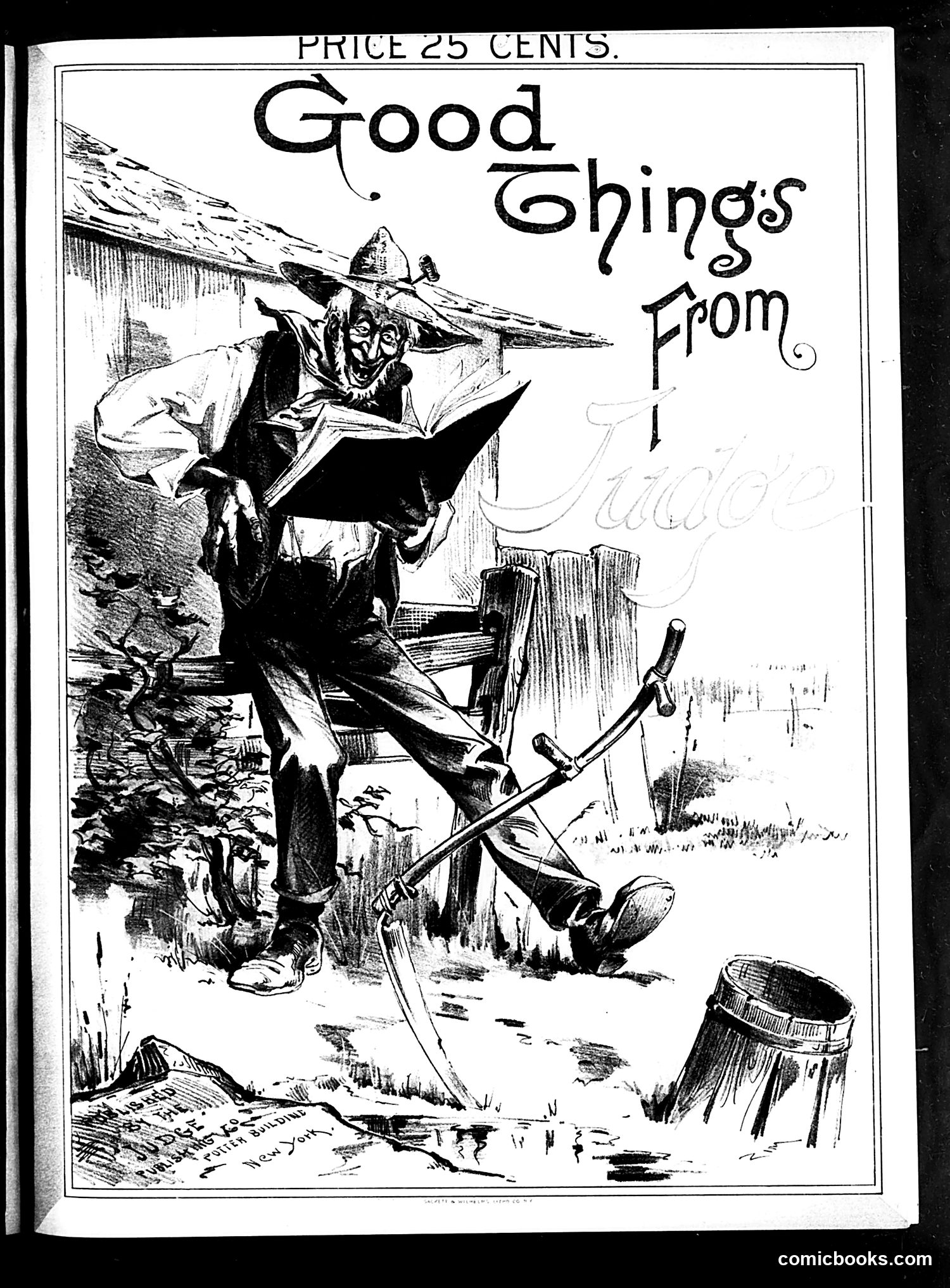
This appears to be a cover or advertisement page from *Judge* magazine, priced at 25 cents. The main illustration shows a grotesque figure—likely a caricatured immigrant or foreign person—holding documents and displaying goods or wares from what appears to be a specific location (the destination text is partially obscured in the image). The exaggerated facial features and caricatured style were common in late 19th/early 20th-century satirical publications, often reflecting period attitudes toward immigration and cultural differences. The figure's presentation suggests commentary on imported goods or cultural imports. Without the complete destination text visible, the specific satirical target—whether it's commentary on trade, immigration policy, or cultural attitudes—cannot be definitively determined.
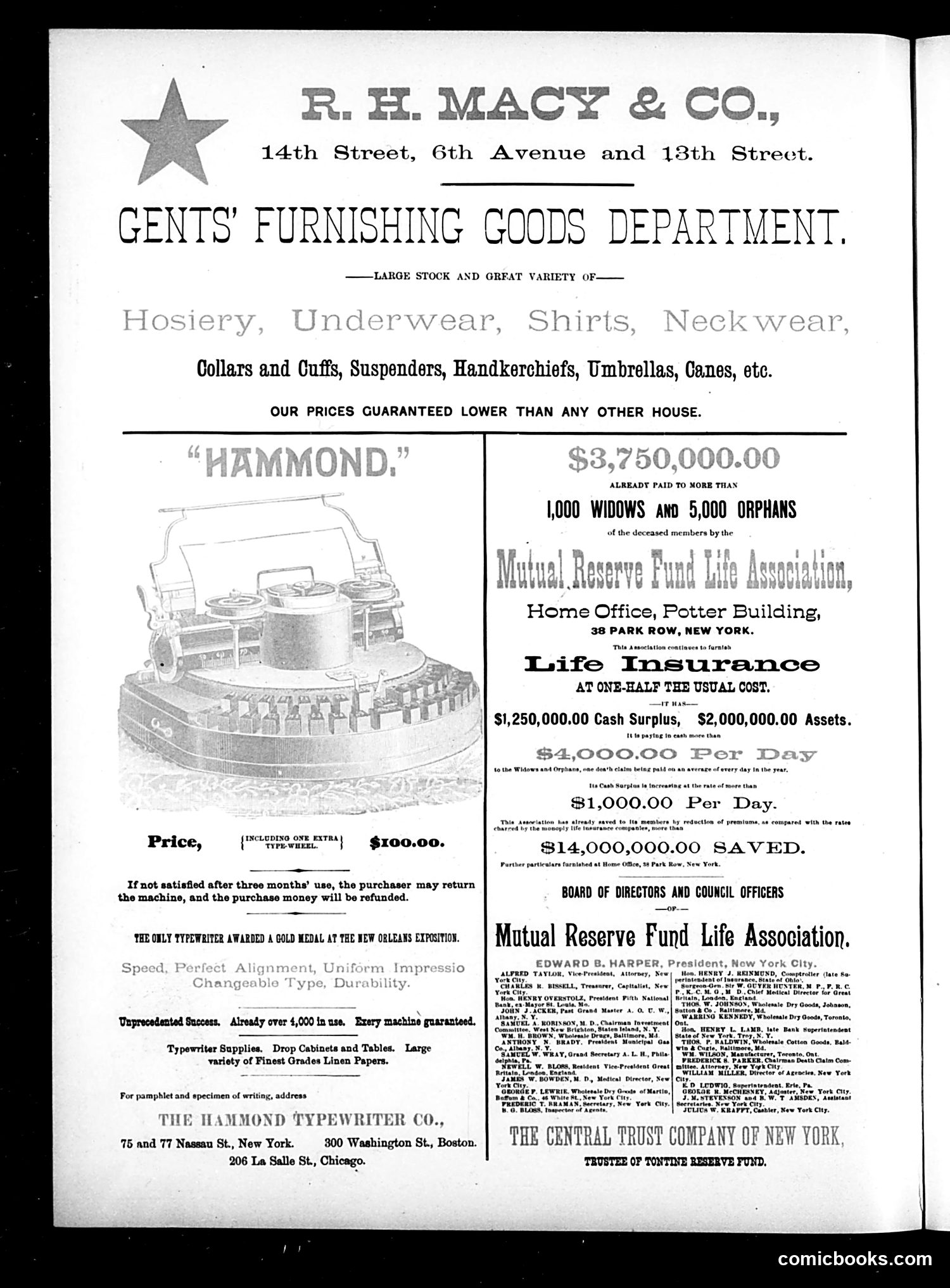
This page is primarily **advertising, not political satire**. The left side advertises the "Hammond" typewriter ($100, with a three-month money-back guarantee), emphasizing its speed, alignment, and durability. The right side contains a lengthy advertisement for the Mutual Reserve Fund Life Association, promoting life insurance at half the usual cost, claiming to have already paid $3.75 million to 1,000 widows and 5,000 orphans. There are no political cartoons or caricatures visible. The only illustration is a technical drawing of the Hammond typewriter mechanism. The page represents typical late-19th/early-20th-century magazine advertising, mixing commercial product promotion with financial services appeals to readers' concerns about family security.
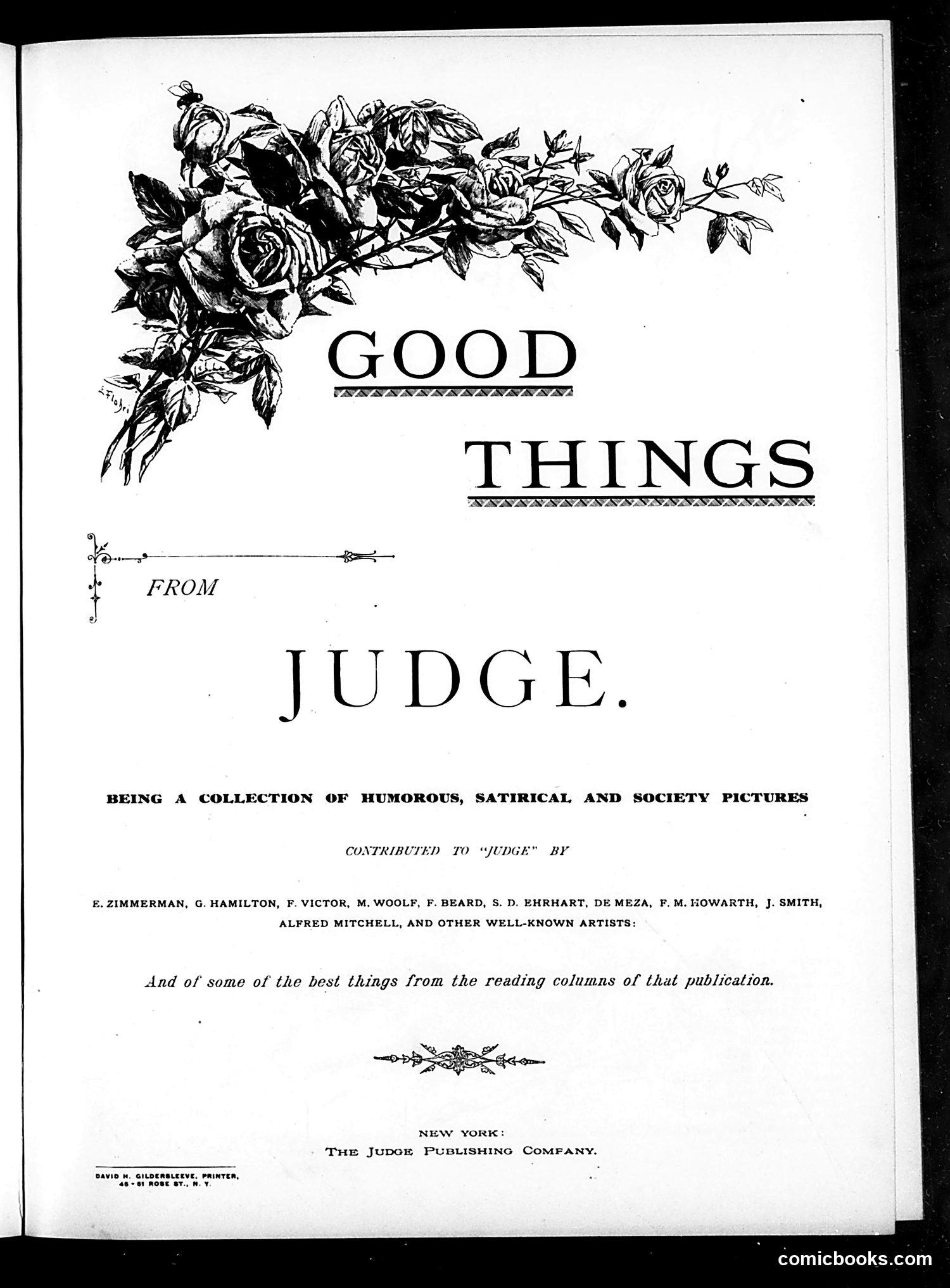
This is a title page for a collection book published by Judge, a prominent American satirical magazine. The page announces a compilation of humorous and satirical illustrations and writings previously published in Judge, credited to notable cartoonists of the era including E. Zimmerman, G. Hamilton, and Alfred Mitchell. The decorative rose illustration and ornamental borders reflect late 19th or early 20th-century design conventions. The publication is from The Judge Publishing Company in New York. This appears to be a bound anthology rather than original content—a common practice where successful magazine material was repackaged into books for broader distribution and permanence.
This is a copyright page from Judge magazine, dated 1887, published by The Judge Publishing Co. The page contains only standard copyright information—no cartoon, satirical content, or illustrations are visible. It serves as a legal/administrative page indicating the publication's ownership and date. To understand Judge's actual satirical content from this period, one would need to examine other pages from the magazine that contain the editorial cartoons and humorous commentary for which it was known during the Gilded Age.
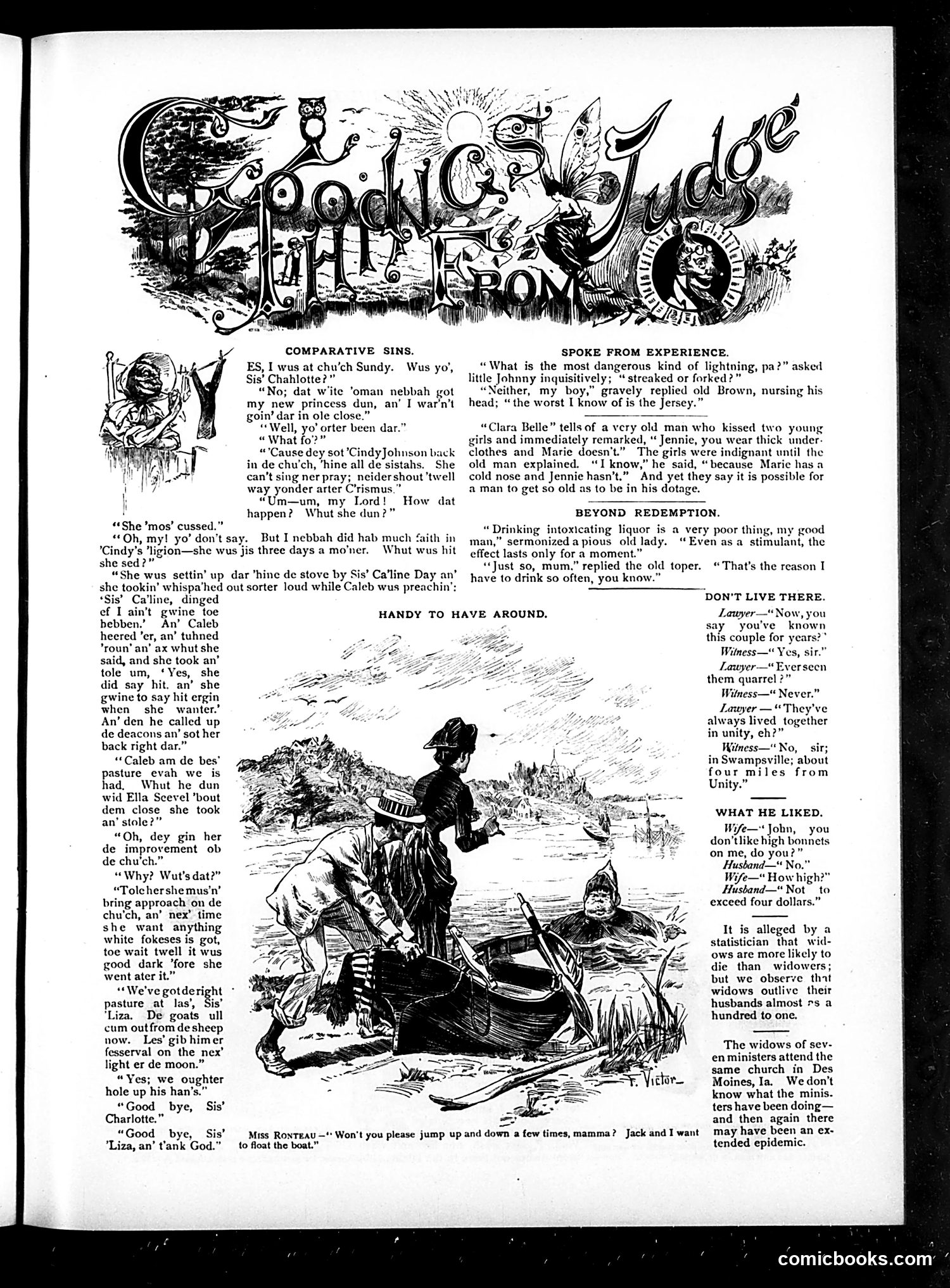
This page contains several satirical pieces typical of Judge magazine's humor: **"Comparative Sins"** depicts two Black women discussing church discipline. The satire critiques selective moral enforcement: a woman is publicly shamed for cursing in church, while another who stole clothing receives only mild rebuke ("improvement"). The joke highlights hypocrisy in how transgressions are judged—the church appears more concerned with decorum than actual wrongdoing. **Other brief humor pieces** include: - A Jersey lightning joke (likely referencing New Jersey's reputation) - An elderly man making inappropriate observations about young women's clothing - A drunk man explaining he must drink frequently because alcohol's effects are temporary - A lawyer discovering a couple lives near but not "in" Unity—a pun on marital harmony **"What He Liked"** satirizes domestic bargaining: a husband dislikes his wife's expensive bonnets, capping acceptable cost at four dollars. The page reflects late-19th/early-20th-century American humor: class commentary, domestic comedy, and casual racial caricature typical of the era.
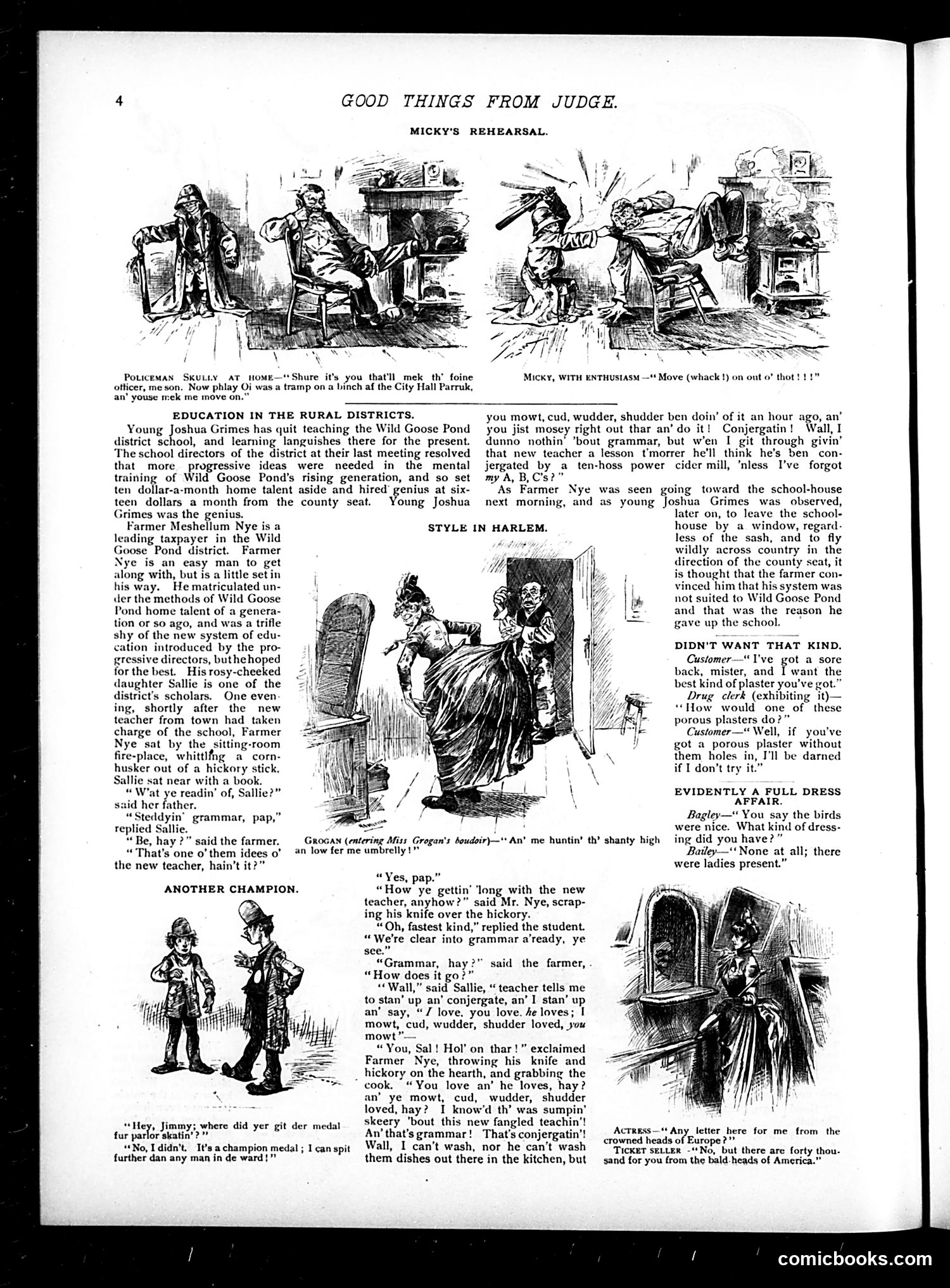
This page from *Judge* magazine satirizes rural American education and ethnic humor circa the 1880s-90s. **Main satire:** "Education in the Rural Districts" mocks the clash between old and new teaching methods. Farmer Nye represents rural conservatism—educated under traditional rote learning—while the new schoolteacher represents progressive "grammar" instruction. When his daughter Sallie recites Latin conjugation ("I love, you love, he loves"), Nye interprets it literally as modern nonsense (people can't actually "love" in present tense while doing dishes). The joke: rural skepticism of formal education appears comically ignorant, yet Nye's practical objections have some validity. **Secondary content includes ethnic caricatures:** "Micky's Rehearsal" depicts Irish-accented policemen; "Style in Harlem" features an African American character bragging about spitting distance as a "medal." These reflect the magazine's casual, now-offensive ethnic stereotyping typical of the era. The satire targets both progressive educators' pretension and rural resistance to change, though the rural figure is positioned as the comic fool.
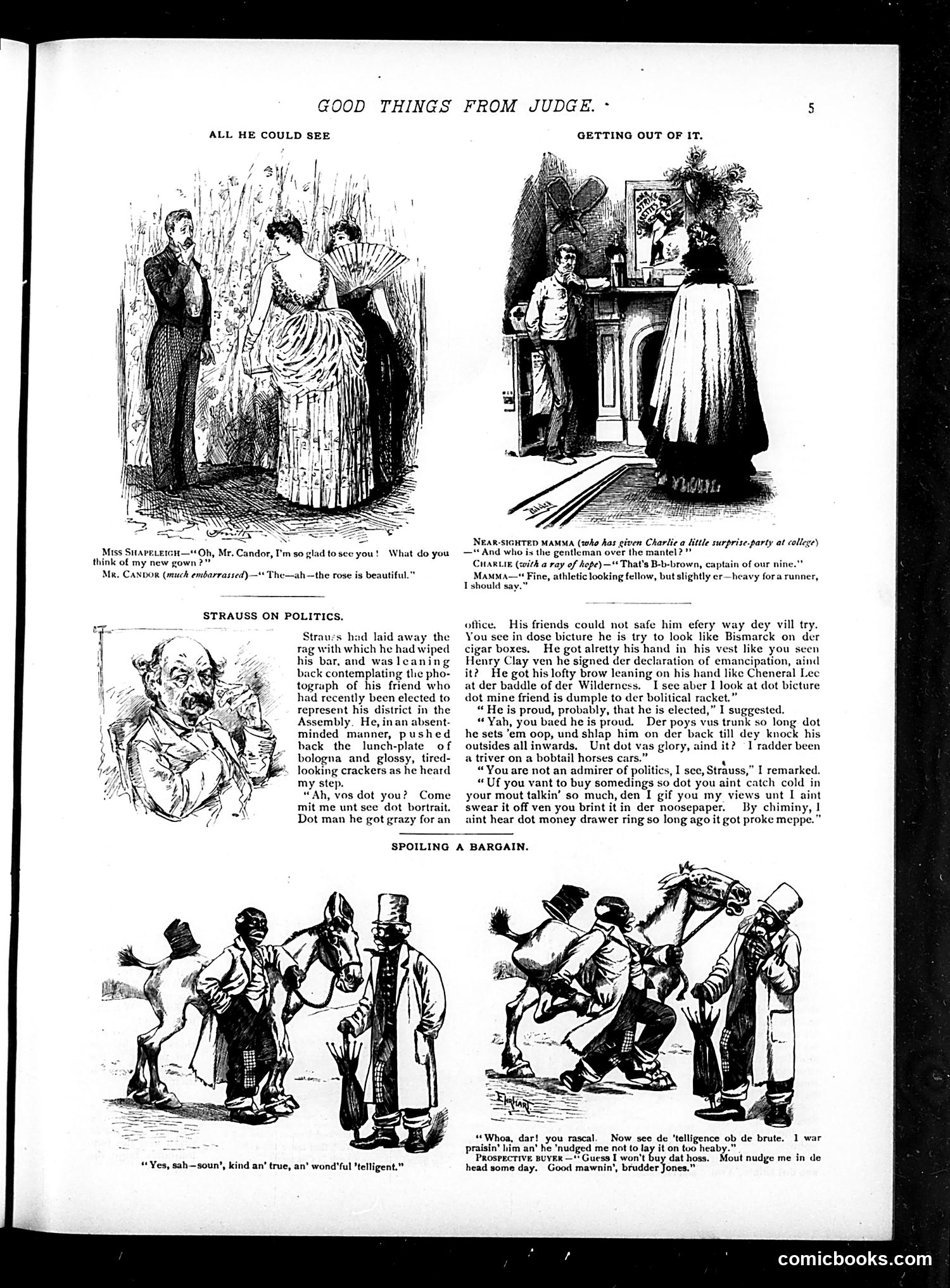
This page contains four satirical sketches from Judge magazine (circa late 1800s): **"All He Could See"**: A man compliments only a rose on a woman's elaborate new gown, unable to see past one detail—satirizing obliviousness or poor social skills. **"Strauss on Politics"**: A barkeeper with a German accent discusses his friend's recent election to the Assembly. Strauss mocks the newly elected official for adopting grandiose poses (imitating Bismarck, Henry Clay, General Lee) while remaining a simple man. The satire targets politicians' pretension and vanity upon taking office. **"Near-Sighted Mamma"**: A mother, unable to see clearly, mistakes a college student named "B-b-brown" (apparently awkward or stammering) for the captain of the baseball team based on his position near the mantelpiece. **"Spoiling a Bargain"**: A horse trader ruins a sale by demonstrating the animal's supposed intelligence—ironically proving the opposite, deterring the buyer. All sketches mock human folly: vanity, political pretension, poor vision (literal and figurative), and self-sabotage.
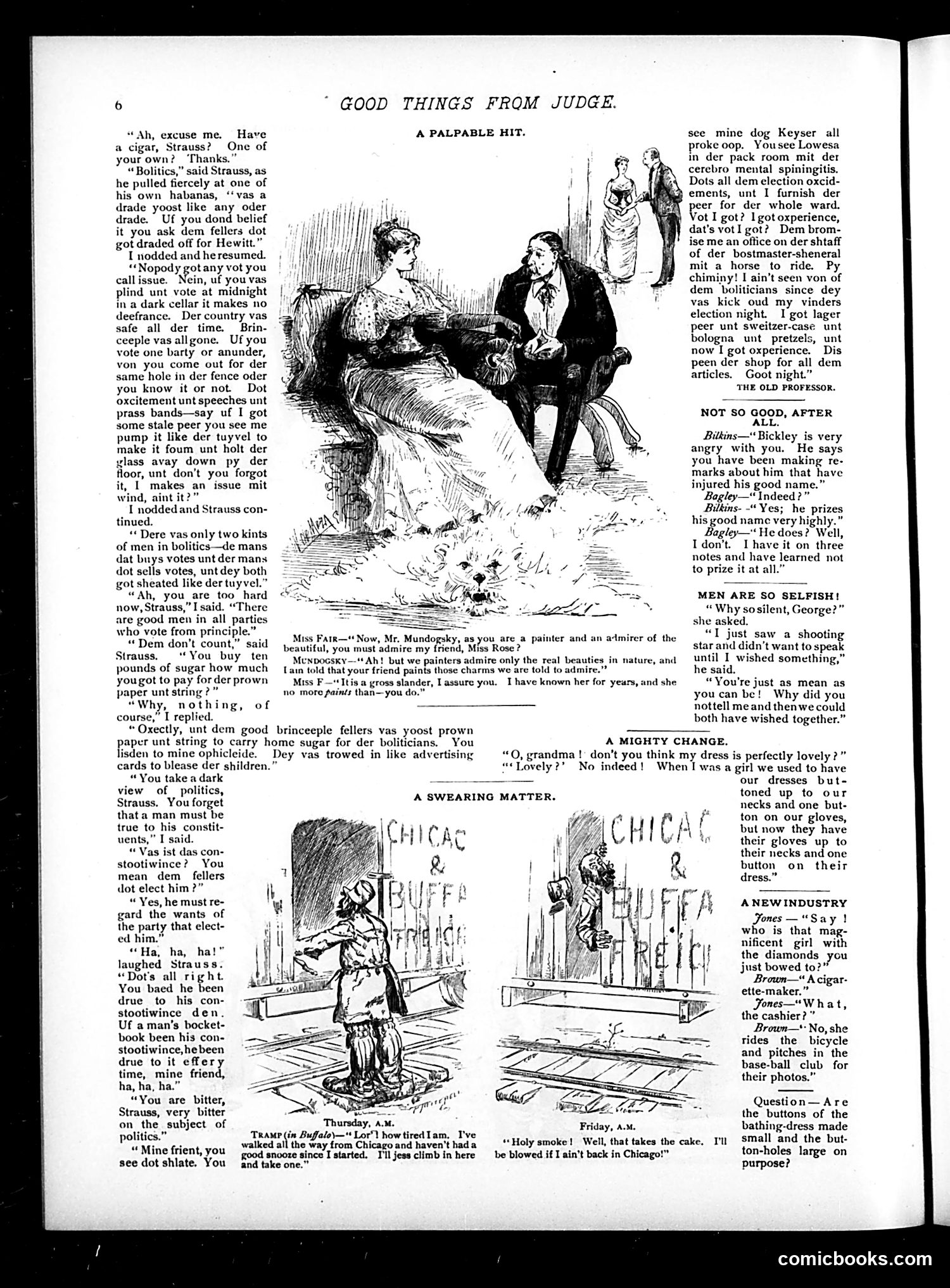
This Judge magazine page satirizes American political corruption through multiple cartoons and dialogues. **Main Feature**: A cynical conversation between a narrator and "Strauss," an immigrant with a German accent, who argues that politics is inherently corrupt. Strauss claims there are only two kinds of politicians: those who buy votes and those who sell them—both cheated equally. He dismisses talk of "principle" and "constituents," suggesting voters are merely traded commodities with no real issues at stake. **The Satire's Point**: Judge is mocking the Gilded Age political machine, where votes were literally purchased, parties made empty promises, and citizens were treated as fungible goods rather than principled voters. Strauss's cynicism—though presented as crude—reflects widespread contemporary frustration with machine politics and vote-buying scandals. **Secondary Cartoons** include romantic/social humor unrelated to politics. The page dates likely to the 1880s-1890s when urban political corruption was rampant and machine politics dominated American cities.
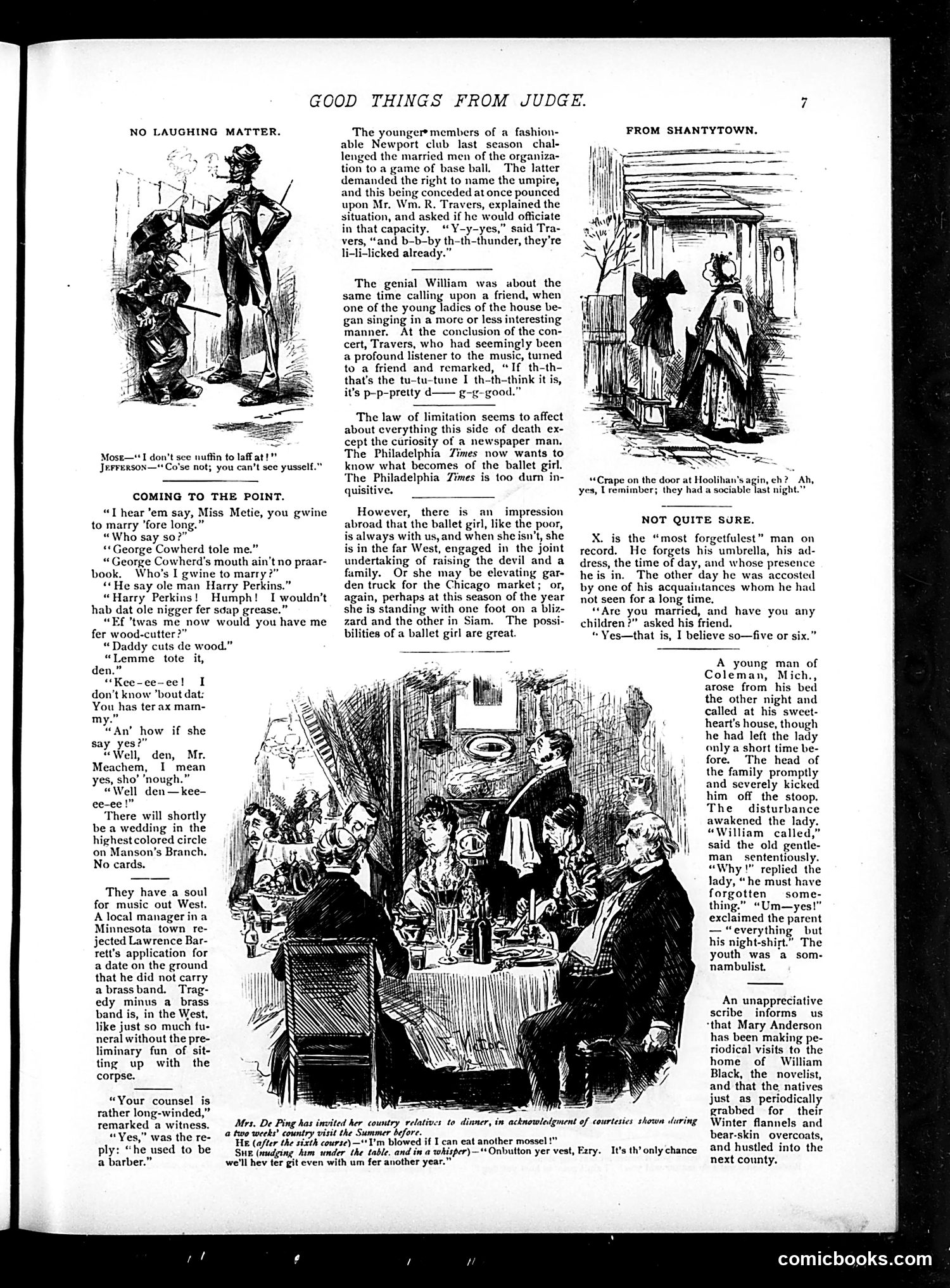
This page from Judge magazine contains several short satirical pieces typical of late-19th-century humor: **"No Laughing Matter"** and **"Coming to the Point"** are dialect comedies featuring African American characters in stereotypical speech patterns—reflecting the racist humor conventions of that era. The jokes rely on minstrelsy-style dialogue. **The Newport Club anecdote** mocks William R. Travers, a wealthy businessman known for his stammer, through his confident predictions about a baseball game and his assessment of a woman's singing. **"The Ballet Girl" section** satirizes newspaper voyeurism, suggesting journalists obsessively track the fates of chorus girls—implying they disappear into Western life or domestic obscurity. **The dinner illustration** shows a country family visitor struggling with multiple courses, humorously depicting rural-urban class differences. **"Not Quite Sure"** jokes about a chronically forgetful man who can't remember if he's married or how many children he has—absurdist humor about absent-mindedness. The overall tone is light social satire aimed at contemporary readers familiar with named figures and fashionable controversies.
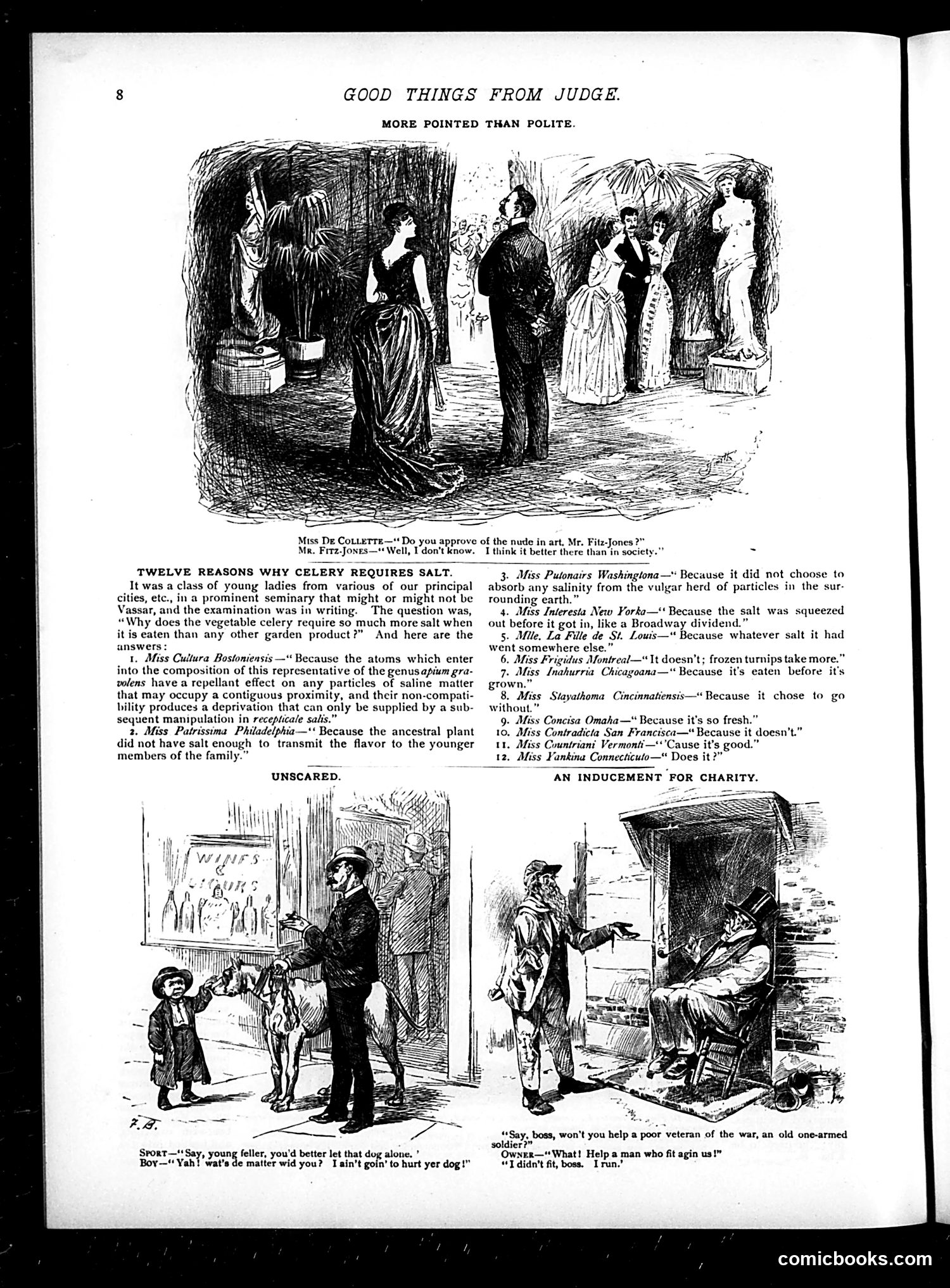
This page from *Judge* magazine contains three satirical pieces: **"More Pointed Than Polite"** mocks pretentious art criticism. A woman asks a man's opinion on nudity in art; he responds that nude figures belong in paintings rather than appearing in public society—a dig at both affected aesthetic discourse and social impropriety. **"Twelve Reasons Why Celery Requires Salt"** satirizes overeducated young women from elite seminaries (possibly including Vassar). Each answer parodies a regional stereotype: Boston's pseudo-scientific verbosity, Philadelphia's ancestral pretension, New York's financial cynicism, Chicago's rush, etc. The joke mocks both pretentious education and regional character caricatures. **"Unscared" and "An Inducement for Charity"** are brief comic vignettes. The first shows a boy unconcerned about a dog threat. The second depicts a one-armed war veteran's pitch to a prospective donor, with dark humor about the Civil War—the veteran admits he "ran" rather than fought, undercutting both patriotic sentiment and charitable impulses. The overall tone is satirical toward social pretension and regional types.
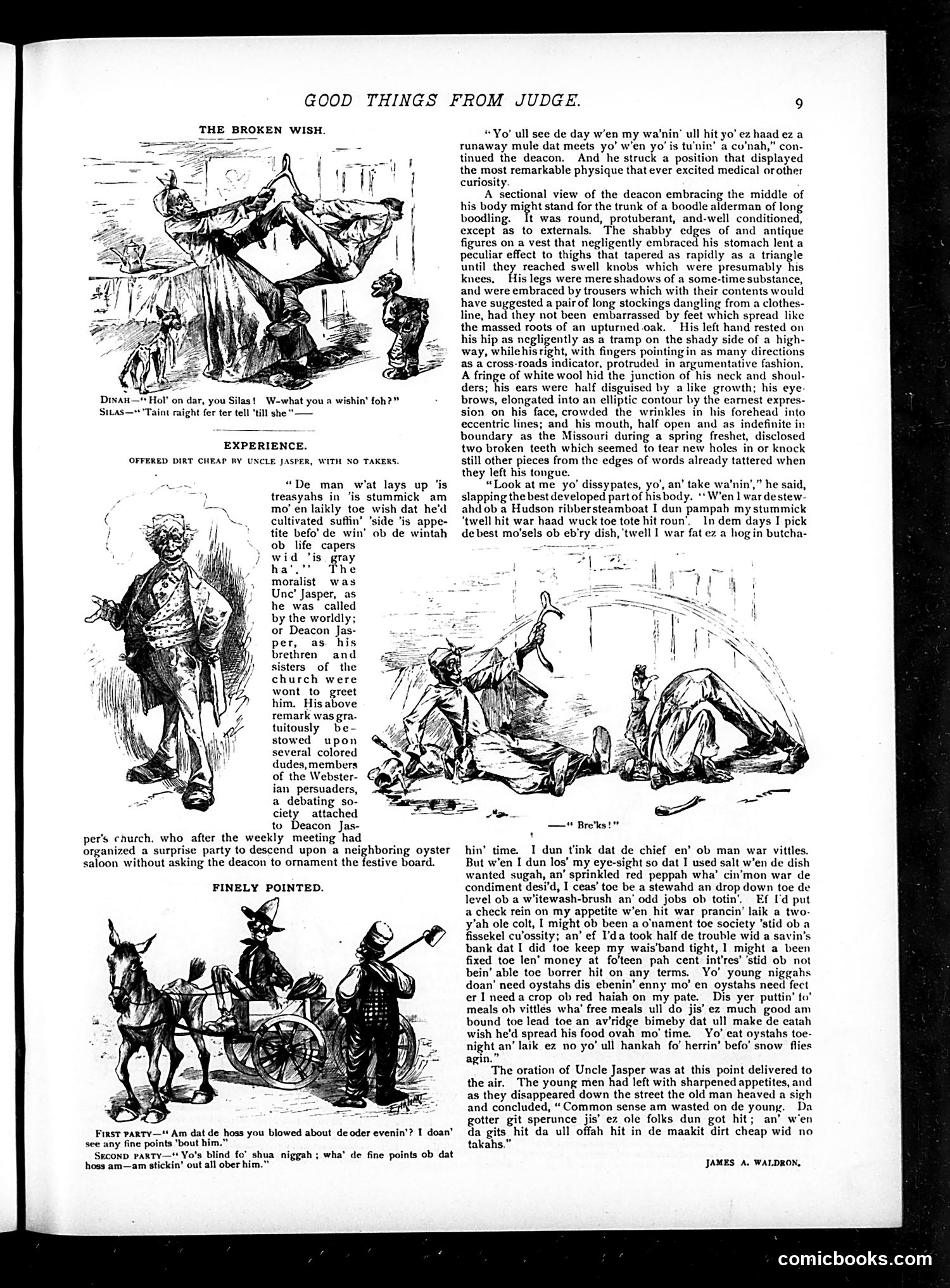
This page contains three satirical sketches using racist dialect and caricatures of African Americans—typical of Judge magazine's era. **"The Broken Wish"** depicts two Black men; one warns the other that wishing for material abundance will lead to regret, illustrated through Deacon Jasper's cautionary tale. **"Experience"** features Deacon Jasper addressing young Black debaters at a church society. His moral lesson: overindulgence (particularly eating) leads to physical and moral decline. The deacon exemplifies this through his grotesquely described, deteriorated body—a consequence of his past gluttony as a riverboat worker. The satire mocks both the dudes' hypocrisy (sneaking to an oyster saloon) and presents the deacon as a moralistic figure. **"Finely Pointed"** shows two men debating a horse's merits—a brief joke about differing standards of evaluation. All three pieces rely on exaggerated dialect, physical caricature, and moral lessons about self-discipline directed at Black characters—reflecting period attitudes toward race and respectability.
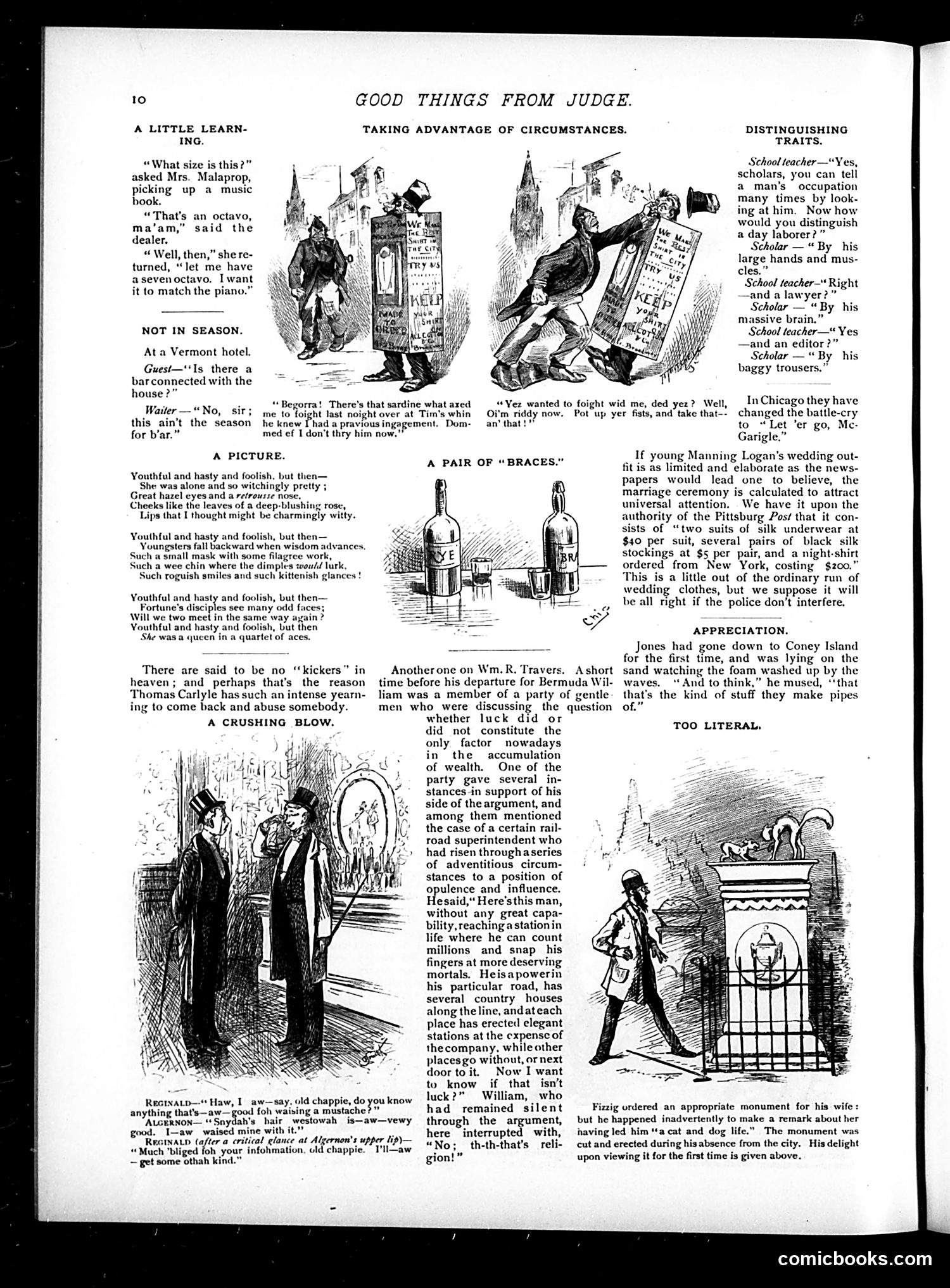
This page from *Judge* contains several short humorous pieces typical of late 19th-century American satire: **"A Little Learning"** mocks malapropisms—Mrs. Malaprop (a stock character type) confuses "octavo" (a book size) with "sevenoctavo," wanting books to match her piano's dimensions. **"Not in Season"** is a Vermont dialect joke playing on the double meaning of "bar"—the waiter thinks the guest means bears, not a drinking establishment. **"A Pair of Braces"** features W.R. Travers (a wealthy New York figure), who argues that a railroad superintendent's success results from "religion" rather than luck—a gentle jab at self-made fortunes. **Other sketches** satirize affectation (the affected "Reginald" and "Algernon" discussing mustaches), working-class occupational signs, and social pretension. The humor relies on wordplay, class observation, and period mannerisms rather than political content.
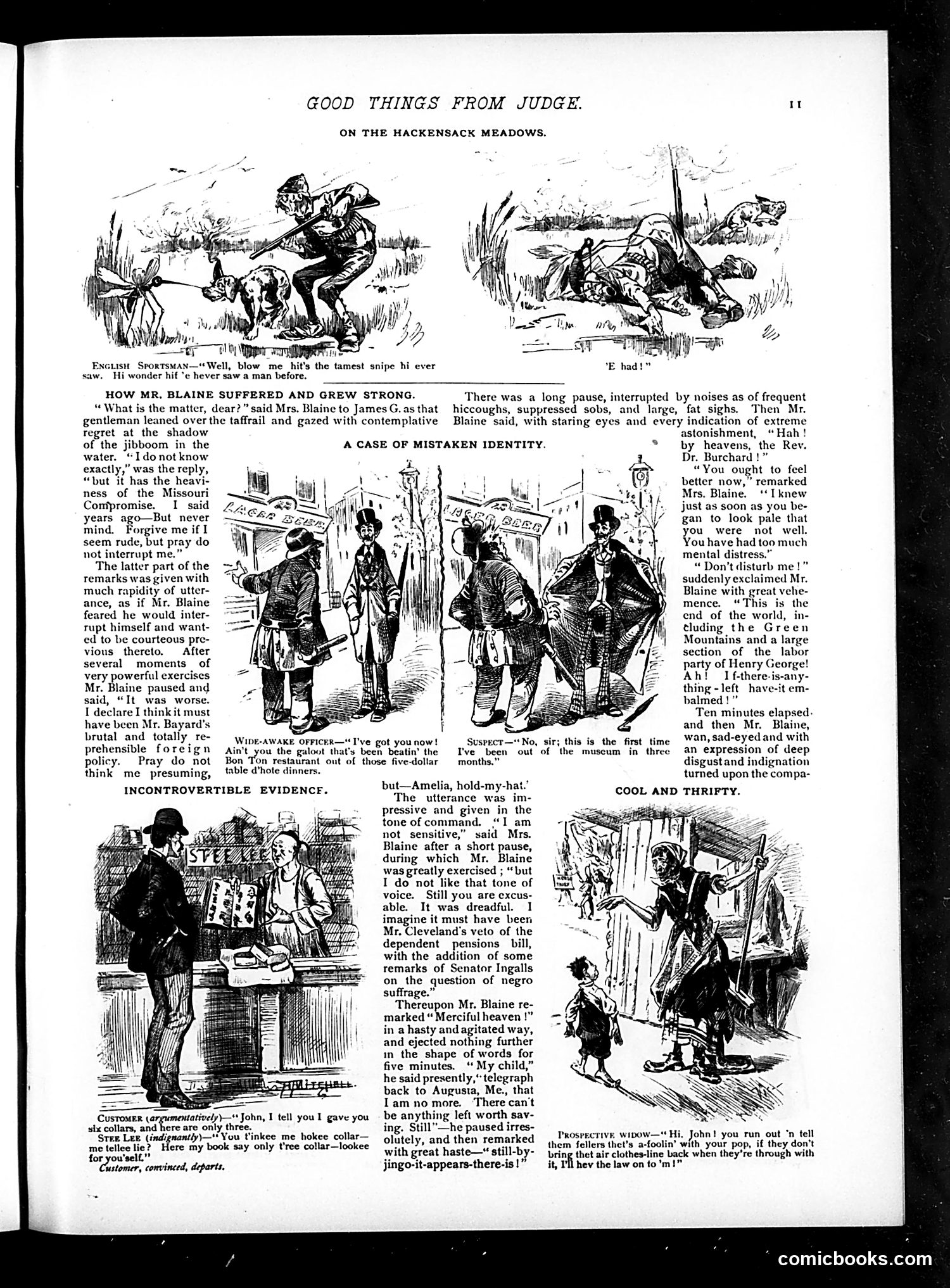
This page contains several satirical sketches mocking prominent American political figures of the era. The central story ridicules **James G. Blaine** (Republican presidential candidate), depicting him as neurotic and obsessing over past political defeats. His rambling monologue blames various Democratic policies—the "Missouri Compromise," **Bayard's foreign policy**, **Cleveland's veto** of pension bills, and **Senator Ingalls' remarks on negro suffrage**—for his current malaise. The satire suggests Blaine is emotionally unstable and dwelling excessively on political grievances. Other sketches include a comedic misidentification involving **Rev. Dr. Burchard** (likely the controversial clergyman associated with Blaine's campaign), ethnic humor depicting a Chinese shopkeeper, and British sporting scenes. The overall message appears to be partisan mockery of Republican figures and policies during the Gilded Age political era, typical of Judge's Democratic-leaning editorial stance.
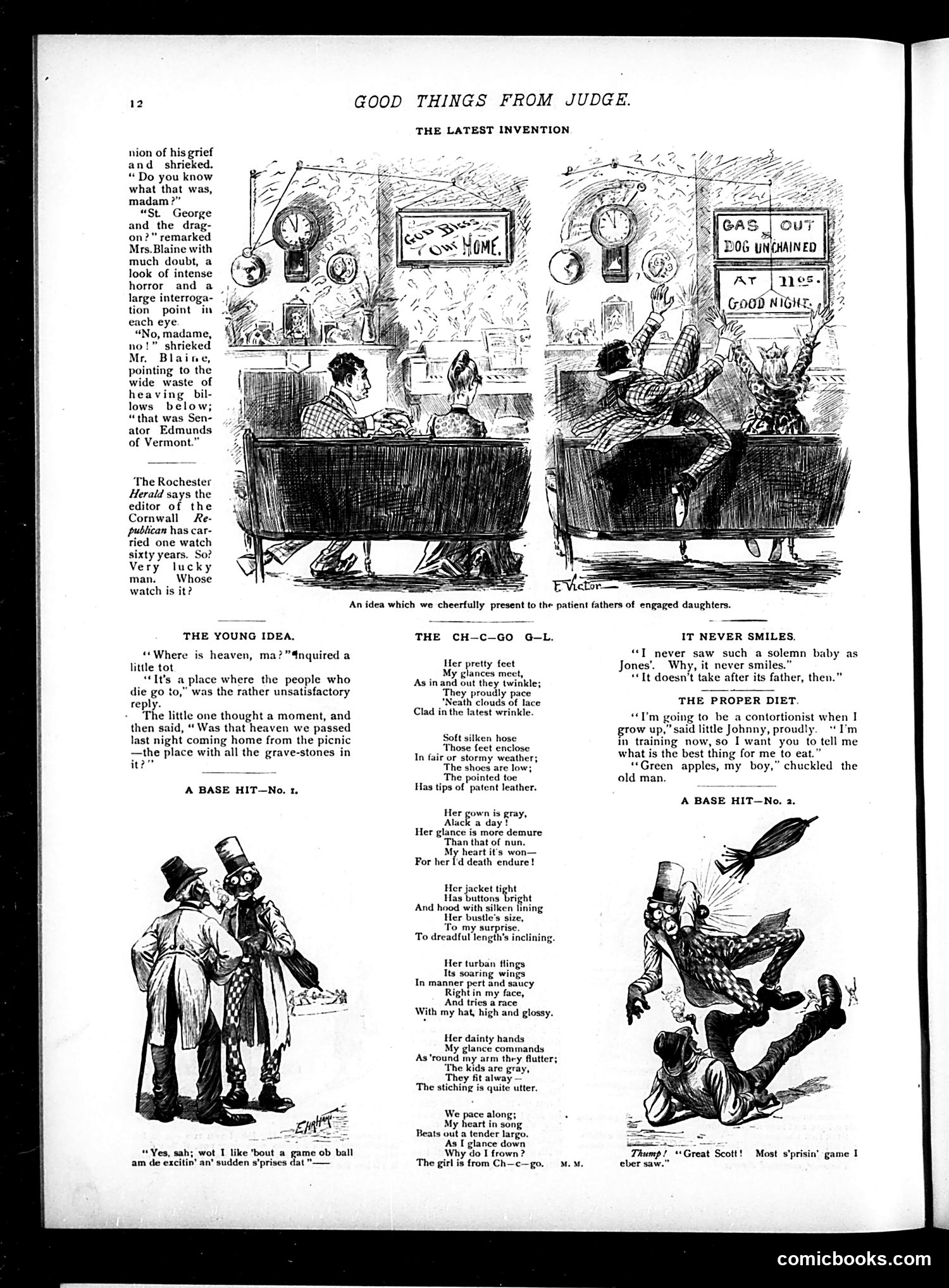
This page from the satirical magazine *Judge* contains several unrelated humorous items: **"The Latest Invention"** shows a cartoon about engaged daughters—a device (appearing to be for extinguishing gas lamps) presented as a "gift" to frustrated fathers, satirizing the expense and burden of having unmarried daughters in the household. **"The Ch-c-go G-l"** is a poem mocking a woman from Chicago, describing her fashionable but excessive clothing (tight jacket, enormous bustle, elaborate turban) with the punchline that despite her stylish appearance, "the girl is from Ch—c—go"—suggesting Chicago women, though fashionable, lack refinement or charm. **"It Never Smiles"** is a brief joke about a solemn baby who "doesn't take after its father," implying the father is equally gloomy. Other items include children's jokes ("The Young Idea") and baseball-related humor ("A Base Hit"). The page represents typical *Judge* content: light social satire targeting contemporary fashions, regional stereotypes, and domestic life, with no apparent political significance.
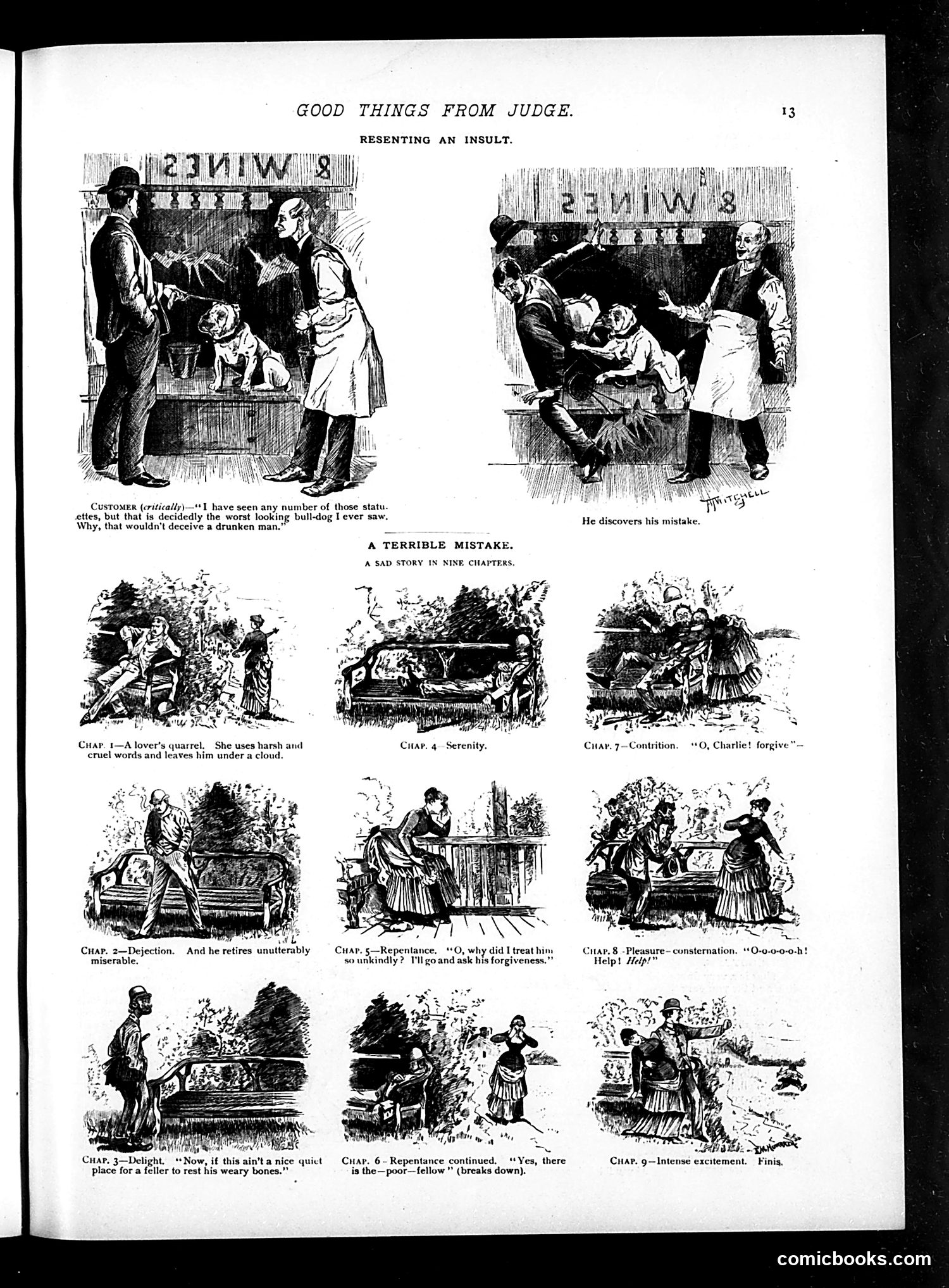
This page from *Judge* magazine contains two separate humorous pieces: **"Resenting an Insult"** (top): A customer insults a shopkeeper's statue collection, calling a displayed piece "the worst looking bull-dog." The shopkeeper's response reveals the "insult" was actually directed at a real, living bulldog—likely the shopkeeper's pet standing nearby. The joke relies on the customer's embarrassing mistake of criticizing an actual dog as if it were art. **"A Terrible Mistake"** (nine-panel narrative): This melodramatic serial tells of a lover's quarrel where a woman uses "harsh and cruel words," leading to the man's dejection. Through escalating emotional scenes—rejection, dejection, attempted reconciliation—the couple reunites. The final panels suggest the reconciliation triggers unexpected chaos ("Help! Help!"), leaving the resolution ambiguous. The satire mocks Victorian-era sentimental romance stories by presenting their predictable emotional arc with exaggerated intensity. Both pieces use visual comedy and narrative structure typical of late 19th-century American humor magazines.
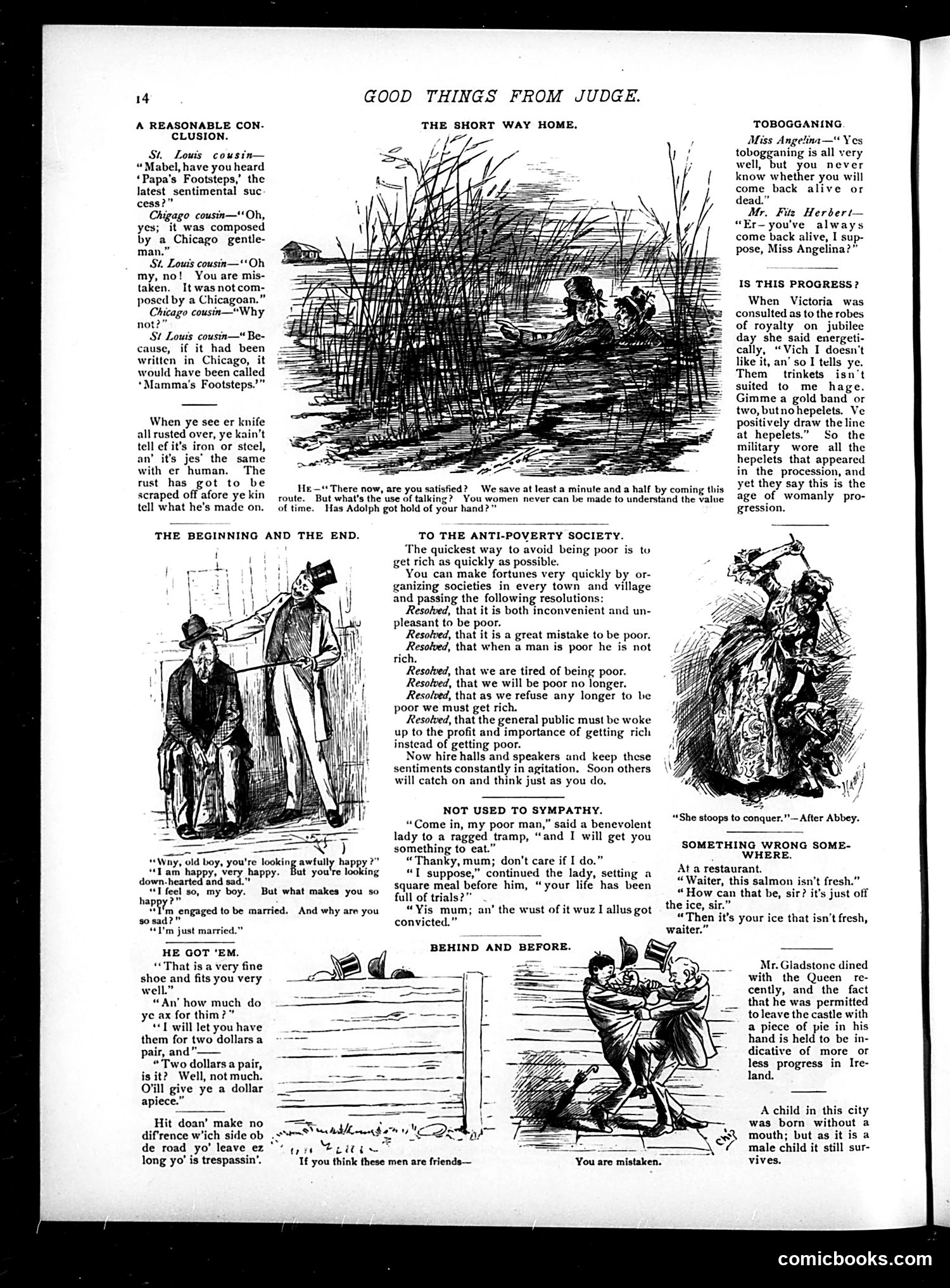
This page from Judge magazine (a 19th-century American satirical publication) contains multiple short comedic pieces mocking contemporary attitudes and social issues. **Key Content:** "A Reasonable Conclusion" jokes about Chicago versus St. Louis character—implying Chicagoans are so hurried they'd rename sentimental pieces after speed rather than sentiment. "The Short Way Home" depicts a couple tobogganing, satirizing how people (especially women) are pressured to waste time on social activities while men rush through them. "To the Anti-Poverty Society" is bitter satire: it ridicules well-meaning poverty-relief organizations by suggesting their resolutions (simply deciding not to be poor) are absurdly simplistic and useless without actual economic solutions. "Not Used to Sympathy" mocks both condescending charity and the poor's resignation to hardship. Other pieces humorously critique restaurant service, haggling over shoes, and social pretension. The overall tone suggests Judge's skepticism toward both Victorian sentimentality and ineffectual charitable movements.
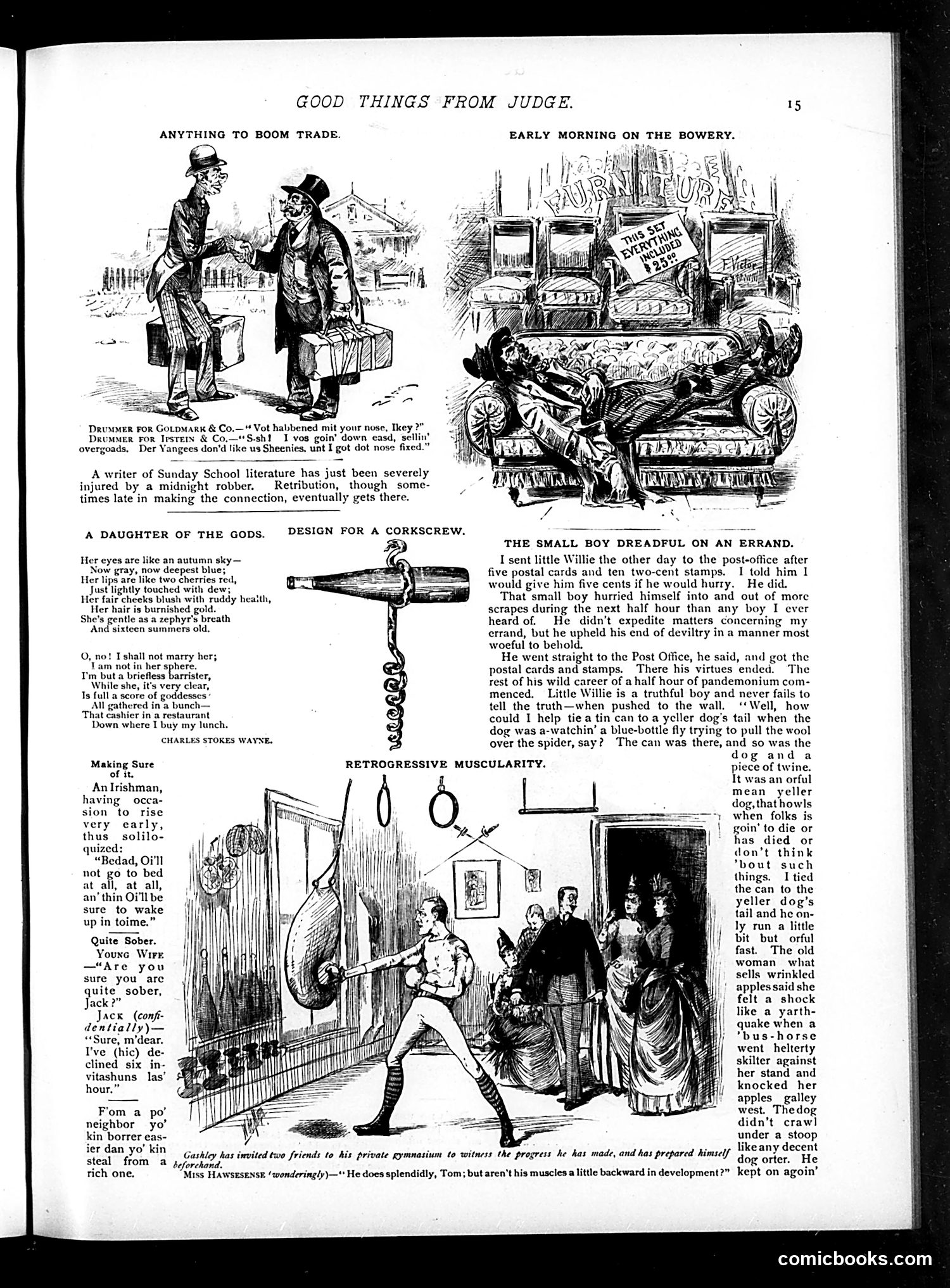
This page contains multiple short satirical pieces typical of Judge magazine's humor: **"Anything to Boom Trade"** mocks Jewish immigrant salesmen ("Sheenies"), showing two Yiddish-accented drummers (traveling salesmen). One explains his broken nose resulted from antisemitic violence while selling in the East, implying discrimination was commonplace and accepted as darkly humorous. **"A Daughter of the Gods"** is a romantic poem about a cashier—satirizing the idealization of working-class women while the speaker recognizes his own lower status as a poor barrister. **Other pieces** include Irish dialect humor ("Bedad"), a story about a mischievous boy running errands, gym humor, and period jokes about drinking and poverty. The cartoons use ethnic stereotypes (Yiddish, Irish accents) as standard comedic material. The page reflects late-19th-century American satire's casual antisemitism, classism, and reliance on immigrant caricature as entertainment—attitudes modern readers would find offensive rather than amusing.
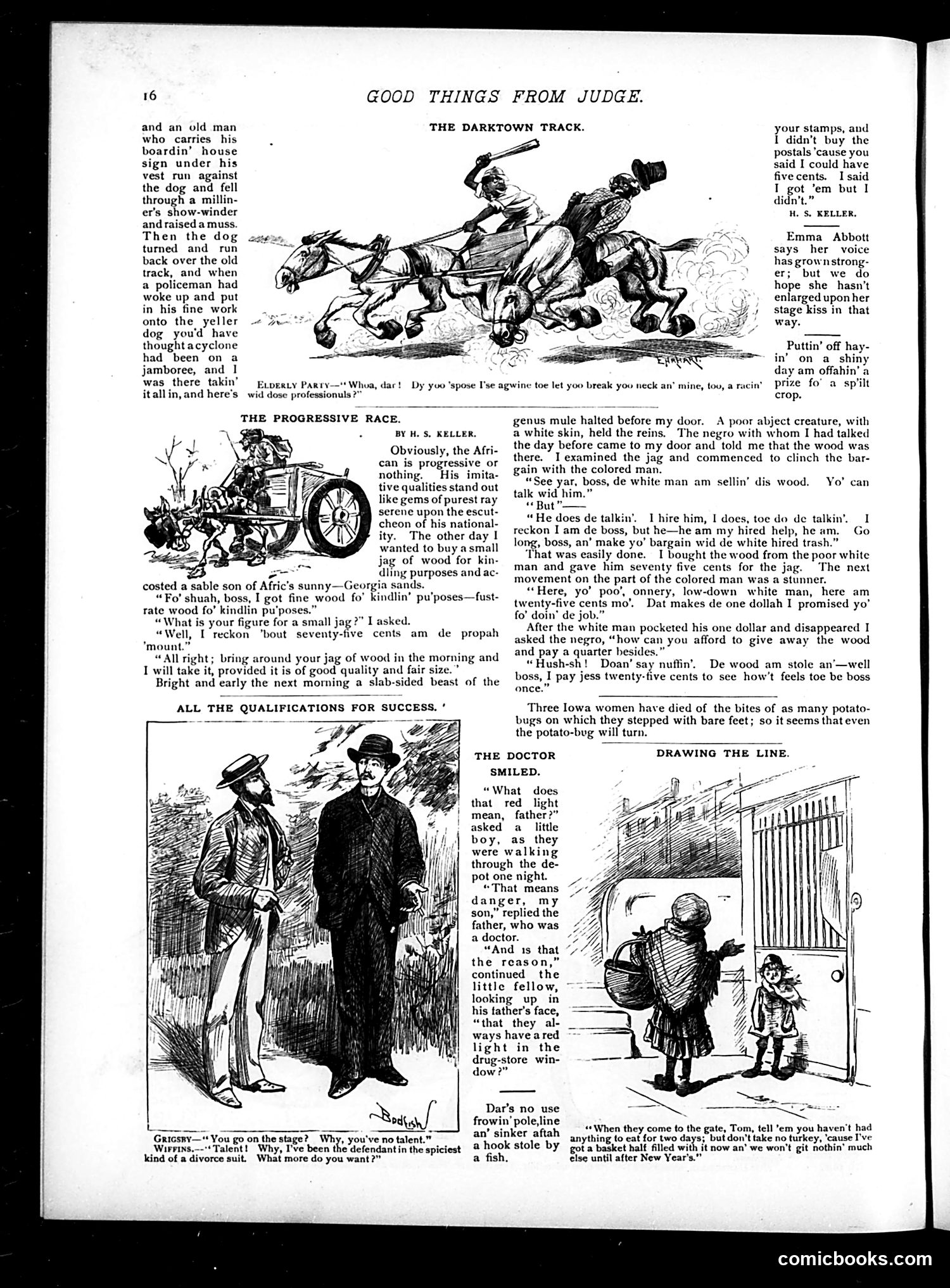
This page contains three distinct pieces of racist satire typical of late 19th-century American humor magazines: **"The Darktown Track"** and **"The Progressive Race"** feature caricatured African American dialect and stereotypes. The narratives depict Black characters in subservient positions, using exaggerated speech patterns. "The Progressive Race" presents a scenario where a Black man hires a poor white man to conduct a transaction, then steals wood to experience "being boss"—the joke mocking both the character's ambitions and economic desperation. **"The Doctor Smiled"** is a wordplay joke: a boy asks why drug stores have red lights (associated with danger/brothels), unaware of the double meaning. **"All the Qualifications for Success"** shows two men discussing theatrical talent, likely satirizing showbiz pretension. **"Drawing the Line"** depicts a gatekeeper refusing entry, its meaning unclear without fuller context. The page reflects Judge's satirical approach to social commentary, though by modern standards the racial humor is deeply offensive and reveals period prejudices rather than meaningful critique.
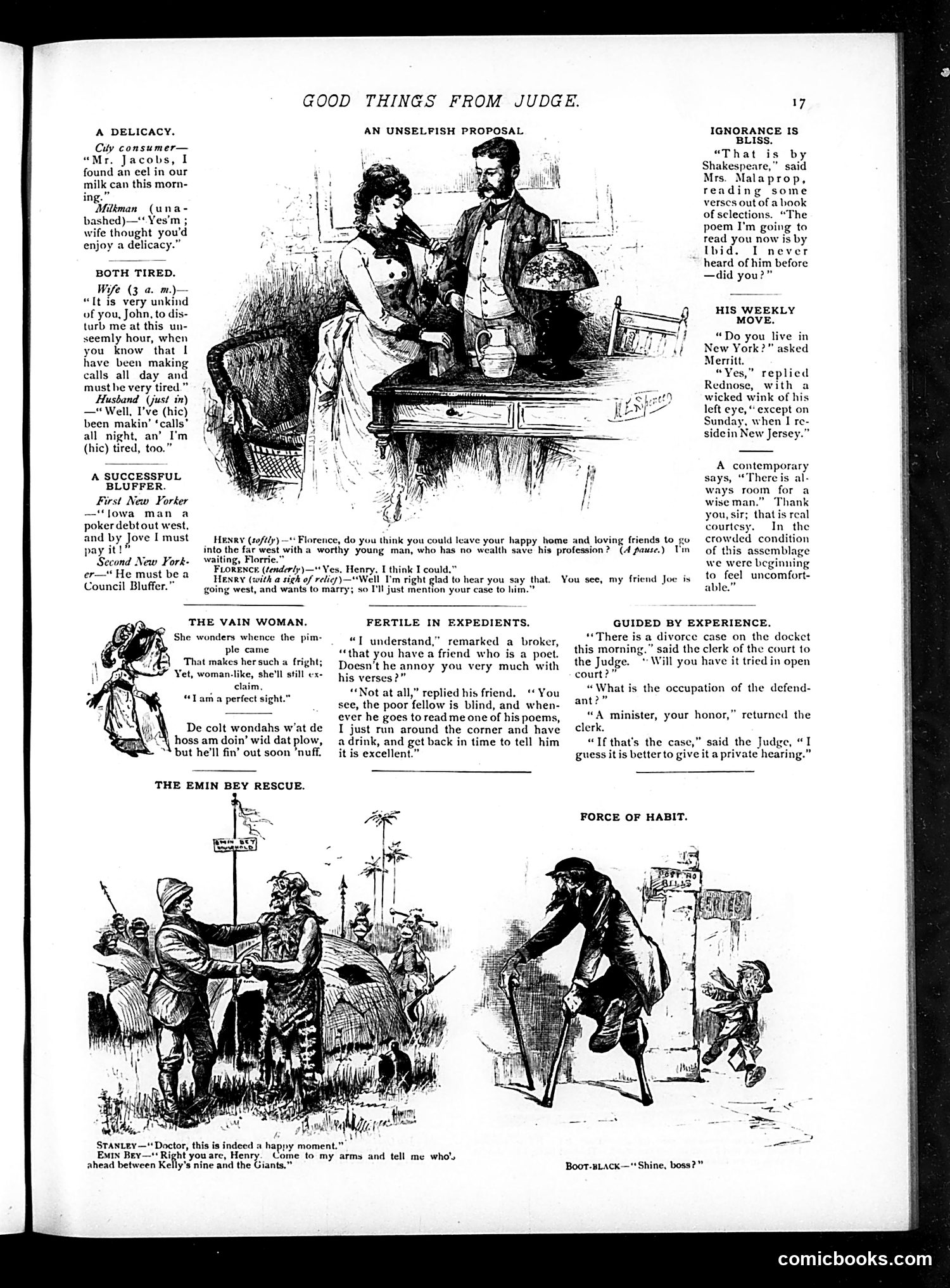
This page contains multiple short satirical pieces typical of *Judge* magazine's humor: **"A Successful Bluffer"** jokes about a New Yorker who must pay a poker debt to an Iowa man—the humor lies in calling Iowa "Council Bluffs" (a real city), making a pun on the debtor being a "bluffer." **"The Vain Woman"** mocks female vanity: a woman complains about a pimple making her "a perfect sight," ironically meaning she looks terrible while fishing for compliments. **"An Unselfish Proposal"** satirizes sentimentality—a man proposes to a woman to move west, then immediately plans to mention her to another man he knows who's also seeking a western wife, revealing his proposal as insincere. **"Guided by Experience"** presents a judge ordering a minister's divorce case heard privately rather than publicly—suggesting ministers' marital troubles might scandalize congregations if exposed. The cartoons use working-class and everyday scenarios to mock human nature: vanity, dishonesty, hypocrisy, and social pretense.
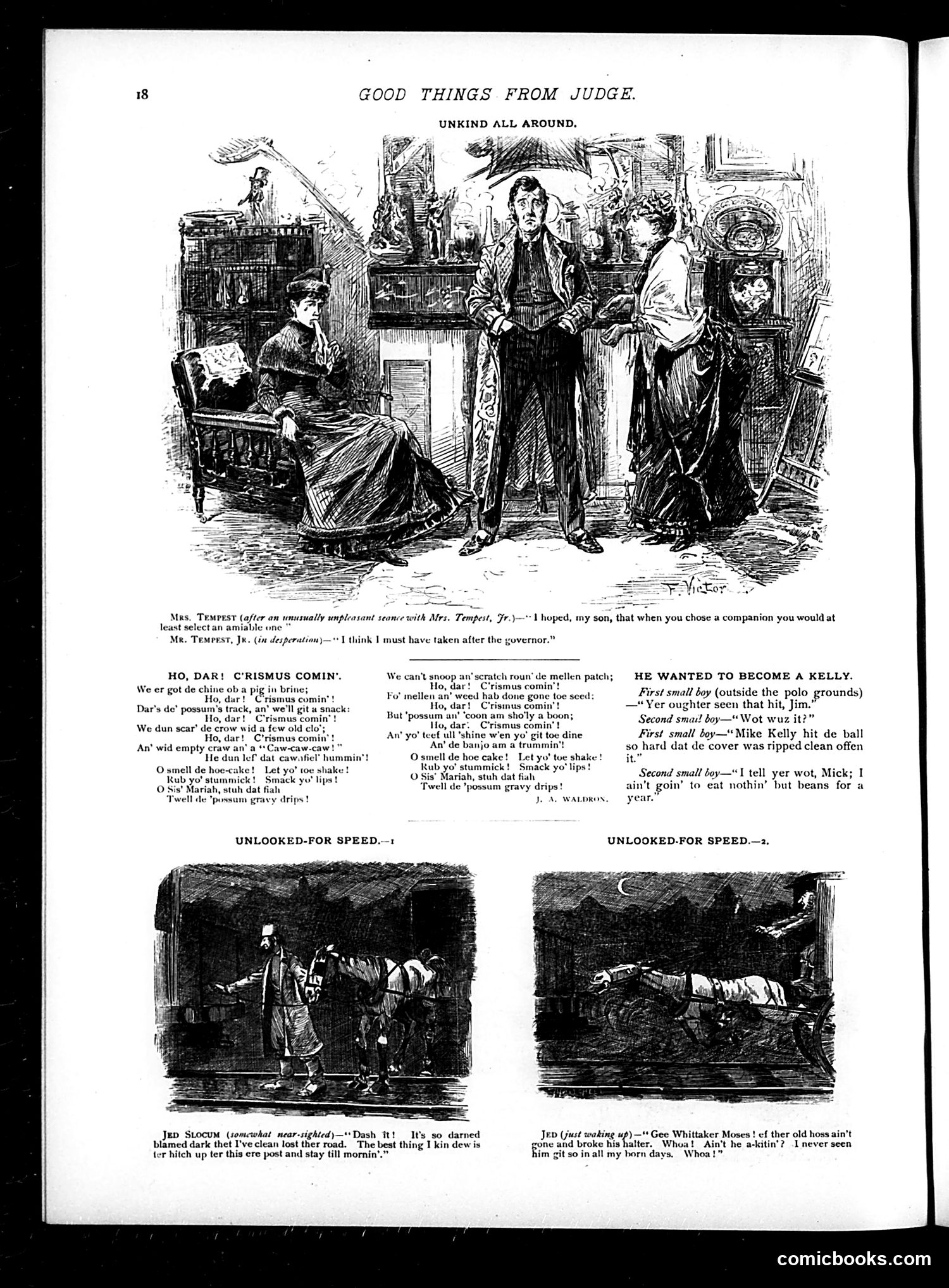
This page contains multiple satirical sketches typical of Judge's humor: **"Unkind All Around"**: A domestic comedy where Mr. Tempest Jr. and his wife have quarreled; when his father criticizes his choice of spouse, the son defensively replies he must have inherited his difficult nature from his father—mutual family blame. **"Ho, Dar! C'rismus Comin'"**: A dialect poem (in the minstrel-show style common to the era) celebrating Christmas anticipation among rural/working-class characters, focusing on possum, coon, and hearty food. **"He Wanted to Become a Kelly"**: Boys discussing polo, where one boy hit the ball so hard the cover tore off—"Kelly" likely references a famous polo player of the period (unclear which). **"Unlooked-For Speed"** (two panels): Comic mishaps where Jep Slocum ties his horse to a post in darkness, then wakes to find the horse has broken its halter and vanished—the "speed" joke being the horse's unexpected rapid departure.
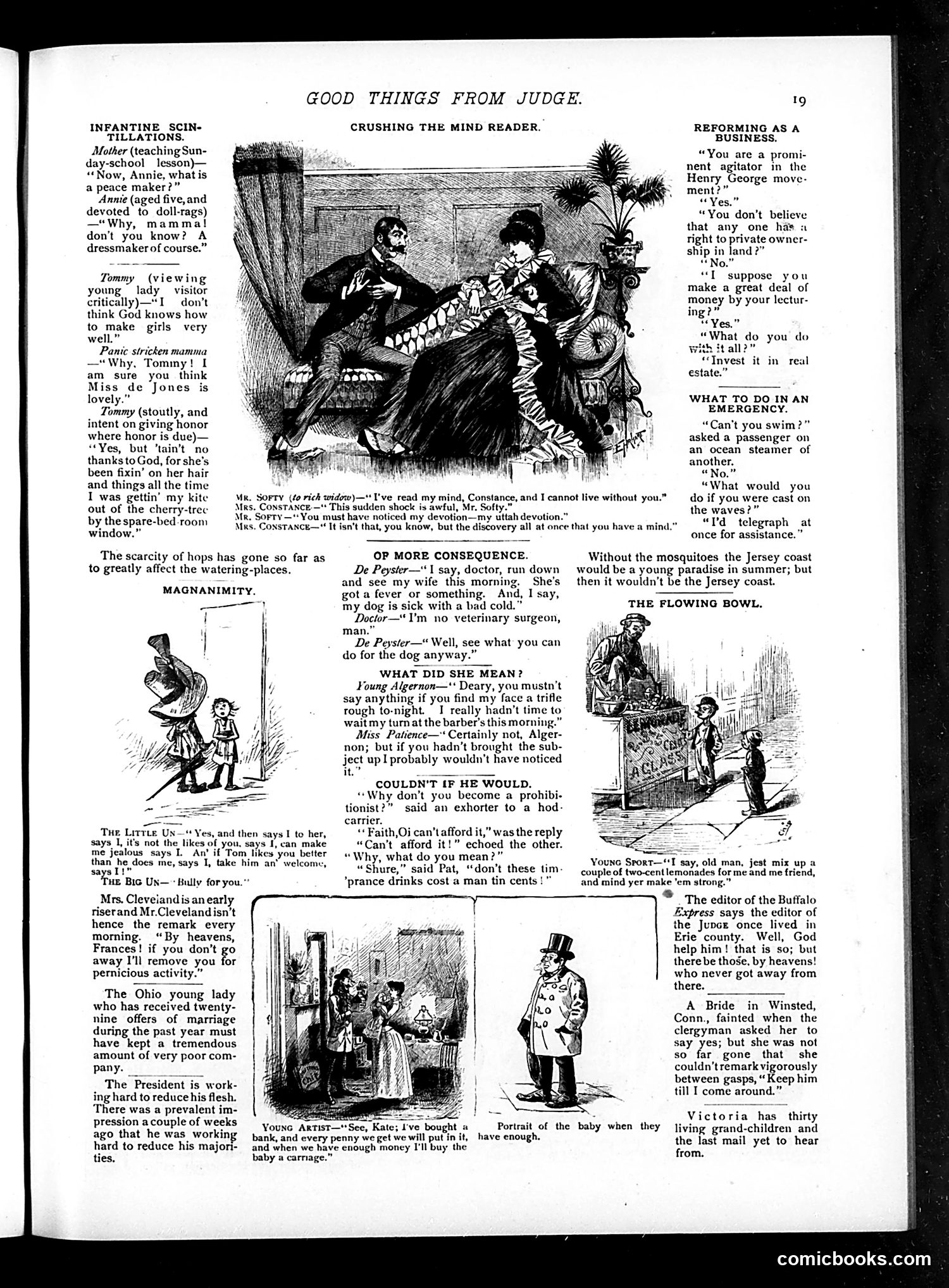
This page contains multiple short humorous vignettes typical of Judge magazine's satirical style: **"Infantile Scintillations"** mocks children's innocent misunderstandings—a girl defines "peacemaker" as a dressmaker; a boy criticizes God's craftsmanship regarding women. **"Crushing the Mind Reader"** satirizes a wealthy widow's vanity: a fortune-teller shocks her not by revealing her secrets, but by suggesting she actually possesses a mind. **"Reforming as a Business"** ridicules Henry George's land-reform movement—an activist lectures about abolishing private land ownership while profiting handsomely from lectures and reinvesting earnings in real estate. **"Of More Consequence"** mocks class priorities: a wealthy man asks his doctor to visit his wife with fever, then insists the doctor also treat his sick dog. **"Couldn't If He Would"** plays on working-class Irish dialect: a hod-carrier refuses temperance advocacy because temperance drinks cost money he can't afford to waste. The cartoons reflect Gilded Age social commentary on hypocrisy, class distinctions, and economic contradictions.
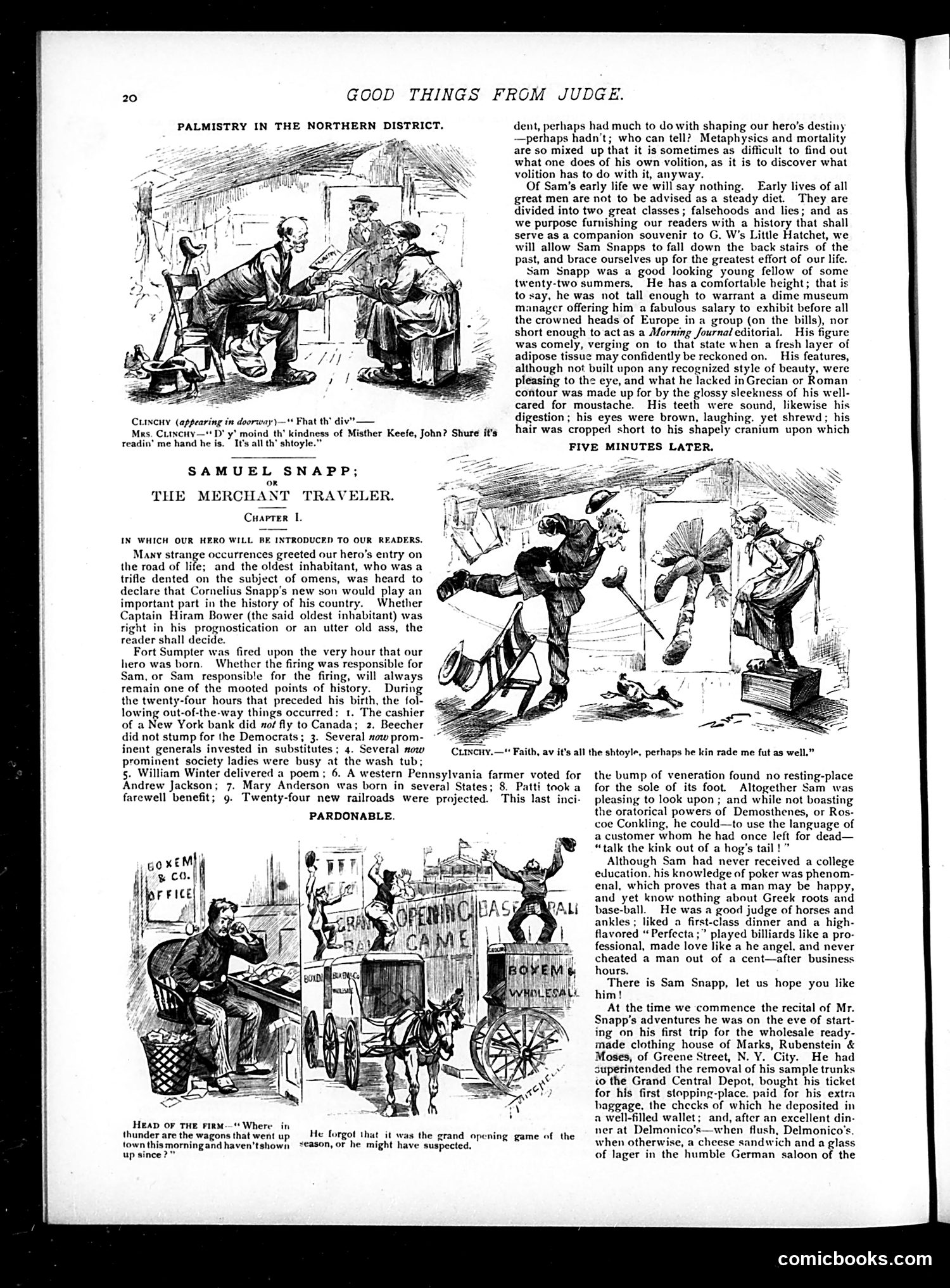
This page introduces "Samuel Snapp; or The Merchant Traveler," a serialized story in *Judge* magazine. The top section includes two illustrated vignettes: one showing a domestic Irish scene with dialect humor, another depicting slapstick comedy (a man being kicked). The main narrative begins Samuel Snapp's biography, humorously cataloging absurd "coincidences" surrounding his birth during Fort Sumter's firing (1861, marking the Civil War's start). The joke relies on satirizing how Americans retroactively assign cosmic importance to great men's births—the text mocks this by listing utterly trivial, contradictory, or obviously false events (William Winter writing poems, multiple versions of Mary Anderson being born "in several States"). The portrait of Snapp himself parodies breathless biographical writing: he's described as averagely attractive, competent at poker rather than classical education, and skilled at smooth-talking—essentially a charming mediocrity being presented as noteworthy. The satire targets both inflated biographical hagiography and American self-mythologizing about "great men."
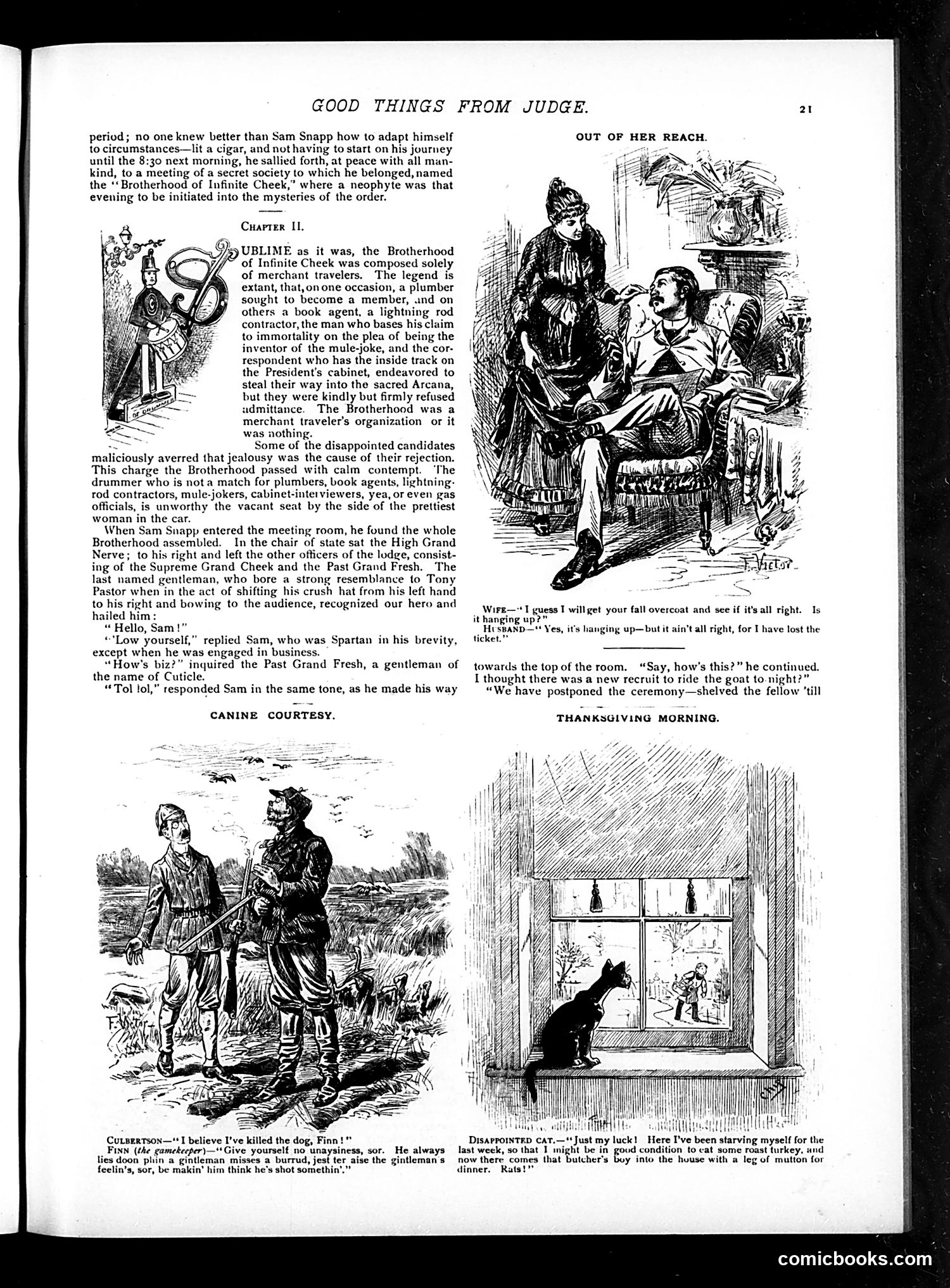
This page contains four distinct satirical pieces typical of Judge's late 19th-century humor: **"Brotherhood of Infinite Cheek"** (main story): A serialized narrative mocking traveling salesmen ("drummers"), a real occupational class. The satire targets their braggadocio and shamelessness—the "infinite cheek" being audacity. The rejected applicants (plumber, book agent, lightning-rod contractor) represent other working-class professions deemed inferior. **"Canine Courtesy"** (cartoon): An Irish gamekeeper explains to a hunter that his dog lies down to console hunters who miss their shots, preserving their dignity. The humor plays on class dynamics and the relationship between master and servant. **"Out of Her Reach"** and **"Thanksgiving Morning"** (domestic cartoons): Brief gag strips about everyday married life frustrations and a disappointed cat missing holiday dinner—gentle, universal humor. The overall page reflects Judge's focus on class-conscious satire, occupational mockery, and domestic comedy for middle-class readers.
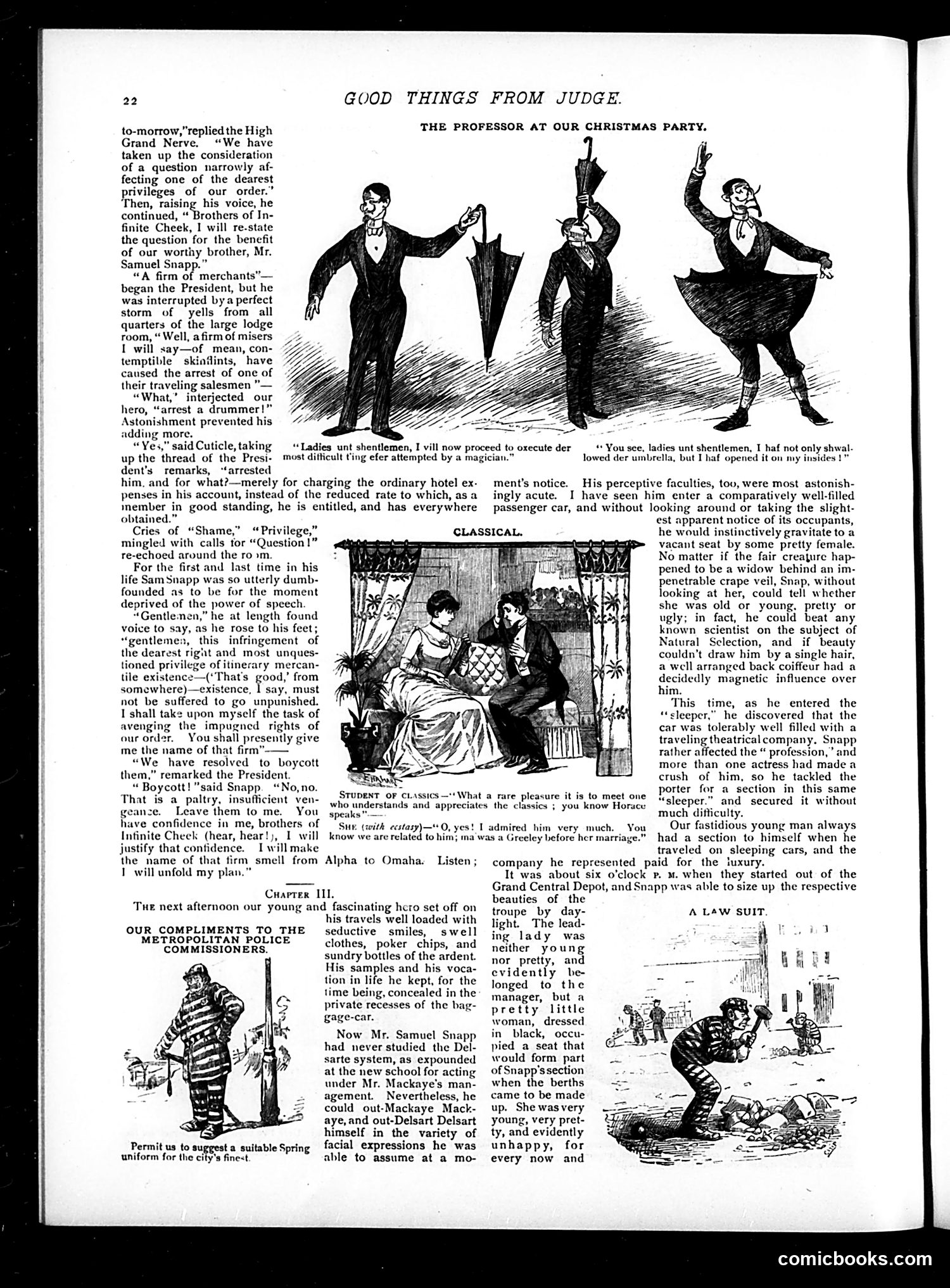
This page contains three satirical pieces mocking American business and social pretensions: **"The Professor at Our Christmas Party"** (top): A magician performs an absurd trick, claiming to have swallowed an umbrella and opened it inside himself—obvious nonsense presented as impressive. This mocks charlatan performers and gullible audiences. **"Classical"** (center): Two characters discuss "the classics." One claims Horace is a relative because his mother was "a Greeley before her marriage"—a joke about Americans lacking genuine classical education, substituting family name-dropping for actual knowledge. **"A Law Suit"** (bottom): Depicts a traveling salesman (drummer) being harassed. The page's main narrative above concerns a merchants' firm wrongly charging a salesman full hotel rates instead of reduced member rates, sparking outrage among the "order" of drummers who threaten boycott. This satirizes both commercial disputes and the self-important fraternal lodge culture of the era. The humor targets fraud, pretension, and petty business grievances typical of Gilded Age American commerce.
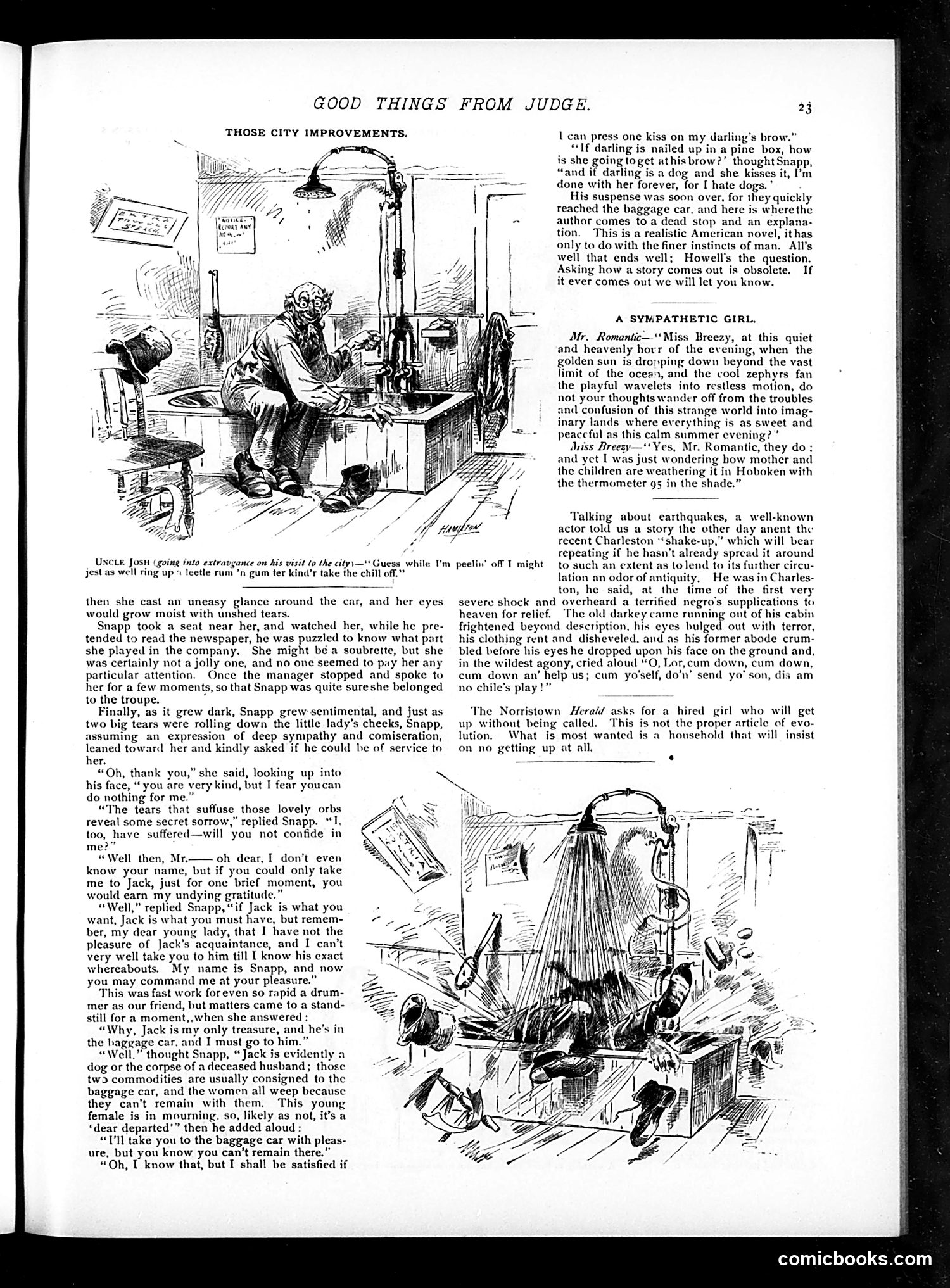
This page contains two satirical pieces from Judge magazine: **"Those City Improvements"** features Uncle Josh, a rural visitor, attempting sophistication in the city. The humor derives from his malapropism "leetle rum 'n gum" (likely "rum and gum" or similar) when trying to order an alcoholic drink—satirizing rural Americans' unfamiliarity with urban culture and speech. **"A Sympathetic Girl"** mocks the Romantic movement's sentimentality. Mr. Romantic waxes poetic about sunset and oceanic beauty inspiring transcendent thoughts. Miss Breezy's response—that she's actually worried about her family suffering in hot, crowded Hoboken—is comedic deflation. The joke: while he romanticizes nature, she has practical concerns about working-class family welfare. This satirizes the gap between Victorian sentimental idealism and harsh economic reality. Both pieces use everyday characters to critique cultural pretensions and unrealistic attitudes of the era.
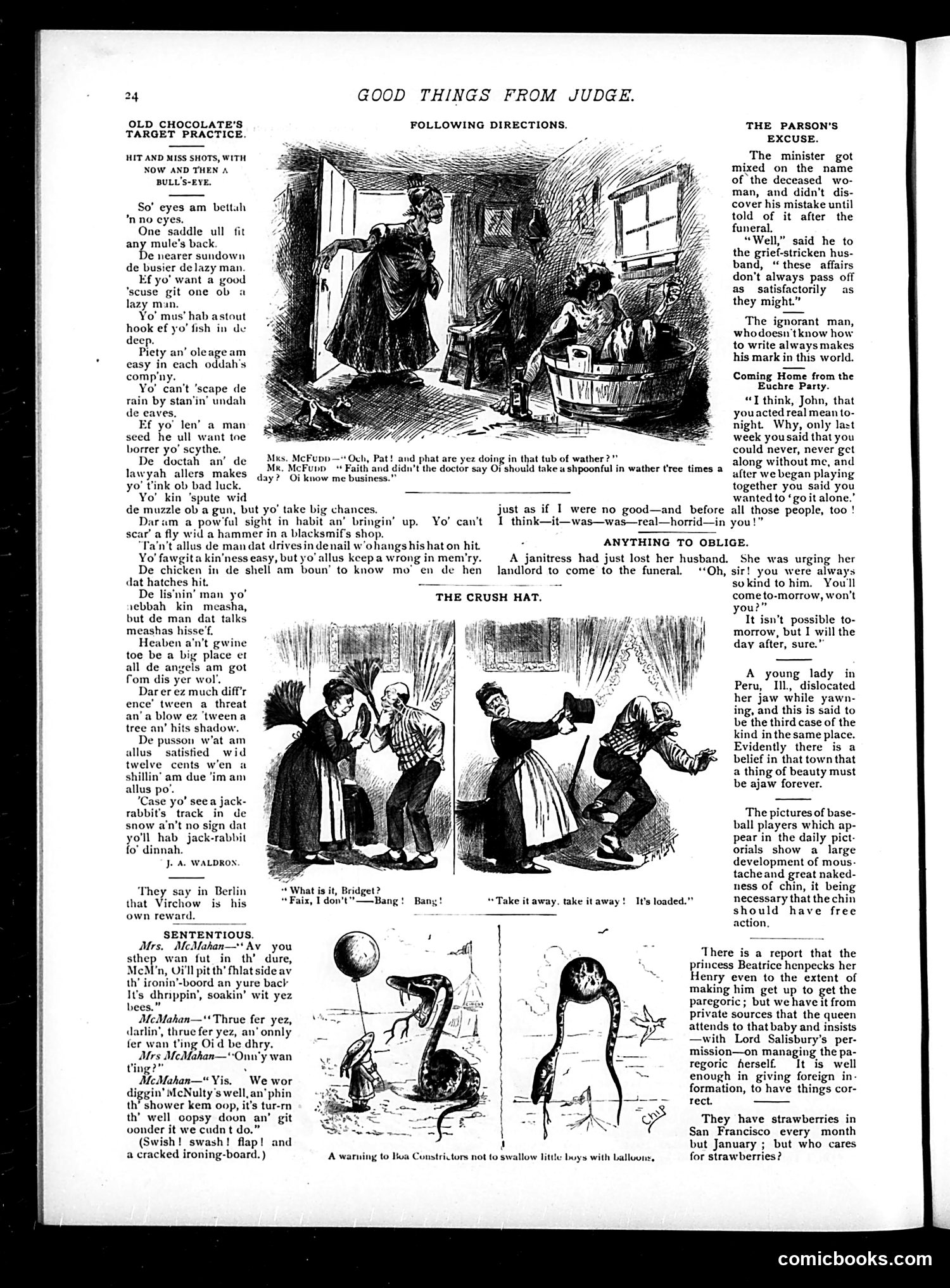
This Judge magazine page contains several satirical pieces typical of the era: **"Old Chocolate's Target Practice"** presents stereotypical African American dialect aphorisms attributed to "J. A. Waldron"—folk wisdom rendered in caricatured speech. This reflects period racial stereotyping common in American humor publications. **"The Crush Hat"** depicts children playing with a hat that gets progressively crushed, with the final panel warning "boa constrictors" not to swallow boys with balloons—darkly comedic visual humor about children's mishaps. **Other sketches** include domestic Irish-American humor (the McMahan couple), and brief anecdotes mocking obliviousness (a parson mixing up a dead woman's name at her funeral; a woman dislocating her jaw yawning). The page reflects Judge's editorial approach: ethnic/racial caricature, slapstick humor, and gentle mockery of middle-class social situations. Modern readers should recognize these pieces as products of 19th-century attitudes toward race and ethnicity that differ significantly from contemporary sensibilities.
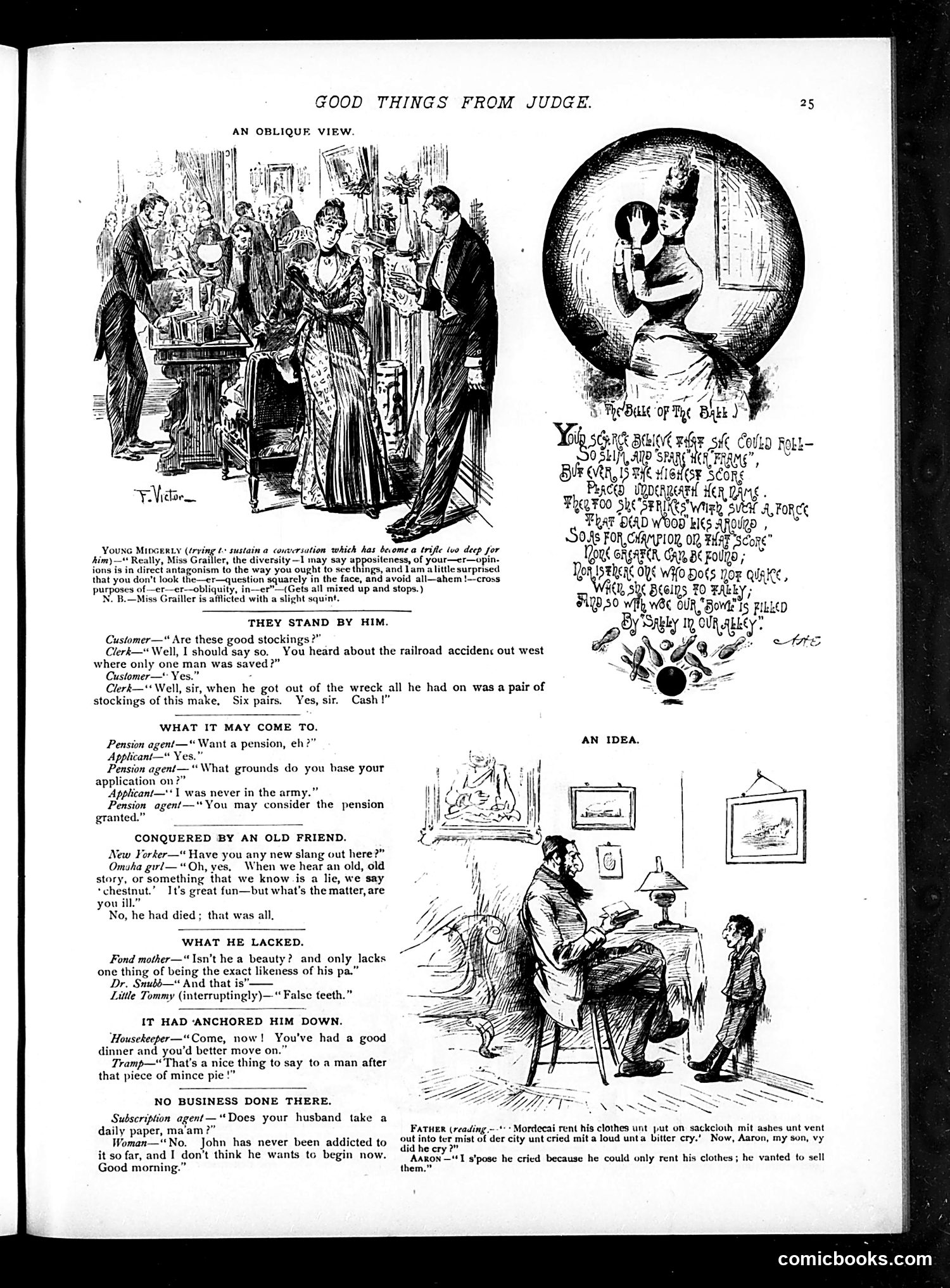
This page from *Judge* magazine contains several short humorous dialogues satirizing American society. Key items: **"An Oblique View"**: Mocks a pretentious speaker struggling to articulate an opinion to a woman with a squint, the humor deriving from his awkward avoidance of directly addressing her physical condition. **"They Stand By Him"**: Dark humor about a railroad accident survivor who salvaged only stockings—the clerk's insistence on cash payment suggests exploitation of tragedy. **"What It May Come To"**: Satirizes pension fraud, where someone receives a military pension despite never serving. **"Conquered by an Old Friend"**: Uses "chestnut" (slang for an old joke) to set up a melancholy punchline about mortality. **"Father" (bottom)**: Jewish immigrant humor playing on broken English and Yiddish-accented speech, with a son's joke about renting versus selling clothes—likely mocking stereotypes about Jewish merchants. These represent typical *Judge* fare: light social satire, disability mockery, and ethnic humor reflecting late 19th/early 20th-century American attitudes.
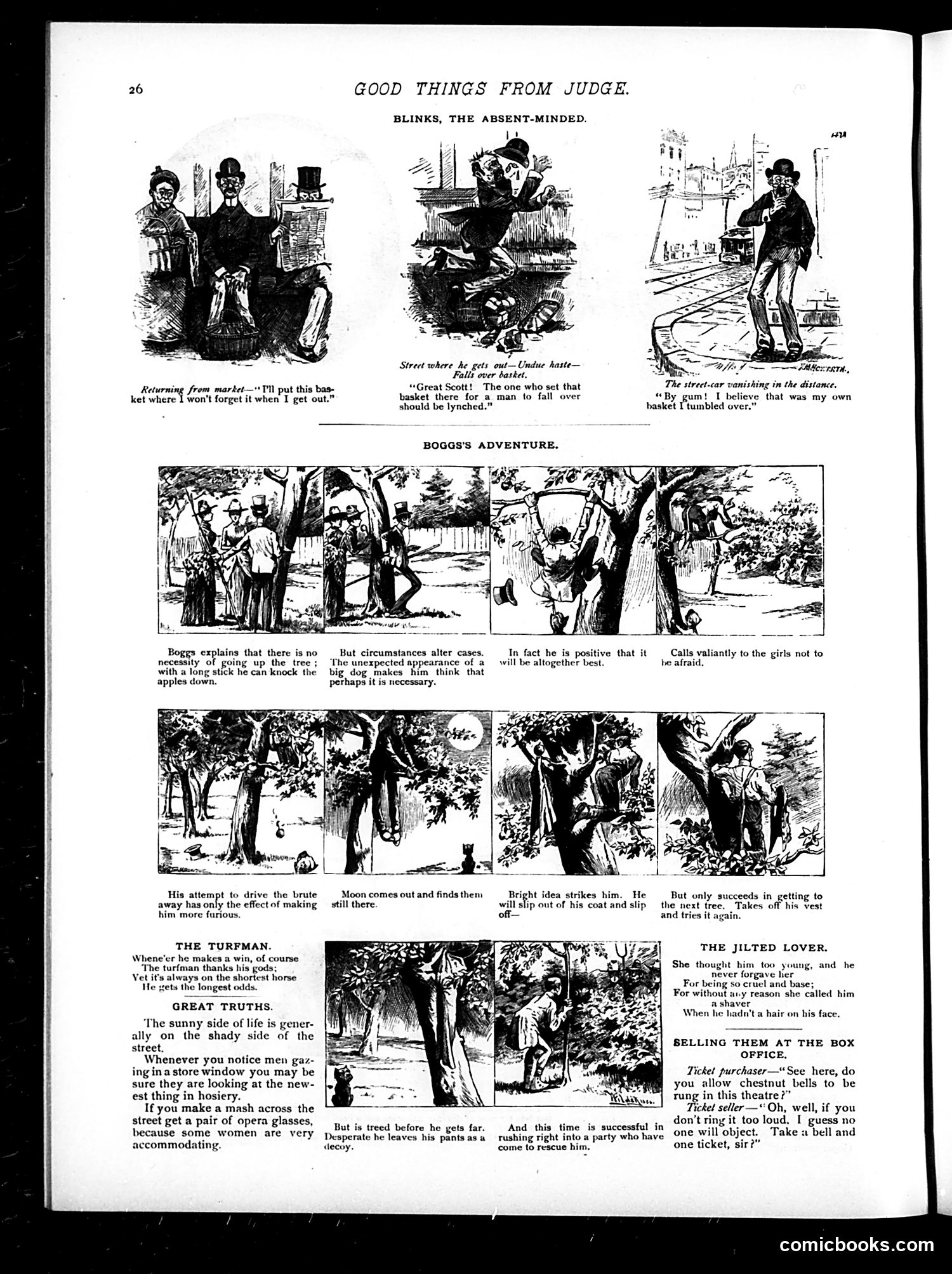
This page contains several humorous short comics typical of Judge's satirical style: **"Blinks, the Absent-Minded"** mocks forgetfulness through slapstick: a man carefully places a basket to remember it, then immediately forgets and trips over it, ironically blaming whoever left it there. **"Boggs's Adventure"** is a visual gag sequence where a man avoids climbing a tree to retrieve apples, but when a dog appears, he's forced up the tree anyway—then loses his clothing escaping. **"The Turfman," "Great Truths," "The Jilted Lover,"** and **"Selling Them at the Box Office"** are brief observational jokes about gambling losses, everyday ironies, romantic pettiness, and theater etiquette—common social commentary for the era. These aren't political cartoons but rather general-interest humor reflecting turn-of-the-century American life: absent-mindedness, class anxieties (hosiery window-shopping), courtship rituals, and urban entertainments. The humor relies on physical comedy and gentle social satire rather than partisan messaging.
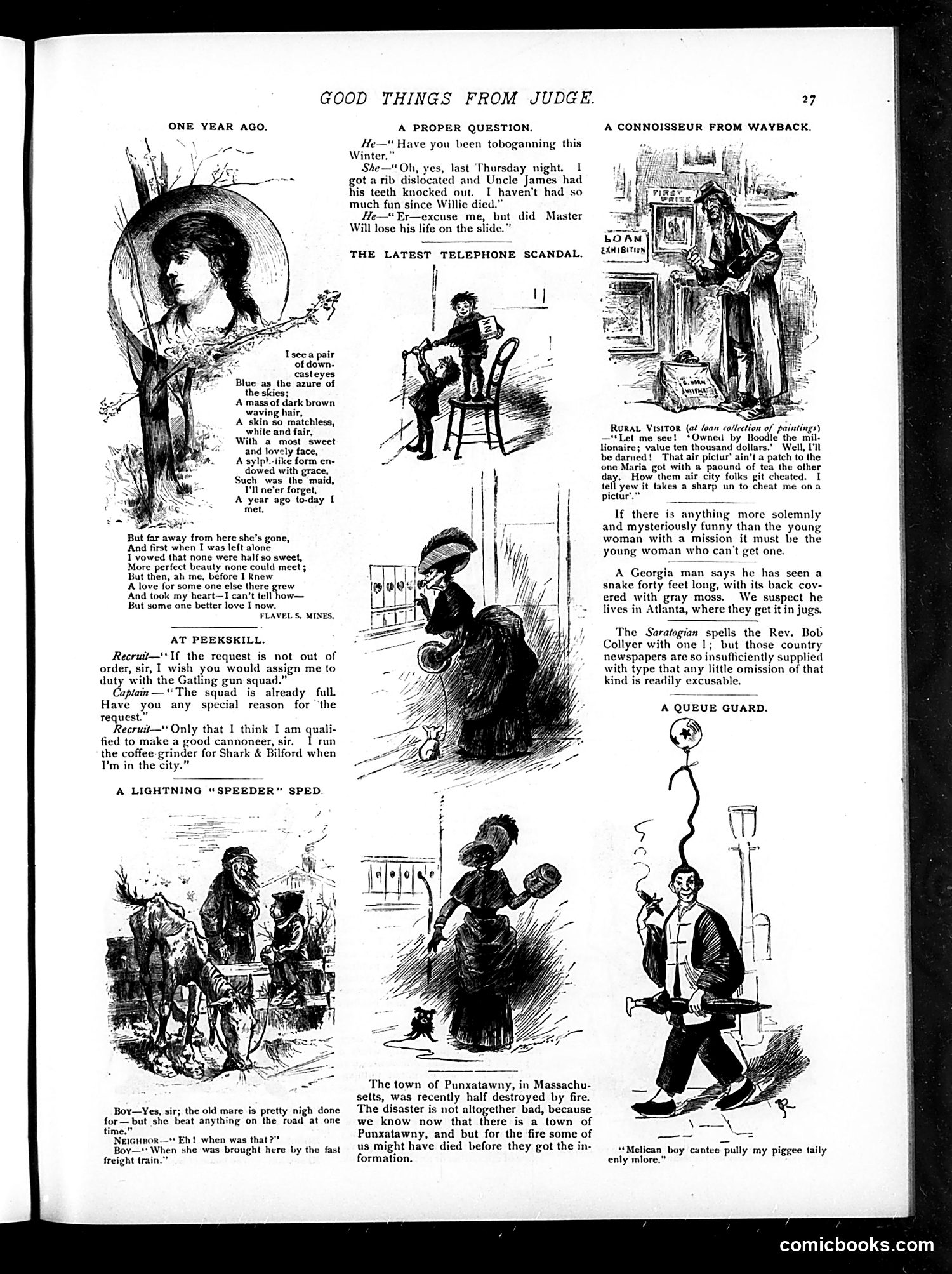
This page from the satirical magazine *Judge* contains several distinct humorous pieces: **"One Year Ago"** is a sentimental poem about lost love—likely satirizing overly romantic nostalgia popular in the era. **"At Peekskill"** jokes about a military recruit comparing his coffee-grinding experience to operating a Gatling gun, mocking the absurd logic of untrained soldiers. **"A Lightning Speeder Sped"** presents a boy claiming an old mare was fast—only revealing it arrived via freight train, a joke about exaggeration and rural gullibility. **"A Proper Question"** satirizes a woman's dangerous toboggan accident where she dislocates ribs and injures others, yet calls it "fun"—mocking either female recklessness or obliviousness. **"A Connoisseur from Wayback"** features a rural visitor dismissing expensive city paintings as inferior to his wife's tea-premium artwork, satirizing rural provincialism and lack of aesthetic sophistication. Minor jokes mock small-town fires and spelling errors in country newspapers. The final cartoon depicts an Asian figure—likely offensive period stereotype humor—with broken English.
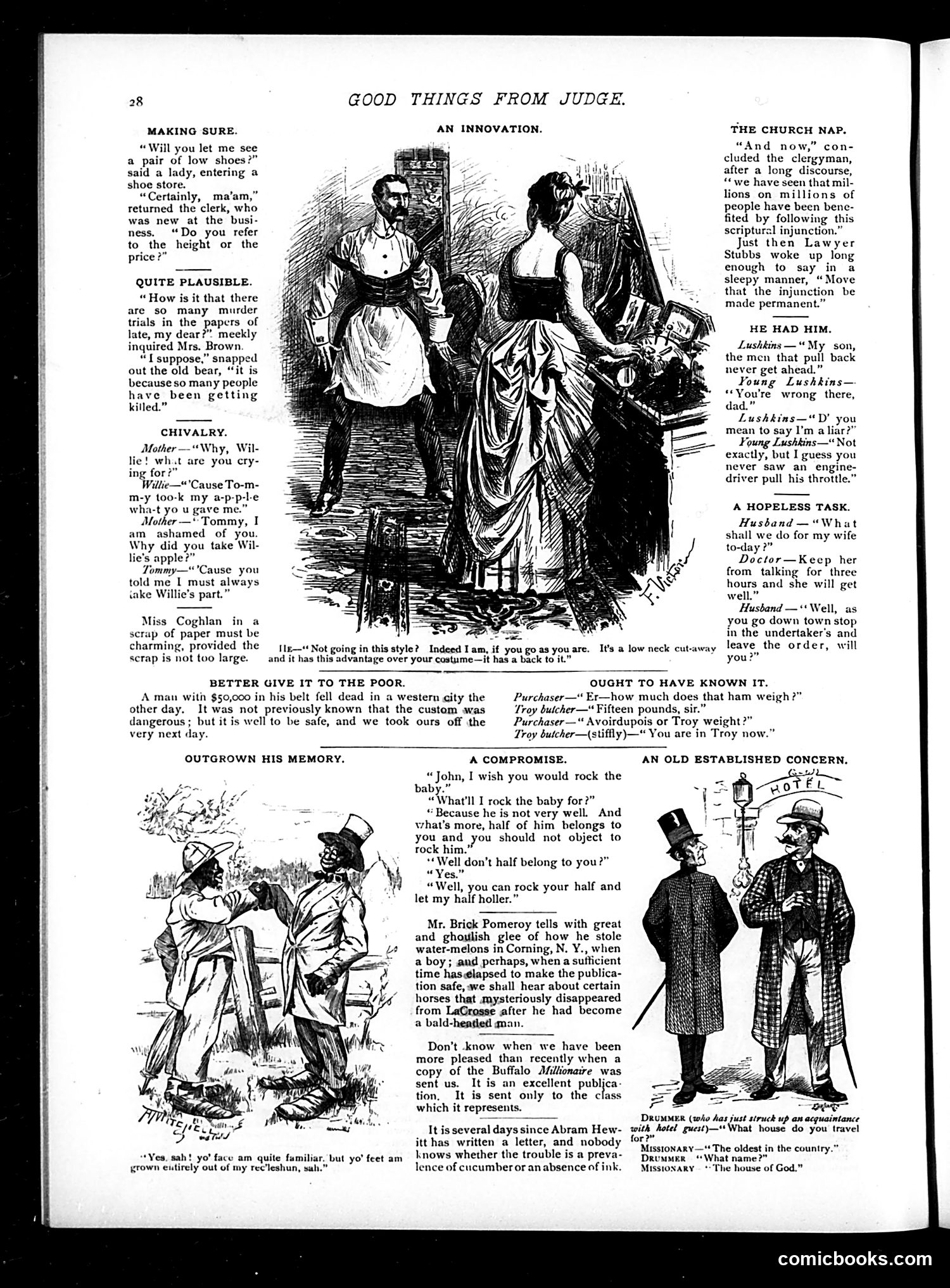
This page collects brief comic anecdotes and illustrations satirizing everyday American life. Notable pieces include: **"Making Sure"**: A joke about a shoe clerk's confused priorities—asking if a customer wants "height or price" for low shoes, mocking retail inexperience. **"Chivalry"**: A boy cries after his friend Tommy steals his apple. When scolded, Tommy defends himself by citing his mother's instruction to "always take Willie's part"—absurdist humor about blind obedience to rules. **"The Church Nap"**: Lawyer Stubbs, asleep during a lengthy sermon, accidentally wakes to request the preacher's injunction be made "permanent"—satirizing inattentive churchgoers and verbose ministers. **"A Compromise"**: Spouses debate who should rock their sick baby, eventually settling that each rocks their "half." Dark humor about marital discord and parental avoidance. **"An Old Established Concern"**: A traveling salesman asks a missionary what company he represents; the missionary answers "The house of God"—gentle religious satire. The cartoons mock pretension, hypocrisy, and absurdity in respectable society.
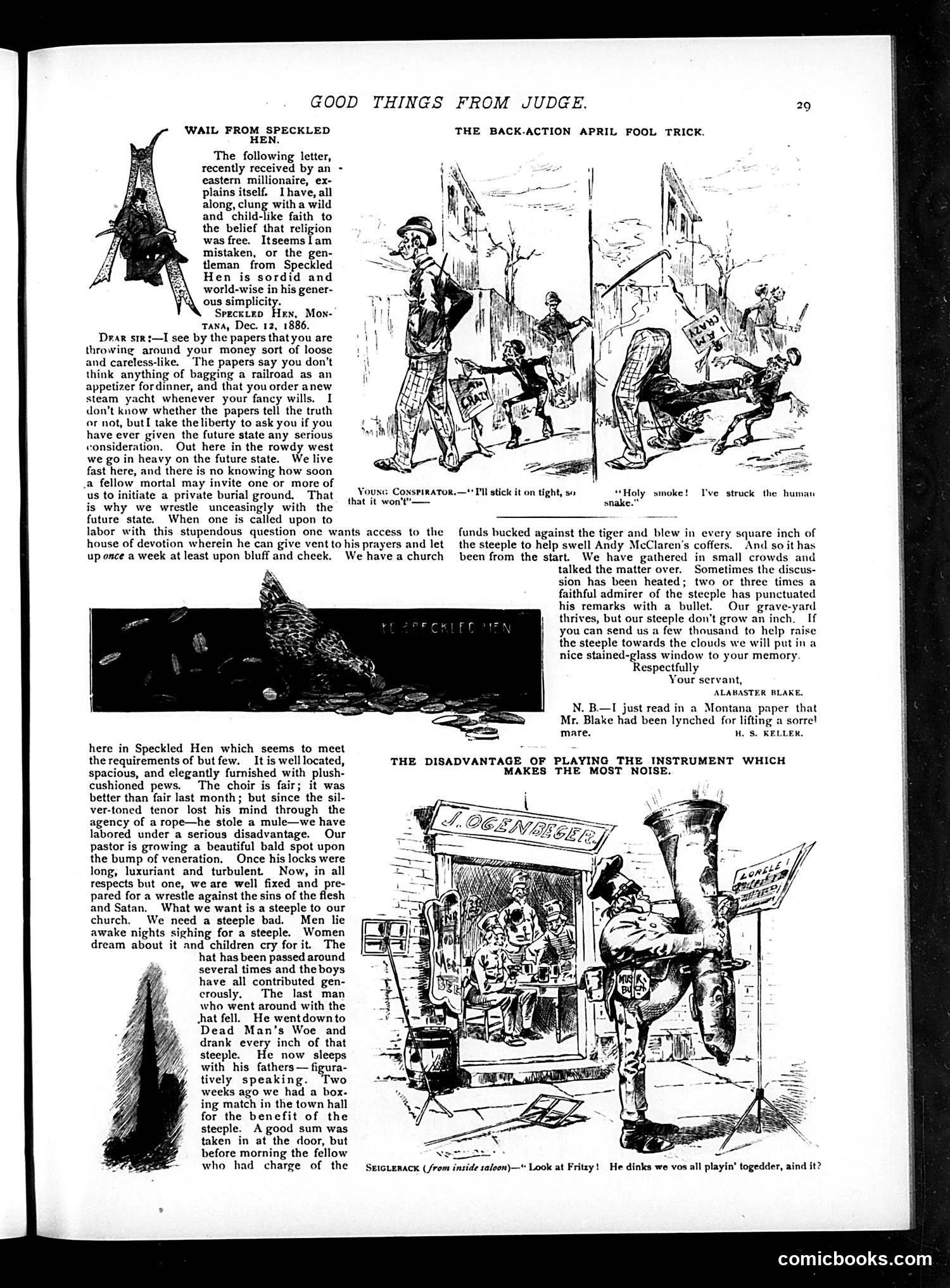
This *Judge* magazine page (dated 1886) contains two satirical pieces: **"Wail from Speckled Hen"** mocks frontier Christianity and hypocrisy. A Montana church desperately needs money for a steeple. The letter from "Alabaster Blake" humorously appeals to a wealthy easterner, revealing that donations vanish (the collection-taker drank the money; funds were stolen) and that frontier "justice" is brutal—Blake himself was lynched for horse theft. The satire targets both the crude western frontier and wealthy eastern philanthropists. **"The Back-Action April Fool Trick"** and **"The Disadvantage of Playing the Instrument Which Makes the Most Noise"** are shorter sight gags: one depicts children tricking someone; the other shows a loud musical street performer annoying neighbors. These are gentle humor rather than political satire. The page satirizes 1880s themes: religious hypocrisy, frontier lawlessness, wealth inequality, and social pretension—all filtered through *Judge*'s upper-class perspective.
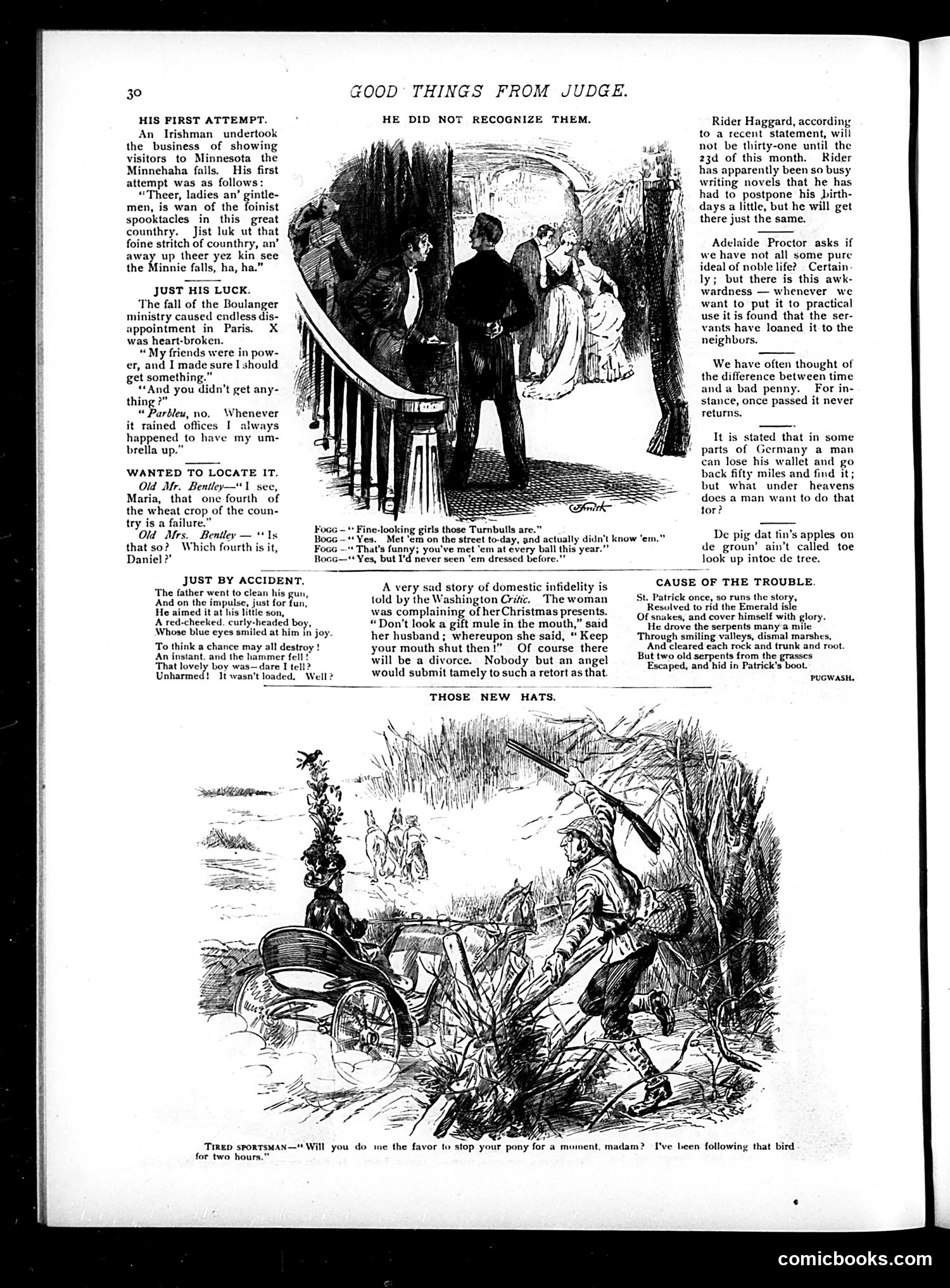
This page collects brief humorous anecdotes and satirical observations typical of Judge magazine's format: **The Irish guide story** mocks stereotypical Irish immigrant speech and incompetence—the guide fails to properly direct visitors to Minnehaha Falls. **"Just His Luck"** references the fall of the Boulanger ministry in France (1880s), satirizing French political corruption where office-seekers expected patronage jobs. **The Turnbull girls cartoon** jokes about women's appearance changing dramatically when dressed formally versus casually—implying they look plain in everyday clothes. **The loaded-gun story** presents darkly ironic "luck"—a father accidentally points an unloaded gun at his son; the punchline's humor relies on the relief that it wasn't loaded. **St. Patrick's snakes** offers Irish folklore humor about two serpents escaping St. Patrick's boot. **The sportsman and pony** ends with a practical joke—the frustrated hunter has been chasing a bird for hours. The page reflects late Victorian/Edwardian satirical humor: ethnic stereotyping, domestic relations jokes, and observational comedy about manners and appearance.
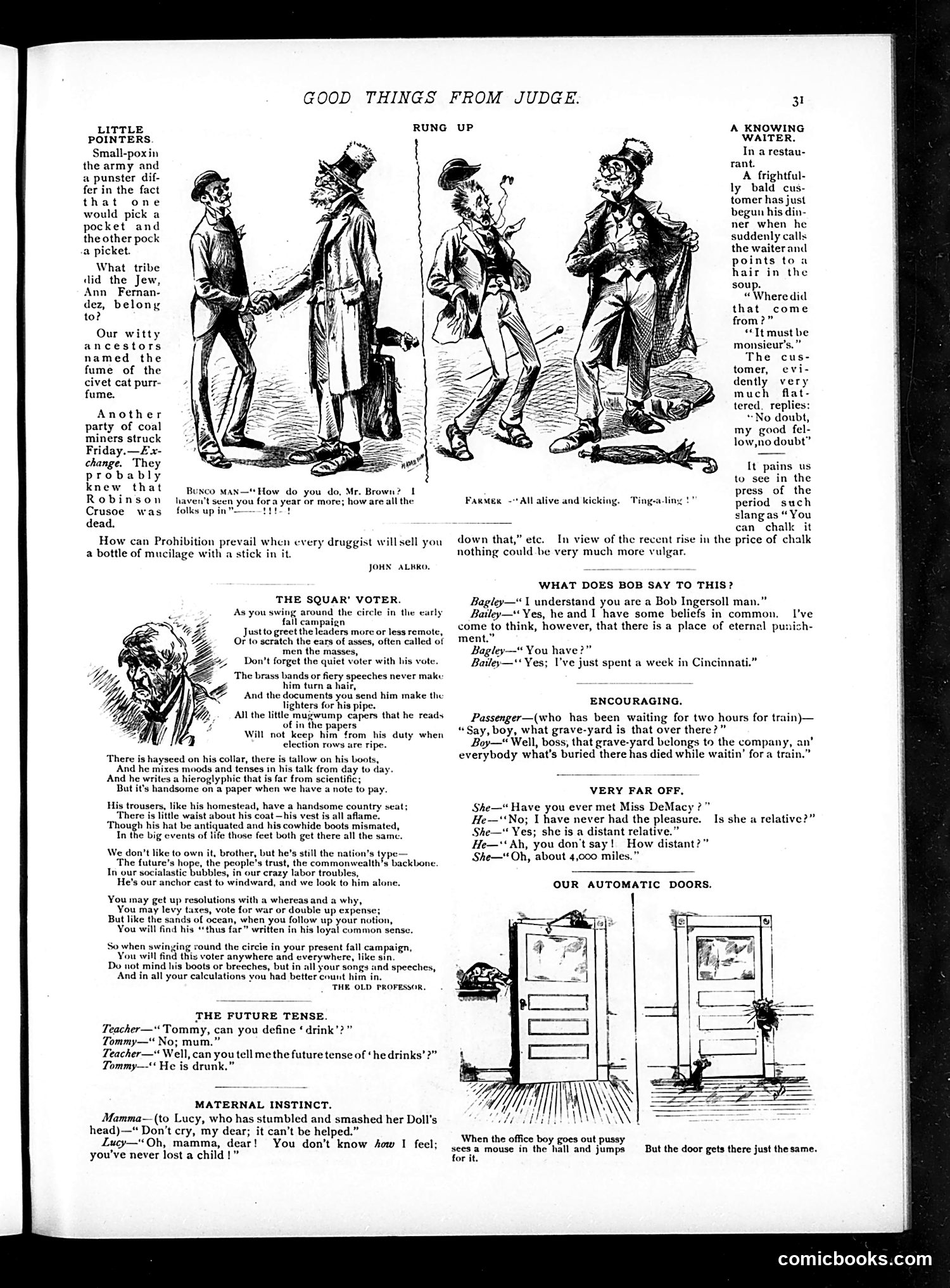
This page from Judge magazine contains several short satirical pieces and cartoons mocking American social types and politics: **"The Squar' Voter"** celebrates the rural, working-class voter as the nation's backbone—a common late 19th-century trope. Despite his rough appearance and grammar, he's portrayed as reliable and sensible, contrasting with educated urbanites and their complicated schemes. **"Rung Up"** shows a humorous exchange between a Bunco Man (con artist) and a Farmer, satirizing rural vs. urban deception. **"A Knowing Waiter"** jokes about a restaurant waiter's smooth response when a bald customer finds a hair in his soup, attributing it to the customer himself—mocking the waiter's clever evasion. **"What Does Bob Say to This?"** references Bob Ingersoll (likely the famous agnostic orator Robert Ingersoll), satirizing someone claiming to share his beliefs yet believing in hell after visiting Cincinnati—suggesting Cincinnati is hellish. The page reflects Judge's consistent themes: rural American practicality, urban pretension, and political/social hypocrisy. The humor assumes readers familiar with contemporary public figures and American class stereotypes.
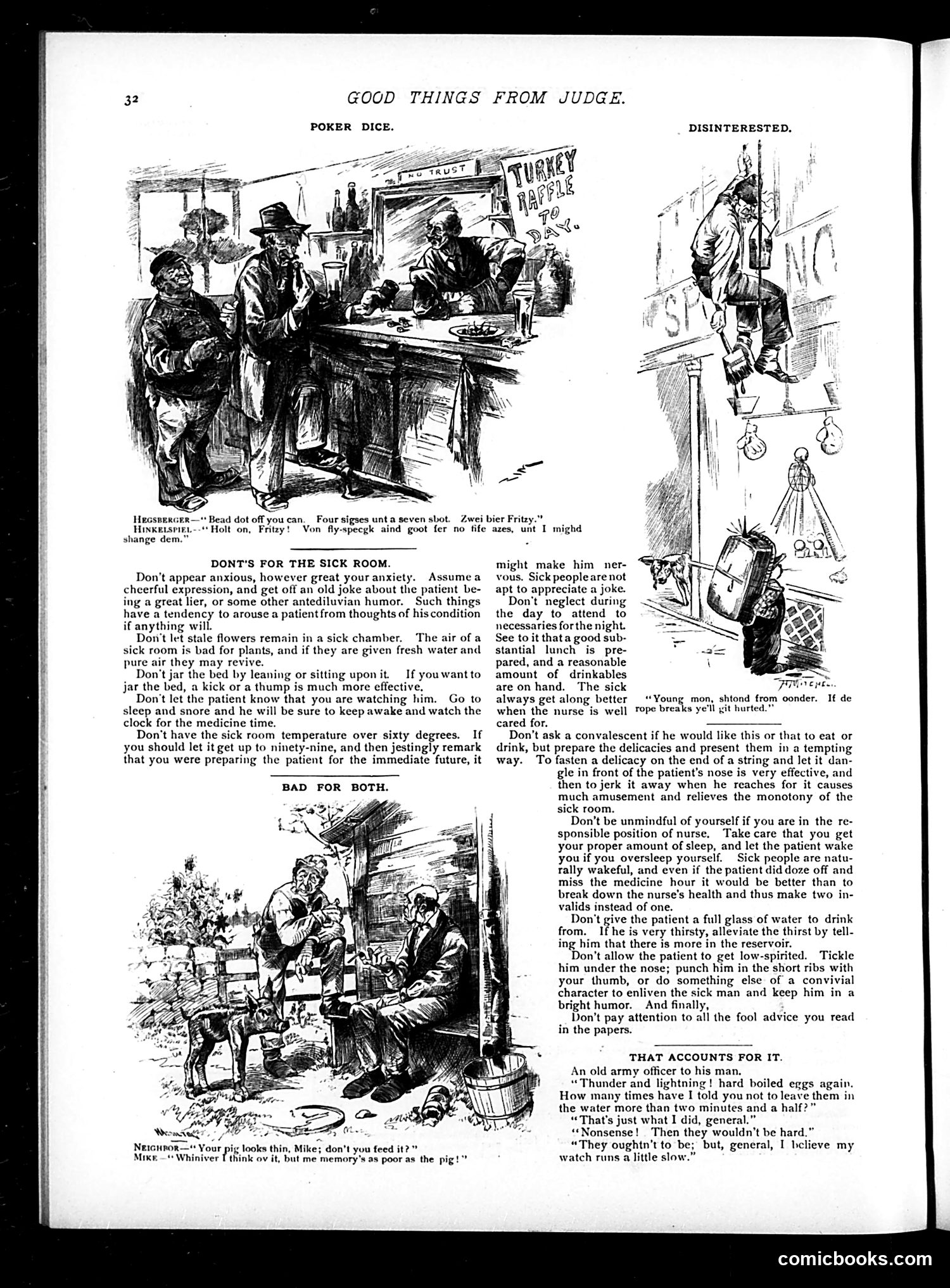
This page contains three distinct satirical pieces from *Judge* magazine: **"Poker Dice"** (top left): A bar scene showing men playing a gambling game with dice. The German-accented dialogue suggests immigrant or working-class characters engaging in casual gambling, likely satirizing either the prevalence of such activities or ethnic stereotypes of the era. **"Don'ts for the Sick Room"** (center): Humorous advice that intentionally reverses proper nursing care—suggesting visitors should disturb patients, keep rooms cold, and play pranks rather than provide comfort. The satire mocks bad hospital visitors and incompetent nurses through absurdist exaggeration. **"Bad for Both"** and **"That Accounts for It"** (bottom): Short joke-cartoons with dialect humor. One involves a poorly-fed pig; the other depicts a servant's excuse about his watch running slow to explain overcooked eggs. Both use working-class characters and accent-based humor typical of period comedy. The overall page represents *Judge's* formula: visual gags, ethnic humor, and satire targeting social incompetence and lower-class characters.
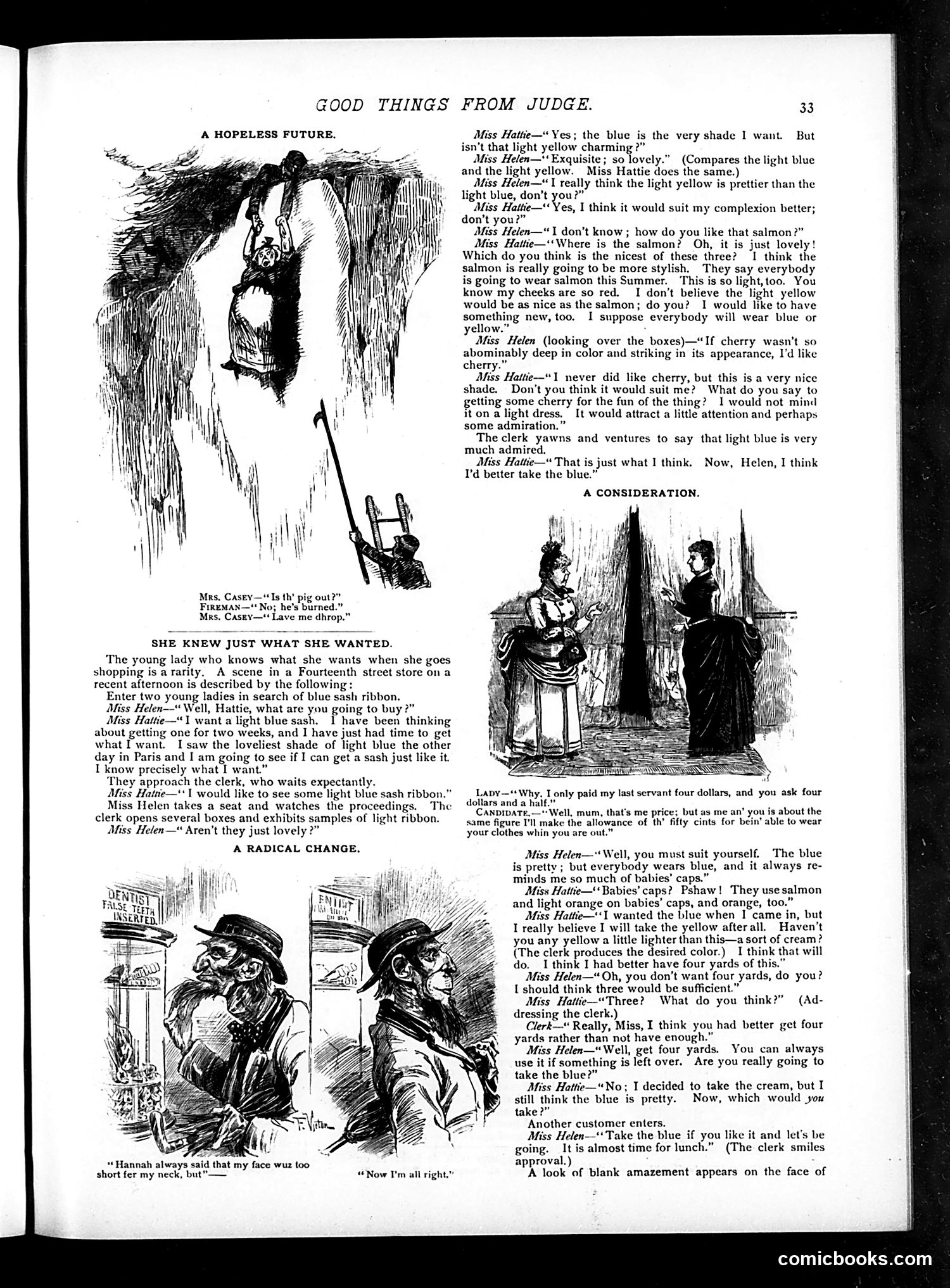
This satirical piece mocks indecisive female shoppers. Two young women enter a store seeking light blue ribbon. Miss Hattie *claims* to know exactly what she wants, having seen it in Paris. However, the clerk sequentially shows samples, and Hattie constantly changes her mind—praising the yellow over blue, then the salmon, then cherry, finally settling on cream-colored yellow instead of her original choice. The humor targets the stereotype of women as frivolous, easily swayed consumers who lack conviction despite confident declarations. The exasperated clerk's yawning response and Miss Helen's bemused observation underscores the satire: Hattie's lengthy deliberation contradicts her stated certainty. The accompanying cartoon "A Radical Change" shows a man's transformation after apparent cosmetic correction, with the caption about his face being "too short for his neck." This appears to mock vanity and physical self-consciousness.
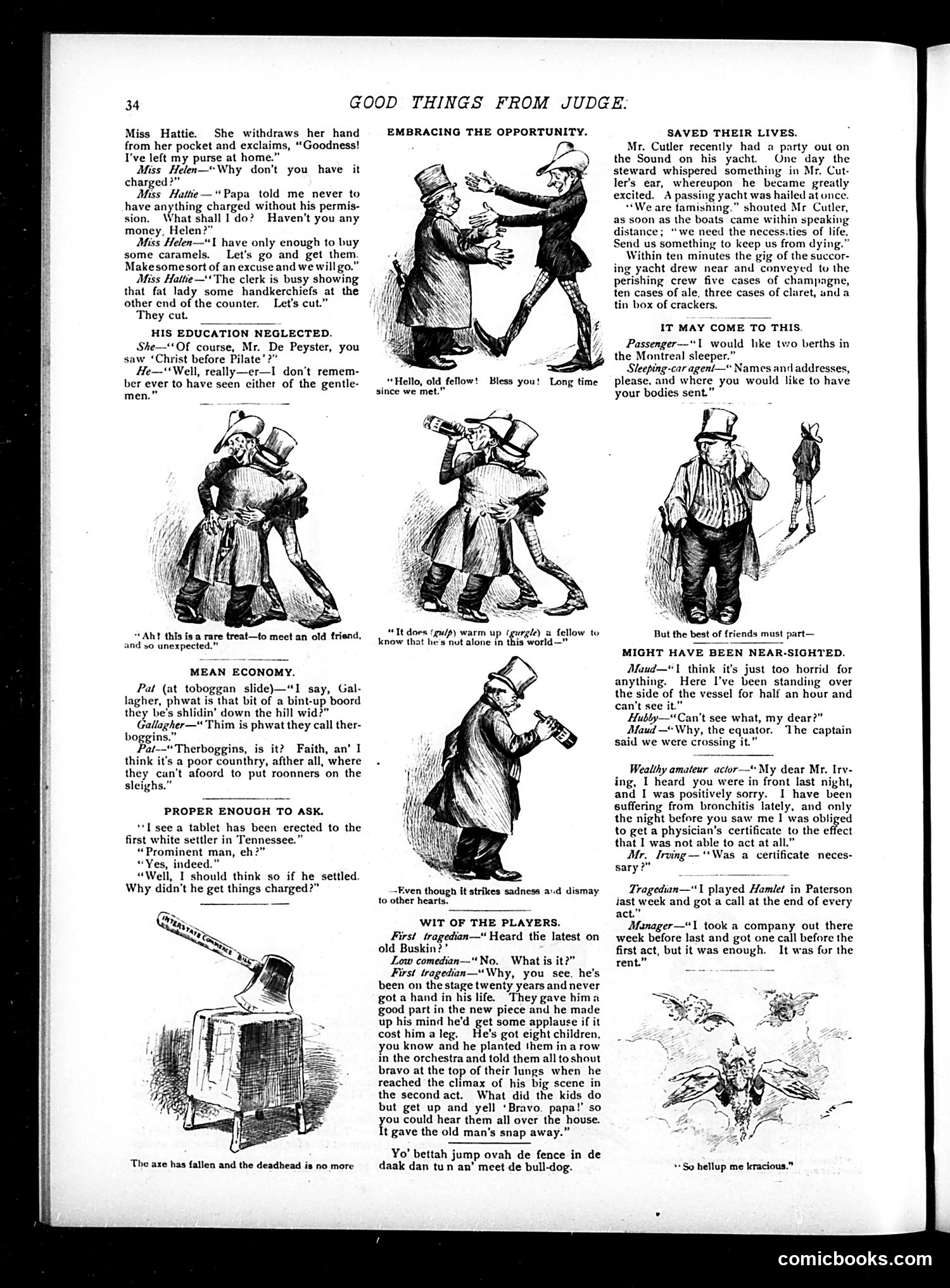
This page from *Judge* magazine contains several brief humorous sketches satirizing social conventions and human foibles of the period. **Key sketches:** "His Education Neglected" mocks a gentleman's ignorance of famous art—he hasn't heard of the biblical painting "Christ before Pilate," claiming not to remember "either of the gentlemen." "Mean Economy" features Irish laborers debating poverty: they're puzzled why their country can't afford metal runners on sleds, only wooden boards ("therboggins"). "Wit of the Players" jokes about a desperate stage actor who planted his eight children in the orchestra to shout "Bravo!" during his performance—they accidentally exposed the trick. "Saved Their Lives" satirizes wealthy excess: a yacht party feigns starvation and receives champagne, ale, and claret as emergency supplies—absurdly luxurious "necessities." Other sketches mock young women shoplifting excuses, a passenger's geographical ignorance (confusing the equator with a visible horizon), and charging purchases without parental permission. The humor targets class pretensions, immigrant stereotypes, and Victorian social anxieties.
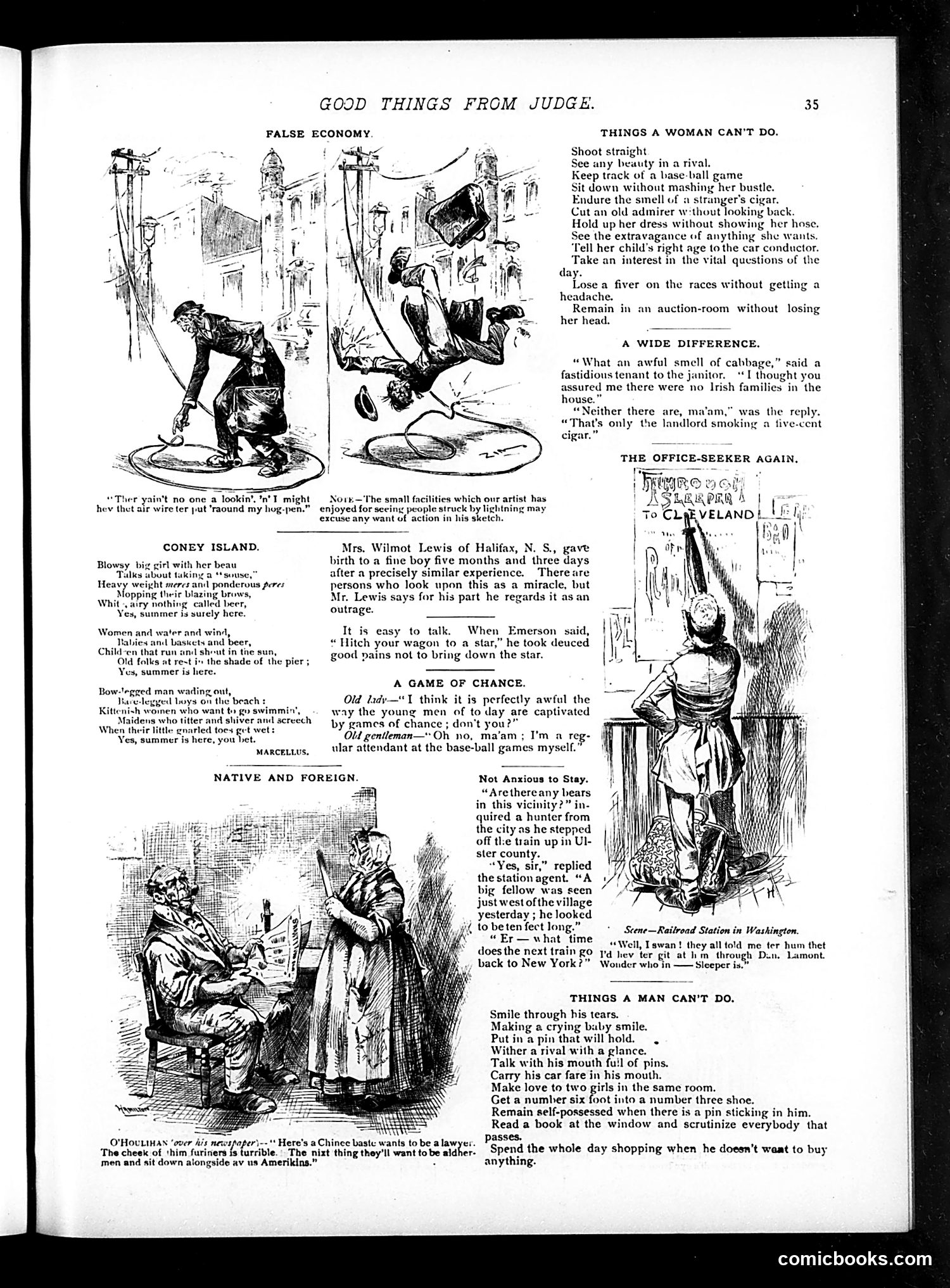
This page from *Judge* contains several satirical pieces mocking gender stereotypes and social pretenses of the era: **"Things a Woman Can't Do"** and **"Things a Man Can't Do"** present exaggerated lists of supposed gender limitations—women are portrayed as emotionally unstable, obsessed with appearances, and irrational; men as physically clumsy and unable to control themselves. The satire works through obvious absurdity. **"A Wide Difference"** mocks Irish immigrants through ethnic stereotyping—a tenant complains about cabbage smell, the janitor blames the landlord's cheap cigar, implying Irish tenants were common and associated with poverty. **"Native and Foreign"** shows an Irish immigrant attempting to navigate American bureaucracy, playing on dialect comedy. **"False Economy"** and other sketches satirize social pretense and economic foolishness through visual gags. The overall tone reflects *Judge's* satirical approach: mocking both gender conventions and contemporary social anxieties about immigration and class status through crude but pointed humor typical of late-19th-century American magazines.
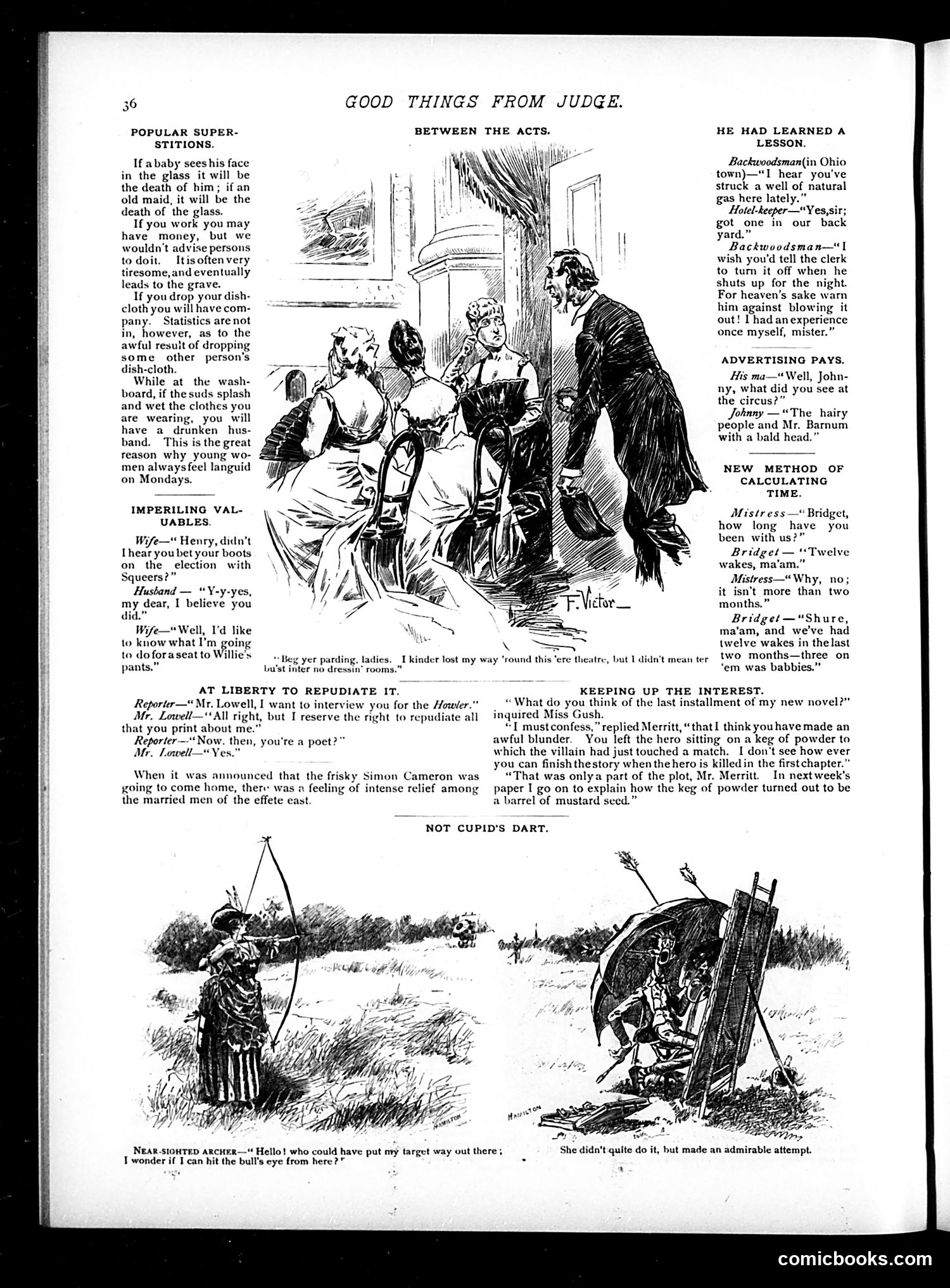
This page collects humorous short pieces satirizing Victorian-era superstitions, social conventions, and domestic life. **Key content includes:** - **"Popular Superstitions"**: Mocks folk beliefs (babies seeing reflections cause death; work leads to poverty; wet suds mean drunk husbands). The humor lies in exaggerating ridiculous logic. - **"Imperiling Valuables"**: A wife scolds her husband for betting "his boots" on an election—implying he gambled away his pants, leaving nothing for their son. Satirizes men's reckless gambling. - **"At Liberty to Repudiate It"**: A poet (likely James Russell Lowell, a real American figure) refuses accountability for interview quotes—mocking public figures' dishonesty. - **"Simon Cameron" reference**: The arrival of this politician brings "relief among married men"—unclear without historical context but suggests domestic discord. - **"Not Cupid's Dart"**: Two archery cartoons with punchlines about poor aim and failed romantic attempts. The overall tone ridicules class pretensions, domestic conflict, and human foolishness through exaggeration and wordplay typical of 1880s-90s satire.
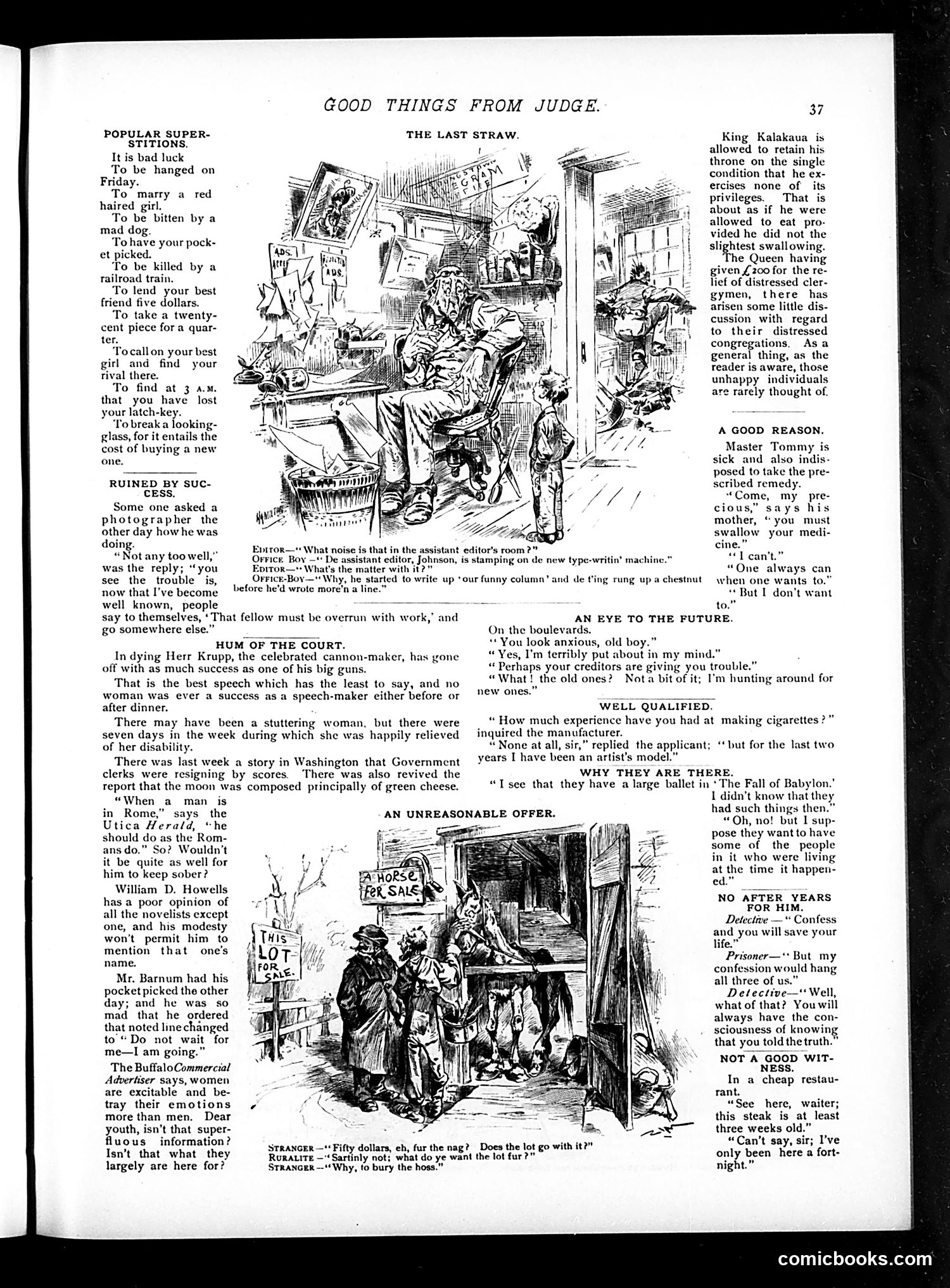
This page from **Judge** (a late-19th-century American satirical magazine) contains several unrelated short humor pieces and two cartoons. **Top cartoon ("The Last Straw"):** Shows an editor at a chaotic newspaper office. The caption jokes that while trying to write their "funny column," a typist kept hitting the same tired joke ("a chestnut"—period slang for a worn-out gag). The satire targets the difficulty of creating fresh humor under workplace pressure. **Bottom cartoon ("An Unreasonable Offer"):** A man attempts to sell a horse and "lot" (land) for fifty dollars. The buyer asks if the land is included; the seller refuses. The joke mocks absurd business logic—like advertising something valuable but excluding its most essential component. The surrounding text includes brief comic anecdotes about social life, politics (King Kalakaua of Hawaii), and workplace situations, plus satirical observations on human nature. The humor relies on wordplay and situational irony typical of 1890s American comedy.
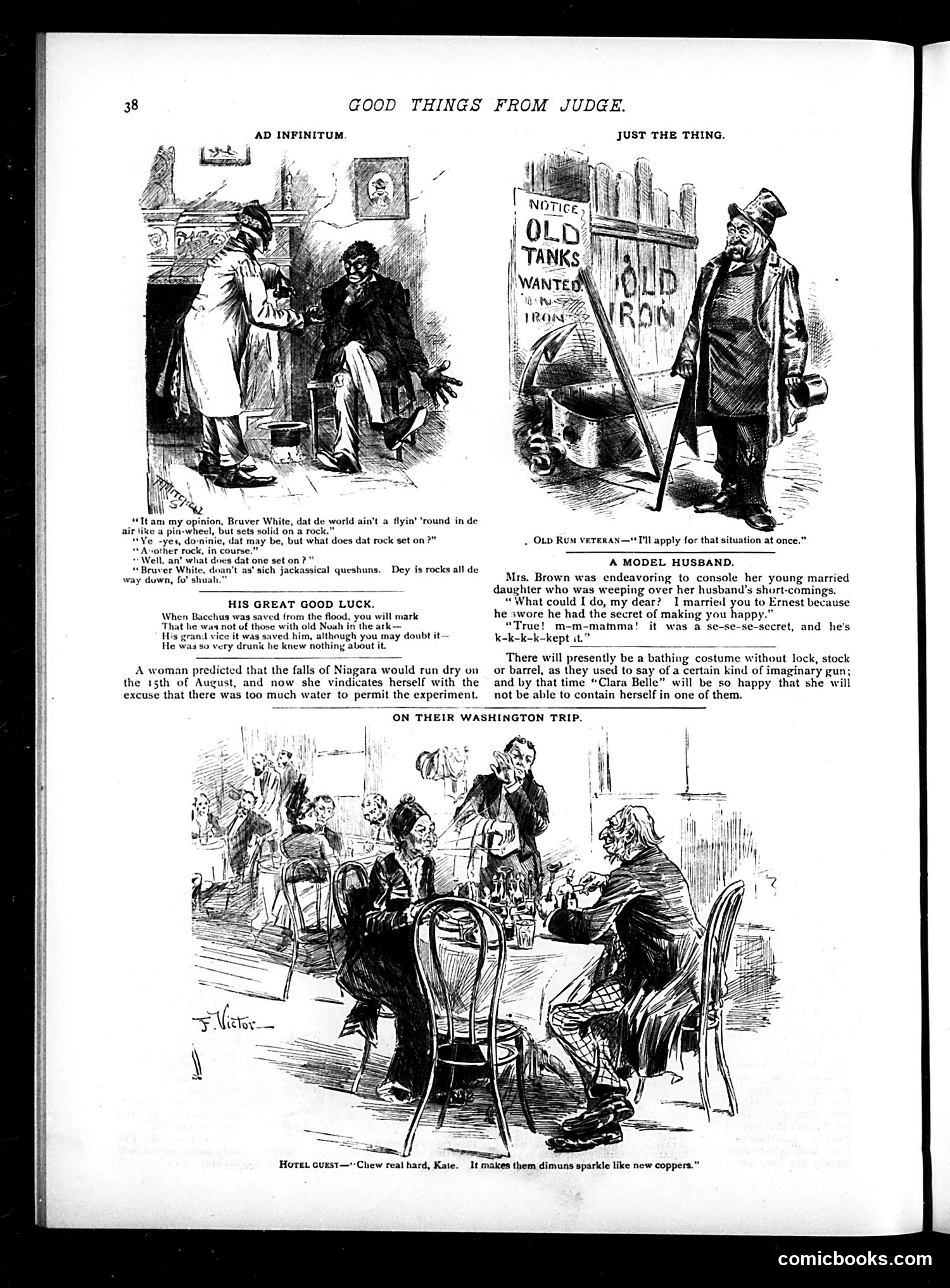
This page contains four separate satirical cartoons and jokes typical of late 19th-century humor: **"Ad Infinitum"**: A Black dialect joke mocking religious/philosophical ignorance—a child asks what supports the rock the Earth sits on, leading to absurd infinite regression. **"His Great Good Luck"**: A classical reference joke: Bacchus (Roman god of wine) survived the biblical flood because he was too drunk to notice, satirizing the protective power of intoxication. **"Just the Thing"**: A working-class man sees a "Wanted: Old Iron" sign and applies, assuming he qualifies—likely a dig at aging laborers or obsolescence. **"A Model Husband"**: A wife jokes that her husband's "secret" to making her happy was literally keeping it secret from her—satirizing failed marriages and male evasiveness. **"On Their Washington Trip"**: Hotel guests discuss polishing copper coins by chewing hard, conflating effort with value—possibly satirizing tourist foolishness or economic naïveté. The humor relies on wordplay, class stereotypes, and situational irony typical of Judge's era.
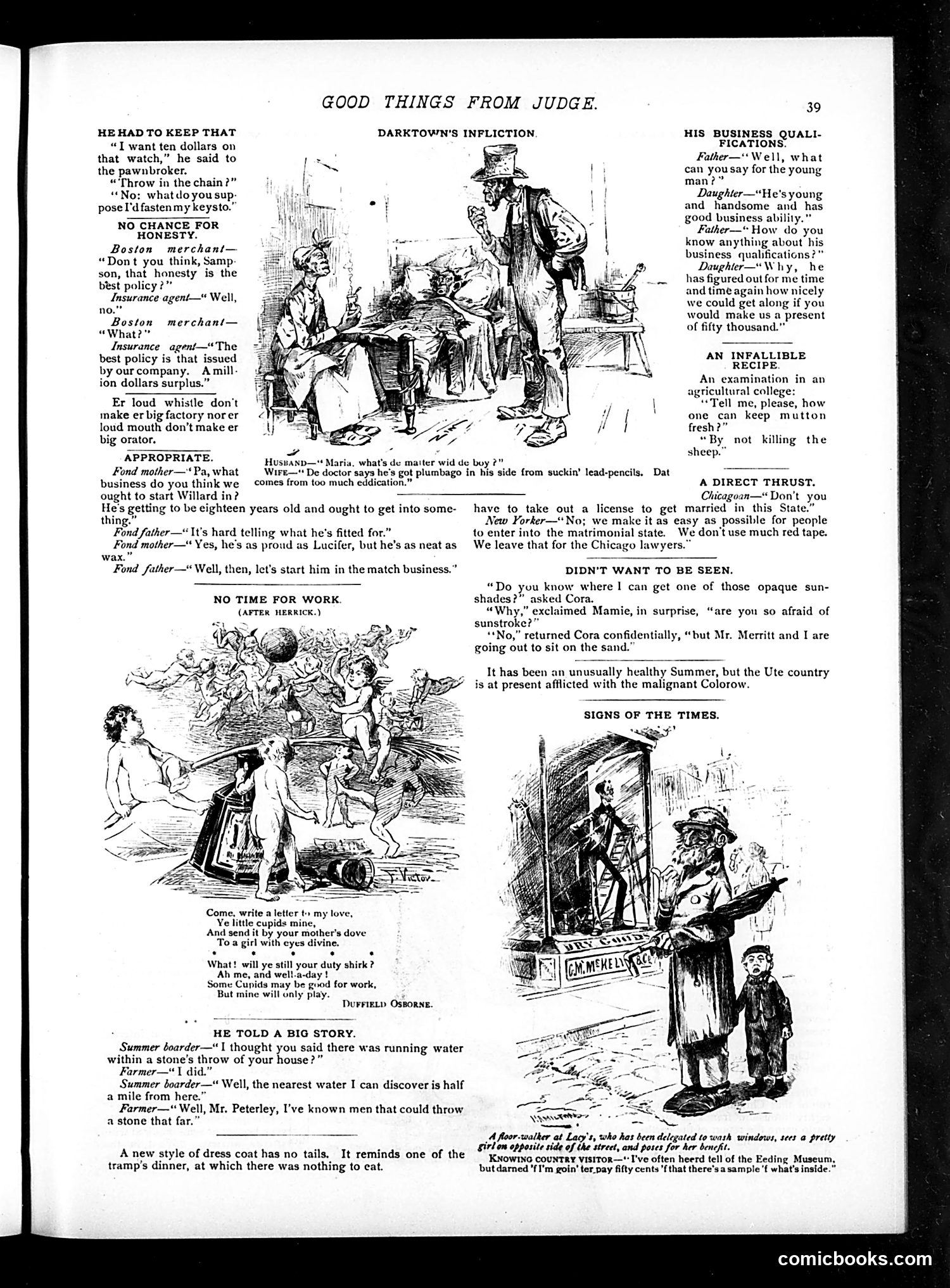
This page contains multiple satirical sketches typical of Judge's humor circa late 19th century: **"Darktown's Infliction"** shows a racist caricature (using period dialect) where a man pawns a watch but won't include the chain—claiming he needs it for his keyhole. The "joke" relies on degrading stereotypes. **Business satire** mocks insurance agents and matchmaking: an agent cynically admits honesty isn't the best policy (his company's policy is); a father suggests his lazy, proud son enter the "match business" (ironic, given his unfitness). **"He Told a Big Story"** features a farmer misleading a summer boarder about "running water within a stone's throw," then claiming he knows men who throw stones a mile. **Urban/Rural humor** contrasts naive city visitors with cunning rural folk or incompetent city professionals (the Chicago lawyer jab). The page reflects Gilded Age preoccupations: commercialism, class anxieties, generational concerns, and urban-rural tensions—all delivered through crude ethnic caricatures and exaggeration typical of the era's entertainment.
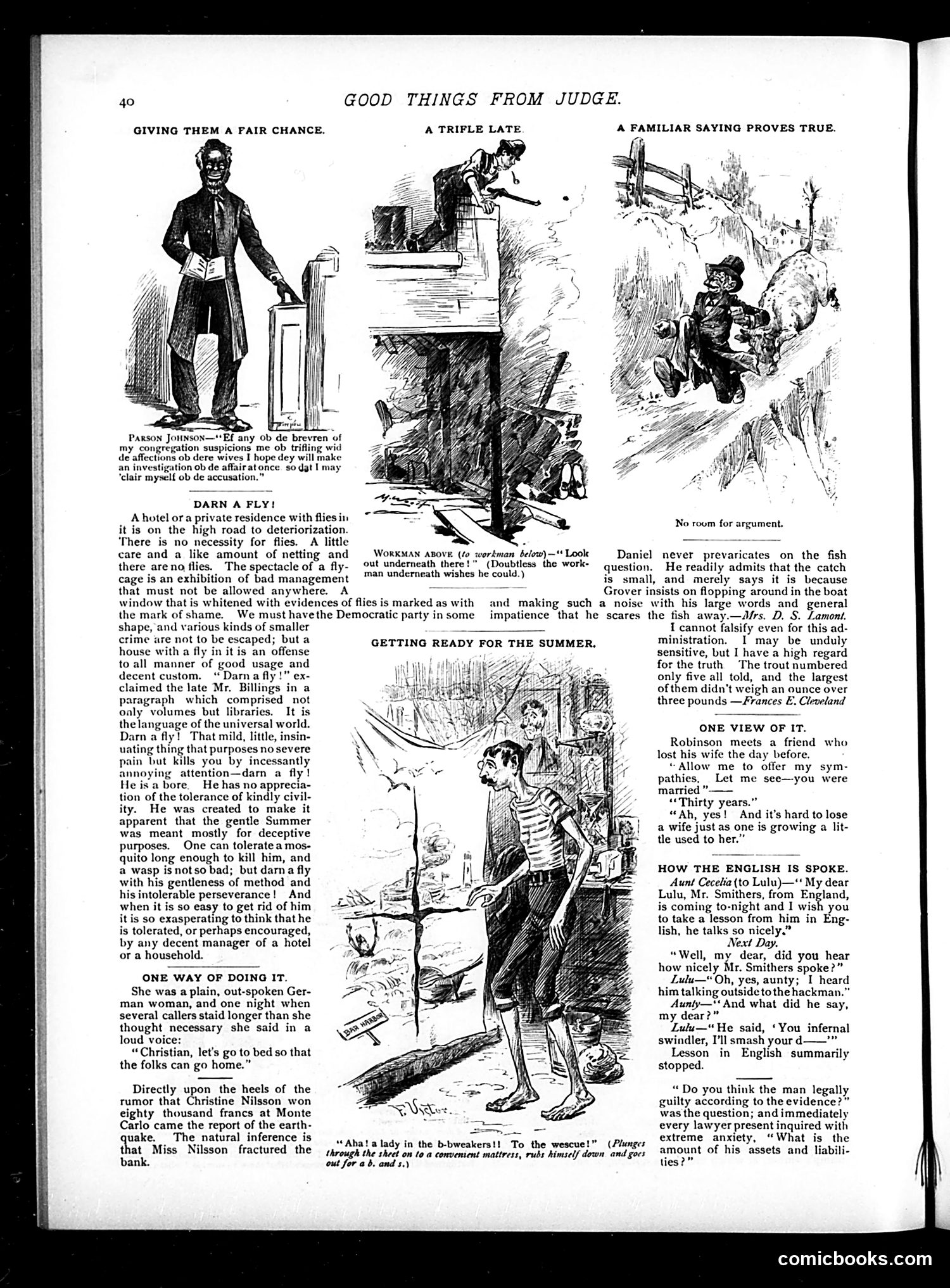
This page collects humorous anecdotes and satirical cartoons typical of Judge magazine's format. **"Giving Them a Fair Chance"** mocks a Black minister (rendered in dialect) who preemptively defends himself against accusations of impropriety with parishioners' wives—the joke being his transparent self-interest. **"A Triple Late"** shows a worker nearly falling, with commentary on workplace safety presented as absurdist humor. **"A Familiar Saying Proves True"** depicts someone running with a pig, illustrating a folk saying (unclear which). **"Darn a Fly!"** is a lengthy essay-complaint about household flies, referencing humorist Josh Billings. It's presented as social commentary on proper household management. **"Getting Ready for the Summer"** shows a man fishing while another looms above—seemingly about summer leisure activities and fishing etiquette. The remaining items include anecdotes mocking Christine Nilsson (opera singer), German immigrants' speech, and English visitors' accents. The humor relies on dialect humor, dated social stereotypes, and domestic observations typical of 1880s-era American satire.
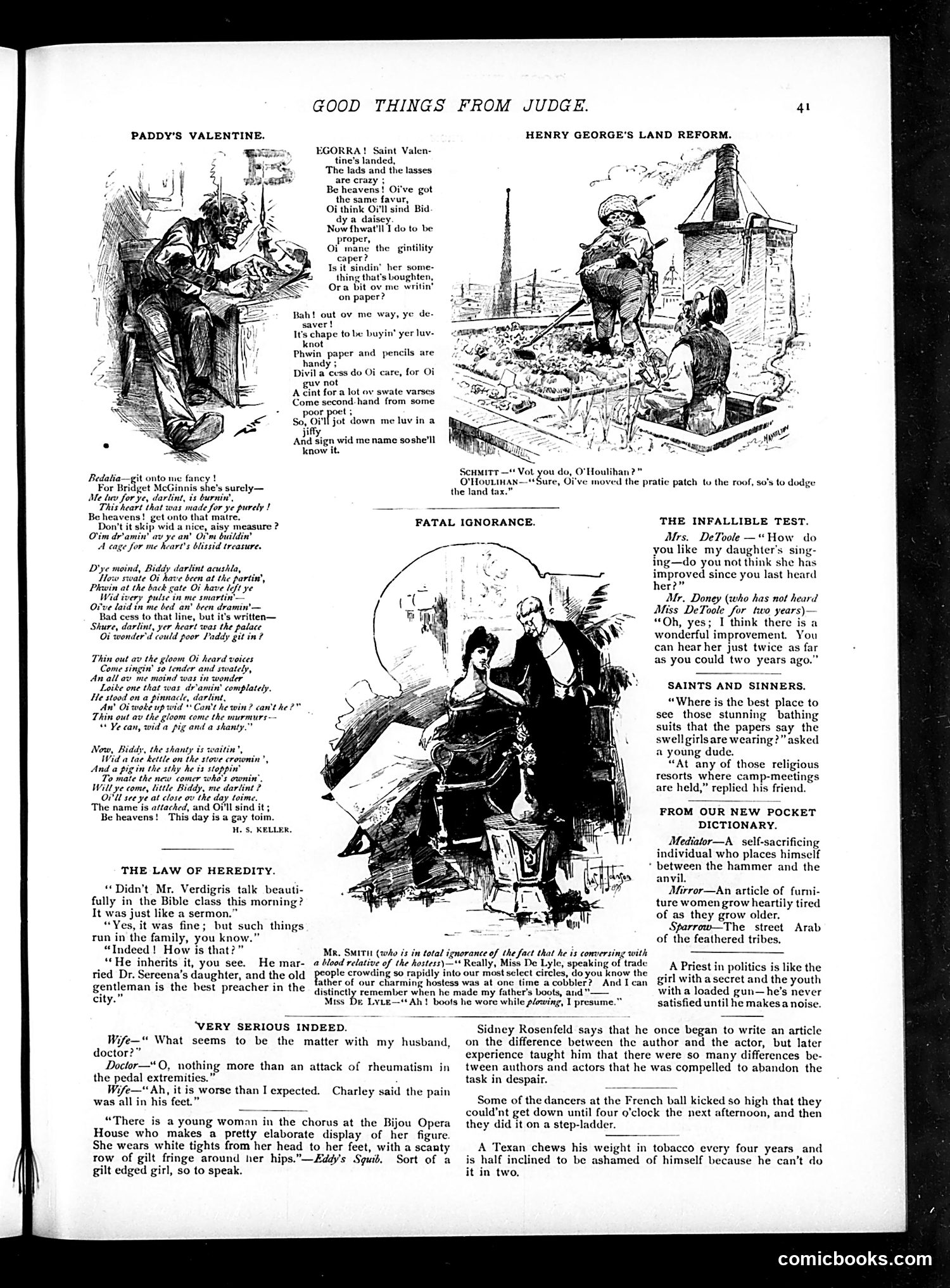
This page from *Judge* magazine contains several short satirical pieces and cartoons: **"Paddy's Valentine"** is a humorous poem in Irish dialect where a working-class Irishman ("Paddy") writes a romantic Valentine to his sweetheart "Biddy," offering marriage and a modest life together ("a pig and a shanty"). The satire gently mocks Irish-American working-class courtship and dialect speech patterns. **"Henry George's Land Reform"** cartoon depicts land reform policy—likely referencing Henry George's single-tax movement—showing tenants or workers being moved off land, satirizing economic restructuring. The remaining pieces are brief joke columns: "Fatal Ignorance" jokes about social etiquette, "The Infallible Test" about flattery, and "Saints and Sinners" makes a joke about religious resorts and fashionable bathing suits. These are typical *Judge* content: light social satire mixing ethnic humor, class commentary, and genteel domestic comedy aimed at middle-class American readers.
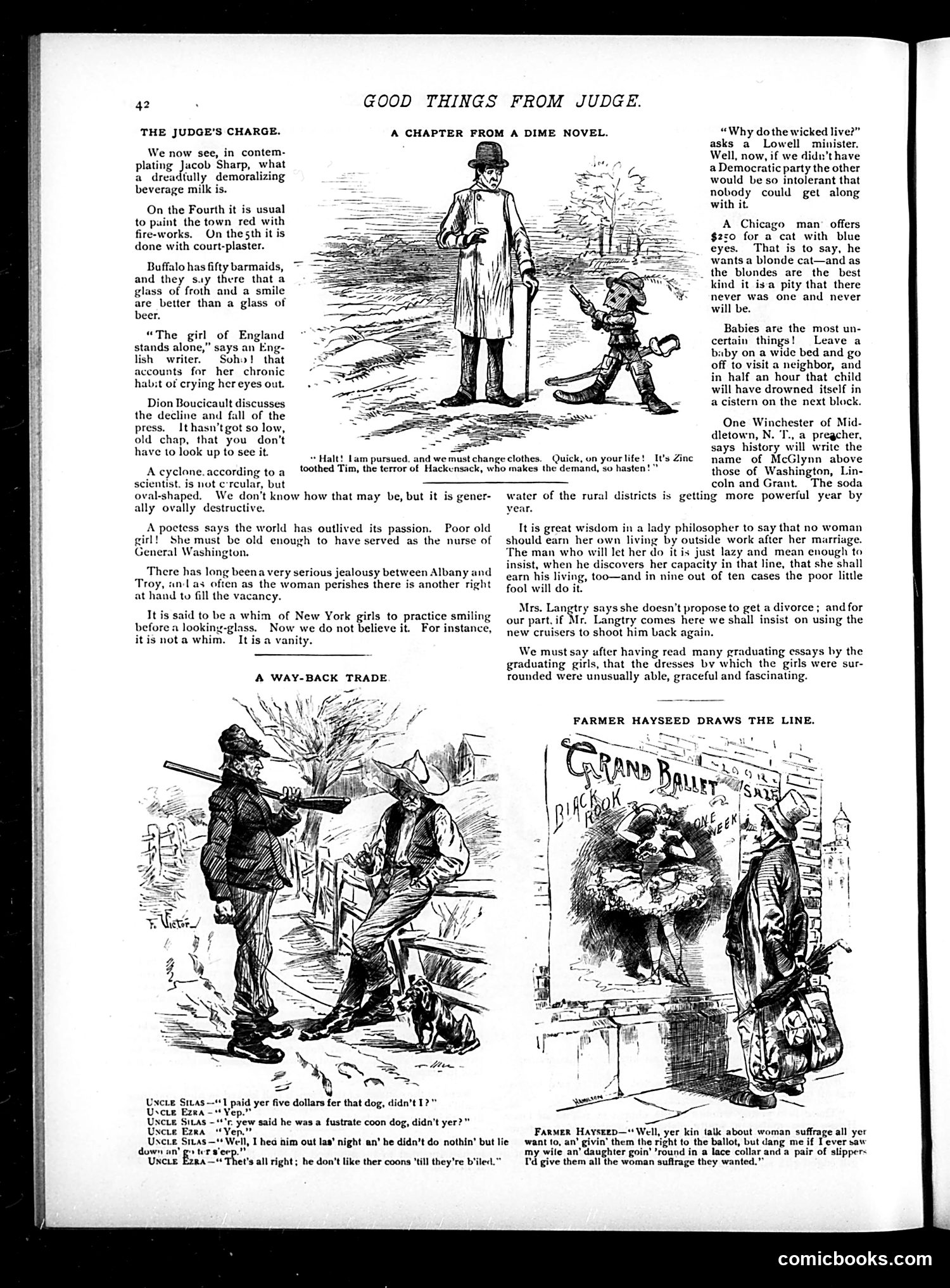
This page contains multiple satirical pieces typical of Judge's late-19th-century humor: **"The Judge's Charge"** consists of brief social commentary jabs—mocking Jacob Sharp (likely a political figure), Buffalo's barmaids, New York girls' vanity, and the decline of press standards. **"A Way-Back Trade"** depicts two rural characters (Uncle Silas and Uncle Ezra) in dialect, discussing a dog transaction. The humor relies on rural/backwoods stereotypes and the absurd detail that the dog won't hunt coons unless they're boiled. **"A Chapter from a Dime Novel"** parodies melodramatic serialized fiction with an illustration of a pursuer demanding clothing exchange. **"Farmer Hayseed Draws the Line"** satirizes resistance to women's suffrage through a rustic character who opposes voting rights but would grant them if women stopped wearing fashionable clothing (lace collars and slippers). The page reflects Judge's typical targets: rural stereotypes, fashion criticism, political figures, and contemporary social debates like women's rights—all presented through condescending humor aimed at educated urban readers.
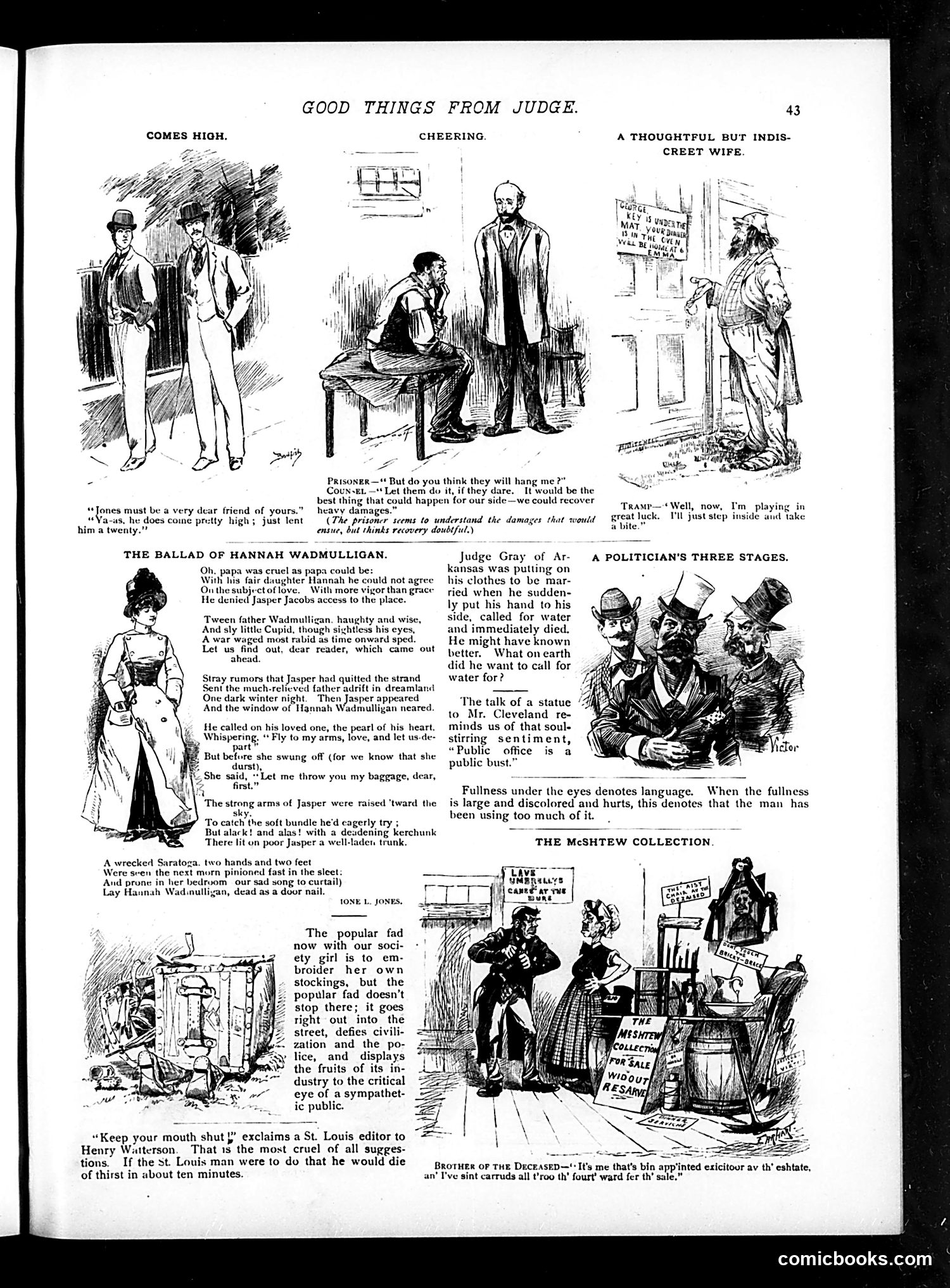
This page contains several satirical cartoons and humorous verses typical of Judge magazine's social commentary. **"Comes High"** depicts two well-dressed men discussing a friend's visit, with a pun on "high" costs versus actual height. **"The Ballad of Hannah Wadmulligan"** is a comedic narrative poem about a father forbidding his daughter's relationship with Jasper Jacobs. The tragic-comedic twist: when Hannah elopes by throwing her baggage down first, a heavy trunk kills Jasper, leading to her suicide—satirizing melodramatic romantic stories. **"A Thoughtful but Indiscreet Wife"** shows a woman promising to help her imprisoned husband's legal case by ensuring he benefits financially from execution—dark humor about wives' unfiltered support. **"A Politician's Three Stages"** presents three degraded figures, playing on the phrase "public office is a public bust"—mocking politicians' moral decline. The page also includes commentary on society girls embroidering stockings publicly and mentions editor Henry Watterson, alongside small anecdotes mocking figures like Judge Gray and references to Irish immigration ("McShtew Collection").
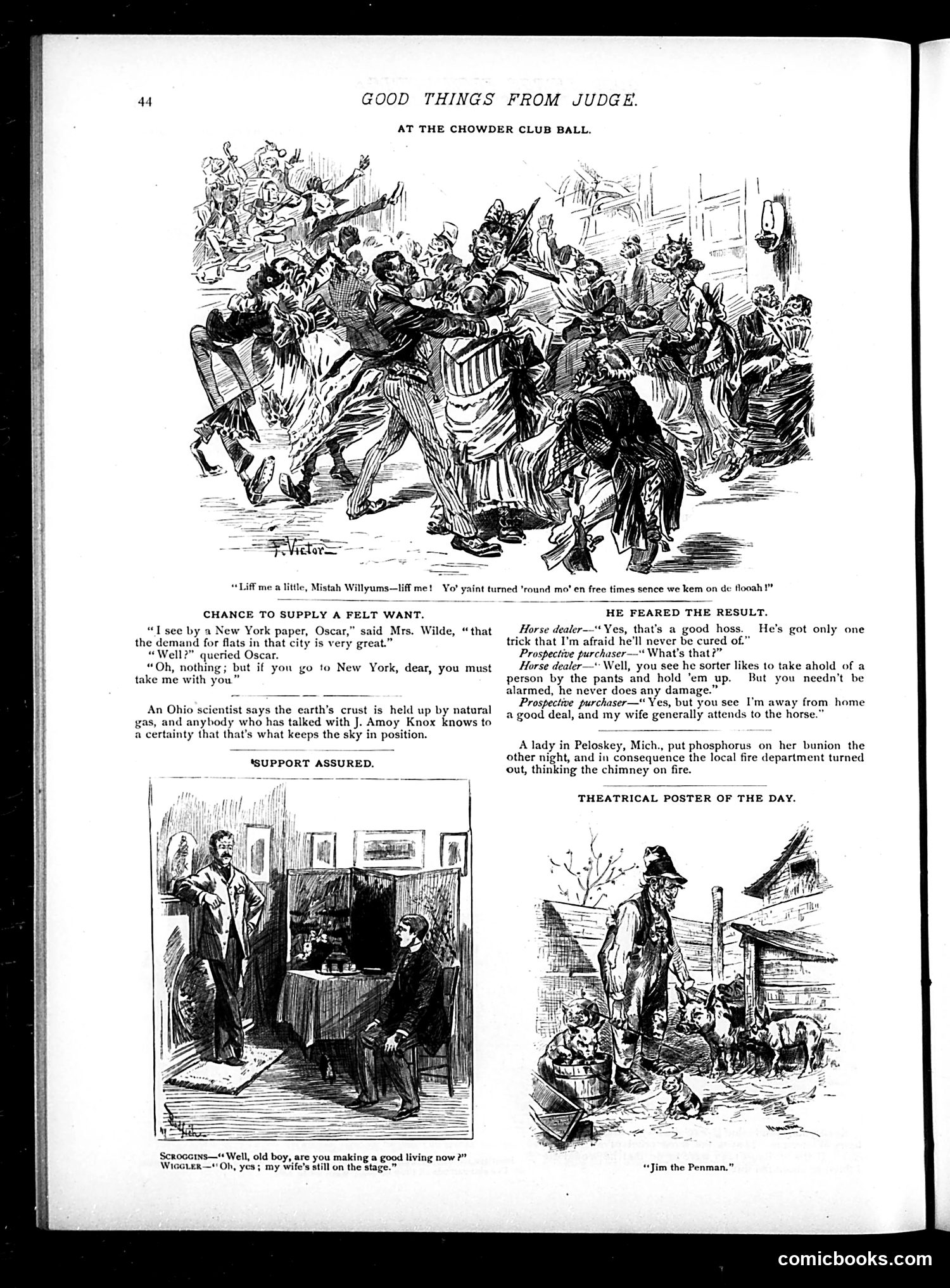
This page from *Judge* magazine contains several satirical humor pieces: **"At the Chowder Club Ball"** (top): A lively scene satirizing African American dialect humor, common in period entertainment. The caption uses exaggerated speech patterns typical of racist minstrelsy conventions of the era. **"Chance to Supply a Felt Want"**: A pun-based joke where Mrs. Wilde references NYC's housing shortage ("flats"), with Oscar misunderstanding "flats" as felt hats—implying she wants him to buy her felt items if he visits. **"Support Assured"**: A joke about a struggling actor whose wife's stage career supports them financially—inverting traditional gender roles for comedic effect. **"He Feared the Result"**: A horse-trading anecdote where a prospective buyer worries a horse's habit of grabbing people's pants will be problematic when his wife handles the animal alone—playing on domestic anxieties. The remaining items are brief observational humor and theatrical advertising. Overall, the page emphasizes wordplay, class commentary, and period-specific social anxieties delivered through *Judge's* characteristic satirical style.
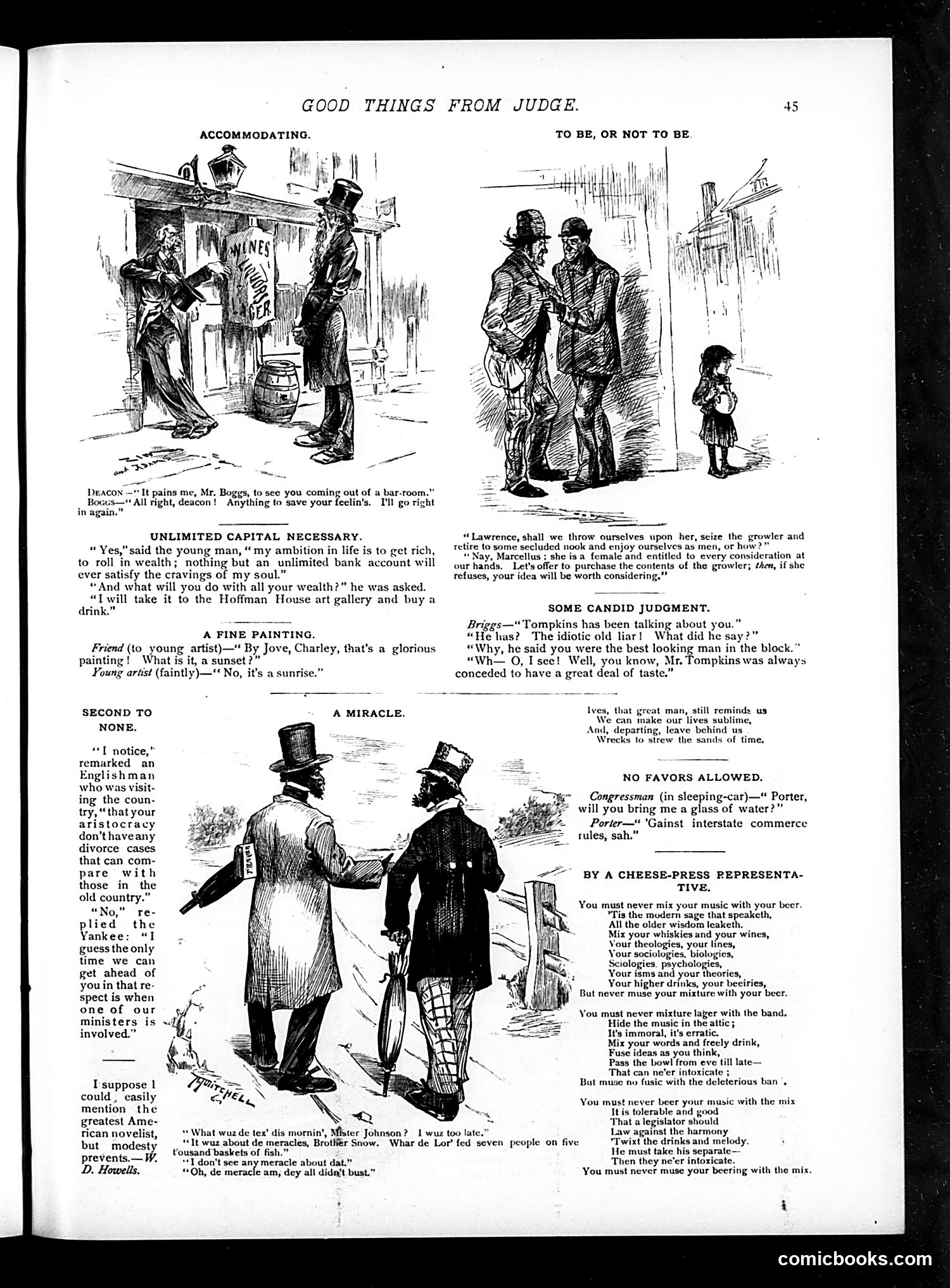
This page contains several short satirical pieces mocking various aspects of American life and hypocrisy: **"Accommodating"** jokes about a deacon's selective morality—he objects to someone leaving a bar but conveniently allows them to return rather than face confrontation. **"Unlimited Capital"** ridicules wealthy ambitions by showing a young man who wants unlimited wealth solely to buy drinks at a fancy hotel bar. **"A Fine Painting"** plays on artistic pretension—the young artist's "sunrise" is indistinguishable from a sunset, mocking both amateur art and pretentious praise. **"Second to None"** satirizes American moral superiority by suggesting American ministers' divorce scandals match British aristocratic ones. **"A Miracle"** uses dialect humor (common to the era, though offensive today) to mock religious exaggeration—calling a miracle that fish baskets didn't break. **"No Favors Allowed"** jokes about strict railroad regulation by having a porter refuse water service as violating "interstate commerce rules." The final piece appears to be nonsensical doggerel satirizing overwrought verse about mixing beverages and music.
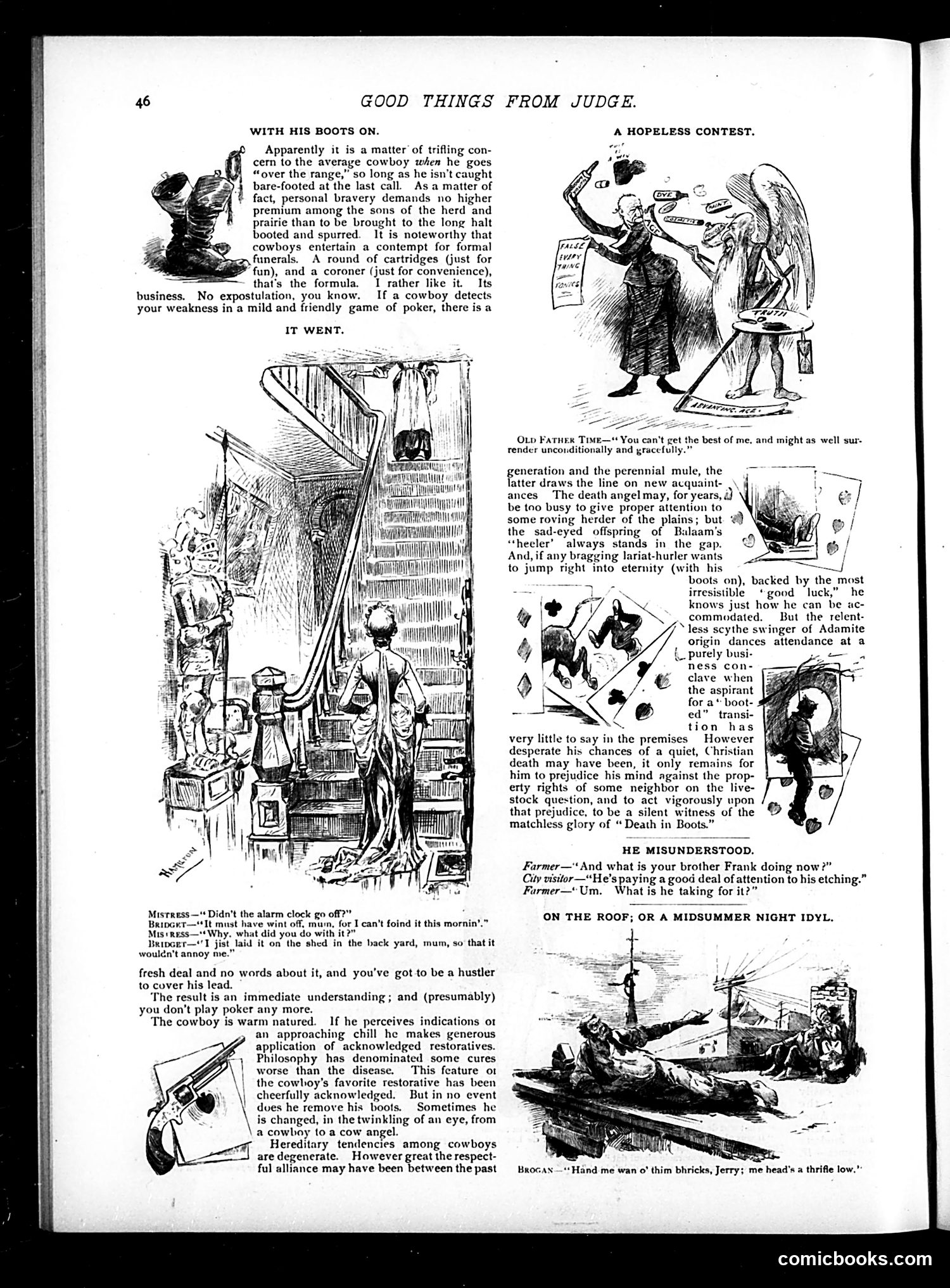
This Judge magazine page contains multiple satirical pieces mocking American social types: **"With His Boots On"** critiques cowboy culture, portraying them as reckless men obsessed with dying "booted and spurred" rather than facing formal funerals. The text sardonically celebrates their contempt for civilization and suggests poker games exploit their weaknesses. **"A Hopeless Contest"** depicts Death personified as unable to defeat a mule—suggesting mules' stubborn nature outlasts human mortality. The joke implies cowboys might die, but mules persist eternally. **"He Misunderstood"** is a brief wordplay joke: a visitor mentions his brother's "etching," which the farmer misinterprets as a profitable activity rather than the art form. **"On the Roof"** shows Irish laborers (indicated by dialect: "bhricks," "thrifle") on a roof, one requesting bricks while allegedly drunk or injured. The cartoons collectively mock working-class Americans—cowboys, servants, and Irish immigrants—through exaggeration and their own supposed ignorance or degradation.
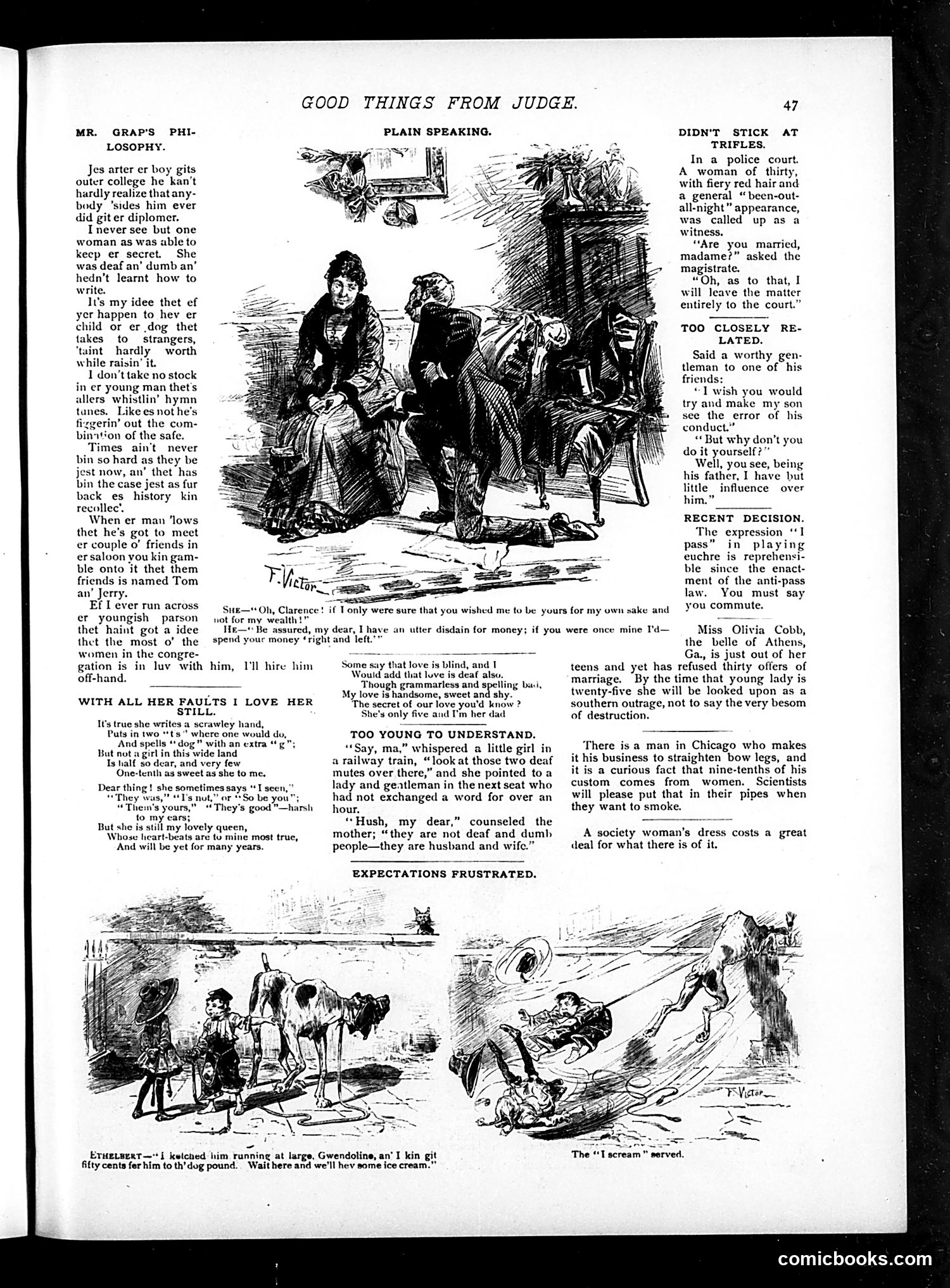
This page collects brief satirical observations and humorous anecdotes typical of Judge magazine's content. The main cartoon depicts a dialogue between a couple, with the woman claiming she loves her fiancé (Clarence) for himself, not his wealth—while he cynically reveals he'd only marry her for money if she were rich. The satire mocks both romantic pretense and mercenary attitudes in courtship. Other items mock social conventions: a man's struggle to influence his own son; the absurdity of married couples sitting in silence like "deaf and dumb people"; and a southern belle's marriageability decreasing with age. The "Plain Speaking" section presents satirical poetry about overlooking a woman's grammatical errors and spelling mistakes out of love. Overall, the page satirizes romantic hypocrisy, gender dynamics, and middle-class social expectations of the era.
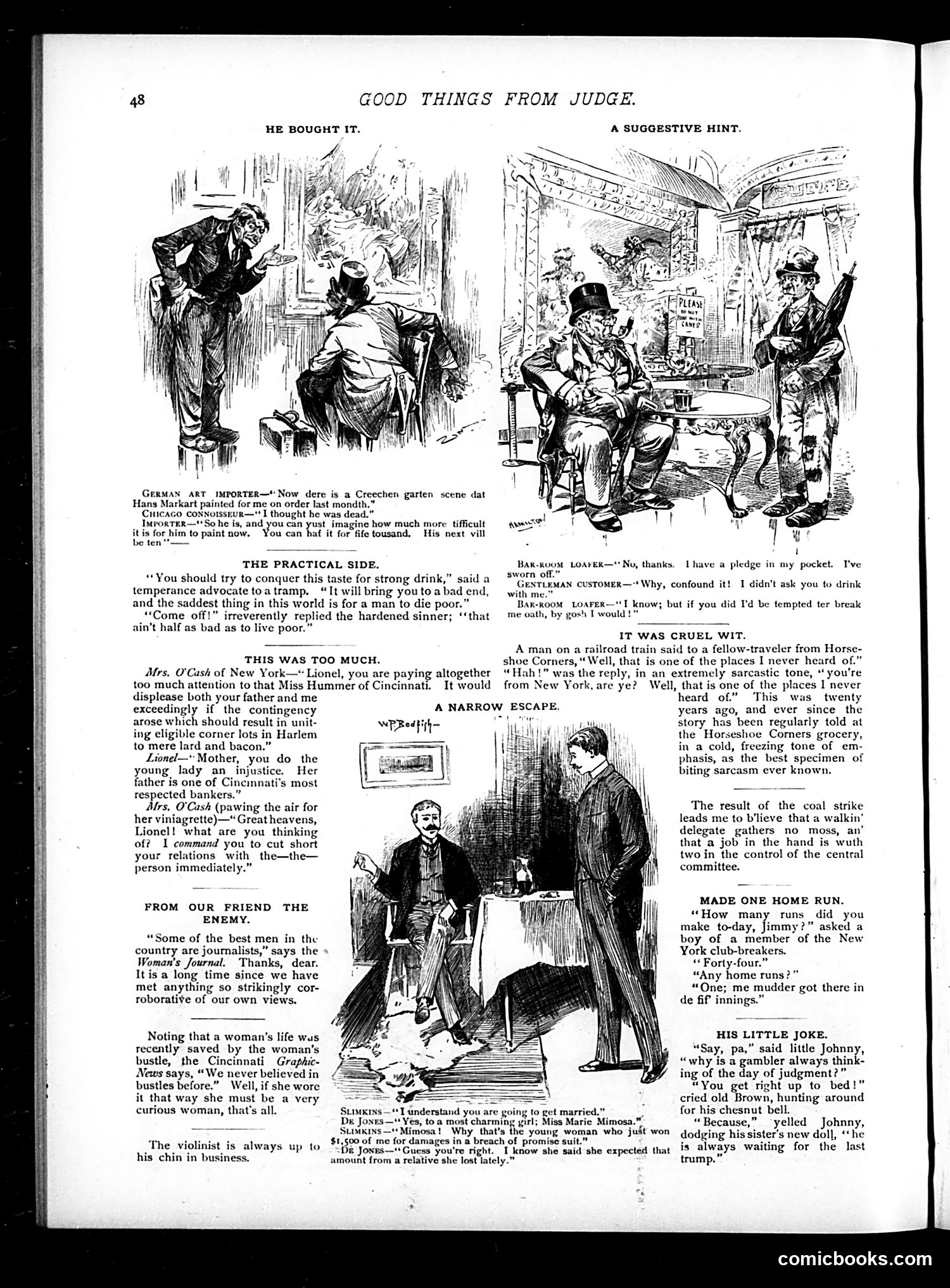
This page from Judge magazine (likely 1880s-90s) contains multiple brief satirical anecdotes and cartoons mocking contemporary society: **"He Bought It"**: A German art dealer sells a painting supposedly by the deceased Hans Makart to a Chicago collector who didn't realize the artist was dead—satire on gullible wealthy art buyers. **"The Practical Side"**: A temperance advocate warns a tramp that drinking leads to dying poor; the tramp quips that living poor is worse anyway—dark humor about poverty and vice. **"This Was Too Much"**: A wealthy New York mother forbids her son from courting a Cincinnati girl, initially thinking her family deals in "lard and bacon," then is horrified to learn they're *merely* bankers—satire on class-conscious snobbery. Other brief jokes mock bar-room pledges, railroad braggadocio, breach-of-promise lawsuits, coal strikes, baseball, and children's irreverent jokes about gambling and judgment day. The humor targets gilded-age pretension, hypocrisy, and social climbing.
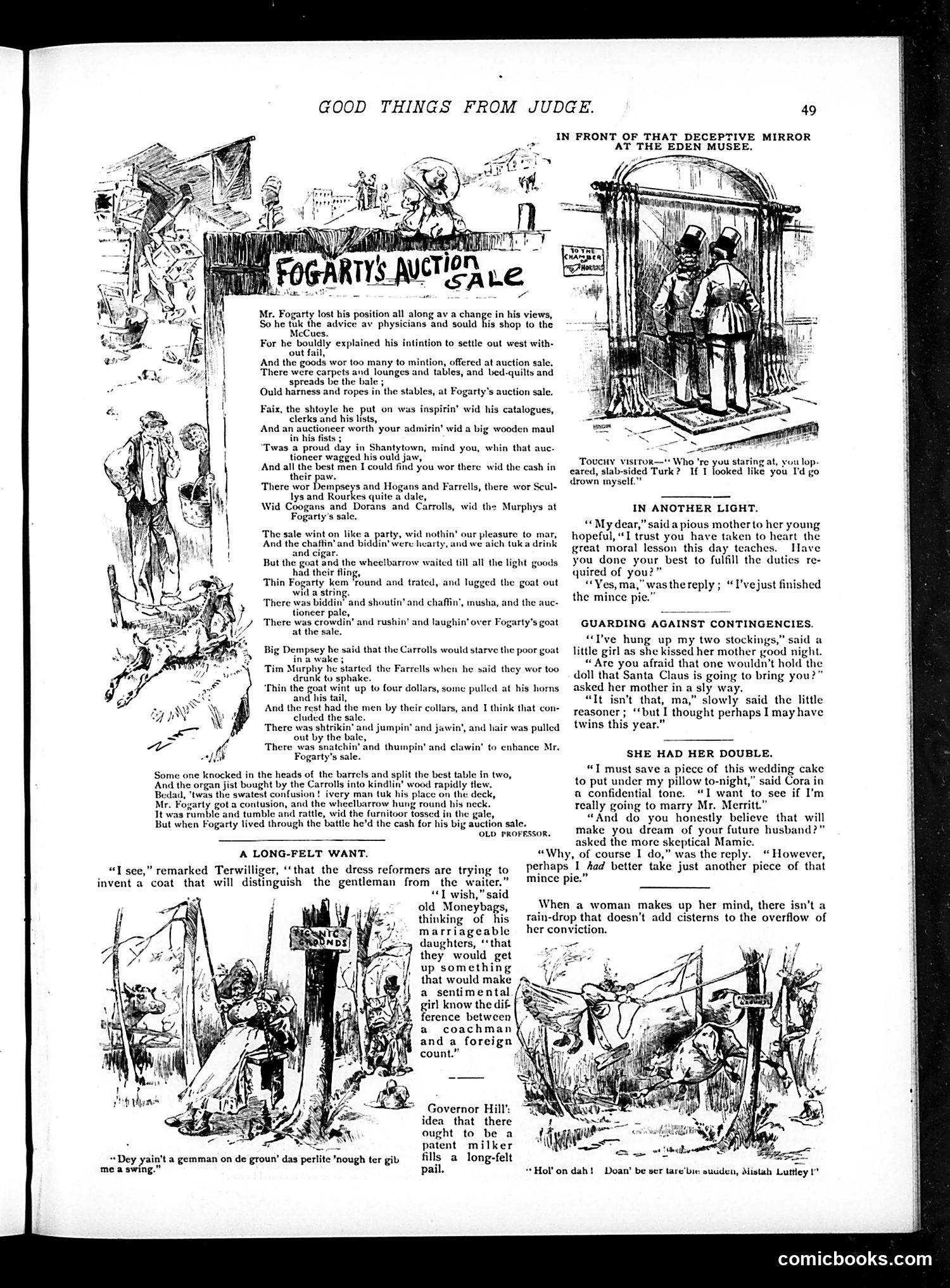
This page contains several humor pieces targeting Irish-American immigrant culture and Victorian social conventions. **"Fogarty's Auction Sale"** (main feature): A narrative poem in Irish-dialect humor about Mr. Fogarty selling his shop and possessions before moving west. The piece satirizes Irish working-class auction culture, depicting chaotic bidding, drunkenness, and a climactic scene where a goat being auctioned causes mayhem—tables smashed, furniture destroyed. The joke relies on ethnic stereotyping: Irish names (Murphys, Carrolls, Dempseys), dialect ("wid," "ould"), and portrayal of Irish laborers as rowdy and impulsive. **Smaller items** include: - "In Another Light": A child's innocent misinterpretation of moral lessons - "Guarding Against Contingencies": A girl hedging bets with Santa Claus - "She Had Her Doubles": A woman seeking supernatural confirmation of marriage through folklore These pieces exemplify Judge's typical humor: ethnic caricature, working-class mockery, and gentle domestic comedy about women and superstition. The illustrations are characteristic pen-and-ink sketches.
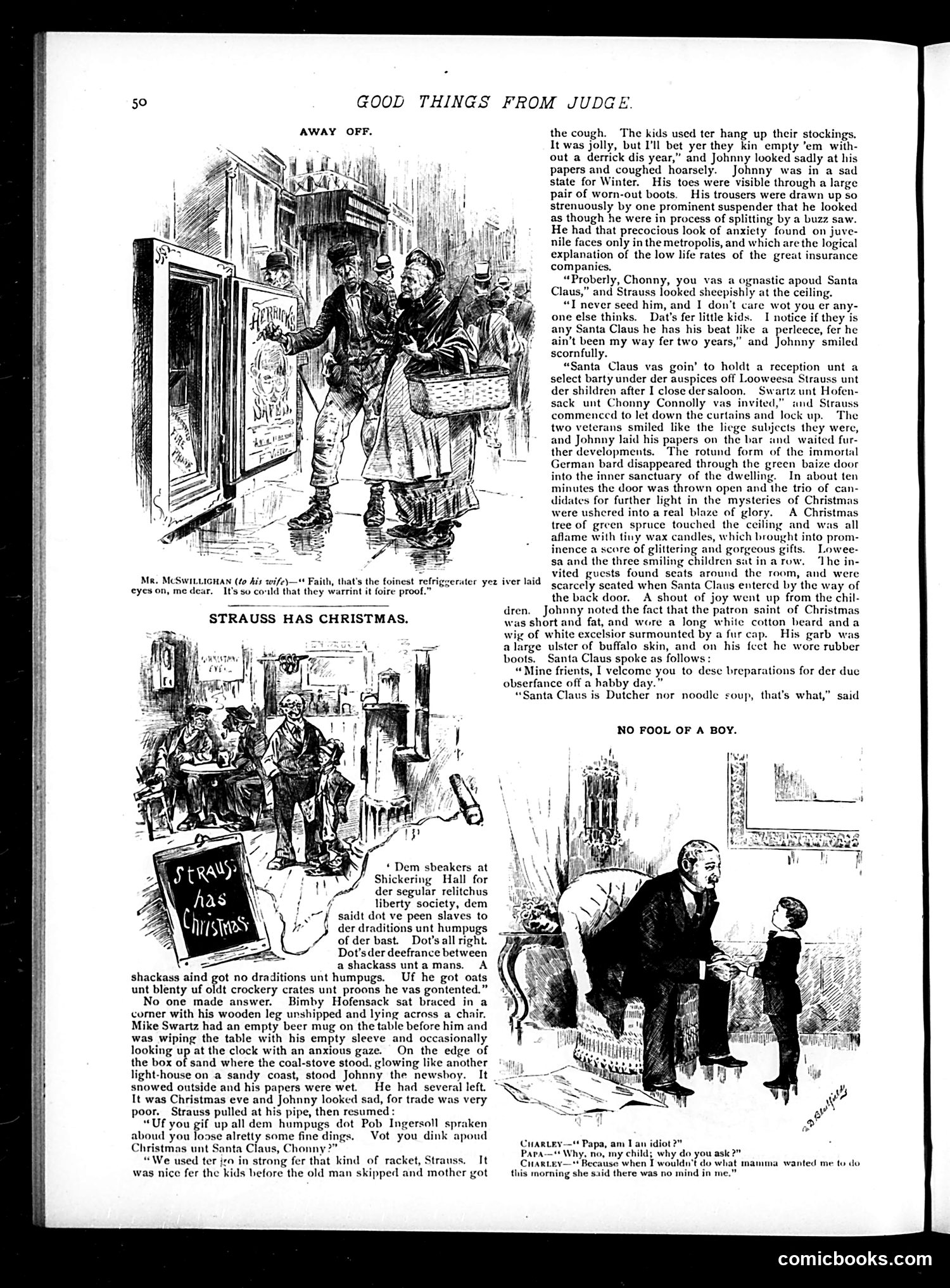
This page contains three interconnected stories depicting German-immigrant characters in late 19th-century America, written in heavy dialect for comic effect. **"Away Off"** and **"Strauss Has Christmas"** follow young Johnny, a poor newsboy, and saloonkeeper Strauss. The satire targets urban poverty: Johnny's threadbare clothes and persistent cough suggest tuberculosis (then a poor man's disease), yet he cynically dismisses Santa Claus as irrelevant to street children. Strauss, a well-meaning German immigrant, arranges a Christmas celebration featuring a homemade Santa Claus who speaks in dialect, creating pathos through the contrast between modest immigrant generosity and genuine childhood want. **"No Fool of a Boy"** shows a father (Charley) telling his son he's foolish for asking questions about parental authority—the caption implies the father wanted the boy to obey without reasoning. The humor relies on ethnic caricature (German-Jewish dialect) and class commentary. Judge magazine satirized both the harsh conditions of poor urban life and the sentimental, often condescending attitudes of middle-class reformers toward immigrants and the poor.
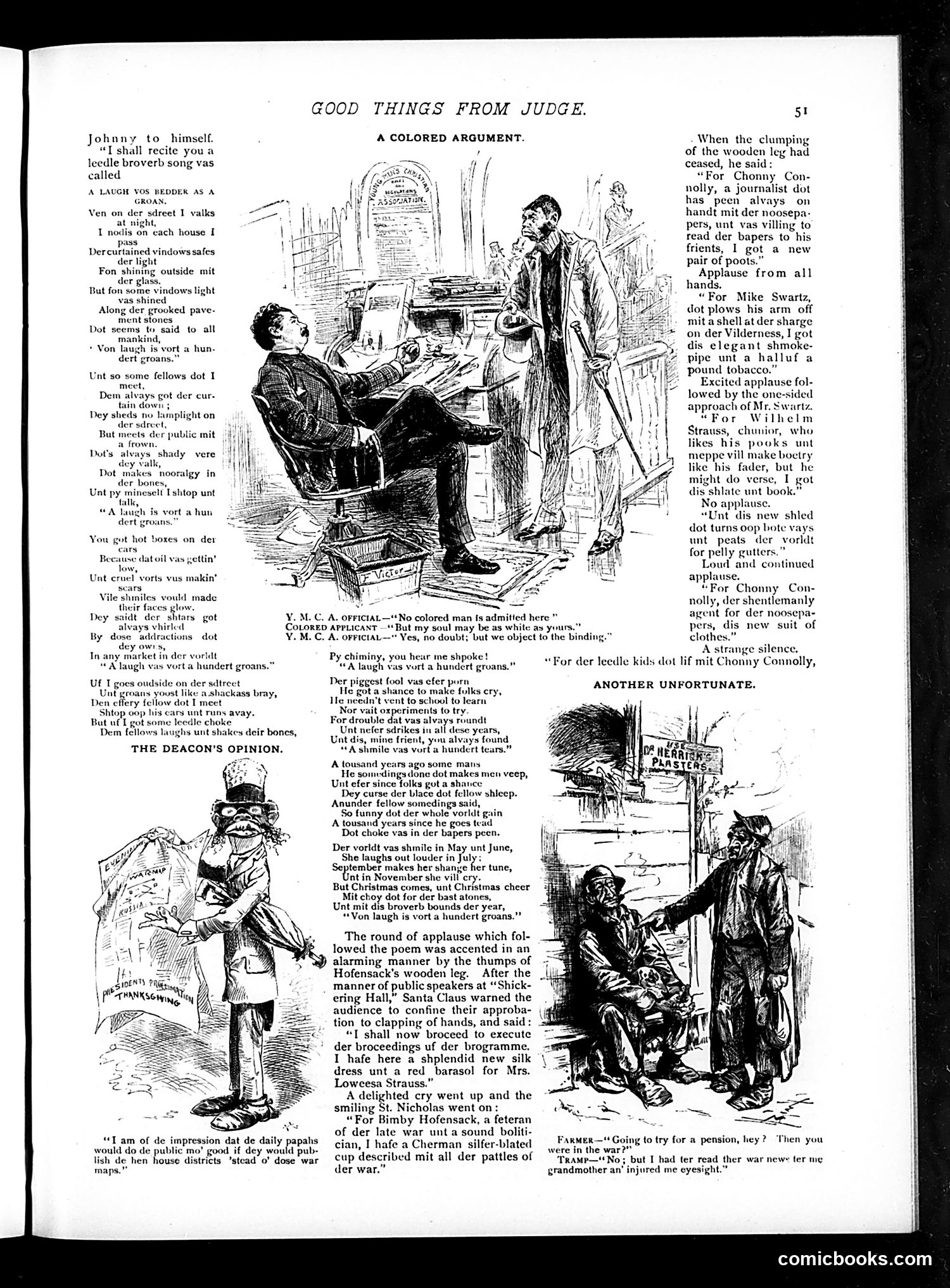
The main cartoon depicts a conflict between a Black man seeking admission to the YMCA and an official who refuses him based on race, claiming "no colored man is admitted here." When the applicant argues his soul may be "as white as yours," the official dismisses this, objecting only to "the binding"—a crude joke suggesting the applicant's dark skin is merely a container for a white soul. Below this, "Another Unfortunate" shows a disabled war veteran (likely Civil War era, given references to "der late war") being denied a pension. The heavy German-dialect poetry ("A laugh was worth a hundred groans") fills the page, written in stereotypical broken English that mocks German-American immigrants. **Context**: This represents 1870s-80s American prejudice—both anti-Black racism (explicit exclusion from public institutions) and anti-immigrant mockery (German speakers portrayed as comical), alongside class commentary about disabled veterans' struggles. Judge magazine used satire to address social issues while relying on offensive ethnic stereotypes standard to the era.
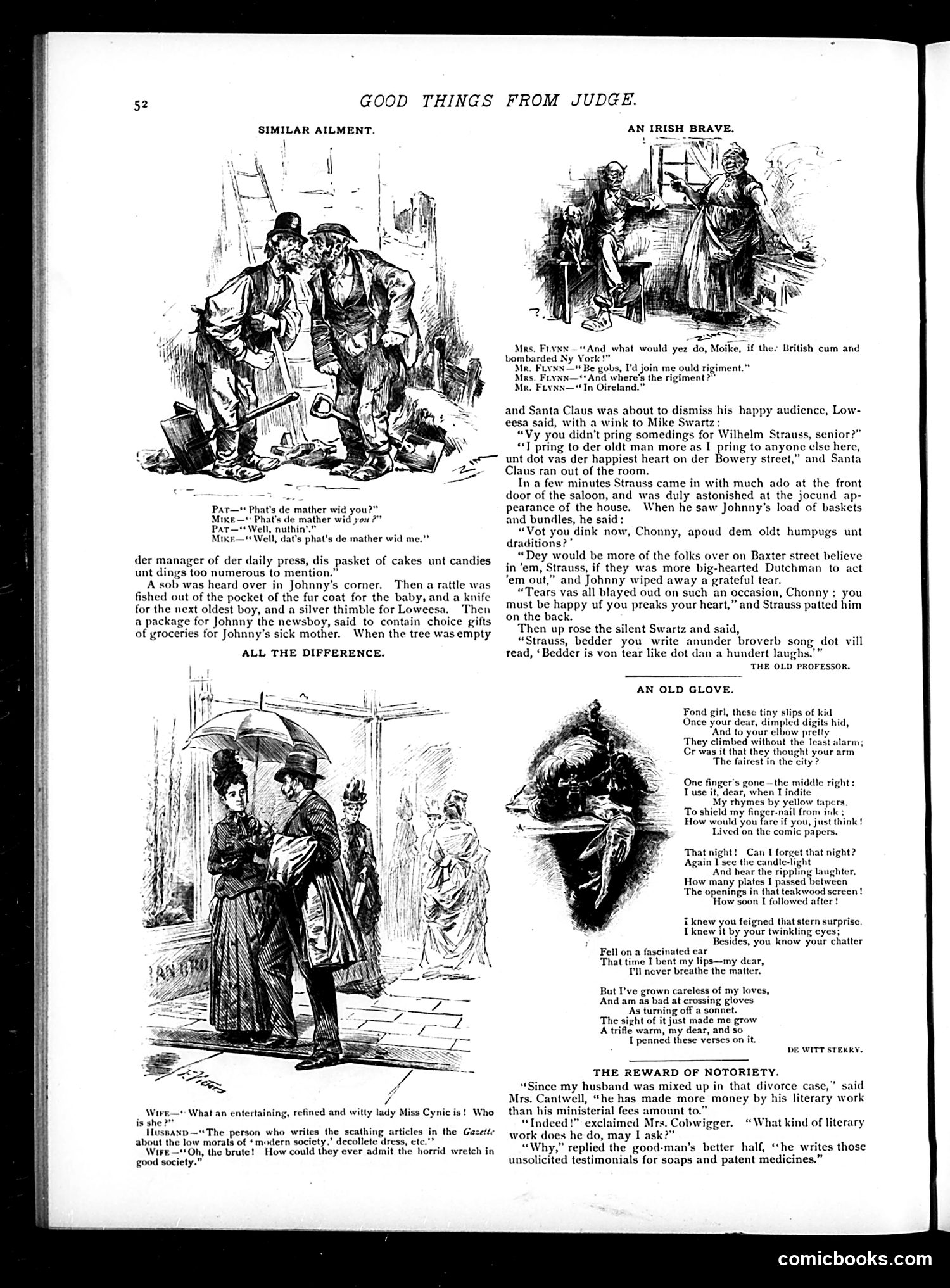
This page contains multiple satirical pieces targeting late 19th-century social issues: **"Similar Ailment" and "All the Difference"**: These mock German and Jewish immigrants' accented speech patterns (rendered phonetically) while depicting working-class family life and press criticism. The humor relies on ethnic stereotyping common to the era. **"An Irish Brave"**: Satirizes Irish immigrants, portraying them as poorly educated through a dialogue about a soldier's regiment "in Oireland." The caricature mocks Irish dialectal speech. **"An Old Glove"**: A sentimental poem about lost romance, unrelated to satire. **"The Reward of Notoriety"**: Satirizes a minister who profits from divorce scandal publicity by writing fake testimonials for patent medicines—criticizing both medical fraud and opportunistic clergy. The page reflects Judge's editorial voice: mocking immigrant communities through exaggerated dialect while attacking corruption and hypocrisy among the respectable classes. Modern readers should note the casual ethnic stereotyping that was standard satirical practice then.
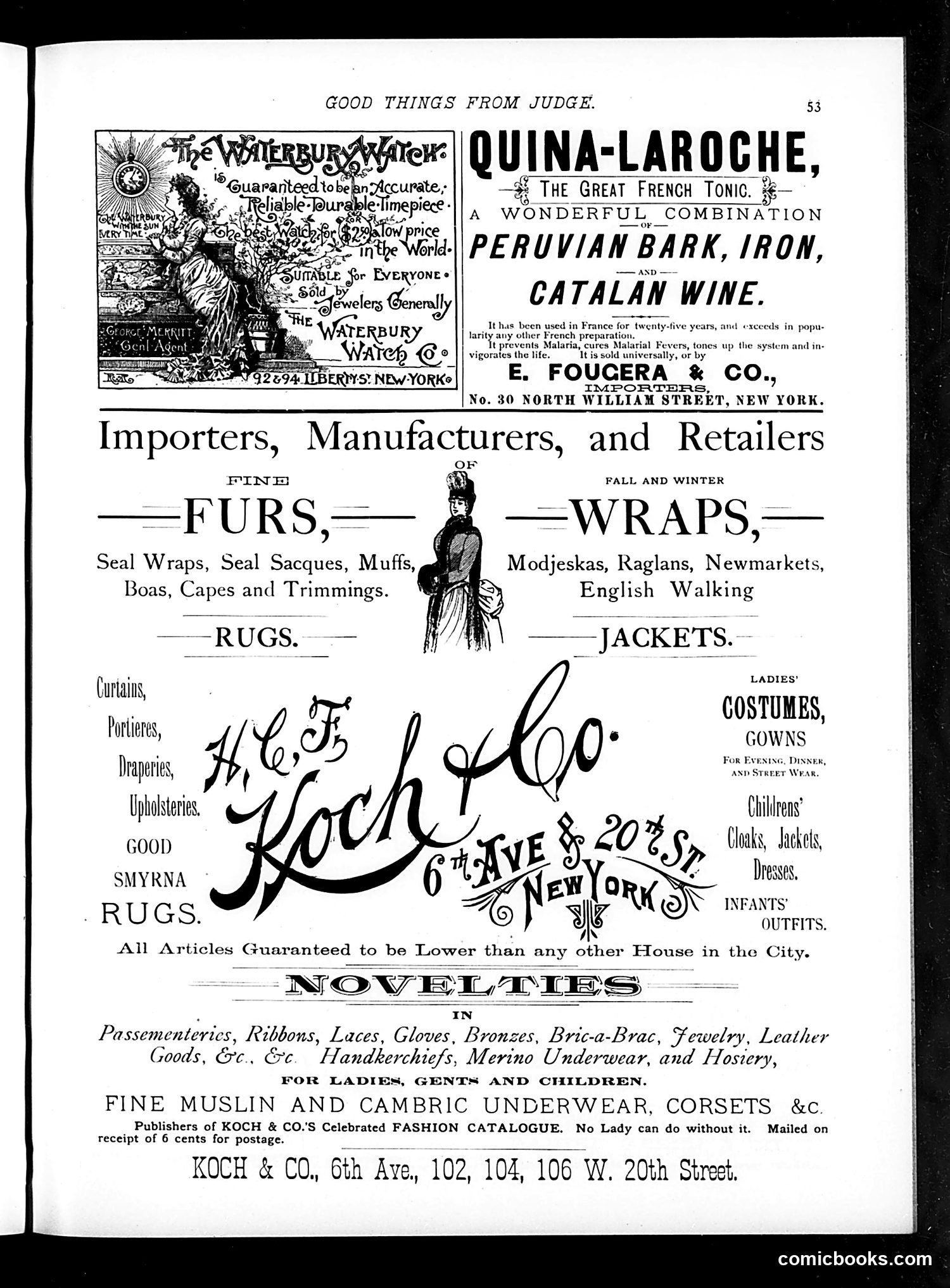
This is primarily an **advertising page** from Judge magazine, not a satirical cartoon. It contains multiple commercial advertisements: 1. **Quina-Laroche**: A French tonic claiming to cure malaria and invigorate the system—typical 19th-century patent medicine advertising with health claims. 2. **Waterbury Watch**: A small watch advertisement (top left) emphasizing durability and low price. 3. **H.E. Koch & Co.**: The dominant ad promoting a New York department store specializing in furs, wraps, rugs, jackets, women's clothing, and novelties. The large cursive text promises lower prices than competitors. **Modern context**: This reflects the Gilded Age retail environment and the boom in patent medicines (many containing questionable ingredients). Department stores were expanding rapidly and competed aggressively on price. The page demonstrates how Judge magazine funded itself through paid advertisements mixed with editorial content. There is no political satire visible here—it's purely commercial.
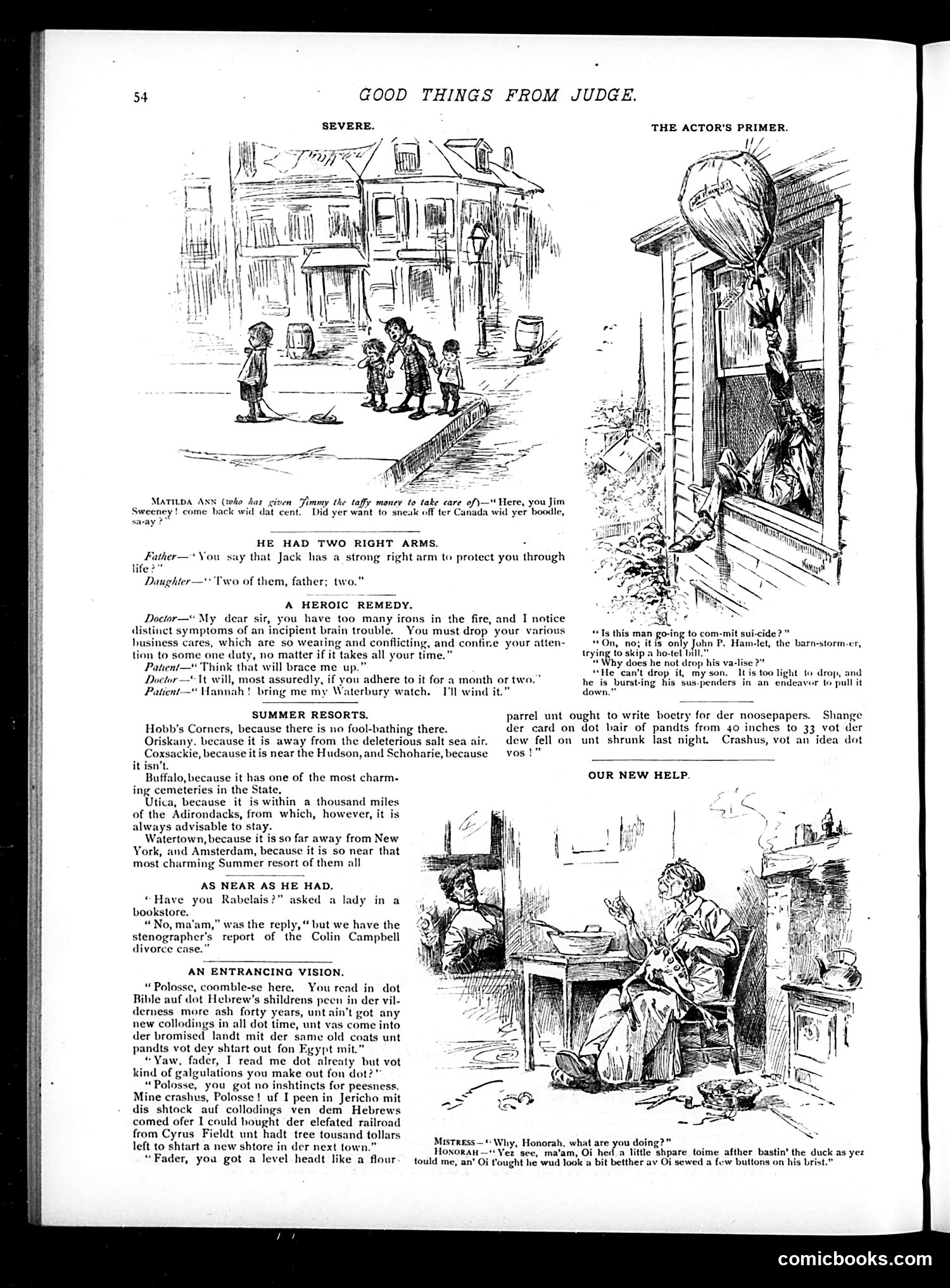
This page from Judge magazine contains several short satirical pieces lampooning common social situations and character types: **"Severe"** mocks a street urchin ("Matilda Ann") attempting petty theft of a penny from another child. **"He Had Two Right Arms"** jokes about a young woman's suitor having two "right arms"—meaning two romantic prospects protecting her through life. **"A Heroic Remedy"** satirizes a doctor prescribing obsessive focus on a single task (winding a Waterbury watch) as treatment for overwork-induced brain strain. **"Summer Resorts"** ridicules Americans choosing vacation destinations for absurd reasons (proximity to cemeteries, distance from nature). **"An Entrancing Vision"** features a Yiddish-accented immigrant father fantasizing about profiting from the biblical Israelites' 40-year wilderness journey—satirizing both immigrant entrepreneurial ambitions and misreading scripture. **"Our New Help"** depicts an Irish servant maid attempting household repairs, playing on period stereotypes of Irish domestic workers' resourcefulness. The humor relies on class commentary, ethnic caricature (common for the era), and satirizing American vanity and materialism.
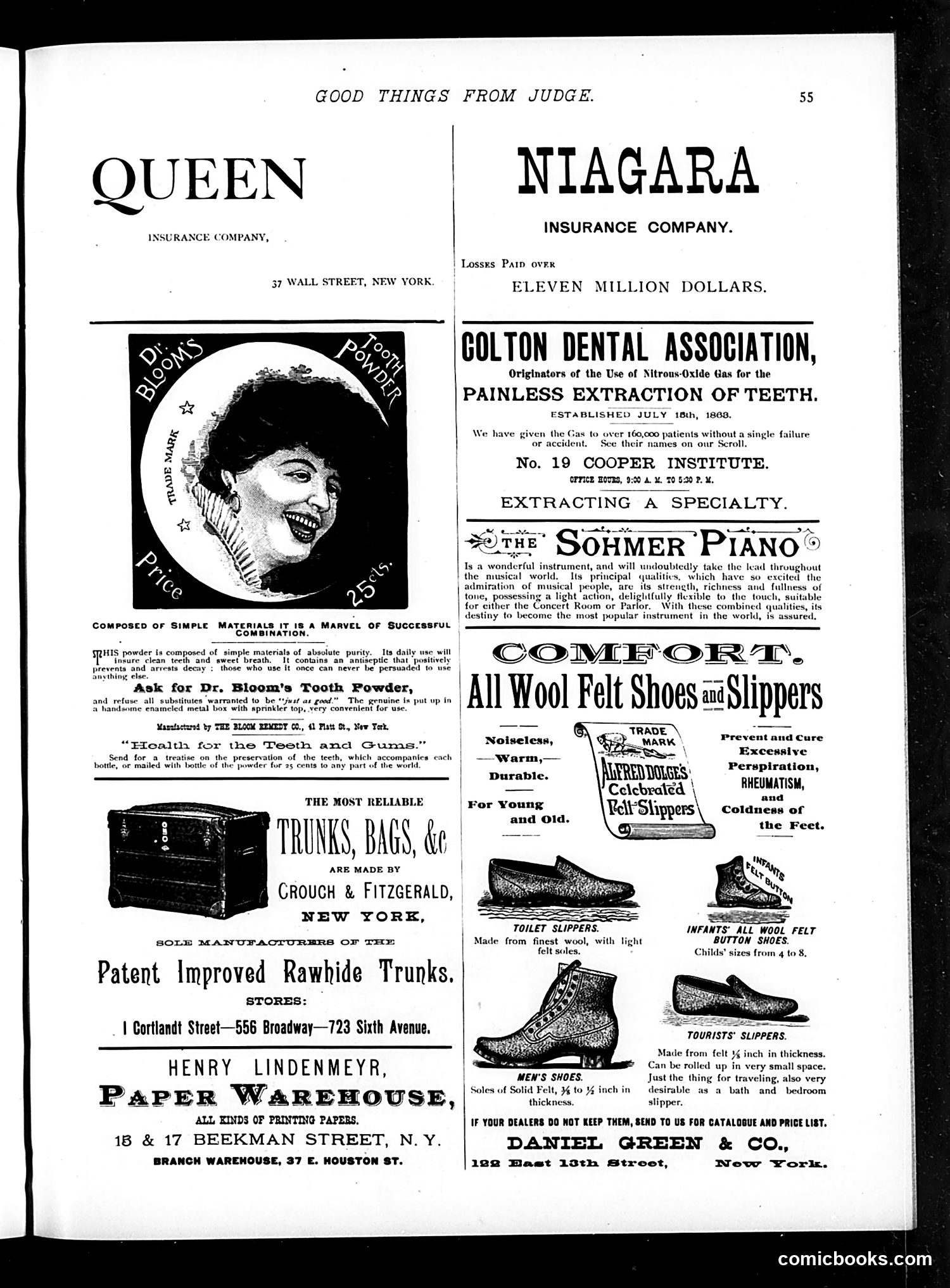
This page is primarily **advertising**, not political satire. It's a collection of late-19th-century commercial advertisements arranged around one illustrated element. The **central image** shows a woman's smiling face in a circular frame labeled "Dr. Bloom's Tooth Powder," with decorative text reading "Blooms," "Tooth Powder," and "Price 25¢" around the border. This is a straightforward product advertisement, not a political cartoon. The remaining content consists of advertisements for various goods: insurance companies (Queen, Niagara), dental services (Colton Dental Association), musical instruments (Sohmer Piano), trunks and luggage, paper warehouses, and felt shoes and slippers. These ads emphasize product quality and reliability—typical marketing appeals of the era. **No satire or political commentary is present.** This appears to be a standard advertising page from Judge magazine, likely used to generate revenue rather than deliver editorial content.
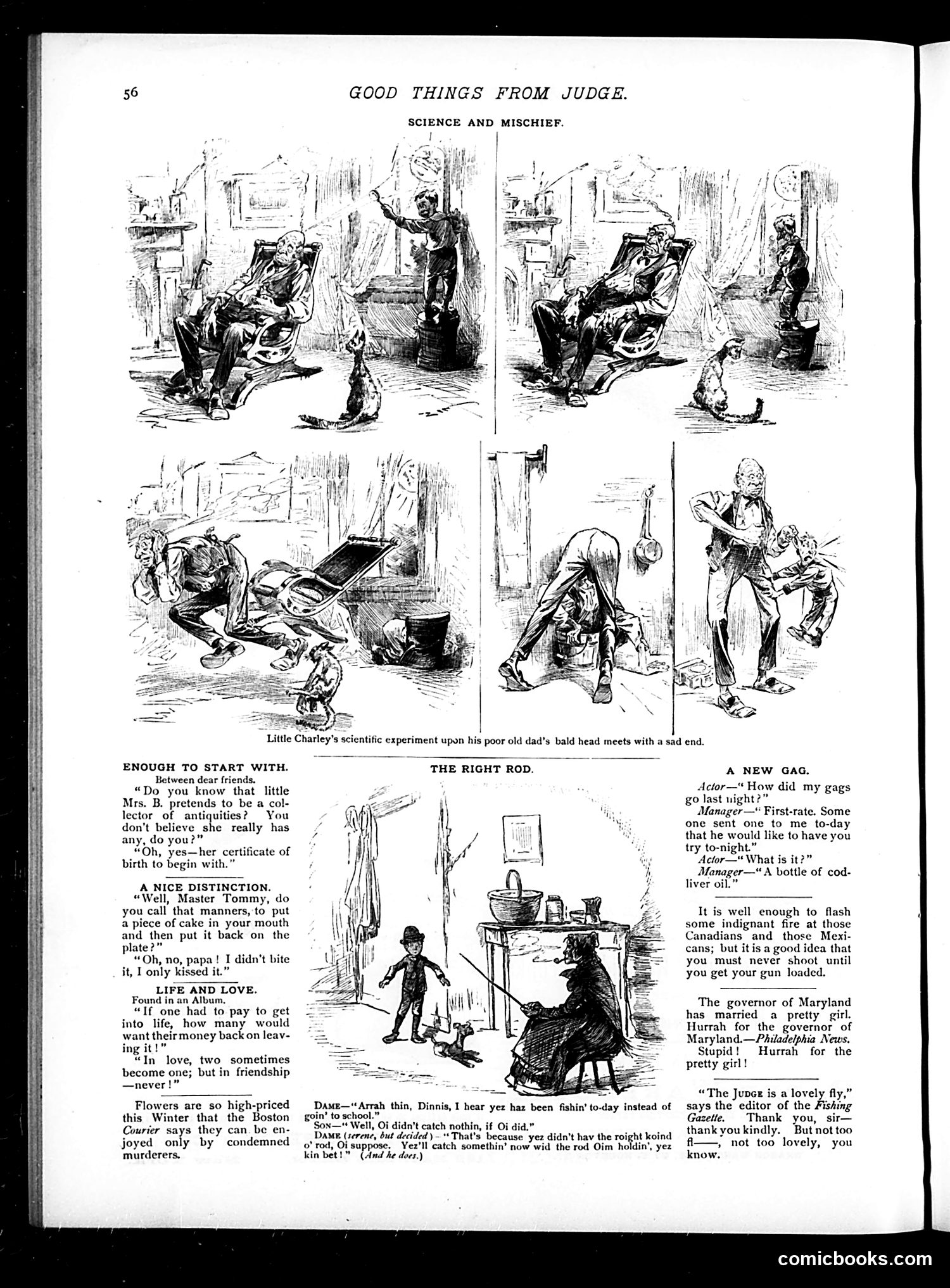
This page contains several brief satirical jokes and a multi-panel cartoon titled "Science and Mischief," which depicts a boy conducting an "experiment" on his bald father's head—likely involving some form of chemical reaction or mishap that ends badly for the father. The surrounding jokes target various social pretensions and gender dynamics of the era: a woman falsely claiming to collect antiquities (mocked for having only a birth certificate), a child's sophistry about "kissing" versus "biting" cake, and a mother beating her son with a rod after he skips school to fish. Other items mock winter flower prices, social climbing, and the absurdity of complimenting both an actor's bad jokes and a fly's attractiveness. The humor relies on wordplay, class commentary, and gentle mockery of Victorian manners and pretension rather than overtly political satire.
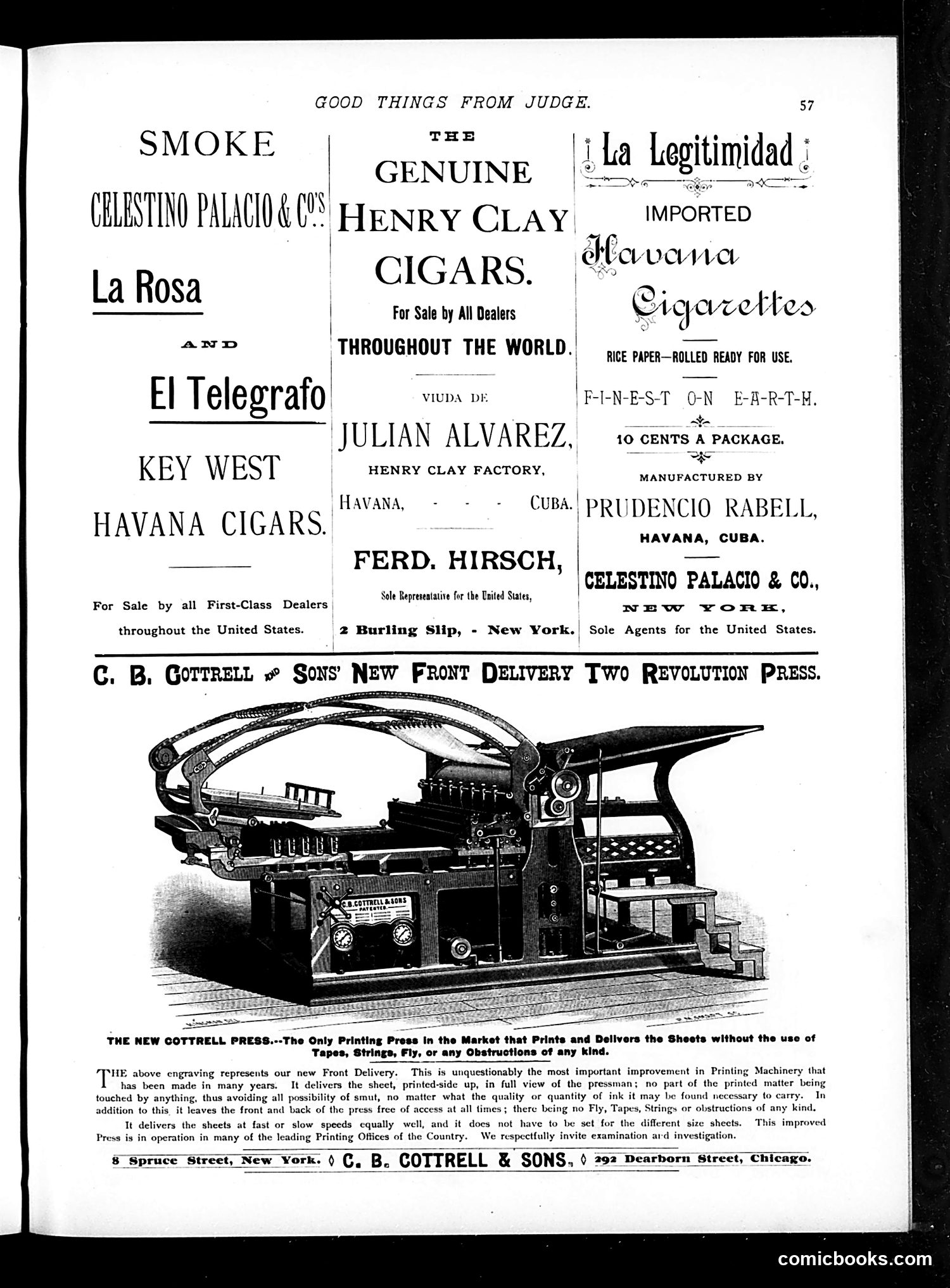
This page is primarily **advertising**, not editorial content or satire. It contains multiple advertisements for cigars (La Rosa, El Telegrafo, Henry Clay brand, and La Legitimidad) and a prominent ad for the C.B. Cottrell & Sons printing press. The cigar ads reflect the late 19th-century American market, featuring brands with Cuban and Key West origins—indicating the popularity of imported tobacco products. The "La Legitimidad" brand name (Spanish for "legitimacy") appears to be marketing rhetoric rather than political commentary. The substantial printing press advertisement suggests Judge's own interest in printing technology innovations. The detailed description of the "Front Delivery" press emphasizes its advantage: delivering printed sheets without damaging the printed surface—a significant mechanical improvement for the era. No identifiable political figures or satirical cartoons appear on this page. It represents how **Judge magazine funded operations through advertising**, with commercial content occupying substantial editorial real estate.
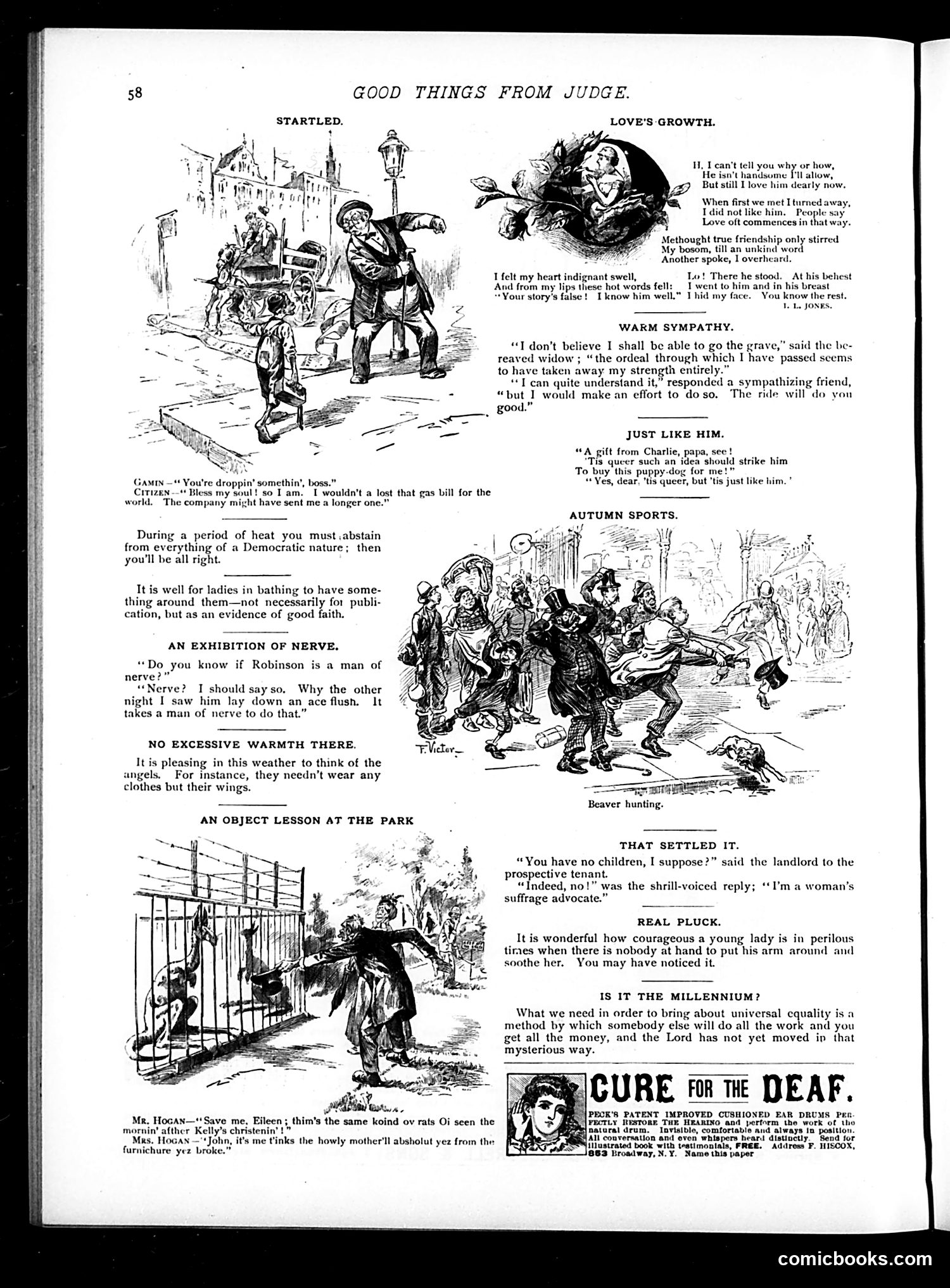
This page collects brief humorous sketches typical of 1890s-era satirical journalism. The cartoons and jokes target social conventions and contemporary attitudes: **"Startled"** (top left): A street scene where a man reacts with exaggerated surprise—likely mocking overly dramatic public behavior. **"Love's Growth"** and related romantic pieces: Light satire on courtship conventions, poking fun at how affection develops unexpectedly and how men (like "Charlie") express romantic interest through impractical gifts. **Political/Social Commentary**: References to "Democratic nature" during heat, women's suffrage advocates (mocked as childless), and universal equality satirize progressive movements of the era as impractical idealism. **"Beaver Hunting"** and Park scene: Visual gags about leisure activities and class interactions. The page's humor relies on recognizing period social norms—courtship rituals, gender roles, political divisions—rather than referencing specific figures. The tone is gently mocking rather than vicious, typical of Judge's middle-class satirical approach.
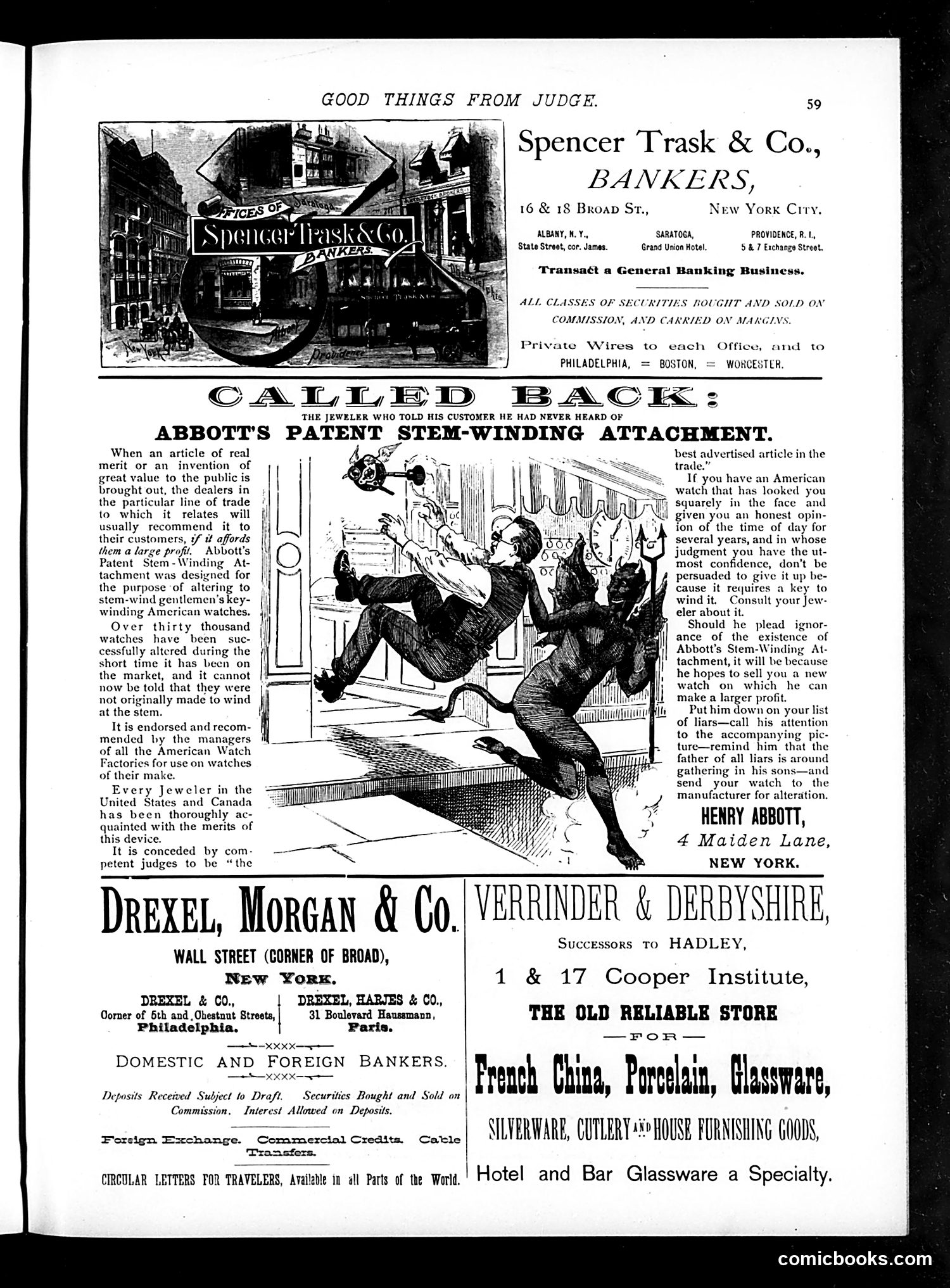
This page is primarily **advertising**, not satire or political commentary. However, it includes one humorous advertisement disguised as editorial content. The main cartoon depicts "The Jeweler Who Told His Customer He Had Never Heard of Abbott's Patent Stem-Winding Attachment"—a comedic exaggeration showing a jeweler being physically thrown out by an angry customer. The joke is straightforward: the text claims that every jeweler in America knows about this watch attachment (which converts key-wound watches to stem-wound), so any jeweler claiming ignorance is obviously **lying to avoid recommending it**—presumably because he profits more selling new watches. The cartoon satirizes dishonest shopkeeping by depicting the customer's justified outrage at being deceived about a well-known product. It's essentially a *testimonial advertisement* using humor to shame jewelers into honest sales practices while promoting Abbott's product. The remainder of the page consists of banker and merchant advertisements.
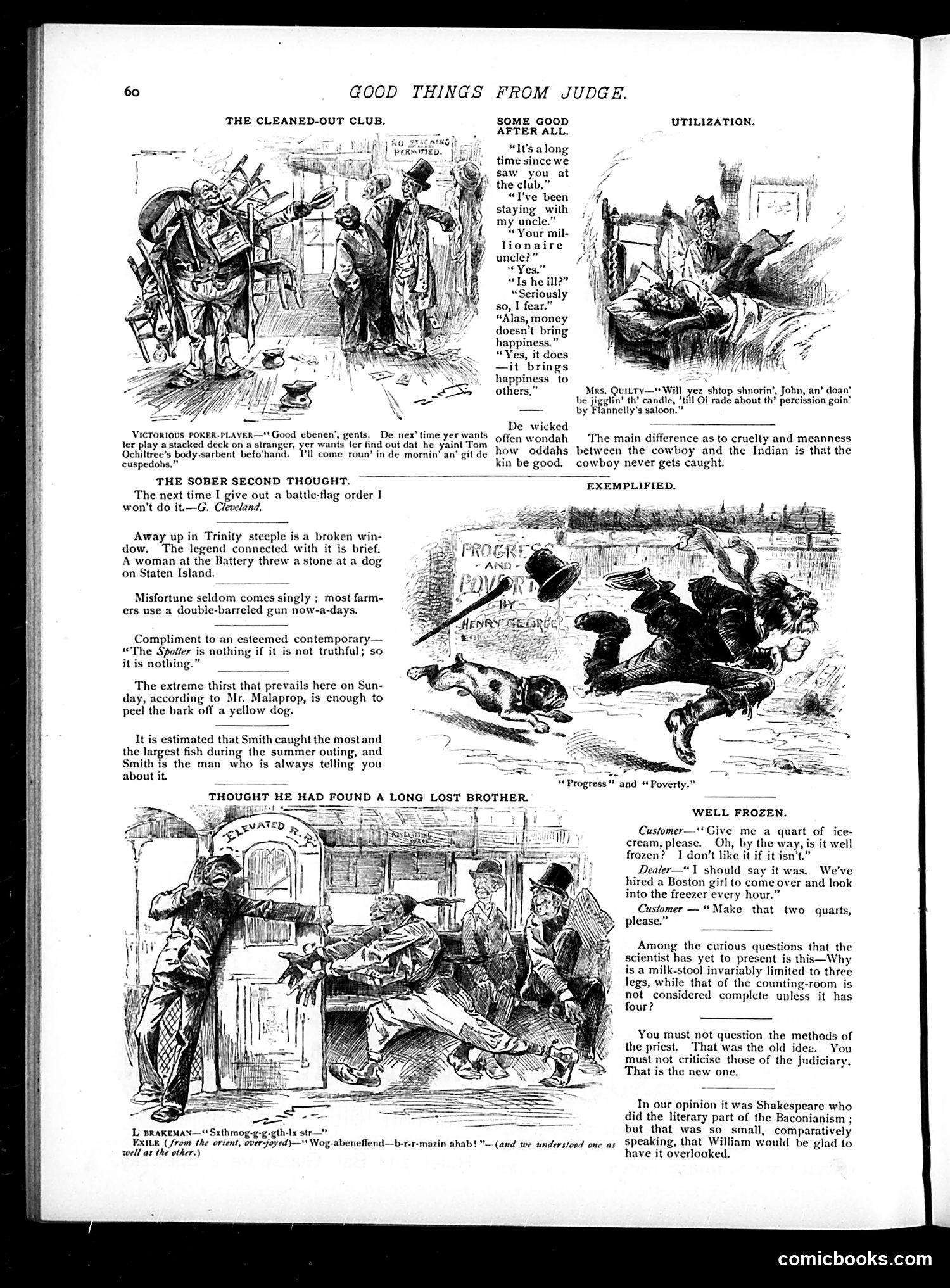
This page contains several satirical vignettes typical of Judge's humor: **"The Cleaned-Out Club"** depicts a poker player boasting about his cheating methods—stacking decks on strangers. The joke is that he's essentially confessing fraud to other club members. **"Some Good After All"** shows a nephew revealing his wealthy uncle's serious illness, then noting that money brings happiness—to others (implying he'll inherit). **"The Sober Second Thought"** references President Cleveland, apparently criticizing a military order he issued then reconsidered. **"Utilization"** mocks Irish domestic servants (depicted with heavy dialect) using candlelight while reading newspapers aloud. **"Exemplified"** compares cowboys and Native Americans, claiming cowboys are merely less likely to be caught being cruel—a backhanded "compliment" satirizing both. The remaining items are brief humorous observations about everyday absurdities (fishing boasts, thirst, ice cream quality, furniture design quirks). The page demonstrates Judge's typical approach: satirizing business dishonesty, class pretension, ethnic stereotyping, and political figures through crude caricature and wordplay.
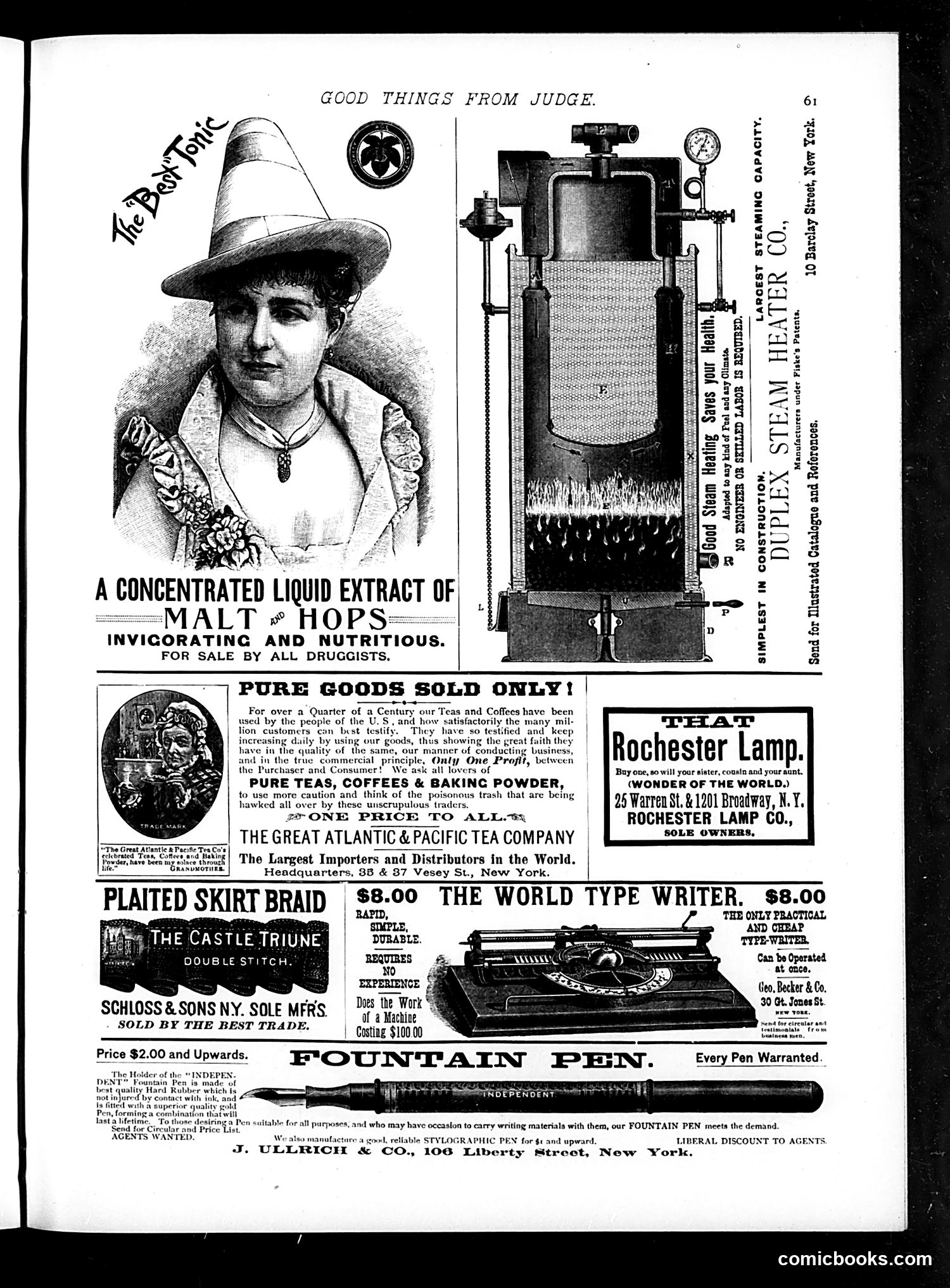
This page is primarily **advertising, not political satire**. It's page 61 from *Judge* magazine and contains various product advertisements typical of the late 19th century. The only illustration with a figure is at top left: a woman wearing an elaborate hat, labeled "The Poor Joker," advertising "A Concentrated Liquid Extract of Malt & Hops" as an invigorating tonic. This appears to be a product advertisement rather than political commentary—the "poor joker" reference likely just means the product is a humorous solution to health concerns. The remaining content advertises everyday products: tea and coffee, steam heating systems, typewriters, fountain pens, and skirt braids. The ads emphasize quality and fair pricing ("One Price to All"), reflecting consumer confidence messaging of the era. Without satirical cartoons or political references visible here, this represents *Judge*'s practical function as a magazine that combined humor with commercial revenue.
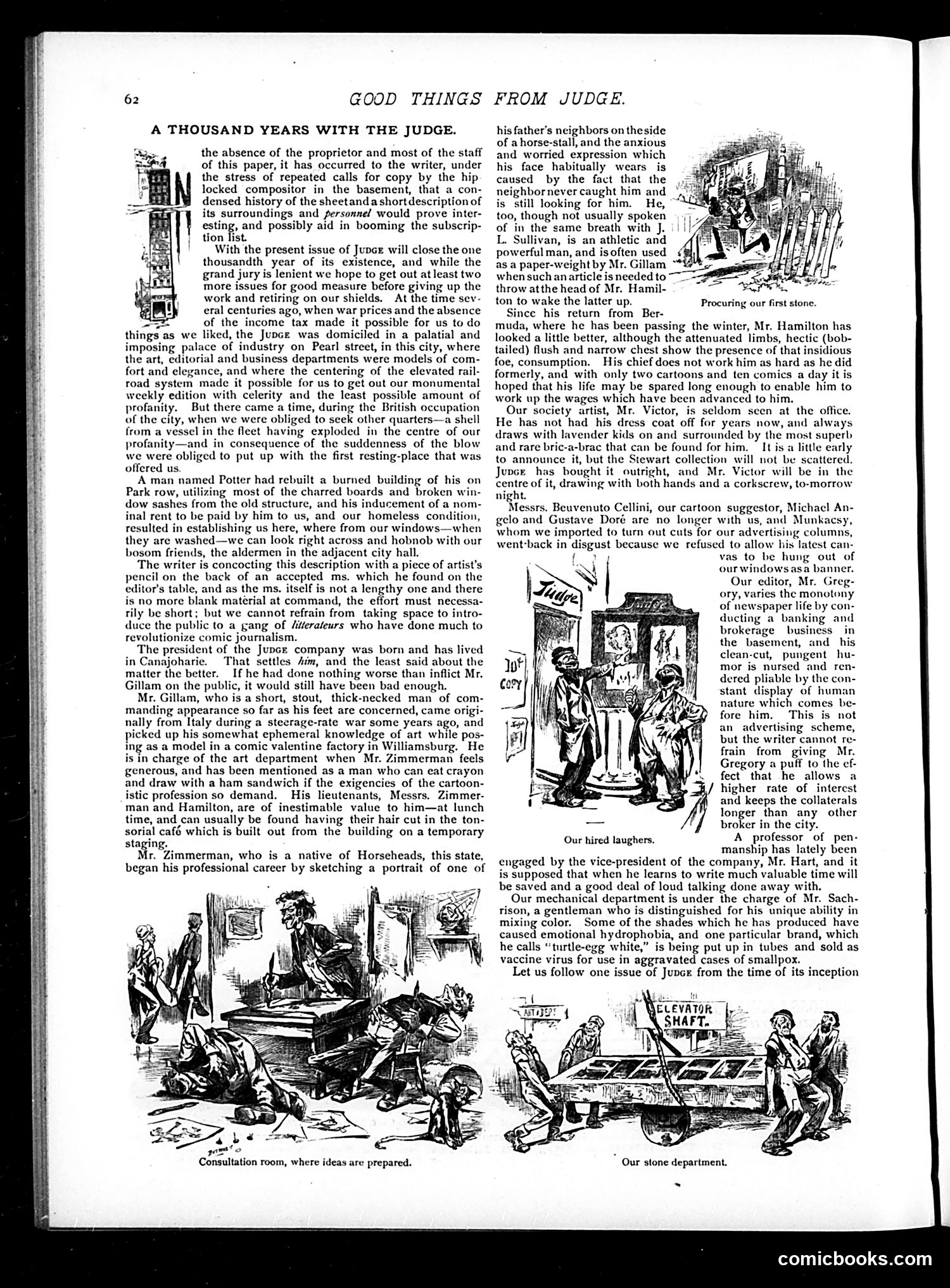
This is Judge magazine's humorous self-description of its own operations and staff. The article mockingly celebrates the magazine's "thousandth year" while admitting it may only survive a couple more issues. The text introduces cartoonists like **Mr. Gillam** (caricatured as short and thick-necked, having learned art in a Valentine factory), and **Messrs. Zimmerman and Hamilton**, described with tongue-in-cheek affection as more useful at lunchtime than during work. The accompanying illustrations show the magazine's actual workspace—the consultation room where ideas develop, the stone department for printing, and the building's proximity to City Hall. The satire targets the magazine's own chaotic operations, underfunded circumstances (the building was rebuilt from charred materials), and comically incompetent yet essential staff. It's essentially Judge joking about its own threadbare existence while celebrating the scrappy irreverence that defined 19th-century American satirical journalism.
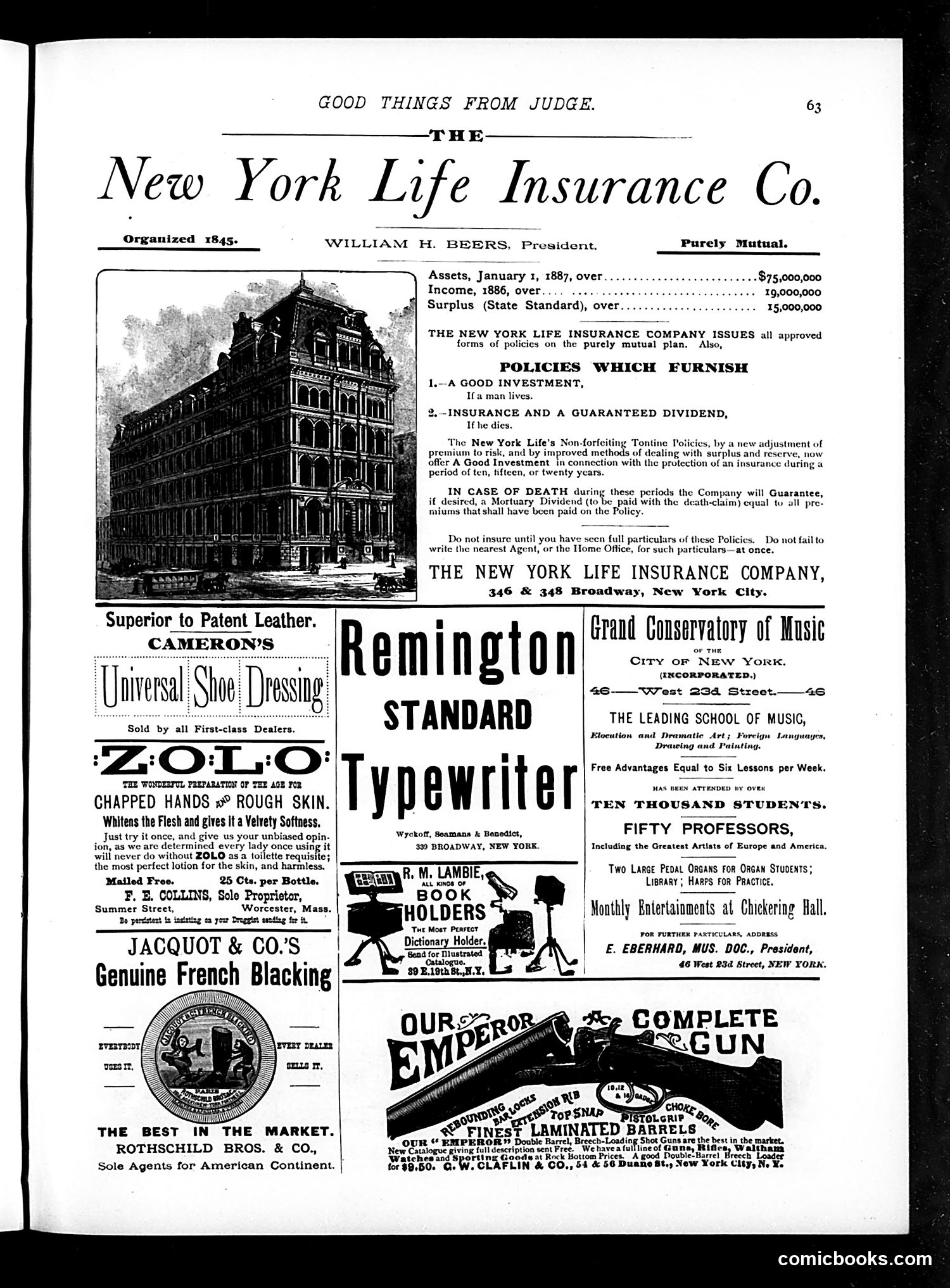
This is primarily an **advertising page**, not a satirical cartoon page. It features multiple commercial advertisements typical of late-1880s American magazines, including: - **New York Life Insurance Company** (dominant ad with building illustration) - **Remington Standard Typewriter** - **Cameron's Universal Shoe Dressing** (for chapped hands) - **Zolo** (skin preparation) - **Jacquot & Co.'s French Blacking** (shoe polish) - **Grand Conservatory of Music** (music school) - **Emperor Guns** (firearms) - Various smaller product ads The page demonstrates how Judge monetized through advertising rather than pure satire on this particular spread. The advertisements reflect upper-middle-class consumer goods and services of the Gilded Age—insurance, toiletries, writing technology, music education, and sporting equipment. No political figures or satirical commentary are visible; this is a straightforward commercial page from the magazine's back matter.
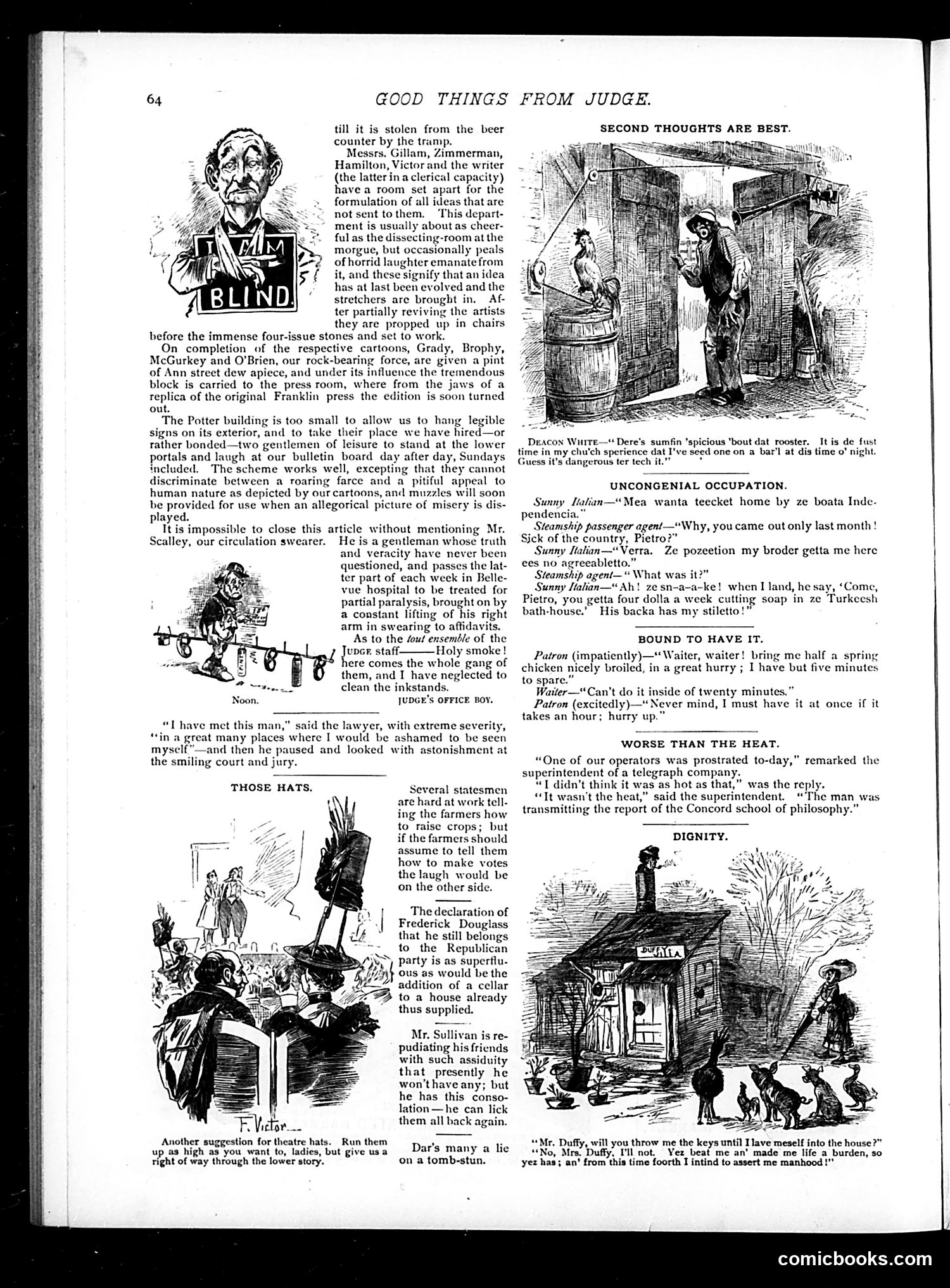
This page contains several satirical sketches and humorous anecdotes typical of Judge's format. The cartoons mock various social absurdities: **"Second Thoughts Are Best"** depicts a rooster in a farmyard, illustrating a dialogue about dangerous experiences. **"Those Hats"** features a caricatured figure (labeled "F. Victor") and satirizes theater hat etiquette—a recurring complaint in this era about women's elaborate hats obstructing theater patrons' views. The text sections include brief humorous vignettes about occupational complaints ("Uncongenial Occupation"), impatient diners ("Bound to Have It"), and workplace frustrations ("Worse Than the Heat"). **"Dignity"** shows a poor man maintaining composure despite hardship, commenting on working-class pride. These are typical Judge content: visual and textual humor targeting contemporary social conventions, workplace irritations, and class dynamics of the period.
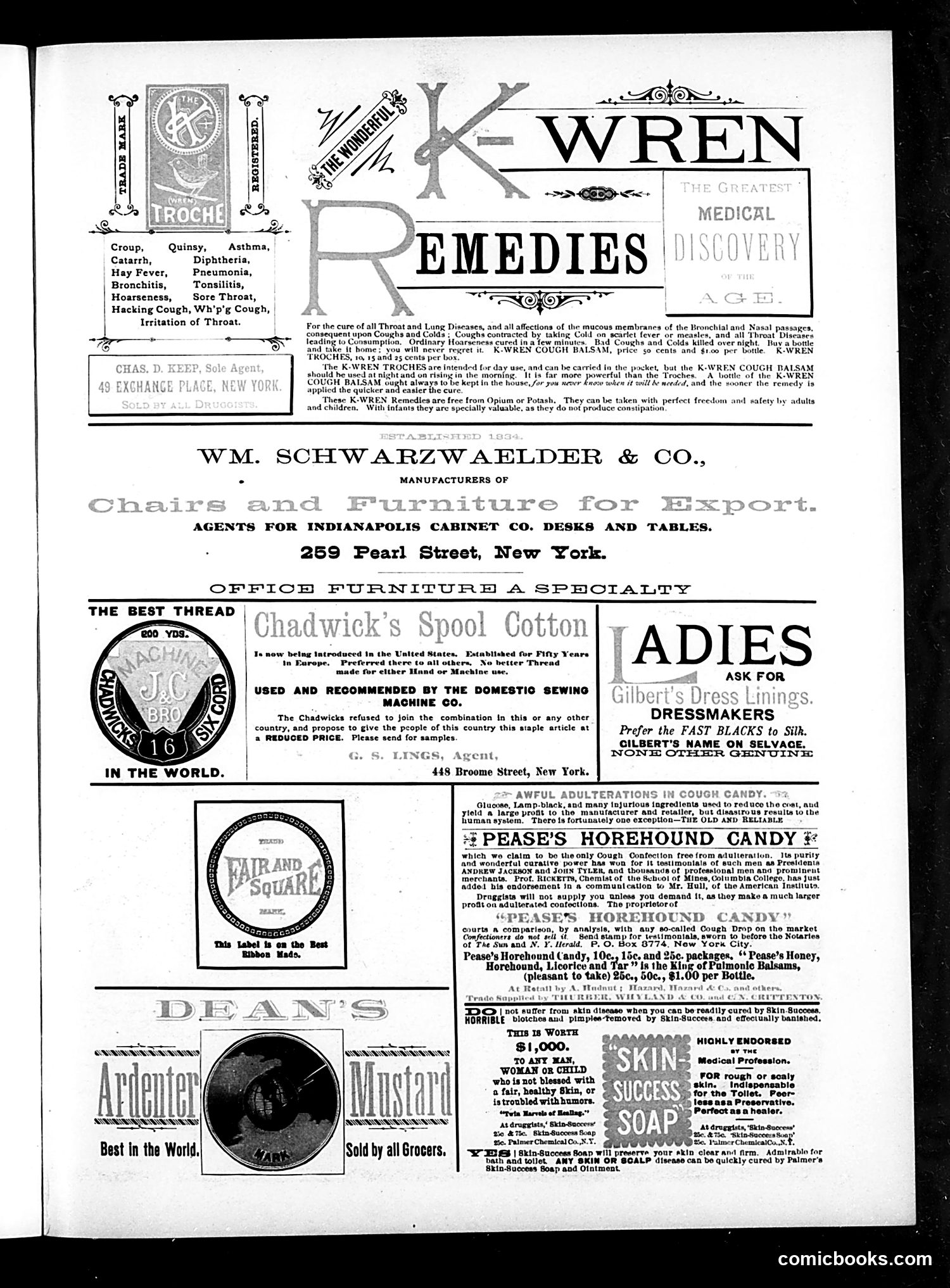
This is primarily an **advertising page**, not a satirical cartoon page. It contains numerous patent medicine and product advertisements typical of late 19th-century American magazines. The ads promote remedies for common ailments—K-Wren Cough Balsam for throat and lung diseases, Pease's Horehound Candy for coughs, and Skin-Success Soap for skin conditions. These advertisements feature exaggerated medical claims characteristic of the era, before FDA regulation of medicines. Notable is the emphasis on testimonials from prominent figures (Presidents Andrew Jackson and John Tyler are mentioned for Pease's Horehound Candy) to lend credibility—a common advertising tactic of the period. There are also ads for thread, furniture, sewing machine supplies, and dress materials from various New York companies. The page reflects Judge's business model: satirical content subsidized by advertising revenue. The ads themselves reveal contemporary consumer anxieties about health and appearance, but contain no visible political satire or social commentary beyond what the dubious medical claims implicitly mock.
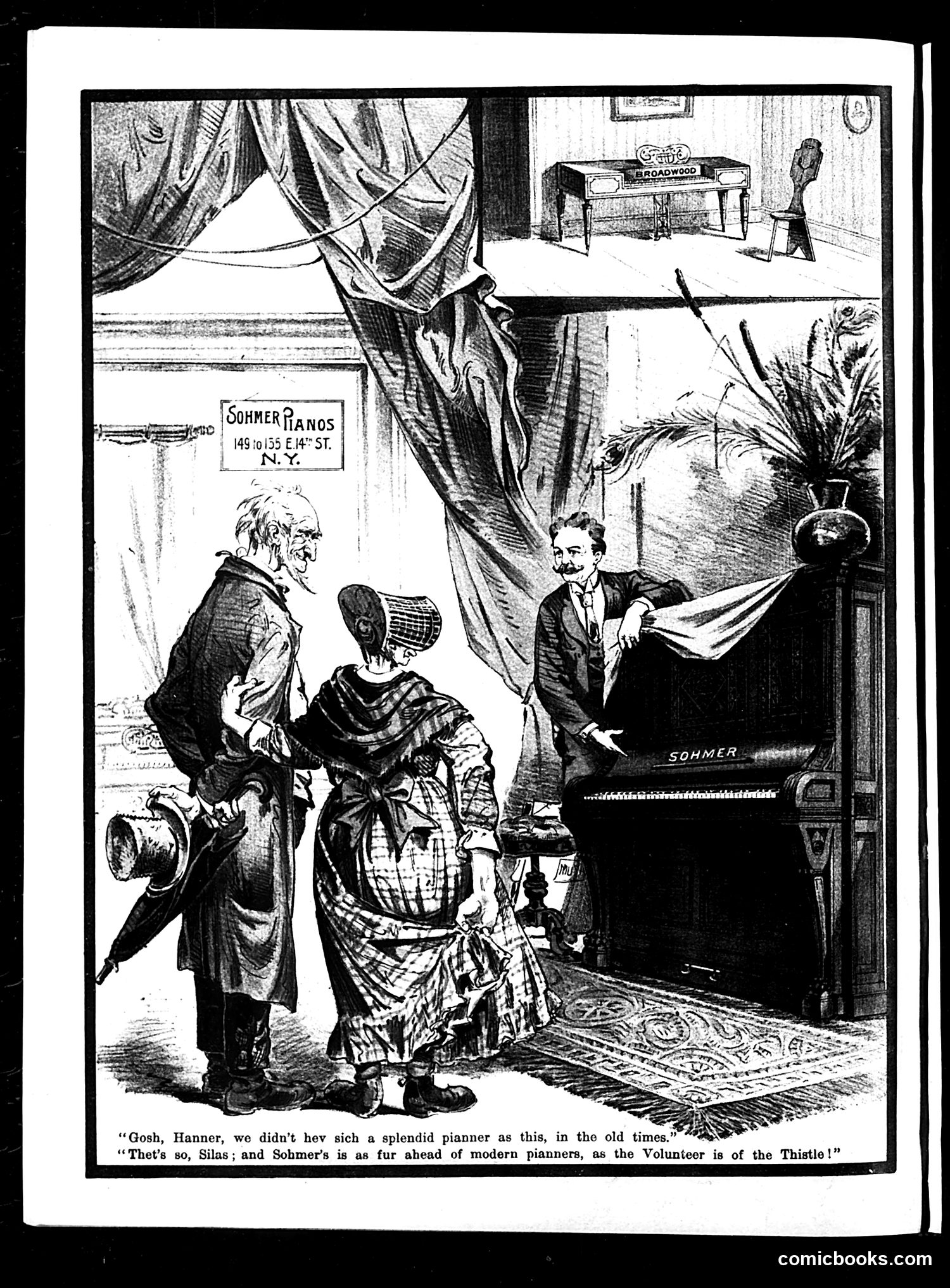
This is a **Sohmer Pianos advertisement** disguised as a cartoon. Two rural characters ("Hanner" and "Silas," speaking in dialect) marvel at a modern piano at what appears to be a showroom. The satire compares Sohmer pianos to the yacht race between the American "Volunteer" and Scottish "Thistle"—a famous 1887 America's Cup competition that symbolized American technological superiority. The joke: just as the Volunteer decisively beat the Thistle, Sohmer pianos are supposedly far ahead of competitors. The ad uses vernacular humor and patriotic boasting typical of Gilded Age advertising. The rural characters serve as "everyman" witnesses to American industrial progress and superiority. The page shows Sohmer's showroom address on East 147th Street, New York.

I can see this is a page from *Judge* magazine with the comicbooks.com watermark, but the image is almost entirely black or severely underexposed, making the actual content—whether cartoons, text, or advertisements—impossible to discern with any clarity. Without being able to see the illustrated figures, captions, or substantive text content, I cannot identify specific political references, caricatures, or the satirical points being made. The page appears to be a scanned archival document, but the image quality prevents meaningful analysis of its historical context or humor. To provide accurate analysis, a clearer image or higher-resolution scan would be needed.