
Judge, 1888 · page 9 of 69
Judge — 1888 — page 9: what you’re looking at
What you’re looking at
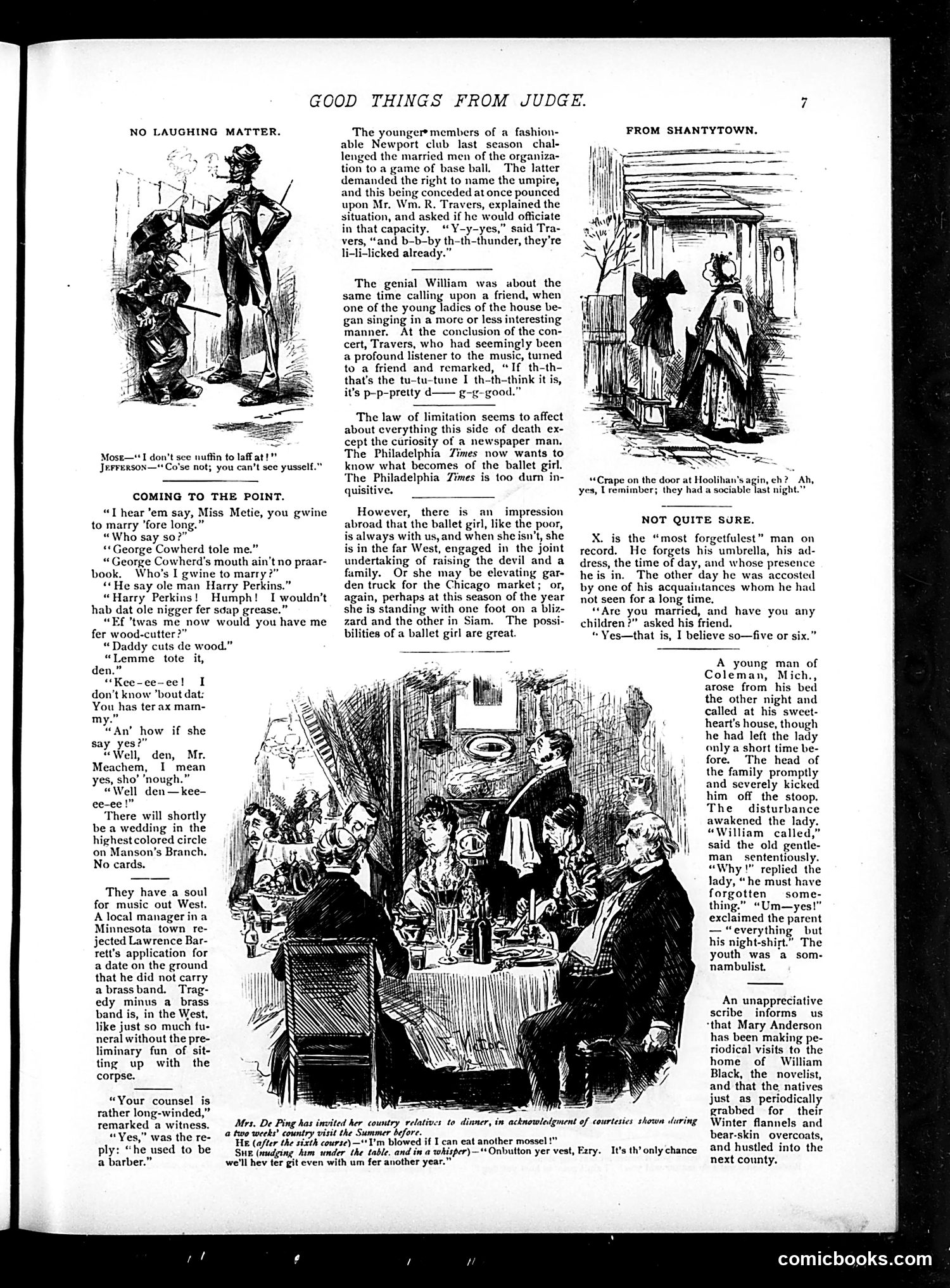
This page from Judge magazine contains several short satirical pieces typical of late-19th-century humor: **"No Laughing Matter"** and **"Coming to the Point"** are dialect comedies featuring African American characters in stereotypical speech patterns—reflecting the racist humor conventions of that era. The jokes rely on minstrelsy-style dialogue. **The Newport Club anecdote** mocks William R. Travers, a wealthy businessman known for his stammer, through his confident predictions about a baseball game and his assessment of a woman's singing. **"The Ballet Girl" section** satirizes newspaper voyeurism, suggesting journalists obsessively track the fates of chorus girls—implying they disappear into Western life or domestic obscurity. **The dinner illustration** shows a country family visitor struggling with multiple courses, humorously depicting rural-urban class differences. **"Not Quite Sure"** jokes about a chronically forgetful man who can't remember if he's married or how many children he has—absurdist humor about absent-mindedness. The overall tone is light social satire aimed at contemporary readers familiar with named figures and fashionable controversies.
📄 Transcribed text from this page (OCR, searchable)
Machine-transcribed from the original scan — historical spelling and the odd misread are preserved.
GOOD THINGS FROM JUDGE. NO LAUGHING MATTER. Mose—'I don't sce nuffin to laff at!" Jerrersox—*Co'se not; you can’t see yusself.” COMING TO THE POINT. “T hear ’em say, Miss Metie, you gwine to marry ‘fore long.” “Who say so?” “George Cowherd tole me.” “George Cowherd’s mouth ain't no praar- book. Who's I gwine to marry?” “He say ole man Harry Perkins.” “Harry Perkins! Humph! I wouldn't hab dat ole nigger fer soap grease.” “Ef ‘twas me now would you have me fer wood-cutter?” “Daddy cuts de wood.” “Lemme tote it, den.” “Kee-ee-ee! 1 don't know ‘bout dat: You has ter ax mam- aie y. “ An’ how if she say yes?” “Well, den, Mr. Meachem, I ‘mean es, sho’ ‘nough “Well den —kee- be a wedding in the highest colored circle on Manson's Branch. No cards. They have a soul for music out West. A local manager ina Minnesota town _re- jected Lawrence Bar- Tett’s application for a date on the ground that he did not carry a brass band. Trag- edy minus a_ brass band is, in the West, like just so much tu- neral without the pre- liminary fun. of sit- ting up with the corpse. “Your counsel is rather long-winded,” remarked a witness. The younger*members of a fashion able Newport club last season chal- lenged the married men of the organiza- tion to a game of base ball. The latter demanded the right to name the umpire, and this being conceded at once pounced upon Mr. Wm. R. Travers, explained the situation, and asked if he would officiate in that capacity. “Y-y-yes,” said Tra- vers, “and b-b-by th-th-thunder, they're li-li-licked already.” The genial William was about the same time calling upon a friend, when one of the young ladies of the house be- gan singing in a more or less interesting manner. At the conclusion of the con- cert, Travers, who had seemingly been a profound listener to the music, turned to a friend and remarked, “If th-th- that’s the tu-tu-tune I th-th-think it is, it’s p-p-pretty d—— g-g-good.” The law of limitation seems to affect about everything this side of death ex- cept the curiosity of a newspaper man, The Philadelphia Zimes now wants to know what becomes of the ballet girl. The Philadelphia Zimes is too durn in- quisitive. However, there is an_ impression abroad that the ballet girl, like the poor, is always with us, and when she isn’t, she is in the far West, engaged in the joint undertaking of raising the devil and a family. Or she may be elevating gar- den truck for the Chicago market; or, again, perhaps at this season of the year she is standing with one foot on a bli: zard and the other in Siam. The possi- bilities of a ballet girl are great. Mrs. De Ping has invited her country relatives to dinner, in acknowledgment of courtesies shown during “Yes,” was the ree @ M00 weeks" country visit the Summer before. ply: “he used to be a barber.” He (after the sixth course) —"' I'm blowed if I can eat another mossel !" v Sue ae ‘him under the table. and in a whisper)—*Onbutton yer vest, Ezty. It’s th’only chance 2nd hustled into the we'll hev ter git even with um fer another year.” FROM SHANTYTOWN. “«Crape on the door at Hoolihan’s agin, eh? Ah, yes, Lremimber; they had a sociable last night.” NOT QUITE SURE. X. is the “most forgetfulest” man on record. He forgets his umbrella, his ad- dress, the time of day, and whose presence heis in. The other day he was accosted by one of his acquaintances whom he had. not seen for a long time. “Are you married, and have you any children?” asked his friend. « Yes—that is, I believe so—five or six.” A young man of Coleman, Mich., arose from his bed the other night and called at his sweet- heart's house, though he had left the lady only a short time be- fore. The head of the family promptly and severely kicked him off the stoop. The disturbance awakened the lady. “William called,” said the old gentle- man_ sententiously. “Why !” replied the lady, “he must have forgotten some- thing.” “Um—yes!” exclaimed the parent — “everything but his night-shirt.” The youth was ‘a som- nambulist. An unappreciative scribe informs us ‘that Mary Anderson has been making pe- riodical visits to the home of William Black, the novelist, and that the, natives just as periodically grabbed for their Winter flannels and bear-skin overcoats, next county. comicbooks.com