
A complete issue · 114 pages · 1926
The Frontier, May 1926
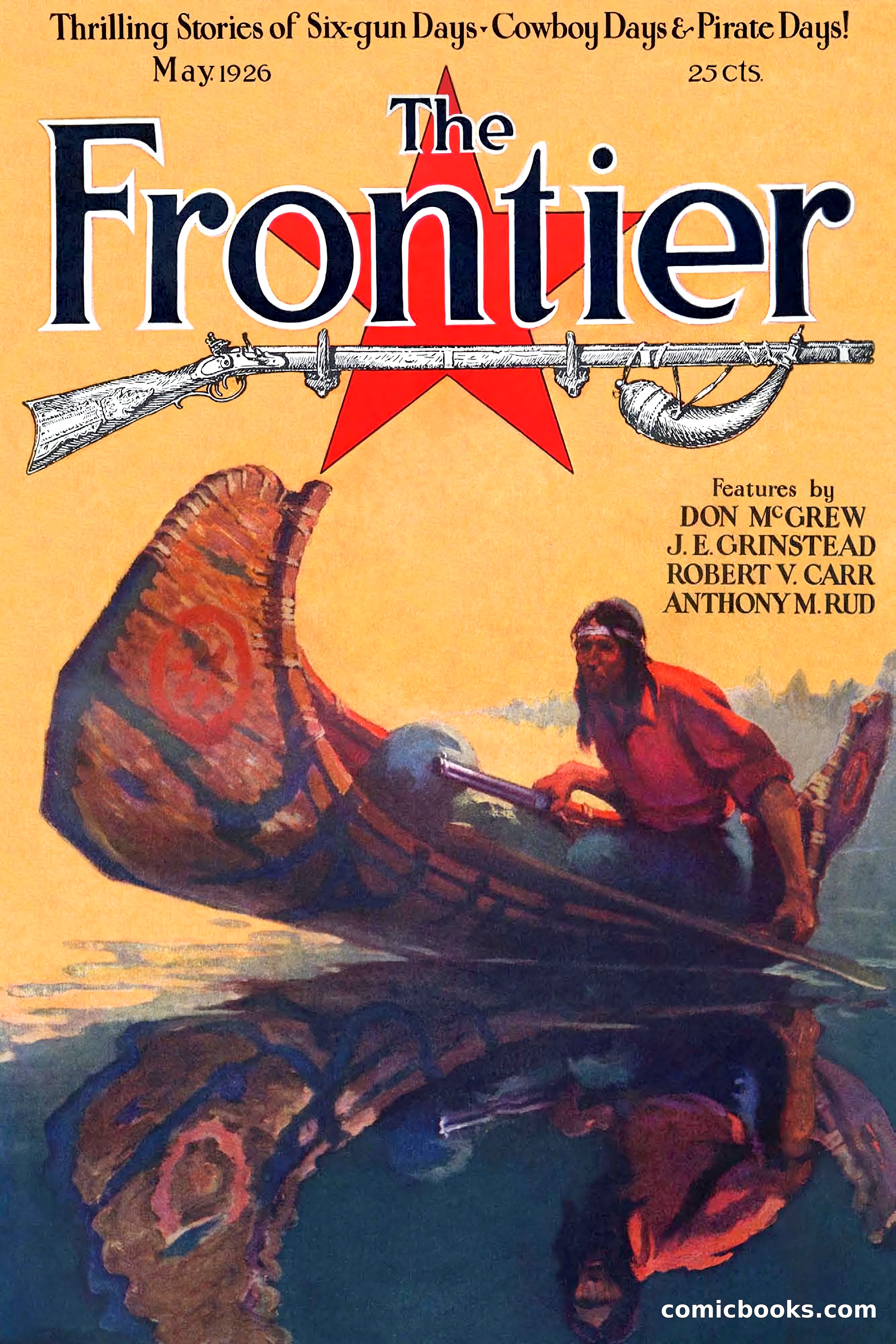
# The Frontier Magazine Cover - May 1926 This is the cover of *The Frontier*, a May 1926 pulp magazine priced at 25 cents. The cover features an illustration of a bearded man in a red shirt in a canoe or small boat on water, with what appears to be a large fish or marine creature visible beneath the surface. The cover promises "Thrilling Stories of Six-gun Days, Cowboy Days & Pirate Days" and lists featured authors including Don McGrew, J.E. Grinstead, Robert V. Carr, and Anthony M. Rud. A rifle and powder horn are depicted across the top of the title, emphasizing the adventure-themed content of this pulp publication.
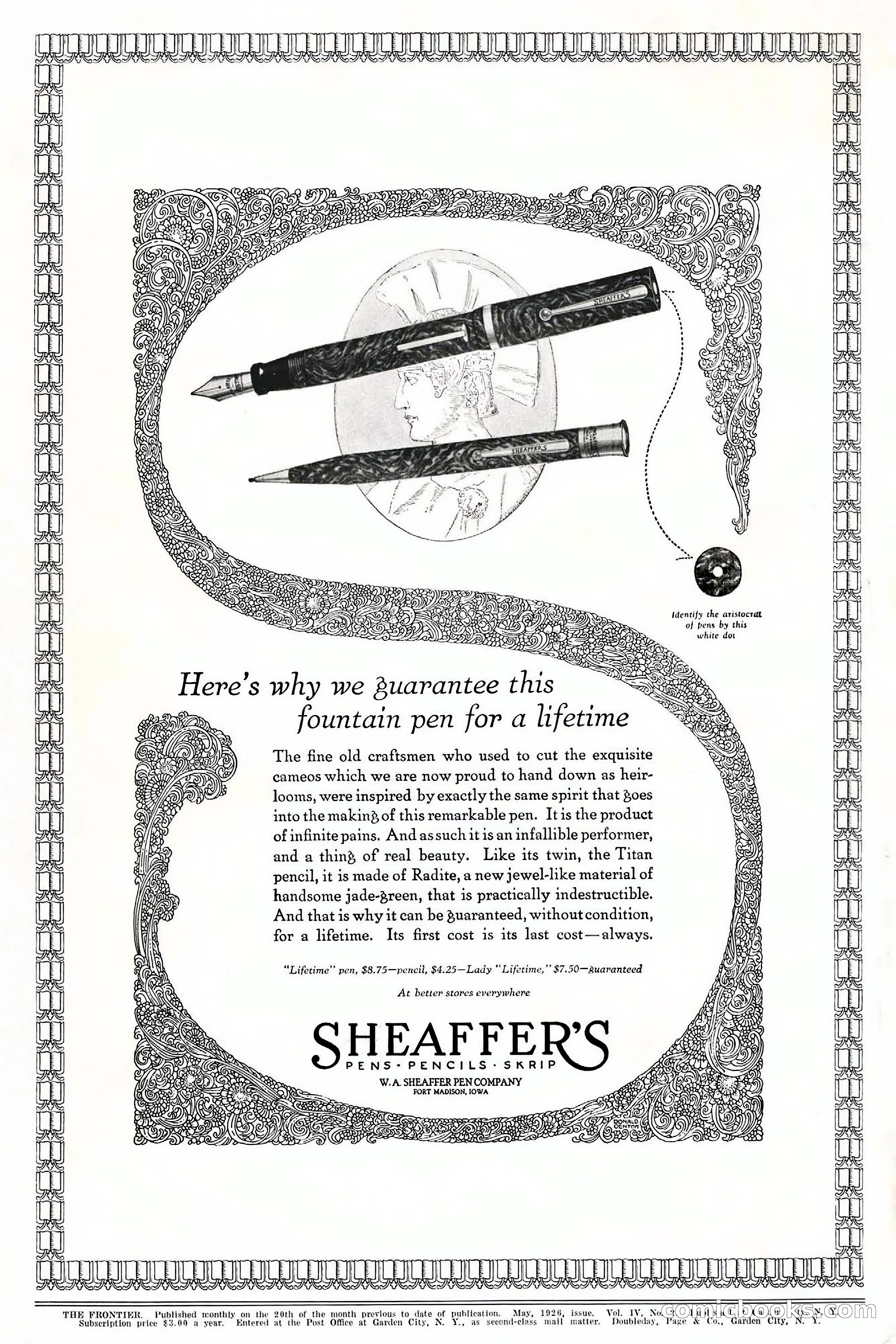
# Advertisement Page This is a full-page advertisement for Sheaffer's fountain pens and pencils, prominently featuring an ornate decorative border. The ad displays two writing instruments (a fountain pen and mechanical pencil) positioned over a classical profile illustration. The headline reads "Here's why we guarantee this fountain pen for a lifetime," followed by marketing text explaining that the pen is made of Radite (described as an indestructible jade-green material) and crafted with the same quality as heirloom looms. The copy emphasizes the pen's durability and lifetime guarantee. Pricing and product details appear at the bottom, with the company name "SHEAFFER'S" and Fort Madison, Iowa address clearly displayed.
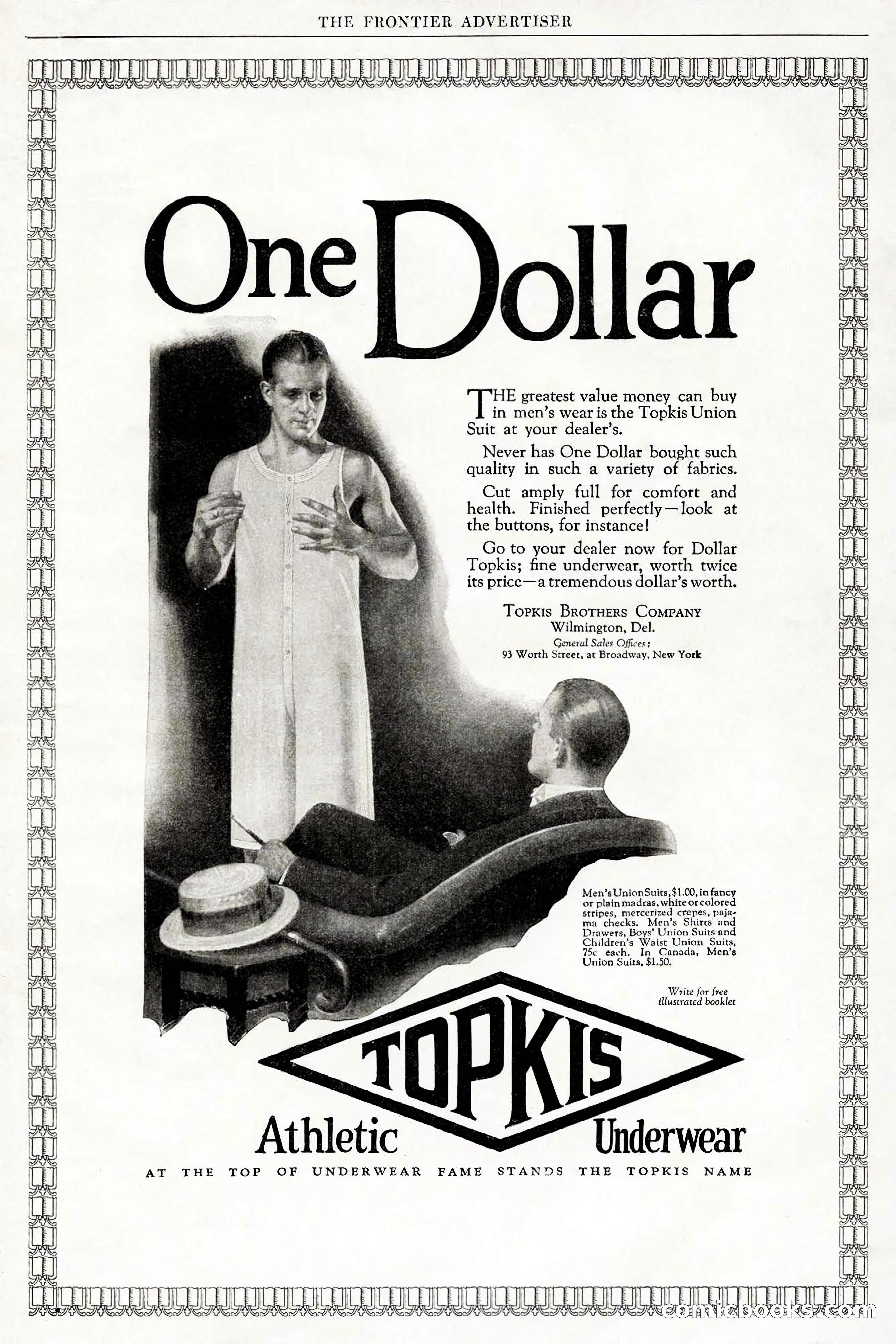
This page is an advertisement, not editorial content from the magazine itself. It promotes Topkis Union Suit underwear for men, priced at one dollar. The ad features a black-and-white photograph showing two men—one standing and displaying an undershirt, the other seated and observing. The advertisement emphasizes the value and quality of the garment, highlighting its variety of fabrics, comfortable fit, and careful construction with attention to details like buttons. The Topkis Brothers Company, based in Wilmington, Delaware, with sales offices in New York, markets this as affordable, quality men's underwear available at dealers.
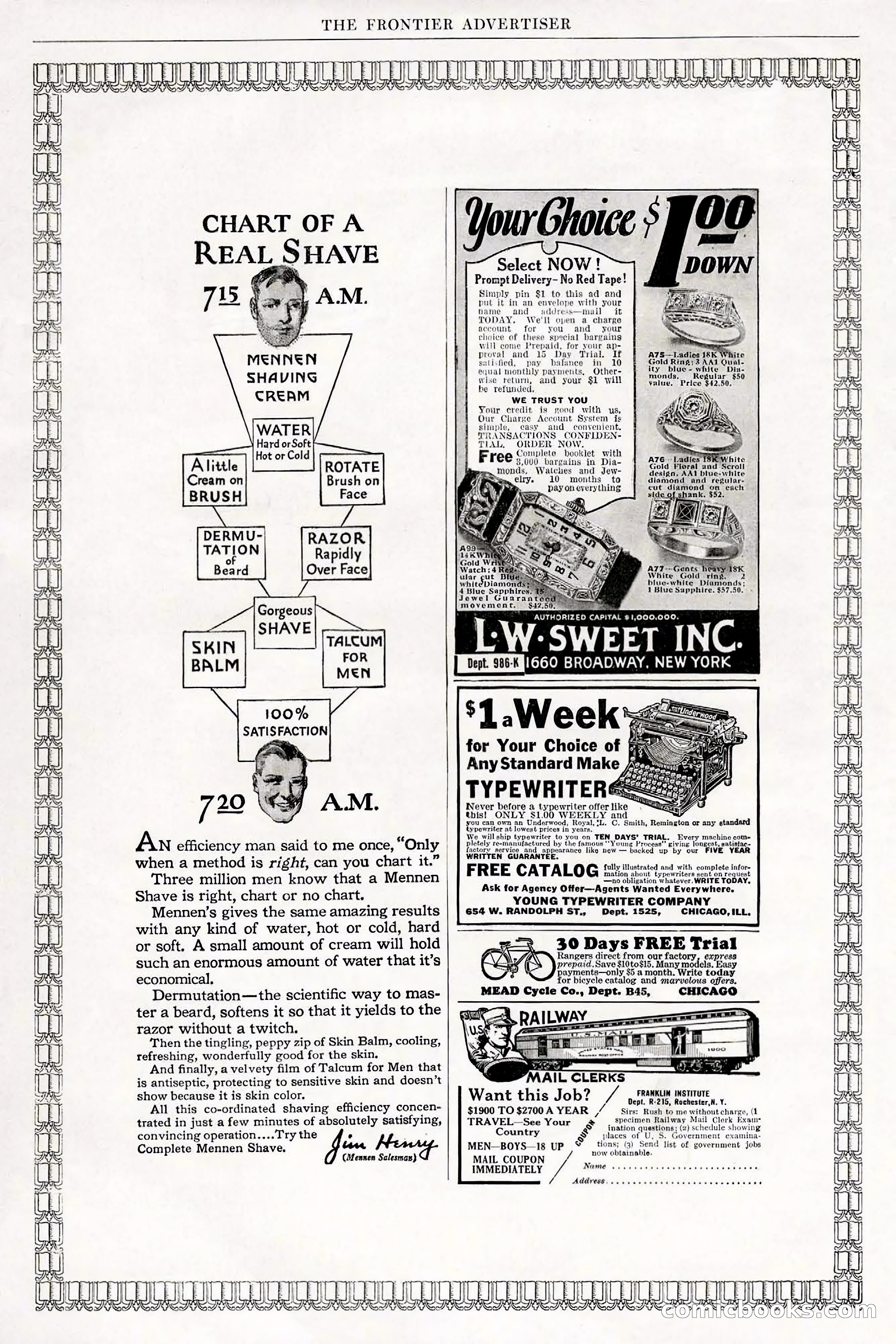
This page is an advertisement section from *The Frontier Advertiser*. The left side features a flowchart titled "Chart of a Real Shave" illustrating the Mennen shaving cream process from 7:15 a.m. to 7:20 a.m., describing the application of shaving cream, water, and razor technique, followed by skin balm and talc. The right side contains multiple advertisements for jewelry (J.W. Sweet Inc.), typewriters (Young Typewriter Company), bicycles (Mead Cycle Co.), and a railway mail clerk job posting. The page is entirely composed of advertisements and promotional content with no story prose or illustrations visible.
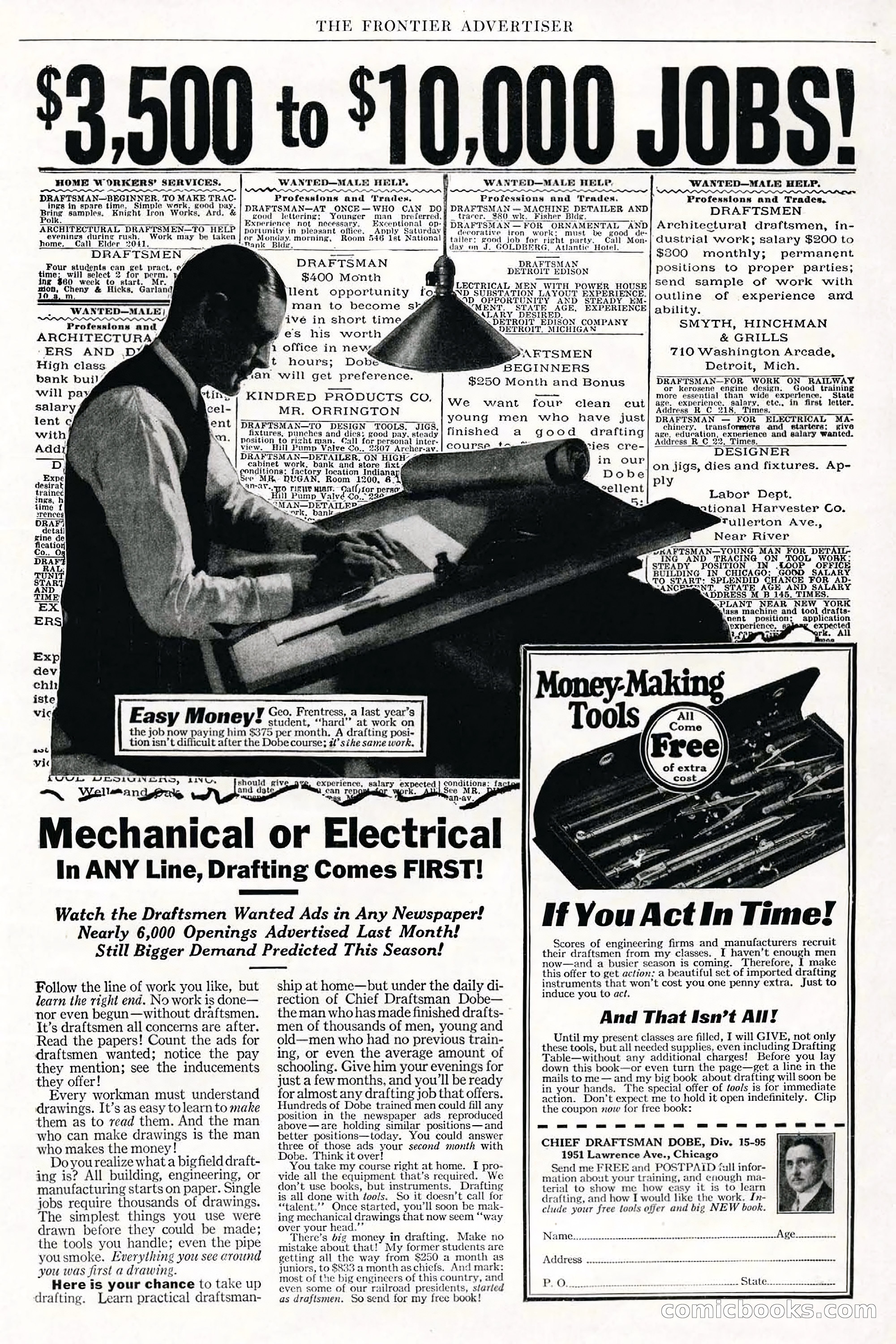
# Description This is an **advertisement page** from *The Frontier Advertiser*, not a pulp fiction story page. The page is dominated by job recruitment ads offering "$3,500 to $10,000 Jobs!" primarily for draftsmen in architectural, mechanical, and electrical fields. The central image shows a man working on technical drawings. Surrounding text emphasizes the demand for drafting skills and encourages readers to learn drafting through correspondence courses. Multiple smaller classified ads advertise specific positions and training opportunities. At the bottom, an advertisement for "Money-Making Tools" promotes drafting instruments, while another ad promises free training materials for aspiring draftsmen. The page functions entirely as employment and vocational advertising.
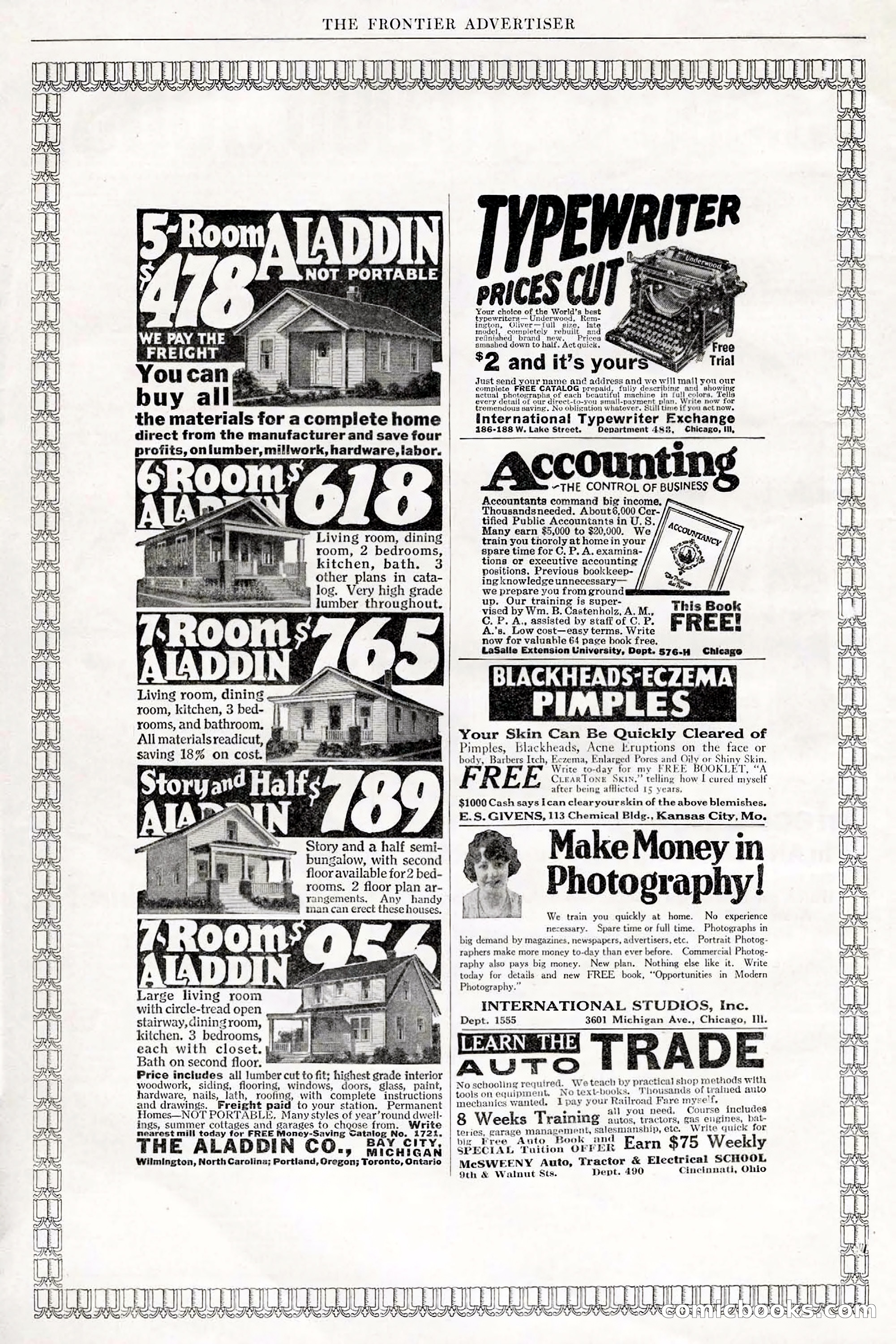
# Page Analysis This is an **advertising page** from *The Frontier Advertiser*, filled entirely with classified and display advertisements from the early 20th century. The visible ads promote mail-order merchandise and services: prefabricated Aladdin homes in various configurations (ranging from $478 to $952), a typewriter with discounted pricing, an accounting correspondence course claiming to train public accountants, a skin-care product promising to cure pimples and eczema, a photography training program, an auto-trade correspondence course, and miscellaneous other mail-order opportunities. The page demonstrates the era's reliance on pulp magazines as advertising vehicles for home building kits, correspondence courses, and patent medicines—reflecting consumer culture and entrepreneurial aspirations of the period.
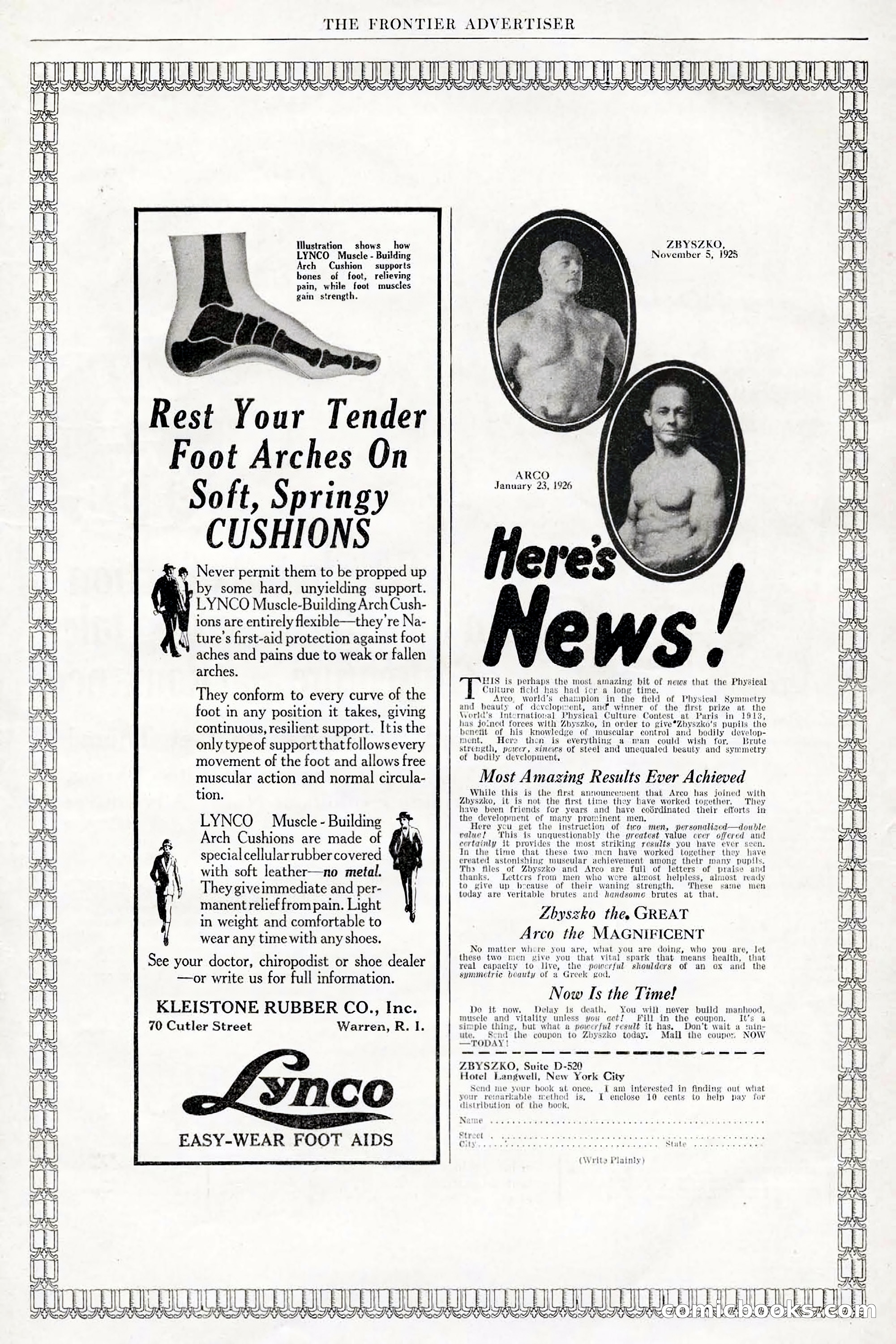
# Page Analysis This is an **advertising page** from *The Frontier Advertiser* (November 5, 1925). The page contains two advertisements: on the left, Lynco Muscle-Building Arch Cushions by Kleistone Rubber Co. promote foot support through flexible arch support; on the right, an advertisement for "Arco the Magnificent" features two photographs of muscular men and promotes physical development and training methods. The Arco ad includes a coupon for interested readers to mail to Zbyszko in New York City. Both advertisements target personal health and physical improvement—typical concerns for early-twentieth-century readers.
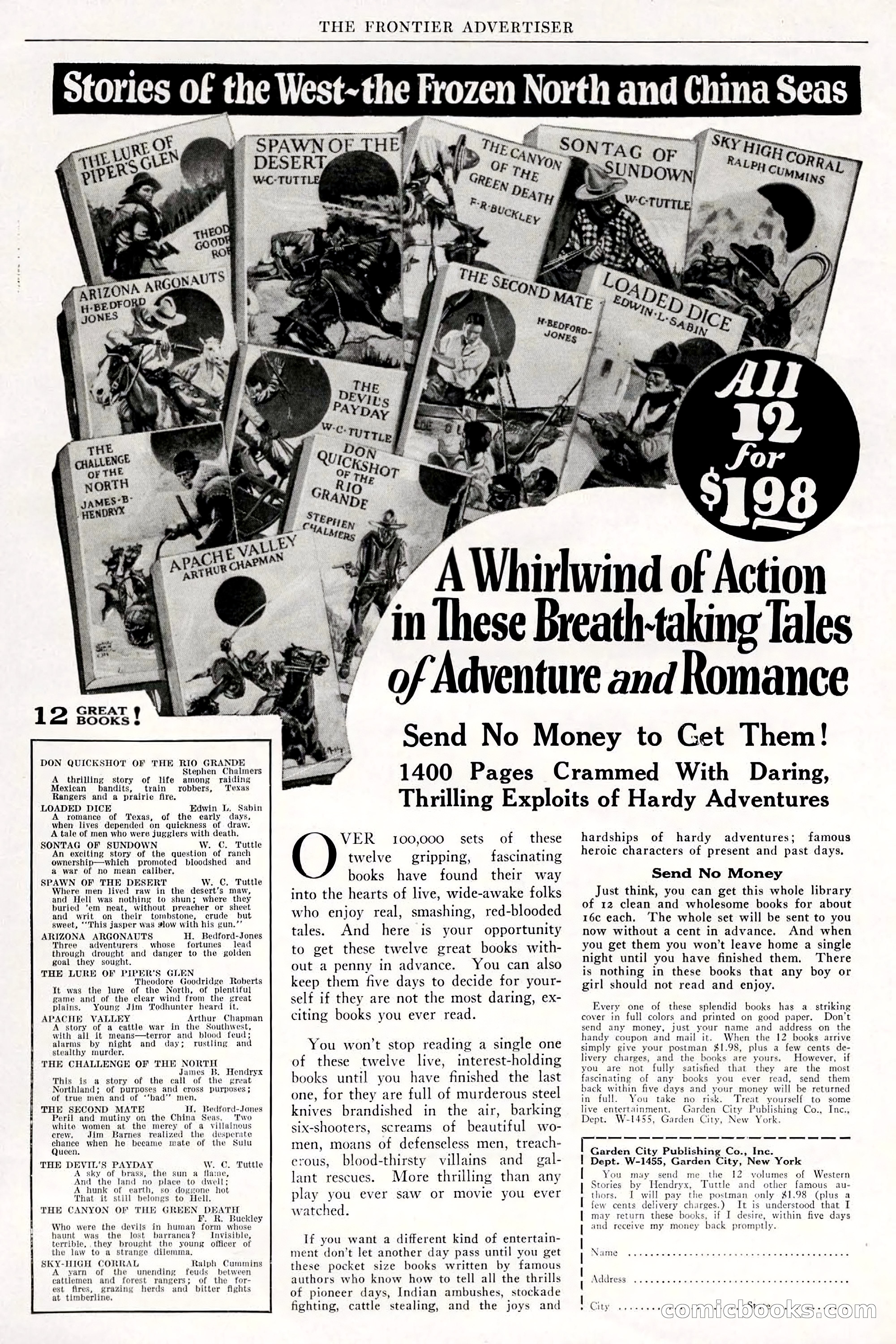
This is an advertisement page from *The Frontier Advertiser* promoting a mail-order book collection. The page displays twelve book covers arranged in a fan pattern, advertising "Stories of the West—the Frozen North and China Seas." The ad offers all twelve adventure and romance books for $1.98 with no money required upfront—customers receive the books first and decide within five days whether to keep them. The text emphasizes the collection contains "1400 Pages Crammed With Daring, Thrilling Exploits of Hardy Adventures" featuring tales of the Old West, polar regions, and Asian settings. Individual book titles visible include works by authors like W.C. Tuttle, Arthur Chapman, and H. Bedford-Jones.
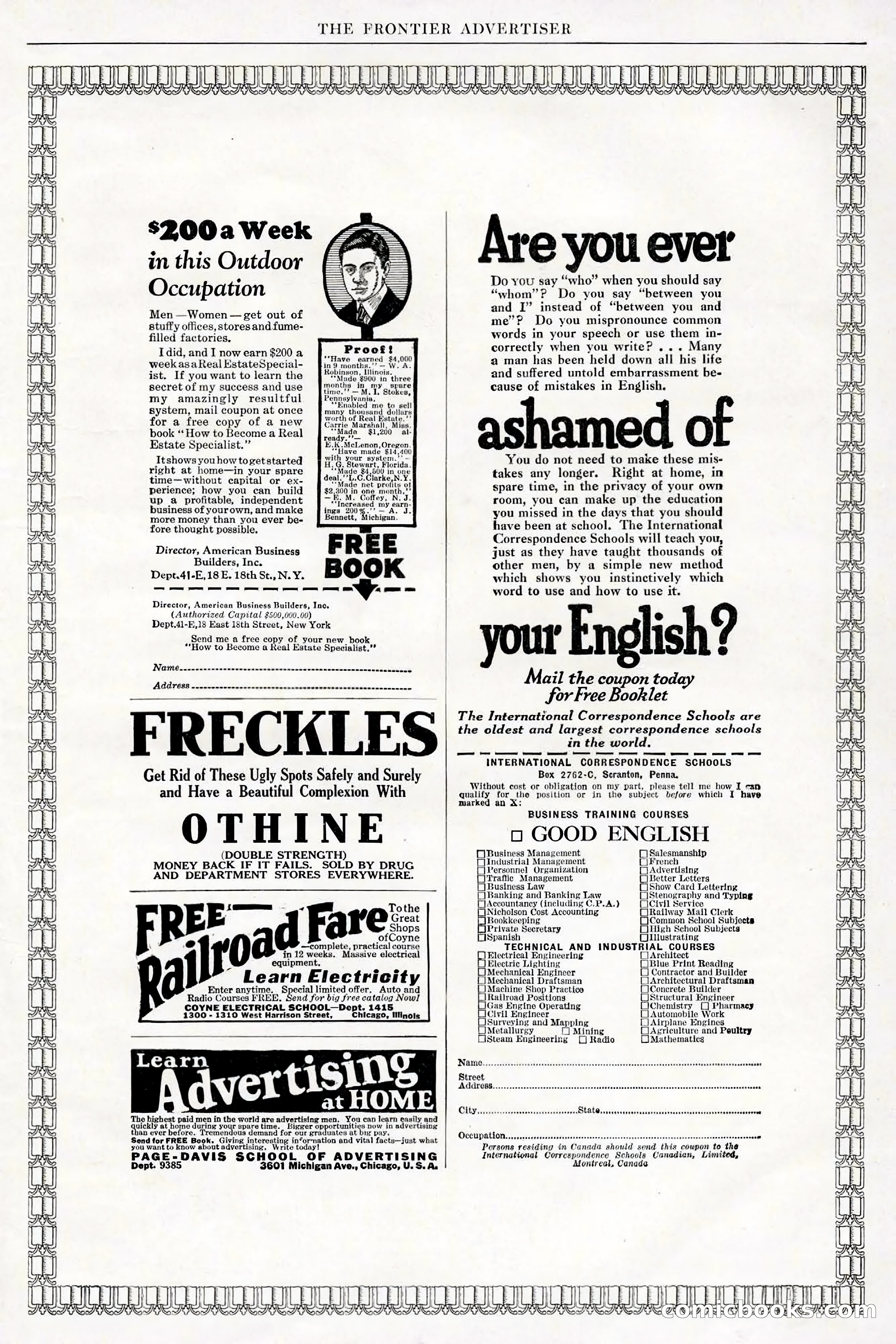
# Description This is an **advertisement page** from *The Frontier Advertiser*. The page consists entirely of classified advertisements and promotional materials for various correspondence schools and mail-order courses popular in the early 20th century. The largest advertisements promote English language instruction through the International Correspondence Schools, a freckle-removal product called Othine, a free railroad fare offer, real estate training, and advertising education through the Page-Davis School of Advertising. Smaller ads include a help-wanted notice for outdoor work and various business training courses. The page is bordered with decorative typography typical of the era.
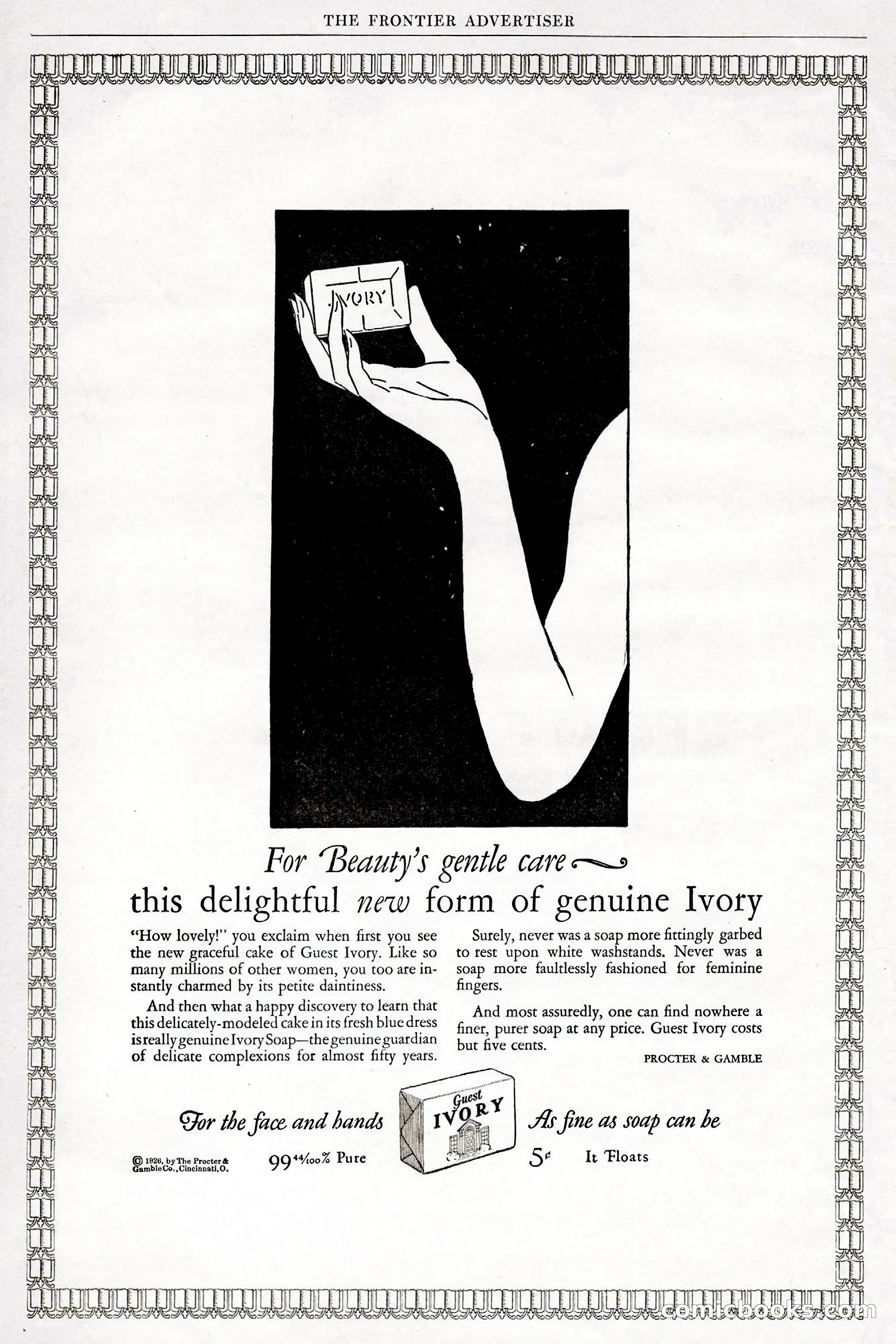
# Advertisement Page This is a full-page advertisement from *The Frontier Advertiser*, featuring a stylized illustration of a hand holding a bar of Guest Ivory soap against a black background. The ad promotes a new cake form of genuine Ivory soap marketed for "Beauty's gentile care," emphasizing its suitability for facial and hand washing. The text highlights the product's purity (99 44/100% pure), affordability (five cents), and gentleness on delicate skin. Made by Procter & Gamble, the soap is described as floating and fine-quality, with the advertisement using period language praising its elegance and suitability for feminine use.
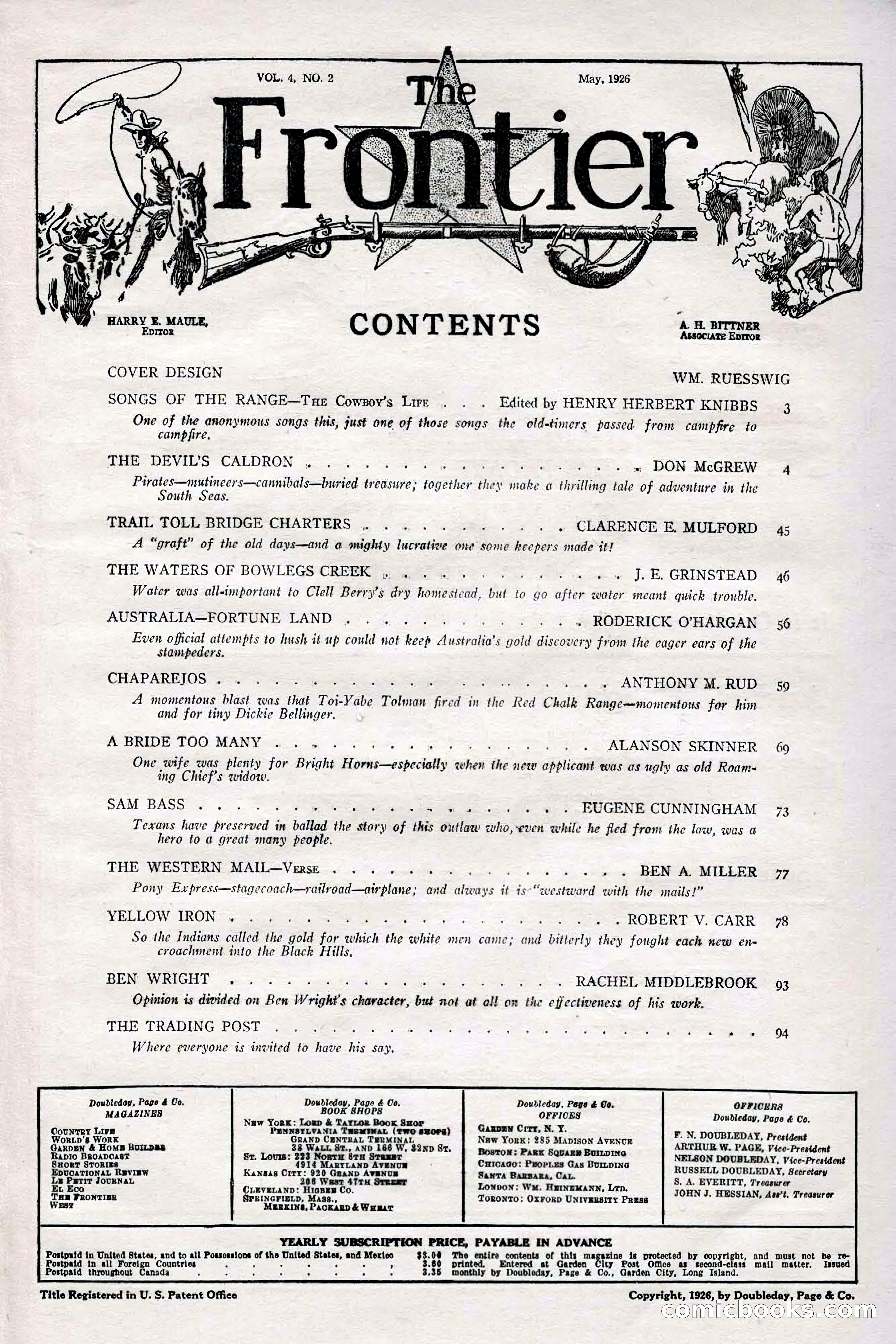
# Table of Contents Page This is the contents page from *The Frontier* magazine (Vol. 4, No. 2, May 1926). It lists twelve stories and features in this issue, including "Songs of the Range" edited by Henry Herbert Knibbs, "The Devil's Caldron" by Don McGrew about pirates and treasure, "Trail Toll Bridge Charters" by Clarence E. Mulford, and "Sam Bass" by Eugene Cunningham about an outlaw. Other pieces include "A Bride Too Many," "Yellow Iron" about conflict over gold in the Black Hills, and "Ben Wright" by Rachel Middlebrook. The page also displays publisher information and subscription rates at the bottom.
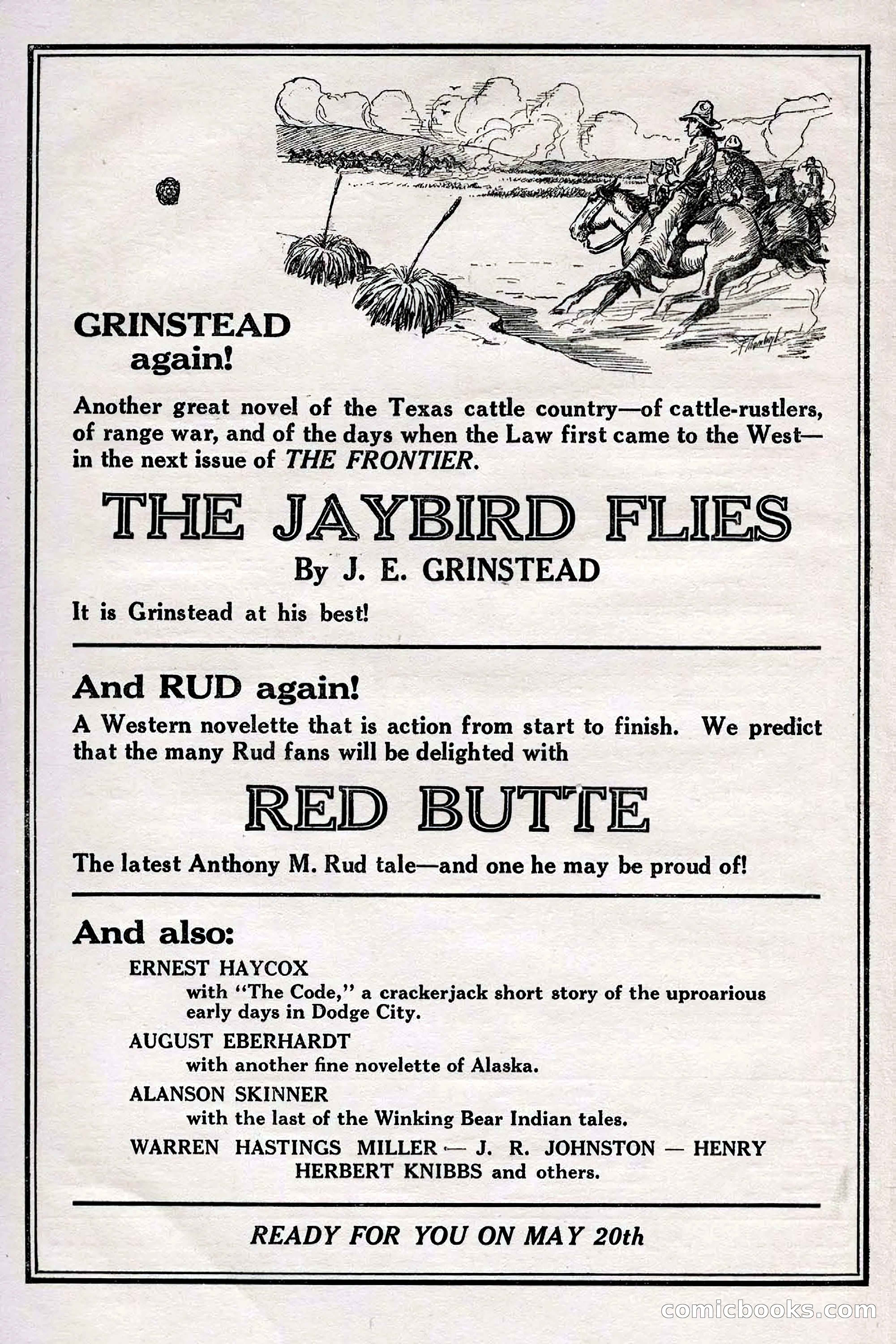
This is an advertisement page from a pulp magazine announcing upcoming stories in the next issue of *The Frontier*. The page features an illustration of cowboys on horseback herding cattle, depicting the Western genre. The main advertisement promotes "The Jaybird Flies" by J.E. Grinstead, described as a novel about Texas cattle country, cattle-rustlers, and range war. Additional stories advertised include "Red Butte" (an Anthony M. Rud tale), works by Ernest Haycox, August Eberhardt, and Alanson Skinner, among others. The page promises these stories will be "Ready for You on May 20th."
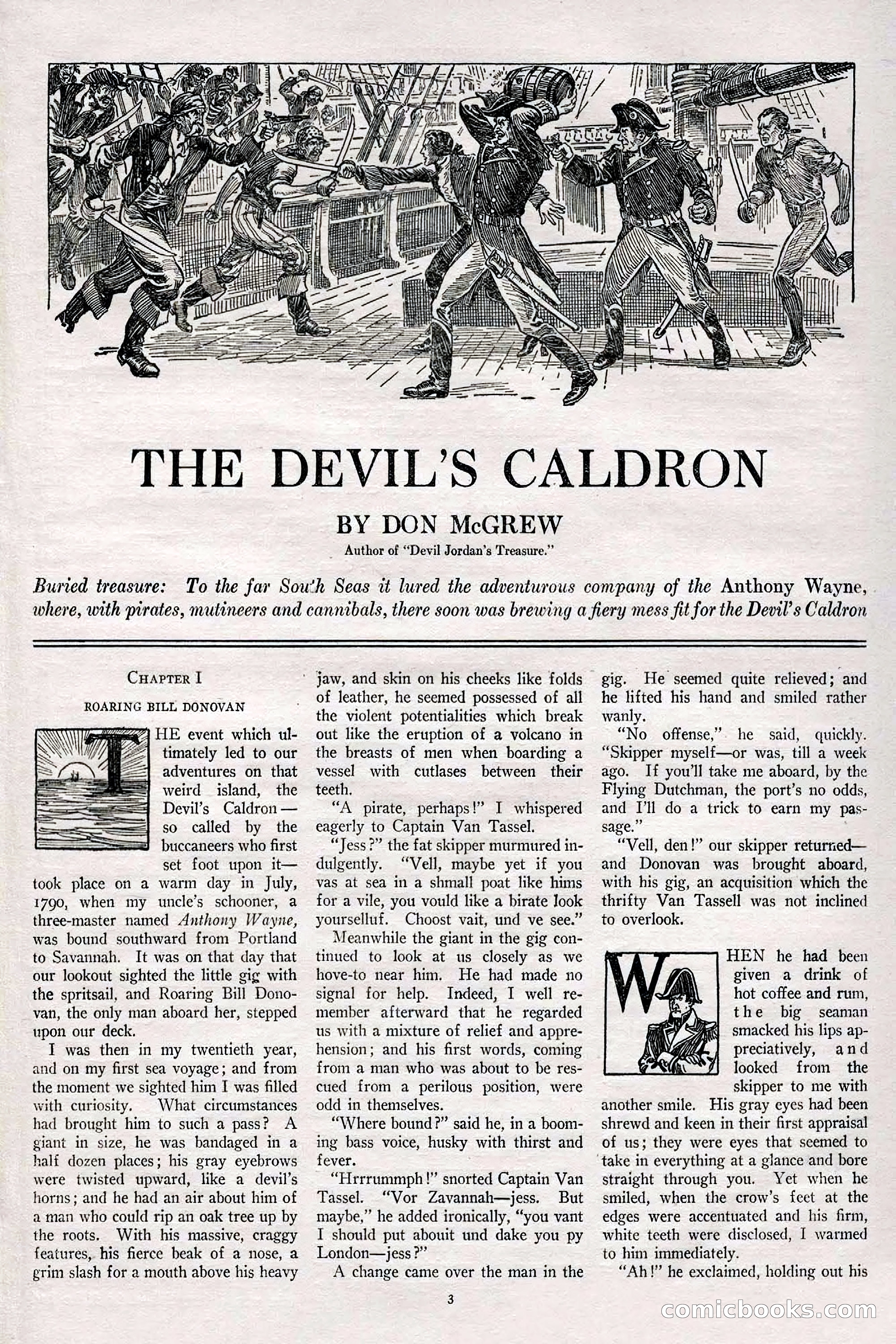
# Page Analysis This page contains the opening of a serialized adventure story titled "The Devil's Caldron" by Don McGrew. The top features a dramatic woodcut illustration depicting armed figures in what appears to be a ship's deck, with some men fighting or struggling. Below the illustration is the story's opening, labeled "Chapter 1: Roaring Bill Donovan," which begins with the narrator recounting an event involving a ship called the *Anthony Wayne* and a mysterious island called the Devil's Caldron. The text describes the narrator's first sea voyage at age twenty and an encounter with a giant pirate captain named Bill Donovan. This appears to be a typical pulp adventure story from an early-twentieth-century magazine.
This is a page of story prose from "The Frontier," showing Chapter II titled "A Battered Ship." The text describes a conversation between sailors aboard a vessel, with one character named Donovan and another identified as Captain Van Tassel discussing encounters with pirates. The narrative mentions a ship named the *Iceluster*, which appears damaged and is described as a British merchant vessel with numerous battle wounds. The prose discusses the ship's condition, the crew's observations of damage from cannon shot, and dialogue between characters assessing the vessel's seaworthiness. A small illustration appears at the chapter heading showing what appears to be a ship's figurehead or nautical imagery.
This page is story prose from "The Devil's Caldron," showing two columns of text with a small illustration embedded partway down. The narrative describes a tense encounter aboard a ship where the captain of the *Retriever* questions the narrator's skipper about their vessel and crew. The dialogue reveals they're preparing for potential combat, with references to loading weapons and positioning men. The embedded illustration shows what appears to be sailors on deck. The text depicts naval conflict or piracy in what seems to be a historical adventure or maritime story, with period-appropriate nautical terminology and characterization typical of early pulp fiction.
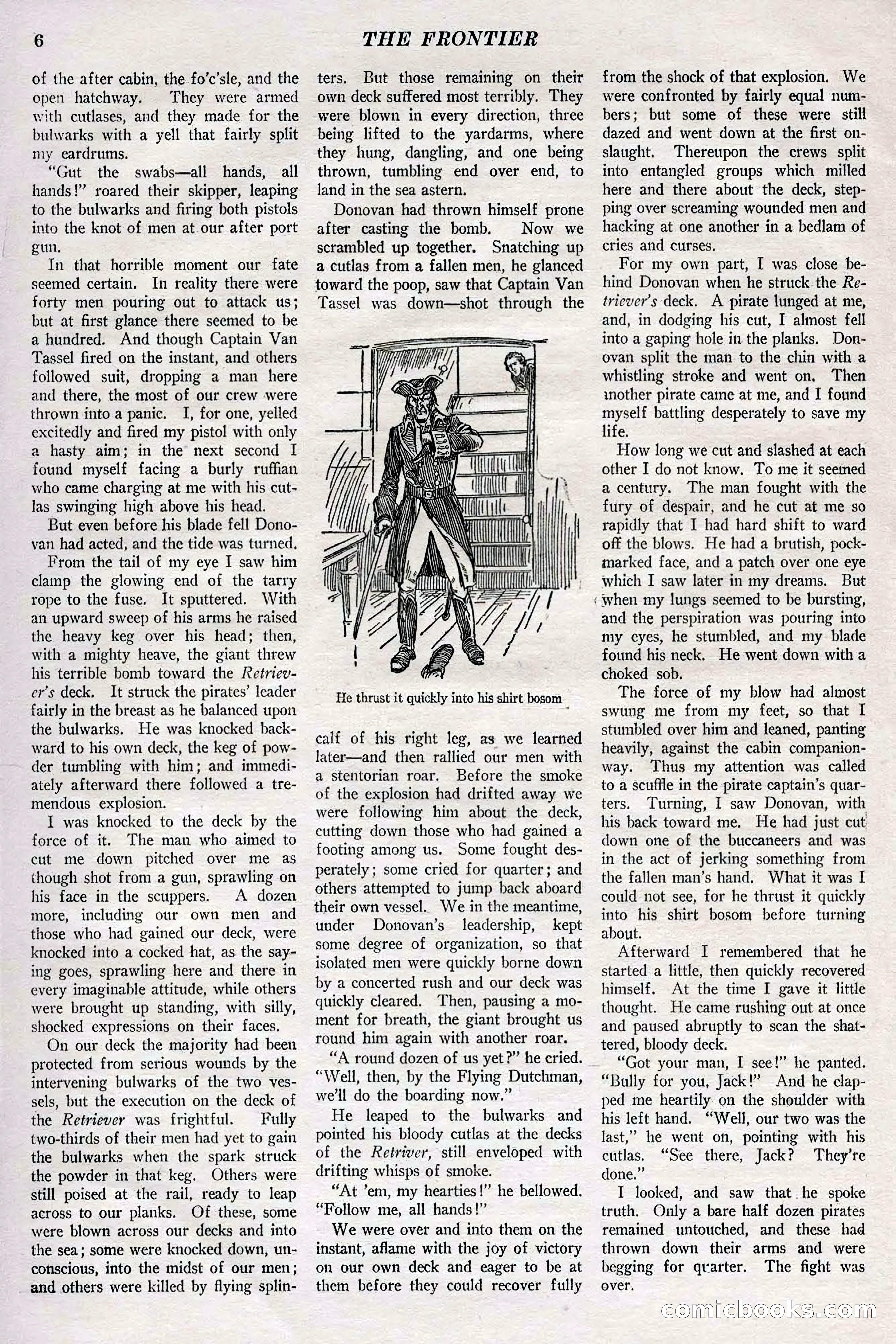
# Page Analysis This is a text page from a pulp fiction story titled "The Frontier," containing two columns of prose narrative and a single illustration. The story depicts a naval battle between what appears to be merchant ships and pirates. The visible text describes intense combat, with the narrator recounting cannon fire, explosions, and hand-to-hand fighting on deck. The illustration shows a pirate captain in period dress thrusting something into his shirt bosom. The narrative focuses on the chaos of the attack, crew casualties, and a climactic moment where the pirate leader and the narrator's captain engage in combat, with the pirates ultimately being repelled.
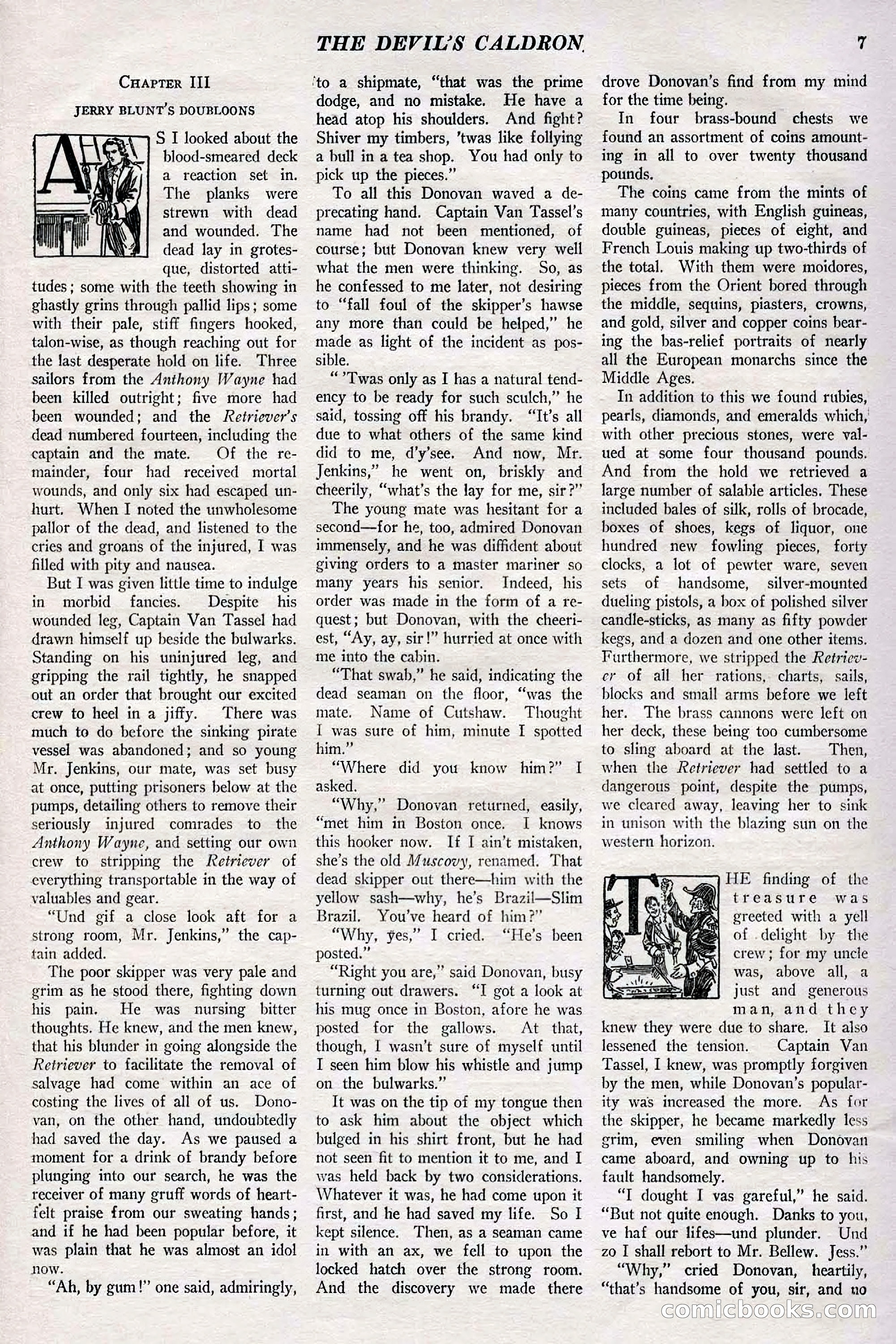
# Page Analysis This is a story prose page from "The Devil's Caldron," Chapter III titled "Jerry Blunt's Doubloons." The page contains two illustrated vignettes (small decorative drawings) embedded within the text. The narrative describes the aftermath of a pirate ship battle, detailing casualties and injuries among the crew. It then focuses on the discovery of treasure: coins from various countries and mints, rubies, pearls, diamonds, emeralds, silk bales, shoes, clocks, pewter ware, dueling pistols, and other valuables stripped from a captured vessel called the *Retriever*. The passage concludes with crew members celebrating the treasure find and the ship sinking in the distance.
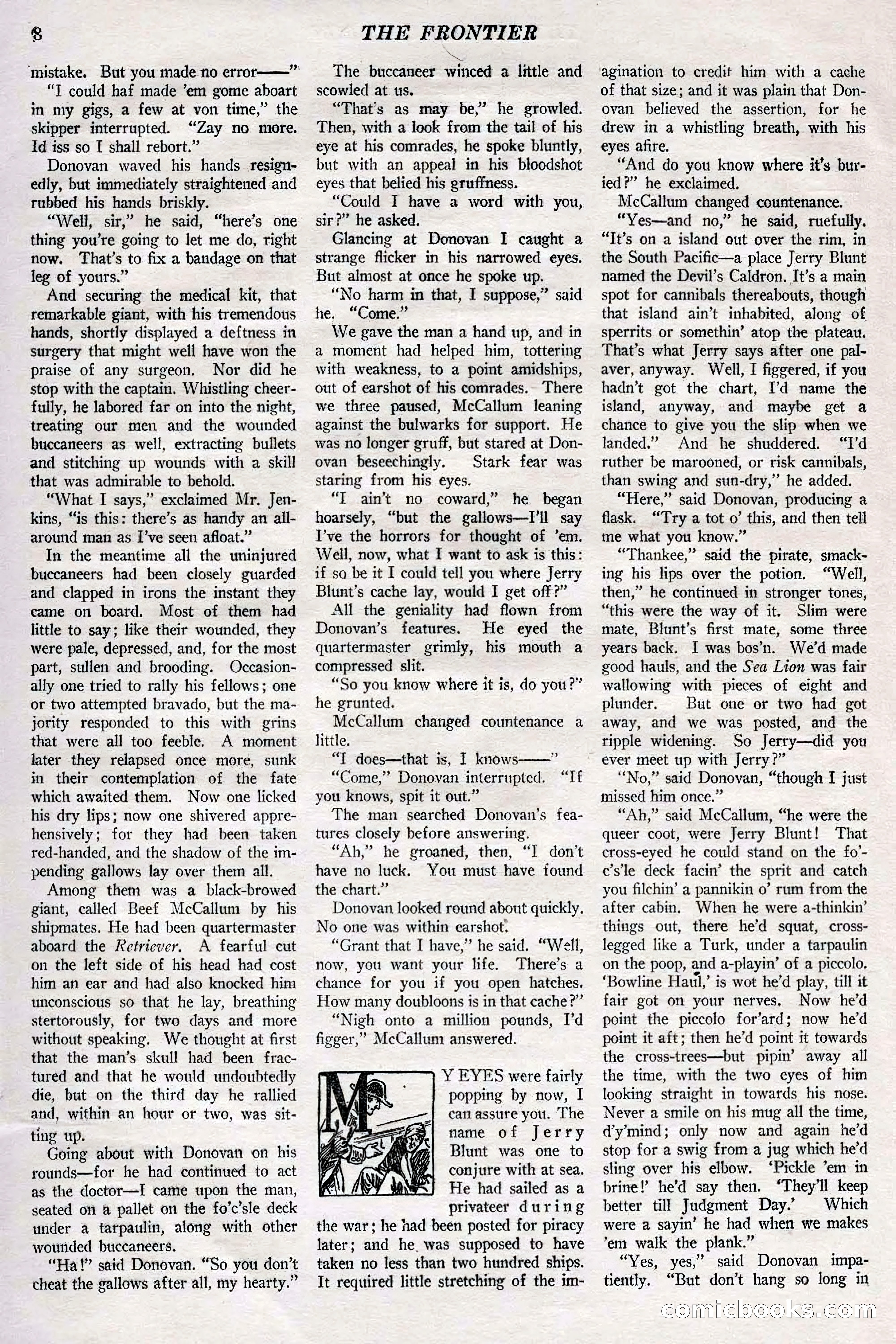
# Page 8 from "The Frontier" This is a text page of story prose with one small illustration embedded mid-page. The narrative appears to involve sailors and pirates discussing a hidden treasure cache, likely on a Pacific island called "Devil's Caldron." Characters named Donovan, McCallum, and Jerry Blunt are central to the dialogue. A quartermaster character named Beef McCullum—who is physically described as scarred and missing an ear—provides information about Blunt's past exploits at sea. The conversation focuses on locating Blunt's buried treasure and the dangers of retrieving it. The small illustration shows a face in profile, possibly depicting one of the characters mentioned in the text.
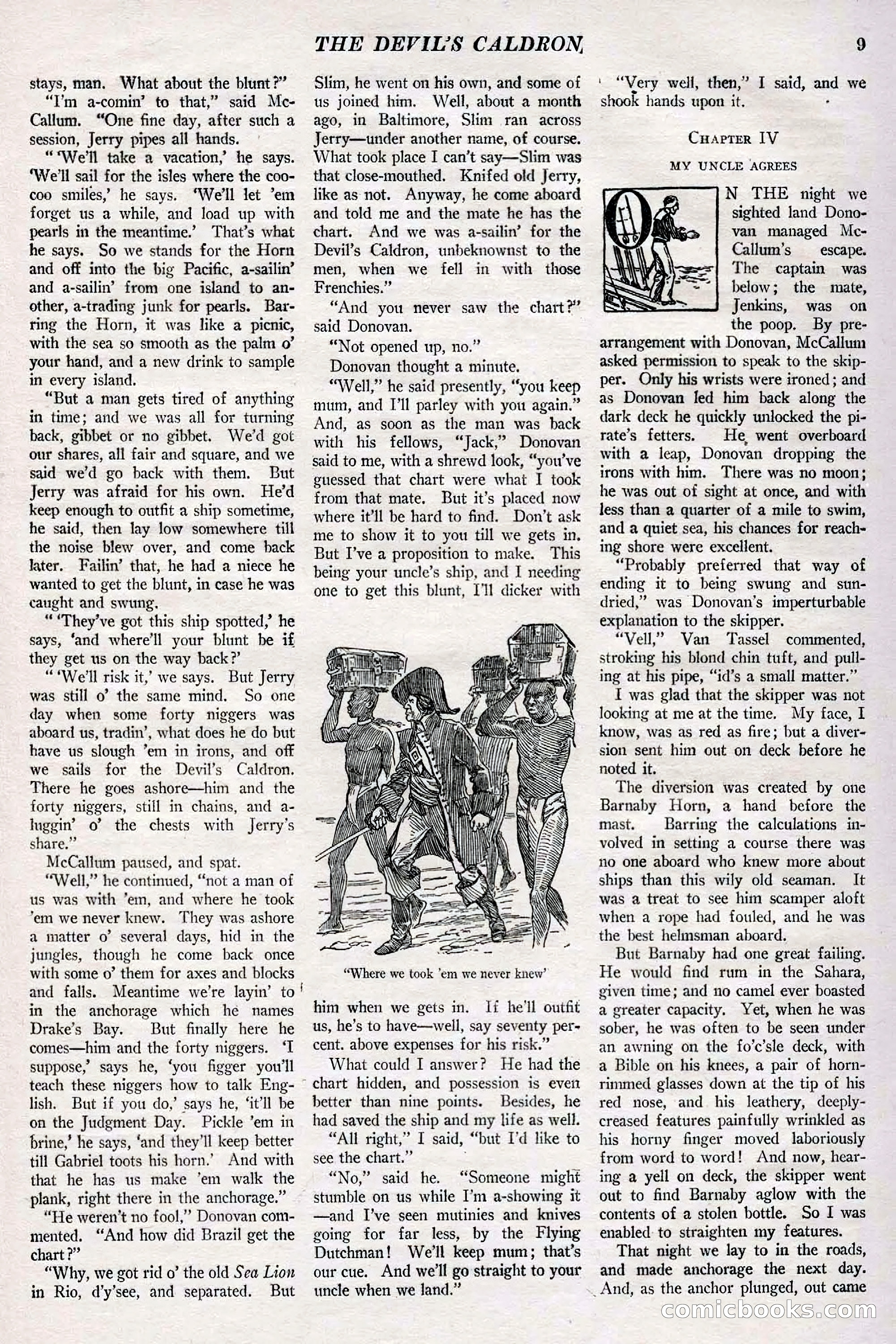
# Page 9 of "The Devil's Caldron" This page contains story prose with two embedded illustrations. The narrative, titled "Chapter IV: My Uncle Agrees," follows a sailor's account of acquiring a ship chart and planning a voyage. The text describes conversations between characters named Donovan, McCullum, and Jerry regarding an escape plan and a mysterious destination. One illustration shows sailors on deck; another depicts men in period clothing apparently in discussion below deck. The page continues a maritime adventure narrative involving treasure, risk, and nautical schemes. The prose style and typography are consistent with early 20th-century pulp fiction magazines.
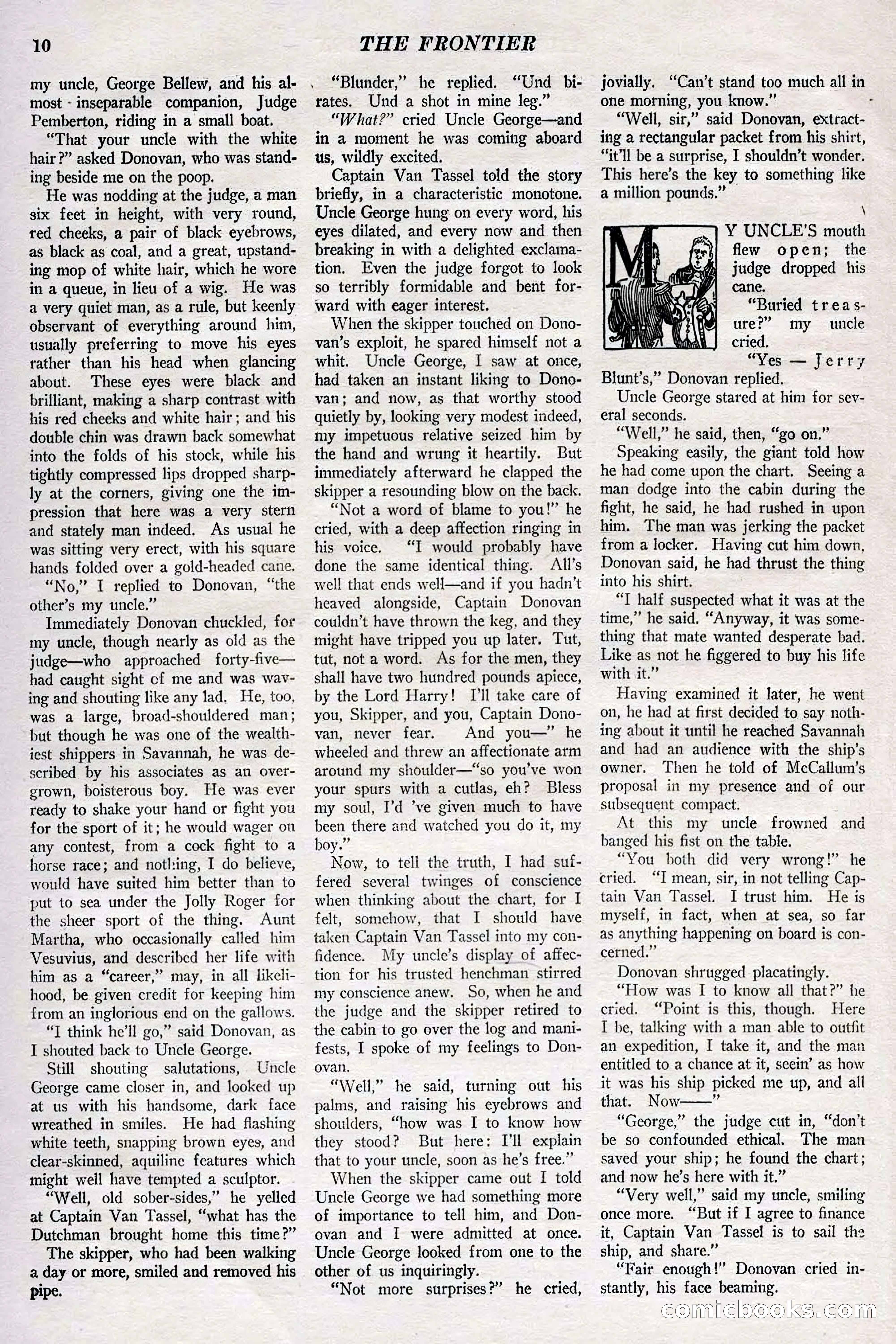
# Page Analysis This is a **story prose page** from a pulp magazine titled "THE FRONTIER" (visible at top). The page contains primarily text with one small illustration embedded in the right column showing what appears to be a man with a cane. The visible narrative concerns a narrator describing his Uncle George Bellew, a ship's captain, and an encounter involving a mysterious object or treasure that Uncle George allegedly obtained. The story involves discussion of a chart, accusations of theft, and negotiation between the narrator's uncle and other parties—likely a Dutchman mentioned in the dialogue. The tone suggests adventure fiction, possibly involving nautical intrigue or buried treasure themes typical of pulp adventure stories.
# Page Analysis This is a story text page (page 11) from a pulp fiction magazine titled "The Devil's Caldron." The page contains two chapters: the conclusion of an earlier chapter and Chapter V ("Equipped and Manned"), which begins with a small illustration showing what appears to be several people in period dress. The text concerns a group preparing a ship for an expedition. Characters named Uncle George, Captain Van Tassel, and others discuss organizing a crew and supplies for a voyage. The narrative mentions acquiring a vessel called the "Anthony Wayne," hiring crew members, and making preparations for what appears to be an adventure or treasure-hunting expedition. The tone and language suggest early 20th-century adventure fiction.
# Page Analysis This is page 12 of *The Frontier*, a pulp fiction magazine. The page contains story prose accompanied by a decorative initial letter and a detailed map illustration. The text depicts a scene where the narrator, seated with Captain Donovan at an inn, discusses obtaining passage on a ship captained by Van Tassel—a figure whom Donovan warns against trusting. The conversation involves a crew of rough but capable seamen and various maritime characters, including a young man named Jenkins who admires Donovan greatly. The map, labeled "The key to one million pounds," appears to show an island or coastal region with geographic features and place names, suggesting the narrative involves treasure or exploration.
# Page Analysis This is a text-only page (page 13) from a pulp fiction story titled "The Devil's Caldron." It contains two chapters: the end of an earlier chapter and the beginning of Chapter VI, "We Sight the Island," marked with a decorative initial letter. The visible text describes a sea voyage, with the narrator reflecting on preparations for departure aboard a ship and introducing various crew members, including the captain and a man named Van Tassel. The passage focuses on shipboard life, the crew's competence, and character observations—particularly regarding the skipper's somewhat aloof demeanor toward the protagonist. The narrative appears to be an adventure or maritime-themed story from the early 20th century.
This page contains story prose from *The Frontier* magazine (page 14). The narrative describes a ship's arrival at a tropical island with vivid descriptions of its landscape—white and yellow rocky hills, coral reefs, colorful sea-shells, and vegetation including coconut palms and mango trees. The text then shifts to Chapter VII ("Unburied Boxes"), depicting the narrator and crew members exploring an anchorage near Blackbeard's Boot. Jenkins, a crew member, points out a great green shark in the water and three skeletons on the sea bottom, prompting discussion about mysterious "niggers" (the text's language). The passage appears to be an adventure or treasure-hunting narrative set in a colonial or pirate-era setting.
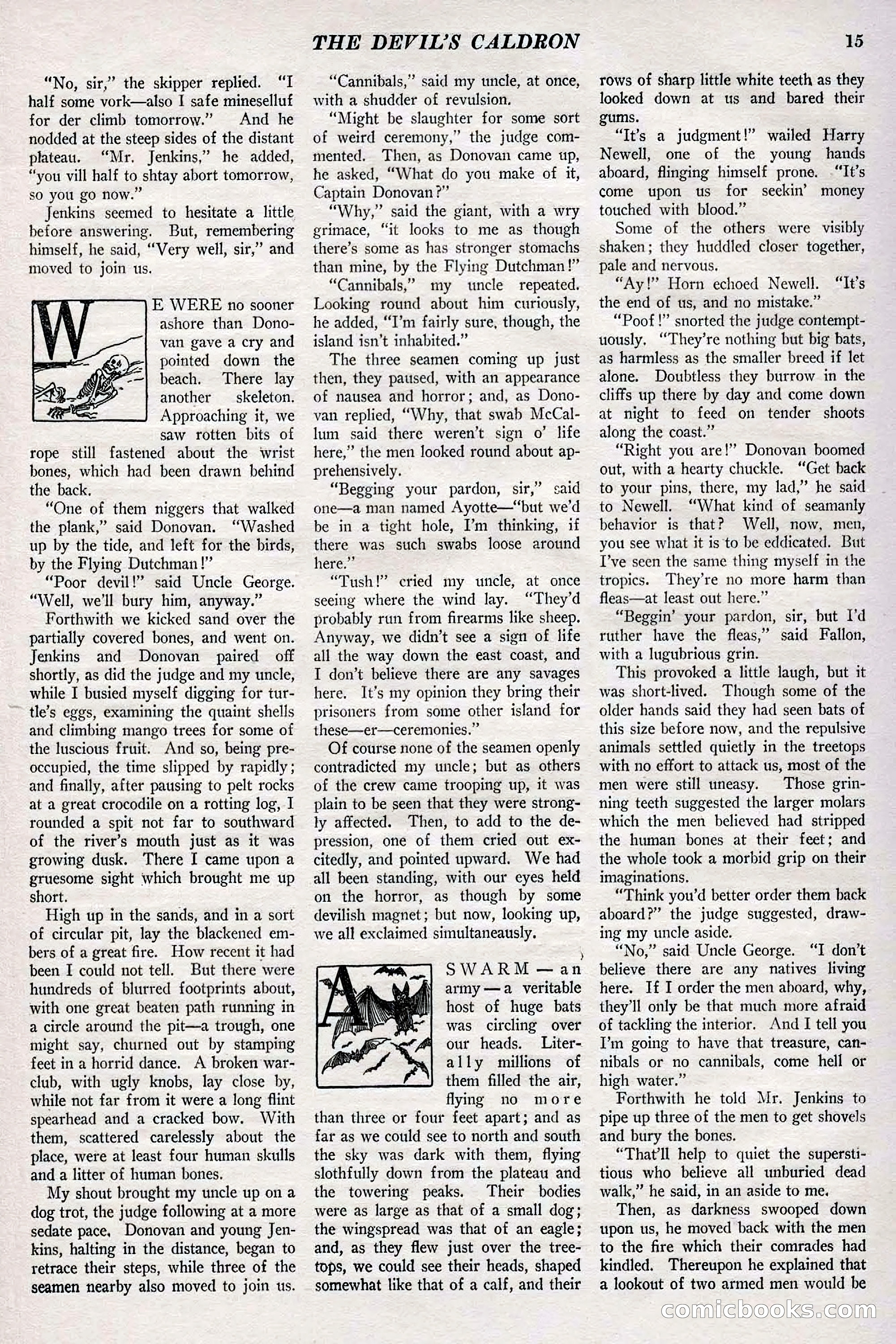
# Page Analysis This is story prose from a pulp fiction magazine, specifically page 15 of "The Devil's Caldron." The text describes an adventure involving sailors discovering a mysterious island with evidence of human habitation and remains. The narrative involves characters named Donovan, Jenkins, the judge, and Uncle George investigating what appears to be an abandoned settlement with skeletal remains and signs of past violence. The crew encounters large bats circling overhead and discusses whether the island harbors dangerous inhabitants. Two small illustrations—one showing a skeletal figure and another depicting a swarm of bats—accompany the text, breaking up the dense prose columns typical of pulp magazine formatting.
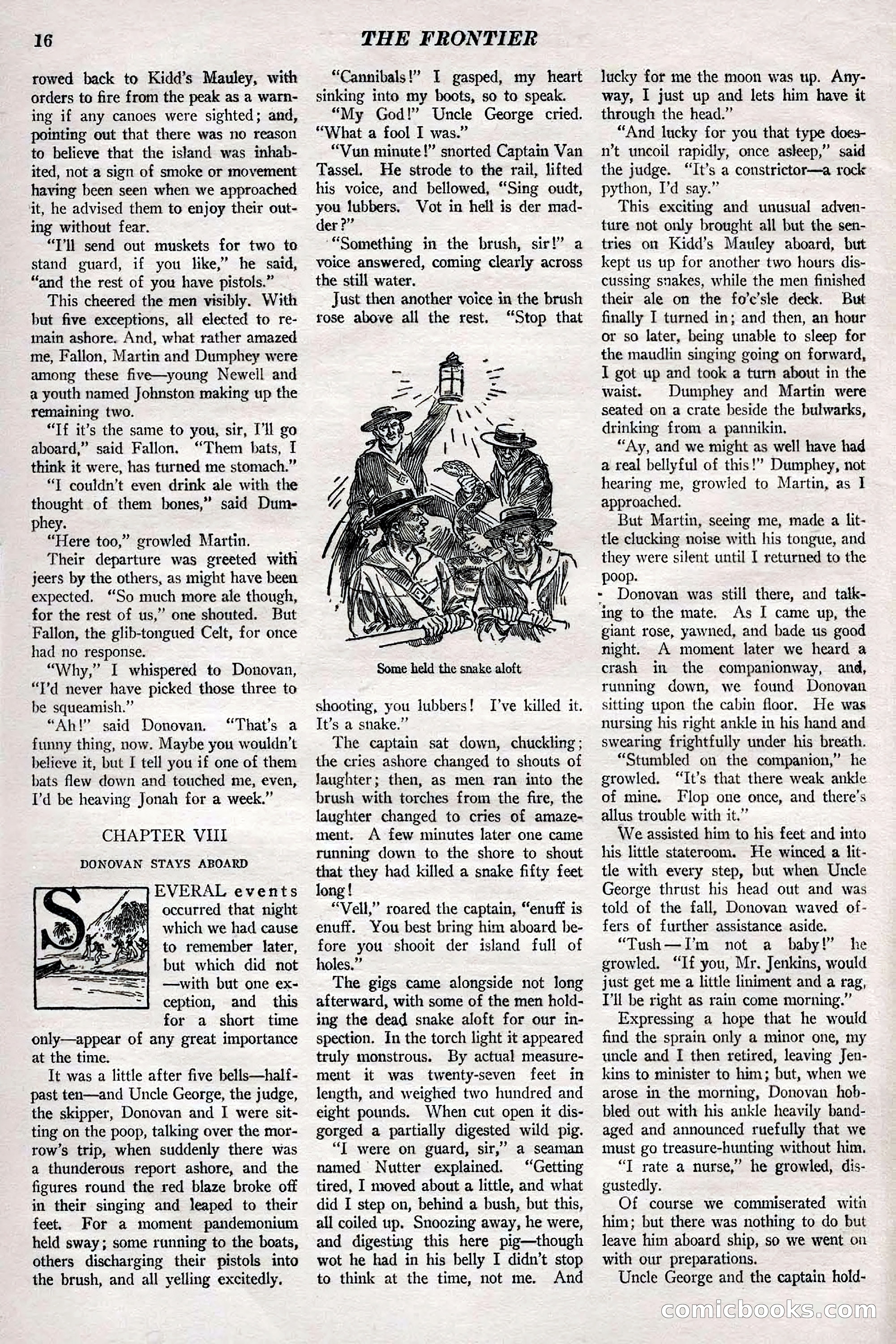
# Page Analysis This is story prose from *The Frontier*, a pulp magazine. The page contains Chapter VIII ("Donovan Stays Aboard") and depicts an adventure involving a large snake discovered aboard a ship. The crew kills a twenty-seven-foot snake weighing over two hundred pounds near the island, causing considerable commotion and laughter among the men. A central illustration shows sailors holding the dead snake aloft. The narrative follows Donovan, who injures his ankle during the incident and must remain aboard ship while the crew continues their expedition. The text emphasizes the excitement and danger of frontier/colonial adventure fiction typical of early pulp storytelling.
# Page Analysis This is a prose story page from *The Devil's Caldron*, numbered page 17. The text describes an expedition inland from a ship, with the narrator and companions exploring a tropical or subtropical landscape. They encounter exotic wildlife (crocodiles, wild hogs, great birds), navigate dense vegetation and vines, and eventually climb a plateau. The passage includes dialogue between characters—including Captain Van Tassel, Uncle George, a judge, and others—as they discuss their discoveries and the difficulty of the terrain. The narrative focuses on the natural environment and the group's observations of unusual flora and fauna during their inland journey.
# Analysis of Page 18 from "The Frontier" This is a story prose page with a small decorative illustration at the chapter heading. The text continues a narrative adventure involving Uncle George, a captain, and a skipper searching for treasure near what appears to be a cave or rock formation. The characters debate the location of a "bald rock" mentioned on a chart, with Uncle George insisting treasure is nearby despite skepticism from others. Chapter IX begins partway down the page, titled "False Bearings," introducing a new scene where the narrator first spots a cave. The illustration shows period figures in what appears to be early 20th-century dress.
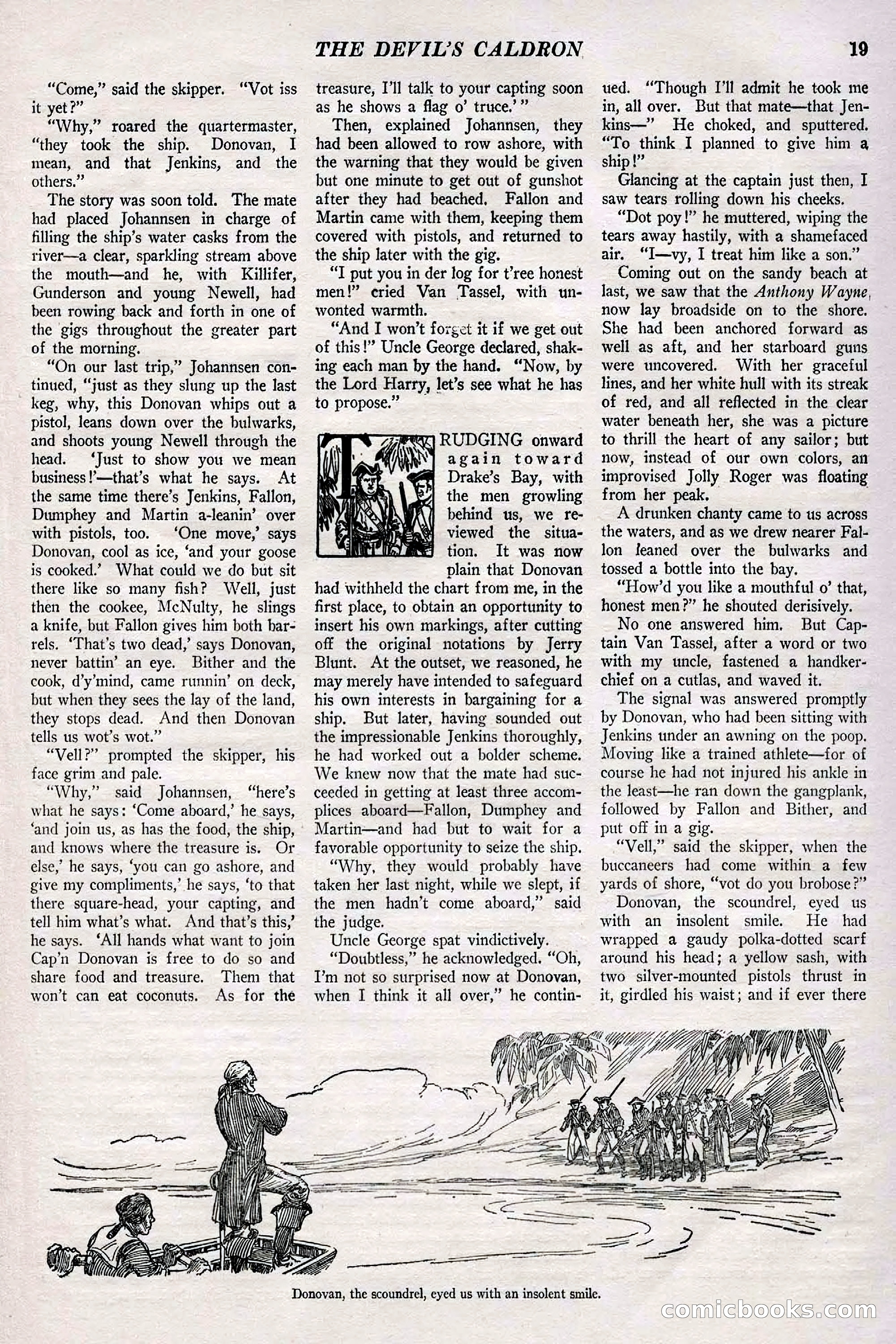
# Page Analysis This is a story prose page numbered 19 from "The Devil's Caldron." The text consists of two columns of narrative describing events aboard a ship, likely pirates or sailors plotting to seize a vessel. The plot involves characters named Donovan, Johannsen, and Van Tassel discussing hidden treasure and a scheme to capture a ship called the *Anthony Wayne*. At the bottom of the page is an illustration showing a bearded man (identified in the caption as "Donovan, the scoundrel") standing in shallow water facing a group of people on shore beneath palm trees. The narrative and illustration appear to depict a swashbuckling maritime adventure story typical of early-20th-century pulp fiction.
# Page Analysis This is a text page from a pulp fiction story titled "The Frontier," showing Chapter X: "Gentry's Strength Grows." The page contains primarily prose narrative with a small decorative illustration at the chapter opening. The story describes a ship stranded near Brazil without boats or supplies. The narrator and crew, led by Captain Van Tassel and a character named Gentry, must establish a defensive settlement inland. The text details their challenges: securing food through hunting, organizing arms and supplies, dealing with desertions when some crew members are sent to scout, and the practical difficulties of survival in an unfamiliar landscape. The passage emphasizes the group's precarious situation and their need to find fresh water and establish a defensible position.
This is a prose story page numbered 21, titled "The Devil's Caldron" at the top. The page contains two columns of text describing a survival situation where castaways are stranded in a cave. The narrative discusses the men's dwindling numbers, their attempts to create food and supplies (including making pottery and hunting), and their decision to post sentries and prepare for potential conflict. There is a small illustration embedded in the lower left showing what appears to be a coastal or beach scene. The story focuses on the characters' efforts to survive and the tensions arising from their difficult circumstances.
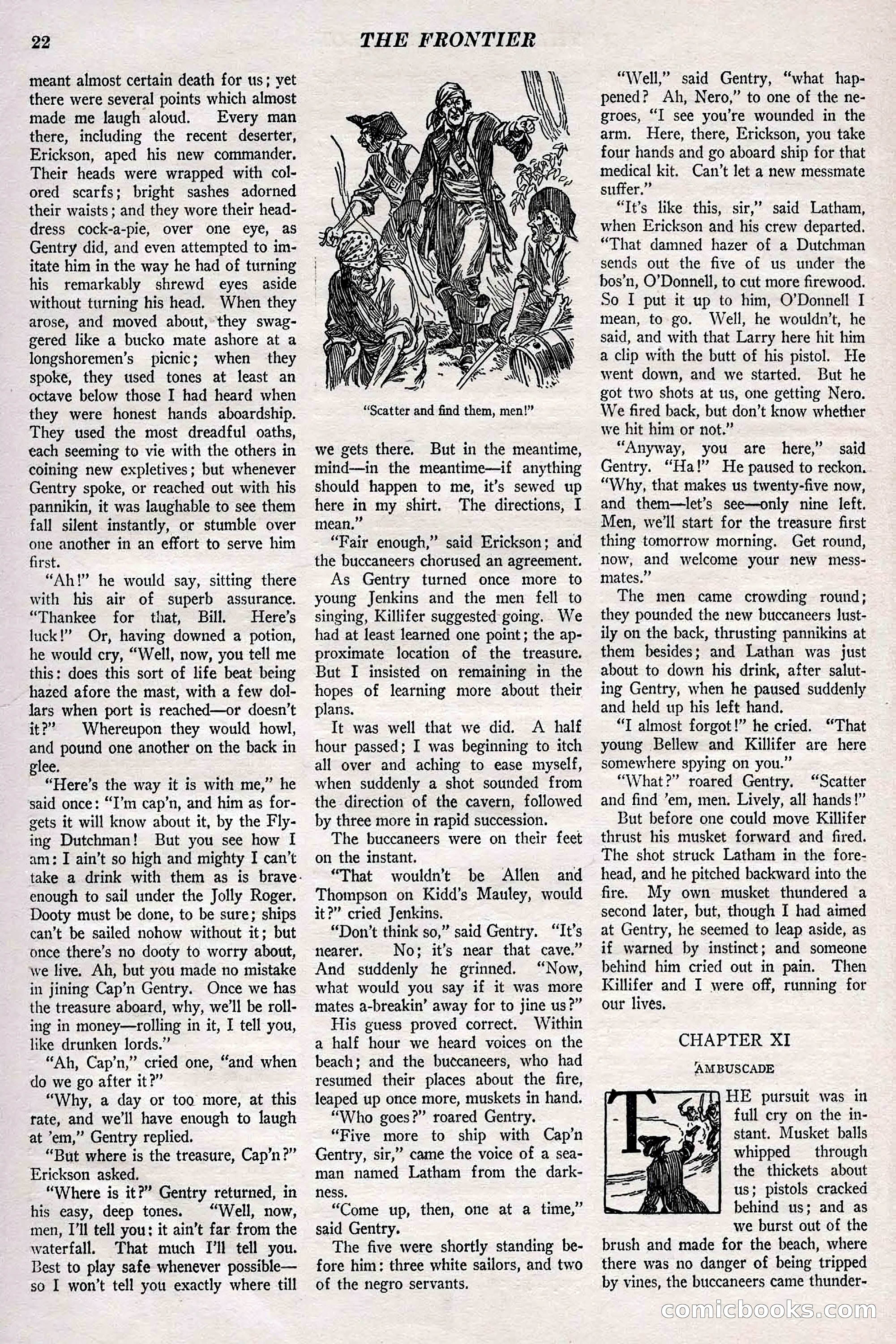
# Page Analysis This page contains story prose from a pulp fiction narrative titled "The Frontier," appearing in what seems to be a adventure or pirate-themed publication. The page includes one illustration showing what appears to be pirates or sailors in period dress, with one figure gesturing dramatically. The visible text depicts a conversation among buccaneers discussing a treasure hunt. Characters named Gentry, Erickson, and others debate whether to search for treasure immediately or wait until morning. A conflict erupts when shots are fired, apparently by someone named Killifer, injuring a character named Latham. The chapter ends with "CHAPTER XI" and the heading "Ambuscade," indicating pursuit is underway.
# Page 23: Story Prose from "The Devil's Caldron" This page contains narrative prose fiction describing a violent encounter. The narrator and companions are fleeing from pursuers across sandy terrain and take shelter in a cave. After a tense battle where they kill or wound their attackers, the group—now reduced to nine members including a captain, several named crew members, and enslaved individuals—prepare defensive positions. The text describes their exhaustion, the dawn breaking over tropical waters, and the captain's strategic decision to either attack their enemies or search for treasure. The passage emphasizes survival, combat action, and maritime adventure typical of early-20th-century pulp fiction.
# Page Analysis This is a text page from a pulp adventure story titled "The Frontier." It shows Chapter XII, "The Mutineers Attack," with a small illustration at the chapter heading depicting what appears to be a person on a sandy slope near a cave. The prose describes a violent confrontation near a fortified position. Characters named Sam, the skipper, and others prepare muskets for an attack while observing enemy movements across a clearing. The narrative includes combat action—gunfire, casualties, and tactical positioning—as the protagonists defend their location against apparent mutineers or hostile forces approaching from the shore. The page is predominantly text-heavy with minimal illustration, typical of pulp magazine interior pages.
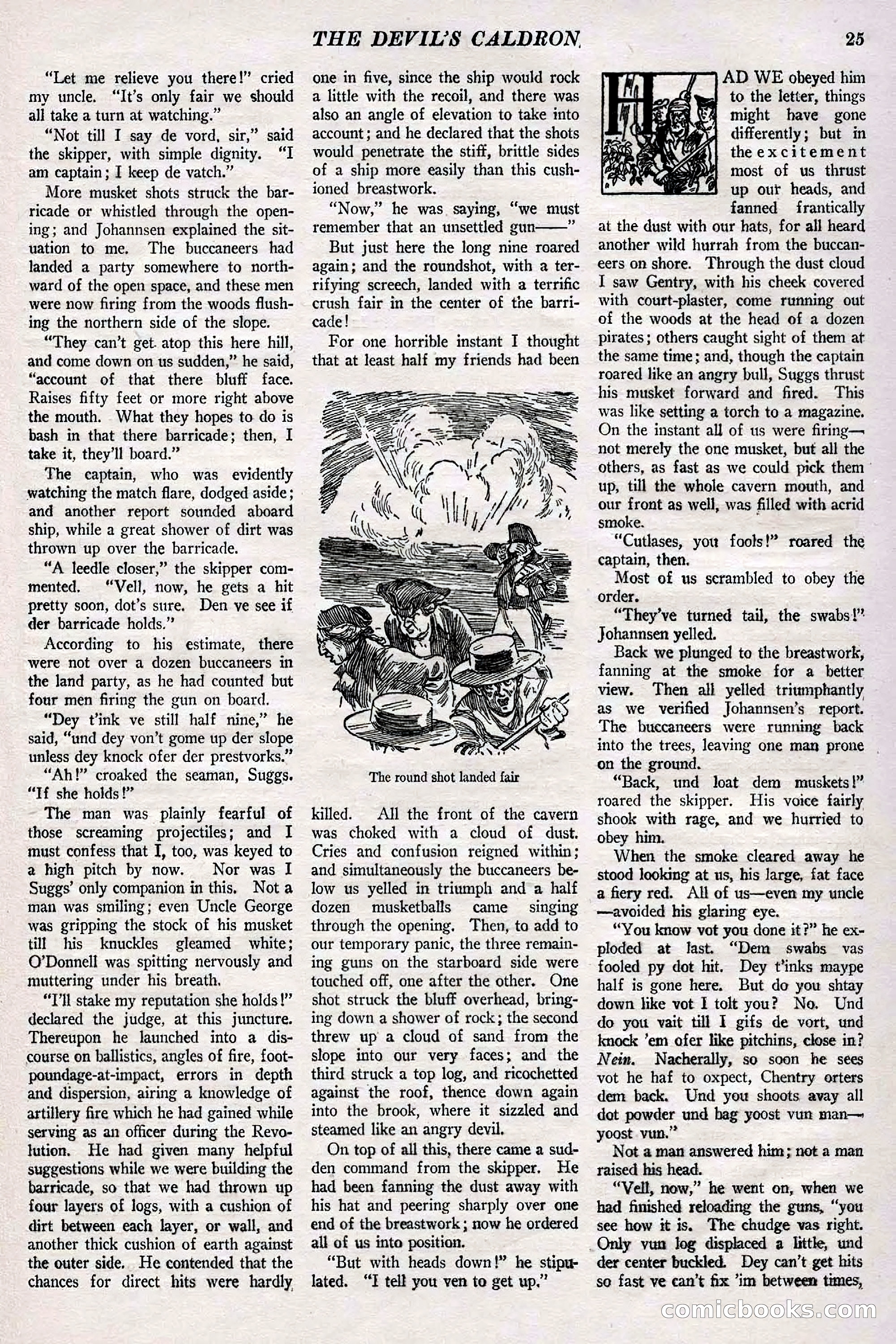
# Page Analysis: THE DEVIL'S CALDRON This is page 25 of a prose story titled "The Devil's Caldron." The page consists primarily of text with one central illustration depicting what appears to be a violent skirmish near a cave or fortification, showing armed men in combat. The visible text describes a naval or military engagement where characters discuss defensive positioning at a barricade. The narrative includes dialogue about cannon fire, musket shots, and tactical decisions during what appears to be a battle. References are made to "buccaneers" and a "skipper," suggesting this is likely a pirate or nautical adventure story set in an earlier historical period, though the specific era remains unclear from this excerpt alone.
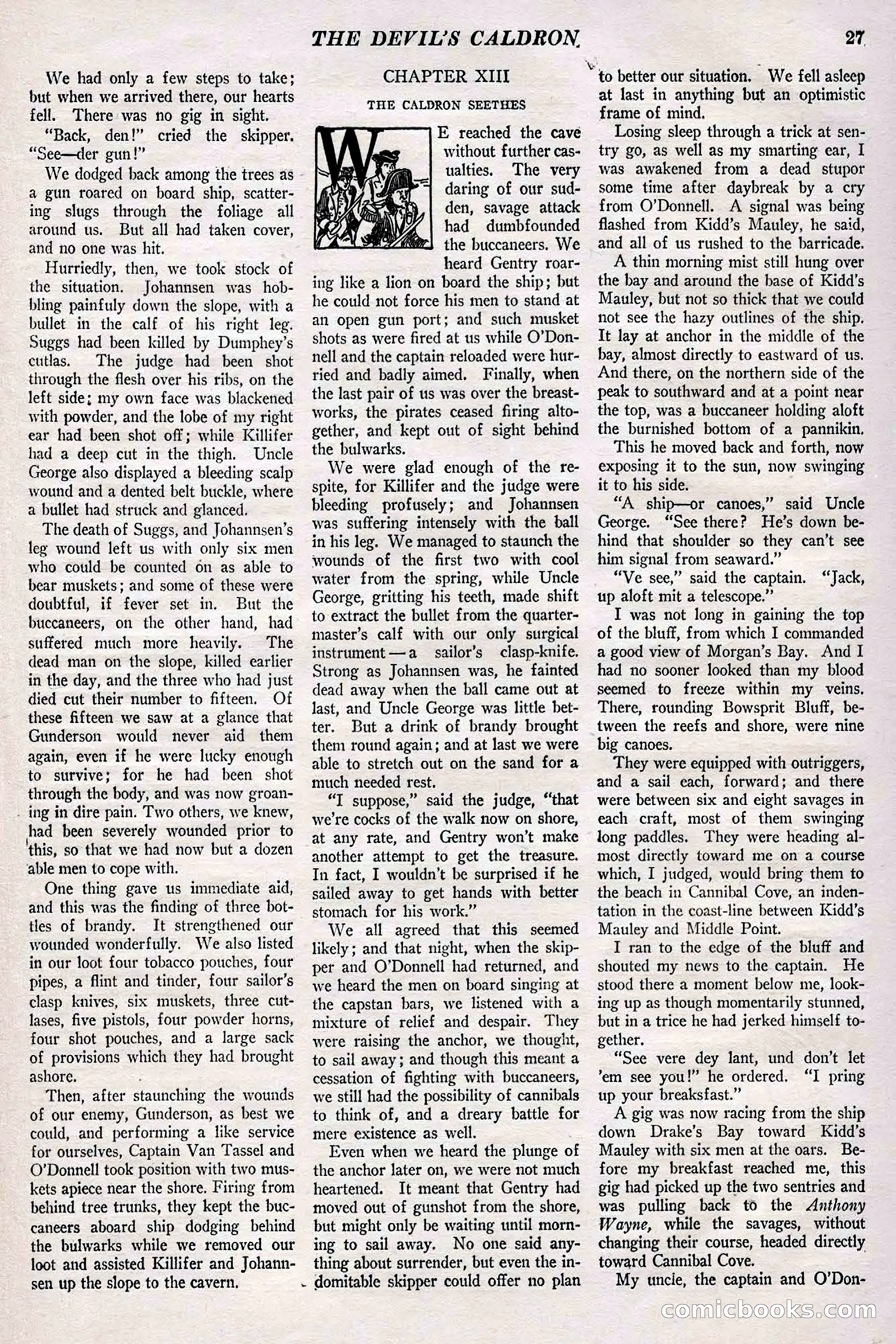
# Page 27 of "The Devil's Caldron" This page contains story prose with a single illustration at the chapter opening. The narrative, Chapter XIII titled "The Caldron Seethes," describes the aftermath of a violent encounter near a cave. The survivors, including characters named Johannsen, Killifer, and Uncle George, tend to their wounds and take stock of casualties. The text details their discovery of a ship in the bay and plans involving canoes to reach Cannibal Cove. The small woodcut illustration at the chapter's beginning shows what appears to be a dramatic scene with multiple figures, though specific details are unclear.
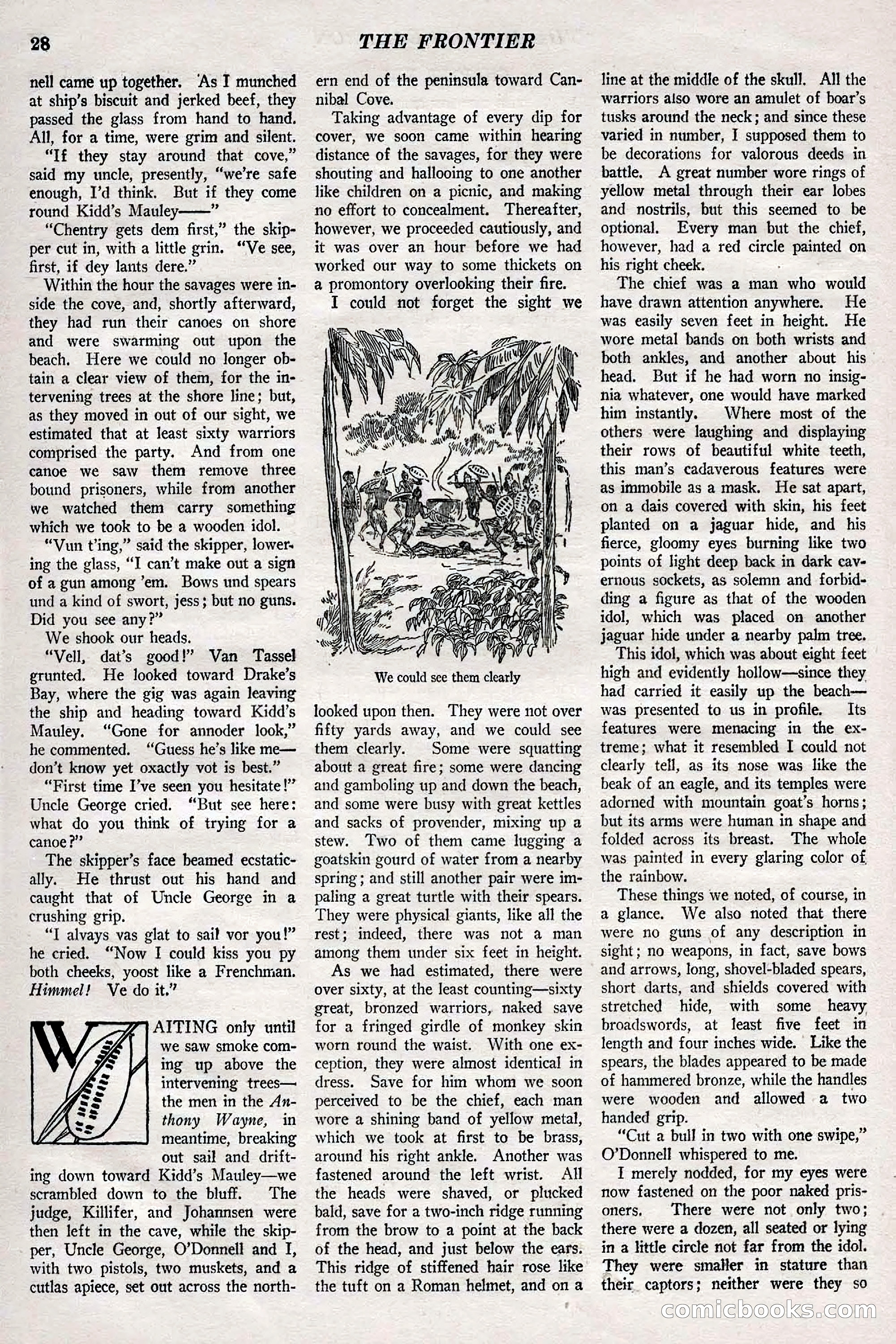
# Page Content Description This is **page 28 of story prose** from *The Frontier* magazine, featuring a narrative about an encounter with indigenous warriors. The text describes the narrator's party observing approximately sixty armed men on a beach near a cove. The passage details the warriors' physical appearance and adornments—including body paint, metal bands, boar-tusk necklaces, and rings—and describes a wooden idol positioned nearby. The narrative also mentions the capture of prisoners and discusses the group's cautious approach. An **illustration in the middle of the page** shows the cove and warriors mentioned in the text. The prose continues with dialogue between crew members debating strategy, appearing to be an adventure or exploration narrative set in an unfamiliar location.
# Page 29: Story Prose from "The Devil's Caldron" This page contains story prose from a narrative titled "The Devil's Caldron." The text describes an action sequence involving what appears to be a confrontation between sailors or military personnel and indigenous warriors. The passage details combat, including musket fire, the approach of a ship called the *Anthony Wayne*, and strategic maneuvering on a beach near what's called Cannibal Cove. A chapter break occurs mid-page, introducing "Chapter XIV: New Allies—and Enemies," which continues the narrative. The prose employs dramatic dialogue and vivid description typical of early-20th-century adventure pulp fiction.
# Page 30 from "The Frontier" This page contains story prose with two small illustrations embedded in the text. The narrative depicts a scene where the narrator's group has captured and released enemy prisoners, who subsequently perform a celebratory dance. The text describes the prisoners' joy, their ritual treatment of a fallen idol, and preparations for burial. The passage concludes with a new chapter ("Chapter XV: Repulsed") beginning at the bottom, where a chief apparently leads warriors away from a shadowy forest toward the west. The prose appears to be from an adventure or exploration narrative, though the specific story title and author are not visible on this page.
This is a text-only page (page 31) from a pulp fiction story titled "The Devil's Caldron." The narrative describes a tense colonial-era encounter between European sailors and indigenous people, featuring gunfire, canoe pursuits, and negotiations for peace. The passage includes dialogue among characters including a captain, Uncle George, Gentry, and O'Donnell as they attempt to capture enemy canoes and secure the captured "poor savage" whom they've tied up. The text focuses on the tactical and emotional dimensions of this conflict, with particular attention to the sailors' cautious movements and their prisoner's willing cooperation against his own people.
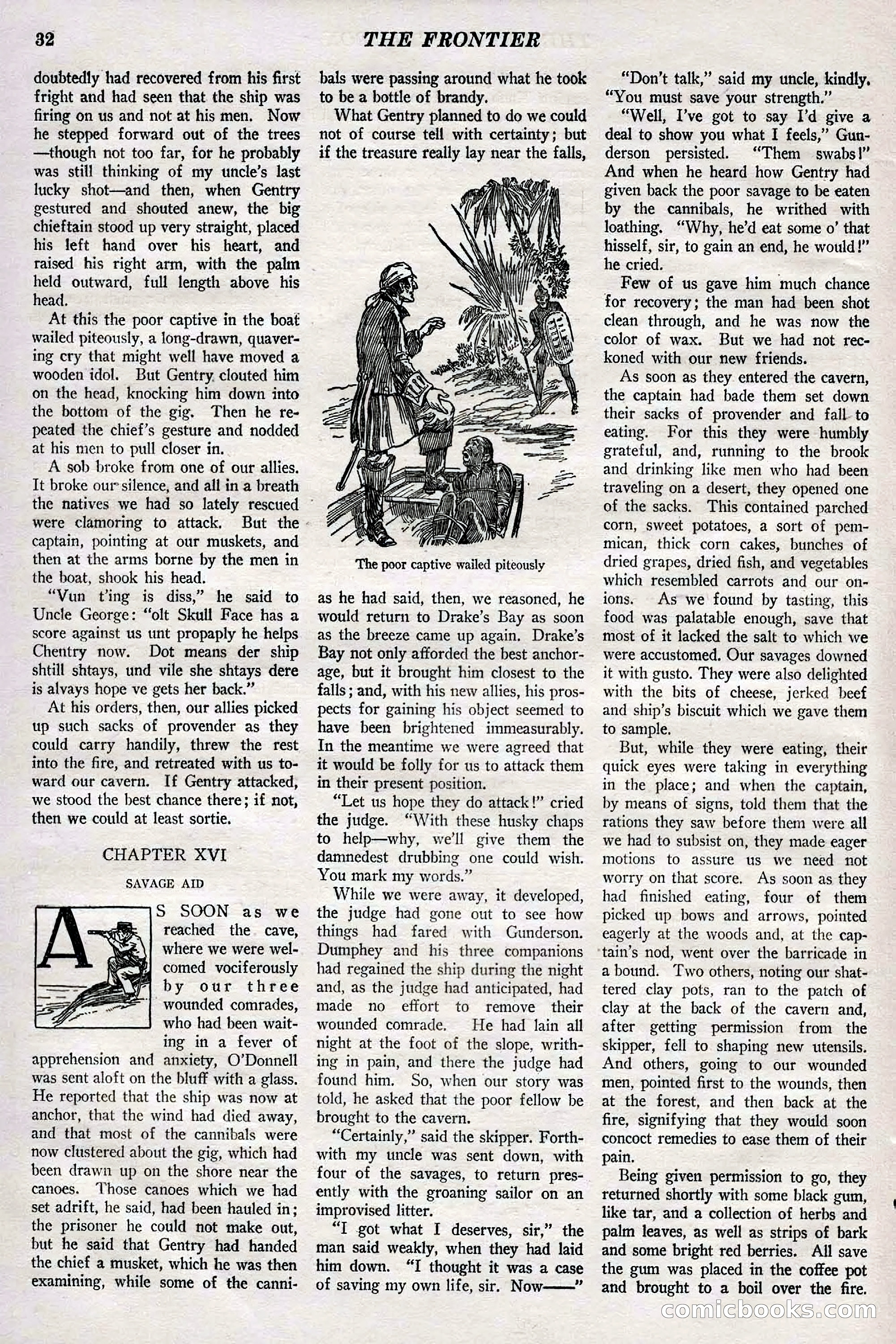
# Page Analysis This is a text page from a pulp fiction story titled "THE FRONTIER" (Chapter XVI: "Savage Aid"). The page contains narrative prose alongside a single black-and-white illustration depicting several figures near what appears to be a shoreline or camp setting. The visible text describes a group of castaways or soldiers who have retreated to a cave for shelter. The narrative discusses their discovery of provisions in sacks—including parched corn, corn cakes, dried grapes, and fish—and their subsequent recovery efforts. The text also references interactions with native peoples and plans to treat wounded companions using herbs and other remedies. The illustration shows figures in period dress (appears to be colonial or early exploration era) gathered near a boat or camp area.
# Page 83 from "The Devil's Caldron" This page contains story prose from what appears to be an adventure narrative. The visible text describes explorers on an island encountering indigenous people called Usagos, who prove to be skilled cooks and hunters. The passage details the group's survival efforts, including food preparation, observations of local customs (such as smoking tobacco and making tools), and interactions with the island inhabitants. There is one small illustration embedded in the lower left—a woodcut-style vignette showing what appears to be figures in period dress. The narrative discusses the explorers' attempts to understand local geography and their concern about potentially encountering pirates or hostile forces on nearby islands.
# Page 34 from "The Frontier" This is a page of story prose with a small illustration. The text continues a narrative adventure story in Chapter XVII titled "I Scout for Treasure." The visible passages describe the narrator's reconnaissance mission: they've escaped into forest terrain, reached a plateau above waterfalls, and discovered a natural tunnel or cavern system. The narrator then scouts a river location, describing it as roughly fifty feet wide with a distinctive rocky projection shaped like a ship's keel. The text discusses the narrator's strategy regarding pursuing enemies and evaluating the river's features and depth. The small illustration shows what appears to be the rocky river formation described in the adjacent text.
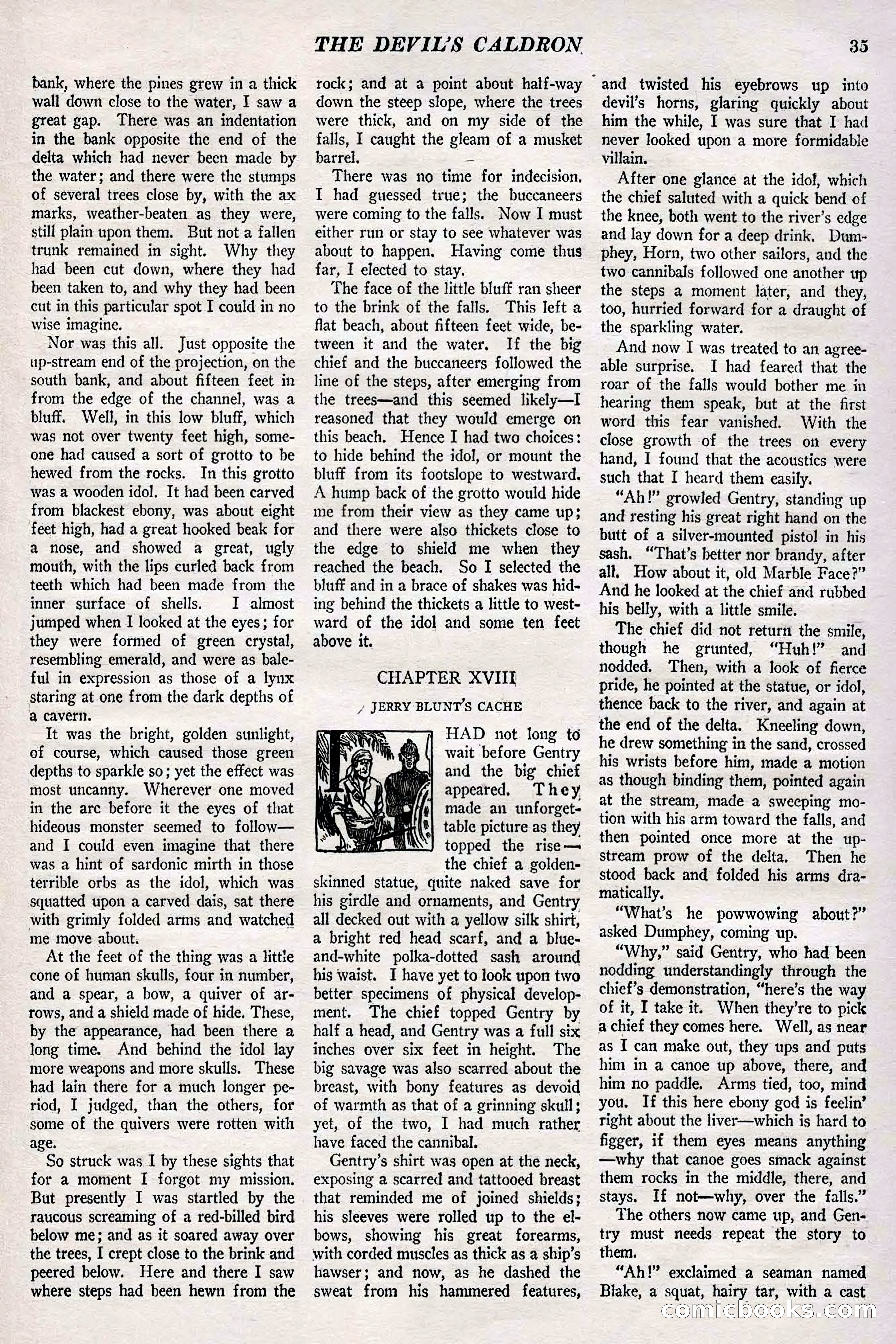
This page contains story prose from Chapter XVIII titled "Jerry Blunt's Cache" in a work called *The Devil's Caldron*. The text describes an adventure narrative involving characters named Gentry, the chief, and a narrator who discover an idol hidden behind a waterfall and discuss retrieving treasure from a river location. A small illustration appears at the chapter opening showing what appears to be two figures. The prose is dense adventure fiction typical of early pulp magazines, featuring exploration, danger, and discussion of hidden valuables. The page number indicates this is page 35 of the publication.
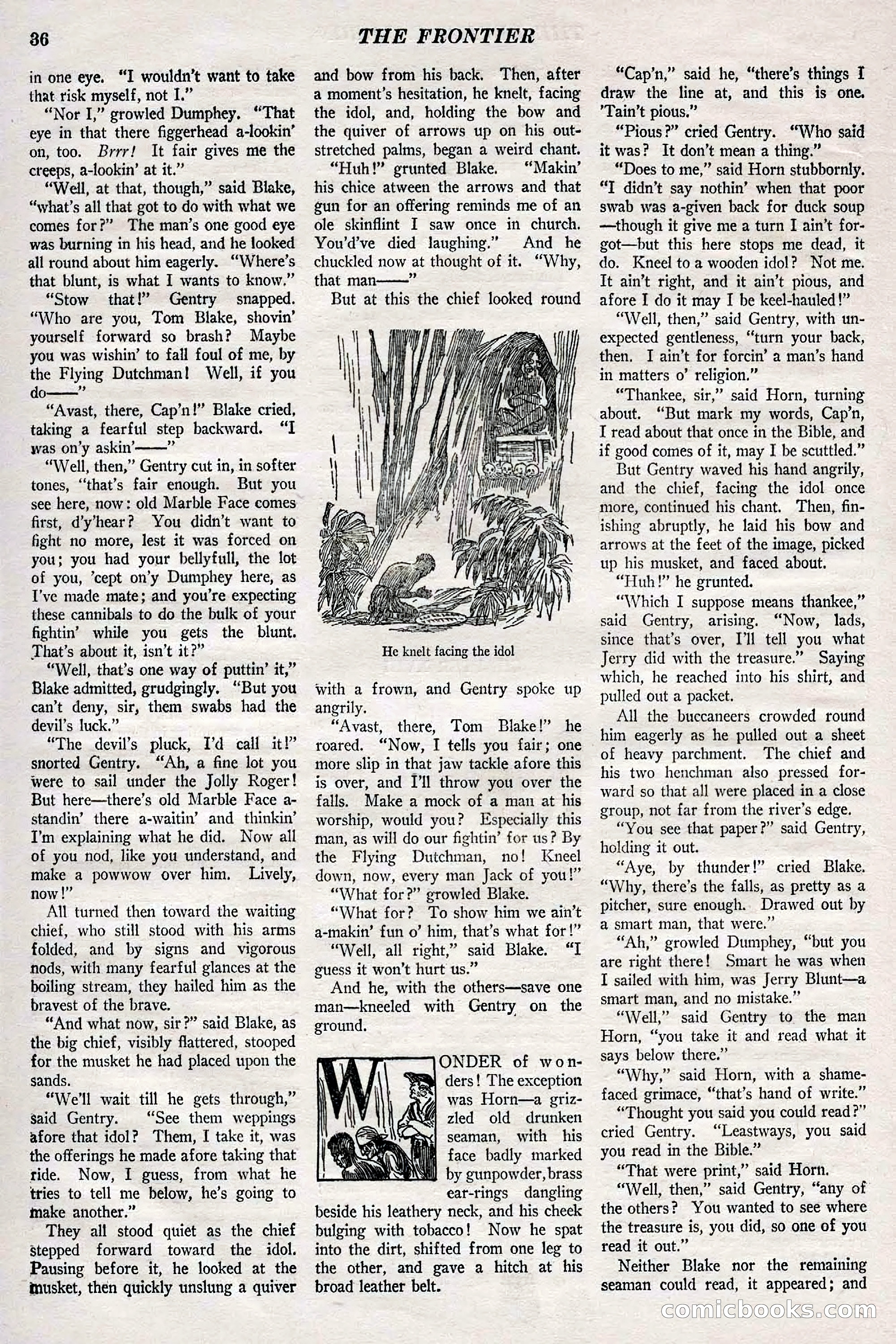
# Page Analysis This is page 36 from *The Frontier*, a pulp magazine. The page contains story prose with one illustration embedded within the text. The narrative depicts what appears to be a tense encounter involving a character named Blake, Gentry, and a Native American chief. Blake confronts Gentry about his brashness, while the chief performs some kind of ritualistic chanting before a wooden idol. The scene involves discussion of weapons, an offering, and apparent conflict resolution. The embedded illustration shows a kneeling figure facing an idol in what appears to be a natural setting with vegetation. The text discusses period-typical frontier adventure themes, though the exact plot context remains unclear from this single page.
# Page 37 of "The Devil's Caldron" This page contains story prose from Chapter XIX, titled "Barnaby Revolts." The text depicts an action sequence where the narrator, apparently hiding in a forest, observes an armed confrontation between pursuers. Characters named Gentry, Horn, Blake, and Dumphey are engaged in a conflict involving gunfire and pursuit across terrain with rocks and water features. The narrator describes his strategic position and his observation of the action, then receives a whispered message from someone named Horn, who appears to be one of the combatants. The prose emphasizes suspense and the narrator's attempts to remain concealed while monitoring the dangerous situation unfolding nearby.
# Page Analysis This is story prose from a pulp magazine titled "THE FRONTIER" (visible at page top). The page contains two chapters: the end of a chapter involving negotiations over treasure location and military strategy at a fortified position, and the beginning of Chapter XX titled "Cannon Ball and Arrow," which features a small illustration of a pipe-smoking man's face. The narrative describes a conflict involving characters named Horn, Gentry, Barnaby, and others who are defending against cannibal attackers. The text discusses defensive positions, weapons (muskets and arrows), and a skipper's orders to prepare fortifications. The prose is adventure fiction typical of early-20th-century pulp magazines.
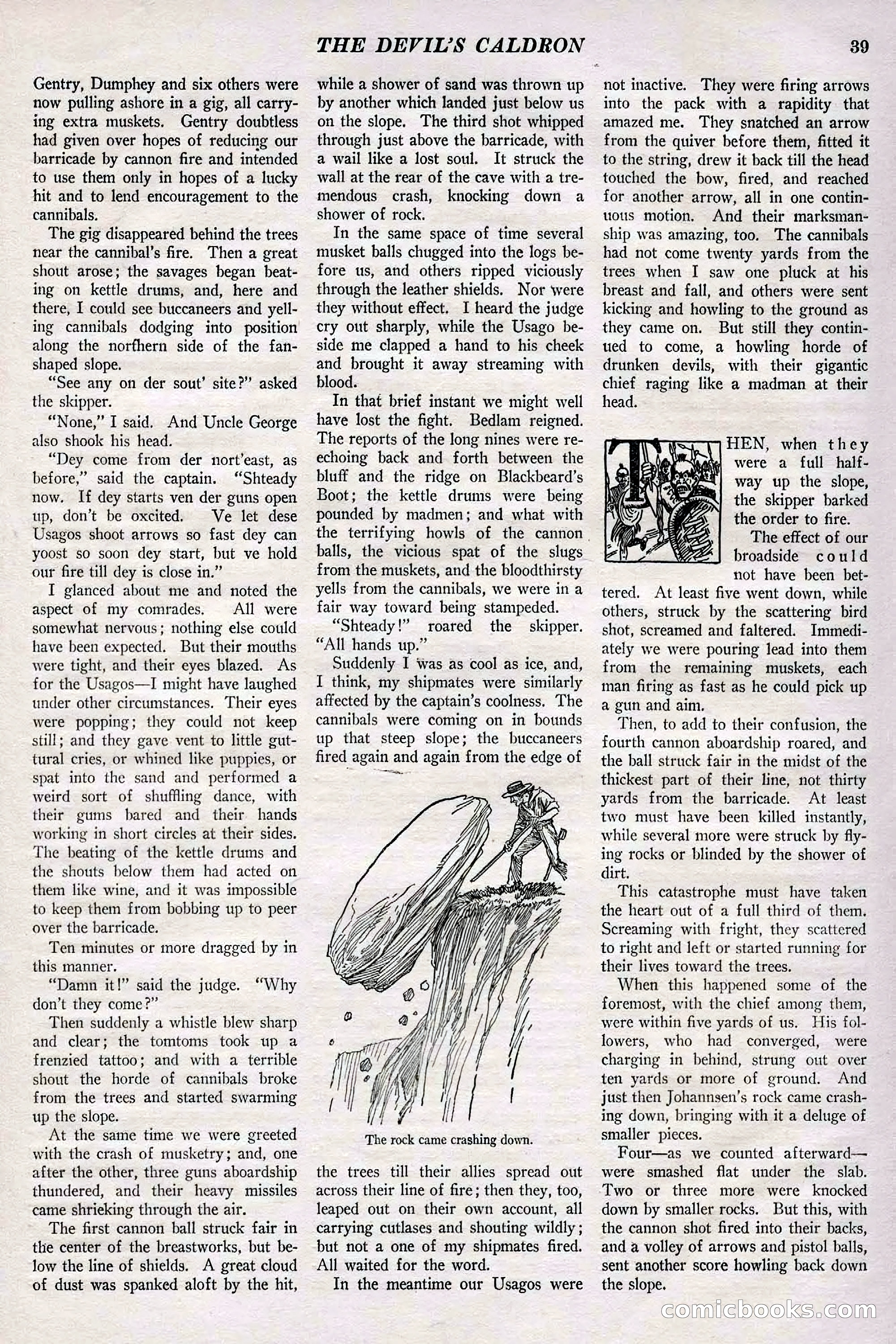
# Page Analysis This is page 39 of story prose from a pulp fiction magazine titled "The Devil's Caldron." The text describes an intense battle scene where characters (apparently sailors or military personnel) are defending a barricade against attacking forces. The passage details cannon fire, musket shots, arrows, and hand-to-hand combat on a slope, with vivid descriptions of casualties and the chaos of battle. A small illustration appears mid-page showing what appears to be a figure falling or being thrown. The narrative emphasizes the rapid succession of attacks, the effectiveness of the defenders' weapons, and the mounting casualties on both sides of the conflict.
# Page Analysis This is a text page from a pulp fiction story titled "The Frontier." The page contains two chapters of prose narrative: the conclusion of an unnamed chapter describing a violent frontier battle at a barricade, and Chapter XXI titled "Barnaby Takes a Chance," which begins with a small illustrated vignette. The visible text depicts combat between colonists and indigenous people (referred to as "Usagos" and "cannibals"), describing casualties, wounds, and tactical retreat. The narrative includes dialogue and focuses on characters named Horn, O'Donnell, Uncle George, and Gentry. Chapter XXI opens with discussion of the skipper tending wounded and contemplating another potential attack.
This is a page of story prose from a pulp magazine, numbered 41. The narrative appears to be set on a ship and involves a crew planning a dangerous mission involving fire and potentially retrieving cargo or a person from an island. The text describes discussions between characters named Horn, Jack, Gentry, and Humphrey about using fires as signals and sneaking aboard a vessel. There is one small decorative illustration—an ornamental capital letter "B" with what appears to be a face or figure inside it—marking a paragraph break midway down the page. The story focuses on maritime adventure and survival tactics, with dialogue revealing tension and risk-taking among the crew members.
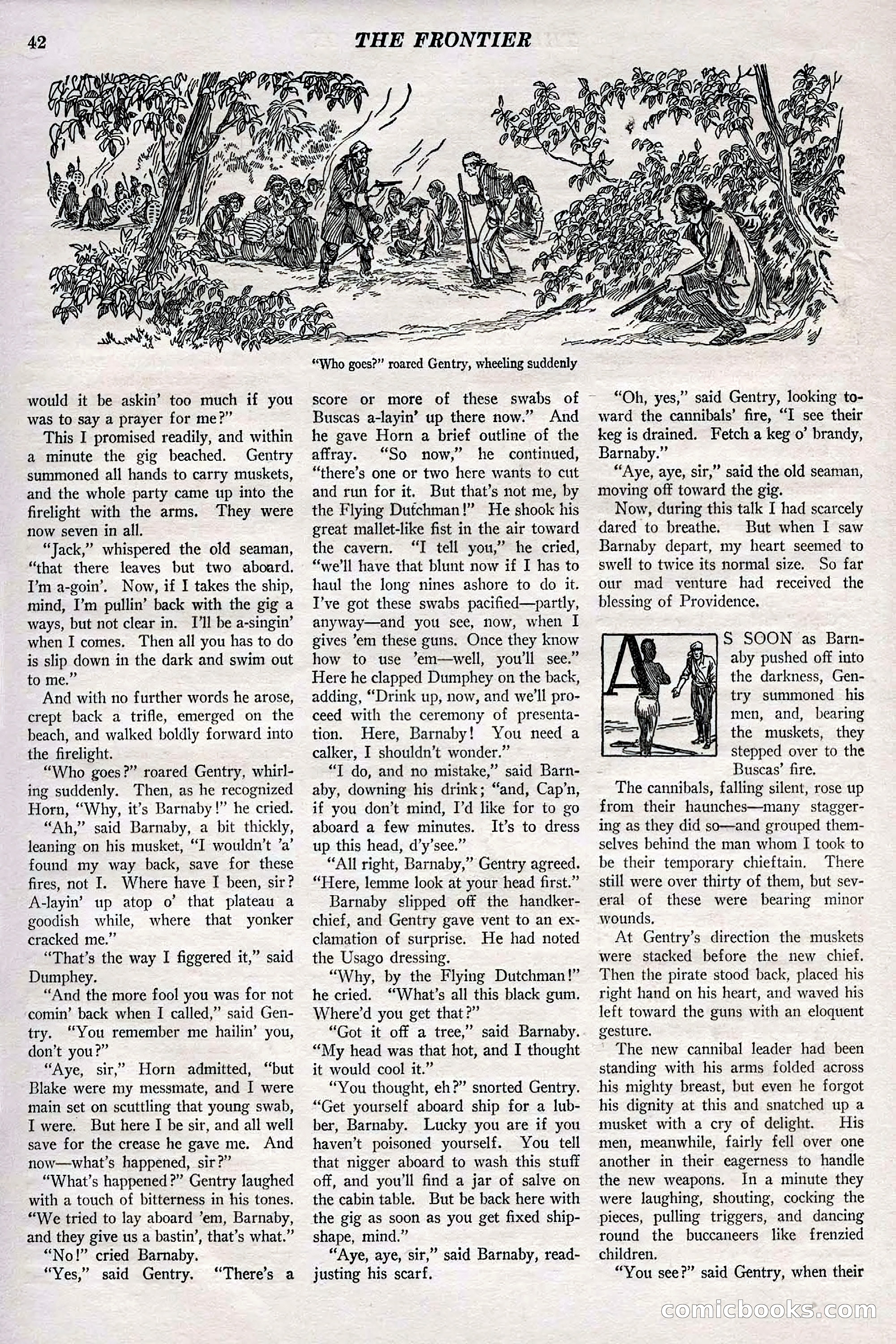
# Page Analysis This is a story prose page from a pulp magazine titled "The Frontier" (visible in the header). The page contains two columns of text with a small illustration embedded within the right column, showing what appears to be figures in period dress in an outdoor setting. The narrative depicts a scene involving characters named Gentry, Barnaby, Horn, and Dumphey discussing a military situation. The men appear to be preparing muskets and engaging with indigenous peoples referred to as "cannibals." The dialogue centers on acquiring firearms, planning an expedition, and managing a group of armed men, suggesting an adventure or colonial-era military story.
# Page Analysis: "The Devil's Caldron" This is a prose text page (page 43) from a pulp fiction story titled "The Devil's Caldron." The visible text comprises two chapters: the conclusion of an unnamed chapter featuring combat between the narrator and armed cannibals on a beach, and Chapter XXII titled "Barnaby's Bomb," which begins at the bottom with a decorative initial letter. The narrative describes intense action—gunfire, hand-to-hand fighting, and an explosion—followed by dialogue between characters named Barnaby and the narrator about escaping by canoe. The text is densely printed in two columns with no illustrations visible on this page.
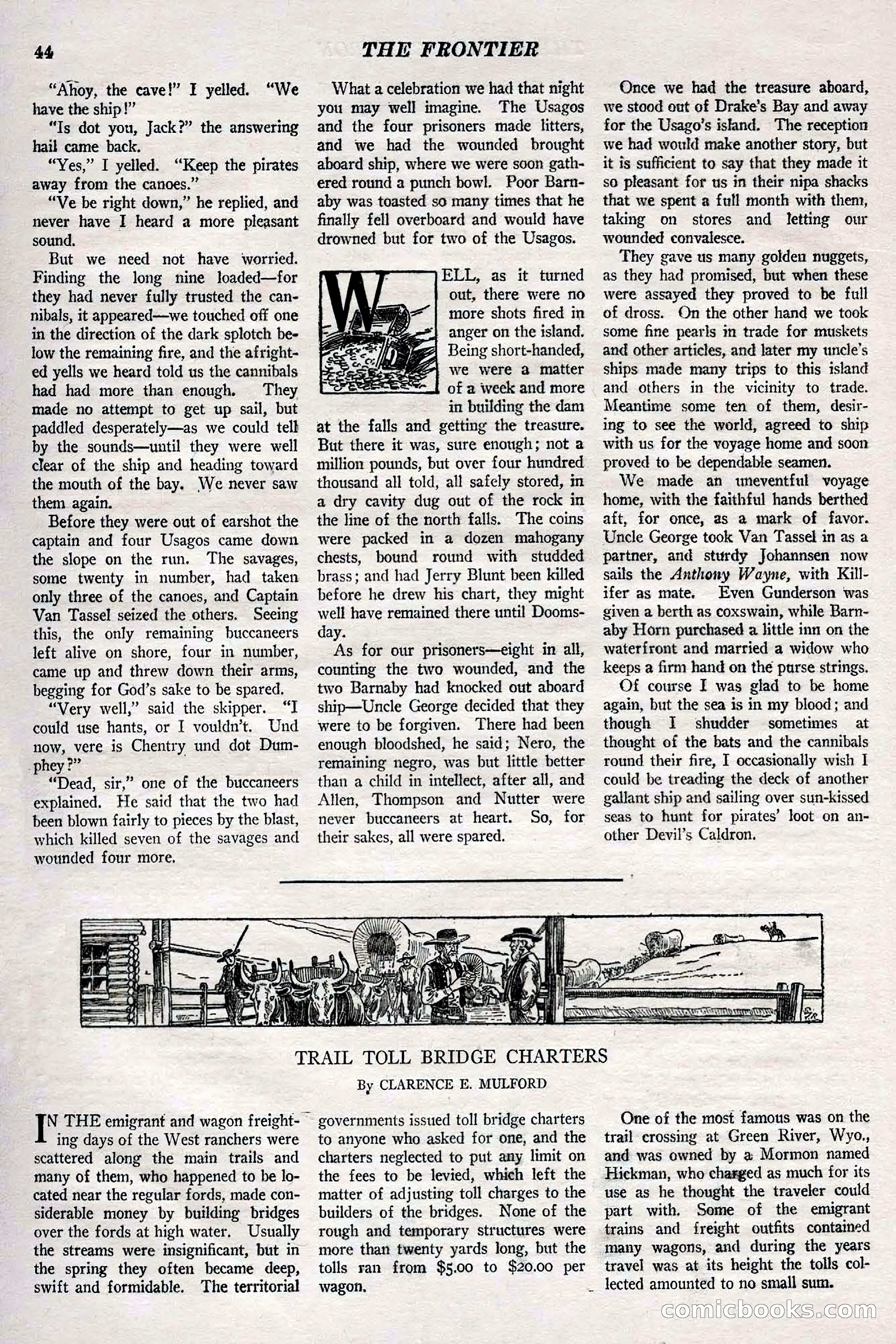
# Page Analysis This is page 44 from *The Frontier*, a pulp magazine. It contains two separate stories in prose format. The upper section concludes a narrative about a ship crew encountering pirates and discovering treasure on an island inhabited by the Usagos people. The narrator describes their eventual return home and reflections on life at sea. Below that is a new story titled "Trail Toll Bridge Charters" by Clarence E. Mulford. It discusses the historical practice of toll bridge charters issued to emigrants and freight operators along American trails during westward expansion. The text mentions specific tolls ($5–$20 per wagon) and references a notable bridge operated by a Mormon named Hickman on the Green River in Wyoming. There is a small illustration of frontier figures with wagons and horses between the two stories.
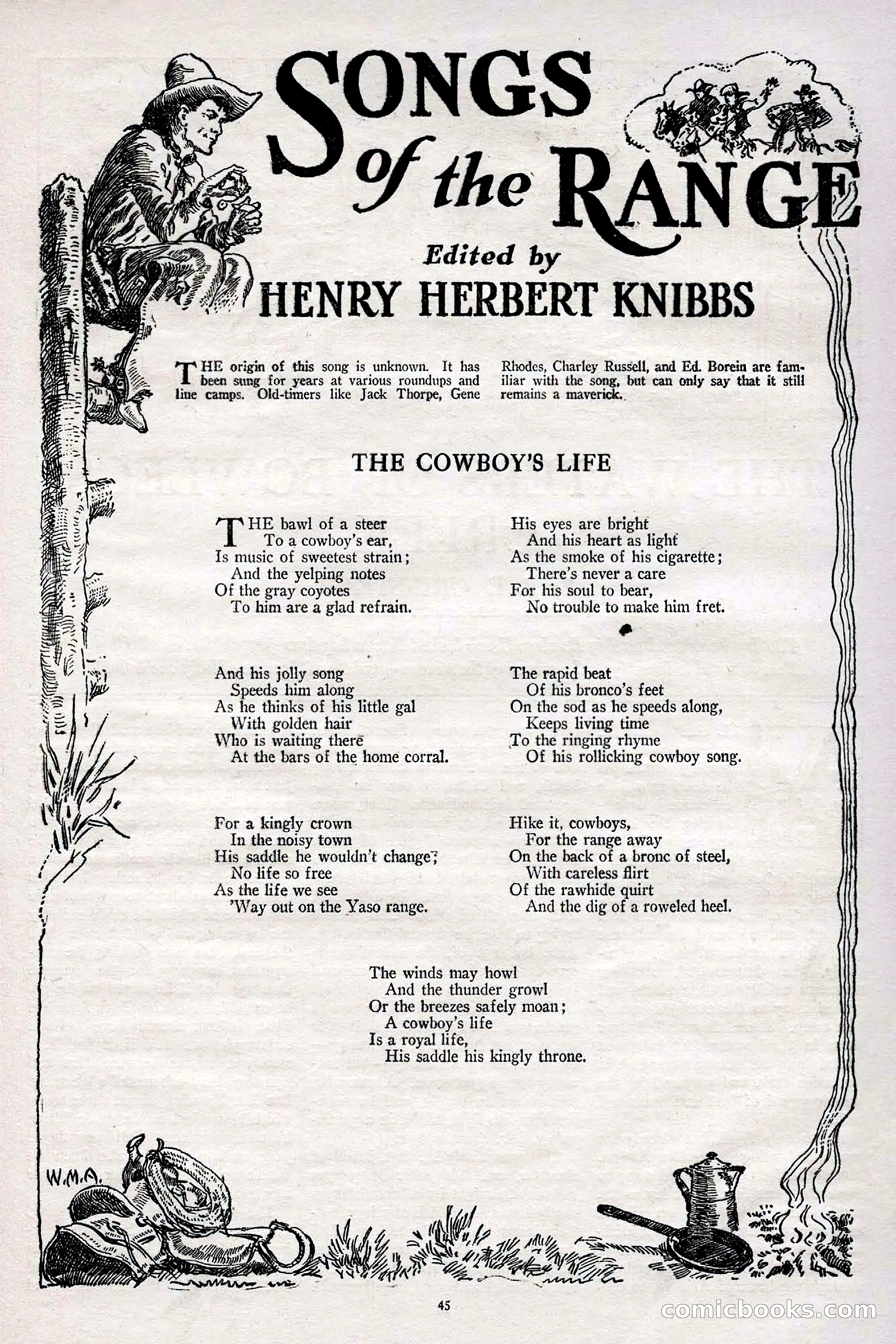
# Page Description This is a text page from a collection titled "Songs of the Range," edited by Henry Herbert Knibbs. The page contains a complete poem called "The Cowboy's Life," featuring Western-themed illustrations in the margins (a cowboy figure on the left, and camping/cooking equipment at the bottom). The poem romanticizes the cowboy experience, celebrating the freedom of ranch life and the cowboy's connection to his horse and the open range. It contrasts the cowboy's independence and simple pleasures with the constraints of town life, presenting his saddle and horse as sources of pride and contentment. An introductory note indicates the song's origins are unknown but have circulated among various ranches and line camps for years.
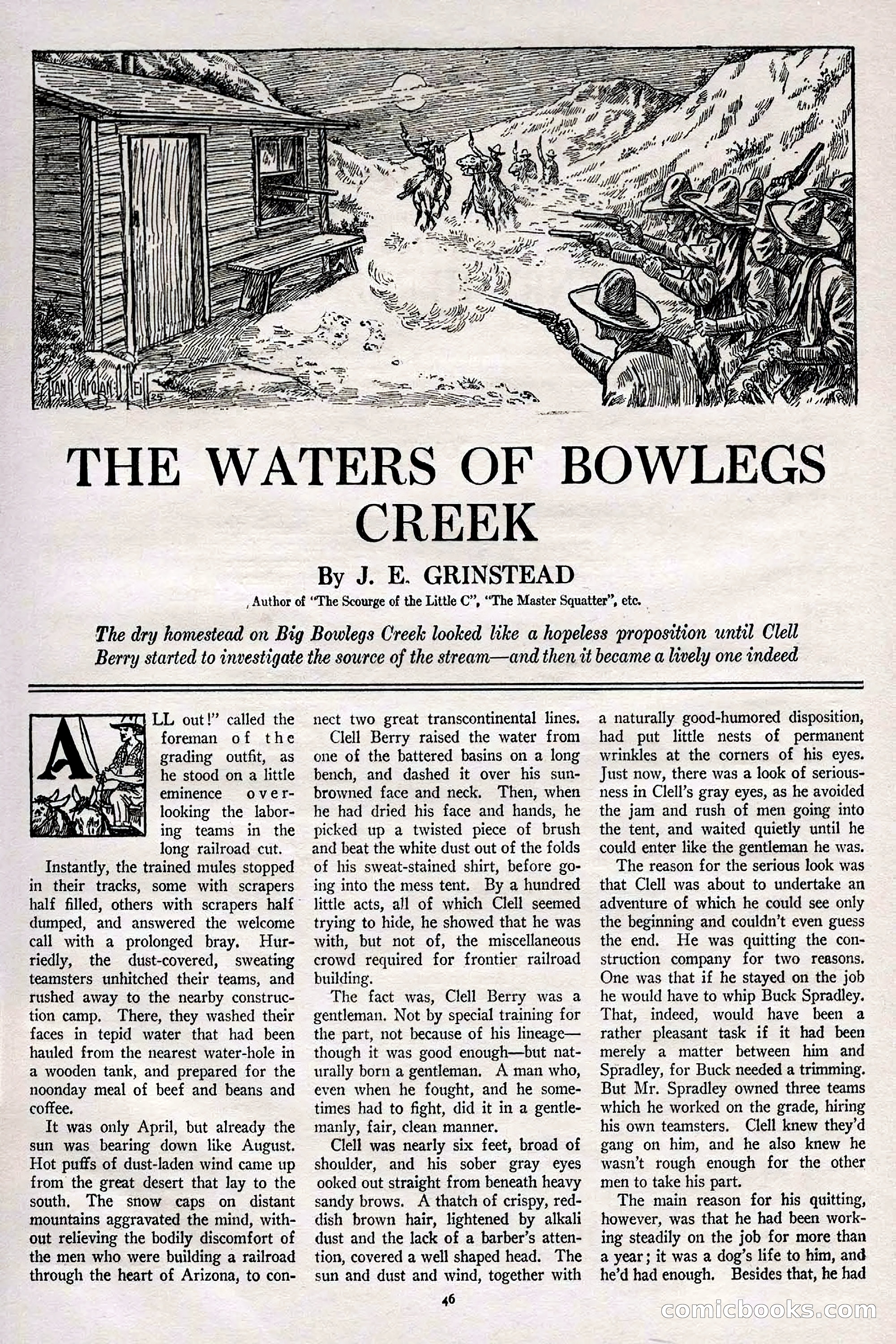
# "The Waters of Bowlegs Creek" This is the opening page of a short story by J. E. Grinstead, featuring an illustration at the top depicting a frontier scene with armed men, horses, and a cabin in a mountainous landscape under moonlight. The story begins by describing a dry homestead on Big Bowlegs Creek and introduces the character Clell Berry, a foreman for a railroad grading outfit. The text explains how Clell investigates the source of a stream and becomes involved in what promises to be an eventful adventure. The passage establishes a Western setting involving railroad construction through Arizona, establishing the hardboiled frontier tone typical of pulp fiction.
# Page Analysis This is a story prose page from "The Waters of Bowlegs Creek" (page 47). The text depicts a conversation between a railroad worker named Cell Berry and a stranger who approaches him in a camp. The stranger, introducing himself as John Marshall, seeks Cell's advice about starting a farm. Marshall explains he has limited funds and asks about obtaining land and water rights near Little Bowlegs. Cell becomes interested in Marshall's proposal and agrees to show him an outfit in the area. The page contains a small decorative initial letter "W" but no full illustrations. The narrative focuses on dialogue and character interaction rather than action.
# Page 48 from "The Frontier" This page contains story prose from what appears to be a Western fiction narrative. The text describes a conversation between characters named Marshall and Clell about traveling to Arizona to establish a mining or farming claim near Little Bowlegs Creek. The story discusses frontier hardships, the purchase of horses and supplies, and an encounter with a visitor named Mosby at their camp. There is one small illustration—appearing to show a wagon or camp scene—positioned in the middle of the page. The narrative focuses on pioneer life, claims staking, and relationships formed through shared frontier challenges.
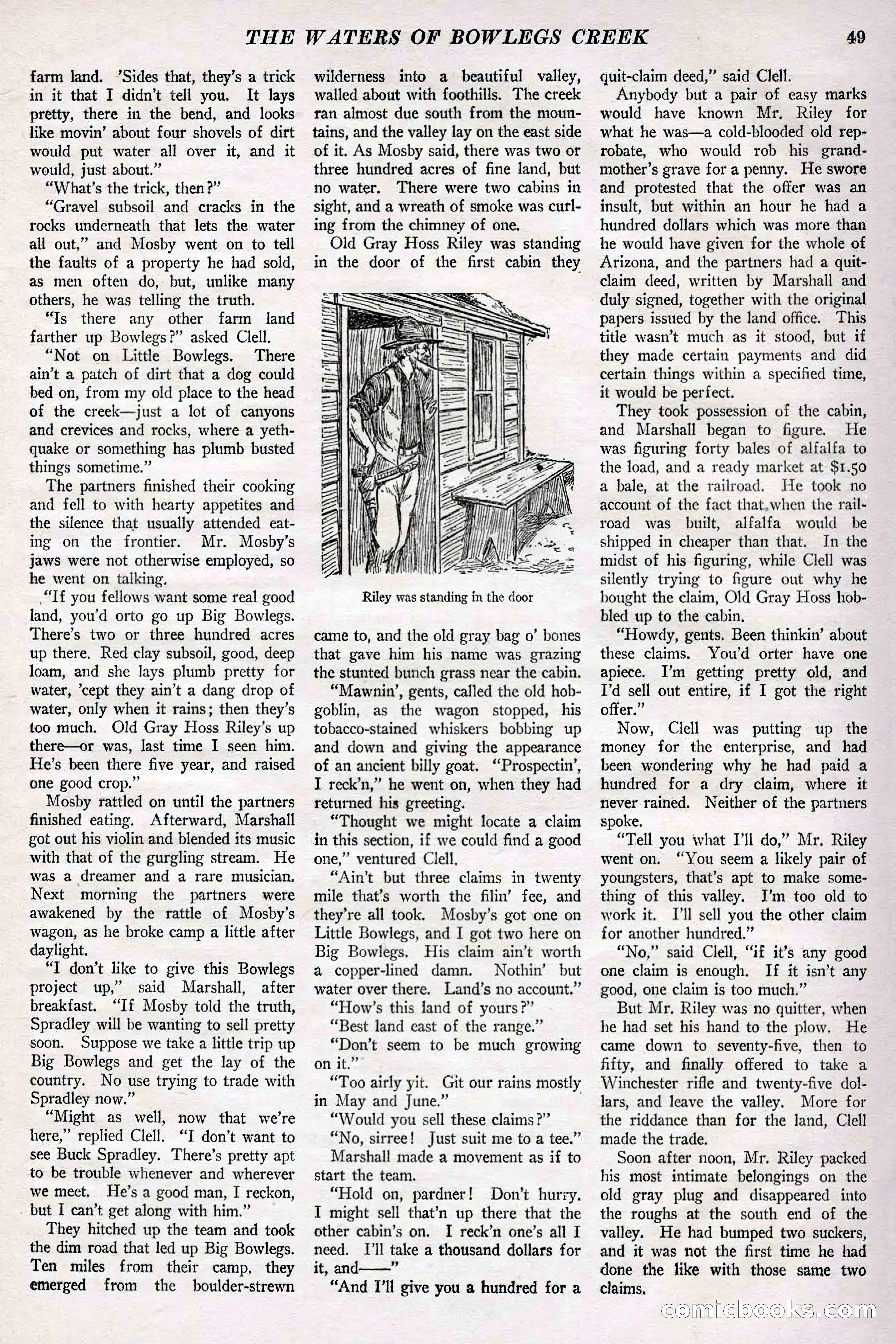
# Page Analysis: "The Waters of Bowlegs Creek" This is a **story prose page with an embedded illustration**. The page shows the continuation of a narrative about frontier land claims and disputes. A black-and-white illustration depicts an old man (identified in the text as Riley) standing in a cabin doorway beside an aged horse. The visible text concerns characters discussing the acquisition and valuation of land claims in what appears to be the American West. Characters named Clell, Marshall, Mosby, and Mr. Riley debate the worth of various claims, with Riley ultimately offering to sell his claim and leave the valley for a sum of money. The dialogue suggests themes of frontier settlement and land disputes, typical of pulp-fiction Western stories from the early 20th century.
# Page Analysis This is a text page from a pulp fiction story titled "The Frontier" (visible in the header). The page contains two columns of prose narrative with a single illustration embedded in the right column. The story concerns a character named Crell Berry, an engineer, who discovers a remote mountain cabin while prospecting for gold and silver. He encounters a young woman named Jenny Tatum and her elderly father at the cabin. The narrative details Crell's observations of the landscape, a natural spring, and his initial meeting with the inhabitants. The illustration shows what appears to be a bearded man in the cabin doorway—likely the father character. The text focuses on dialogue and character introductions as Crell learns about the family's isolated life on the frontier.
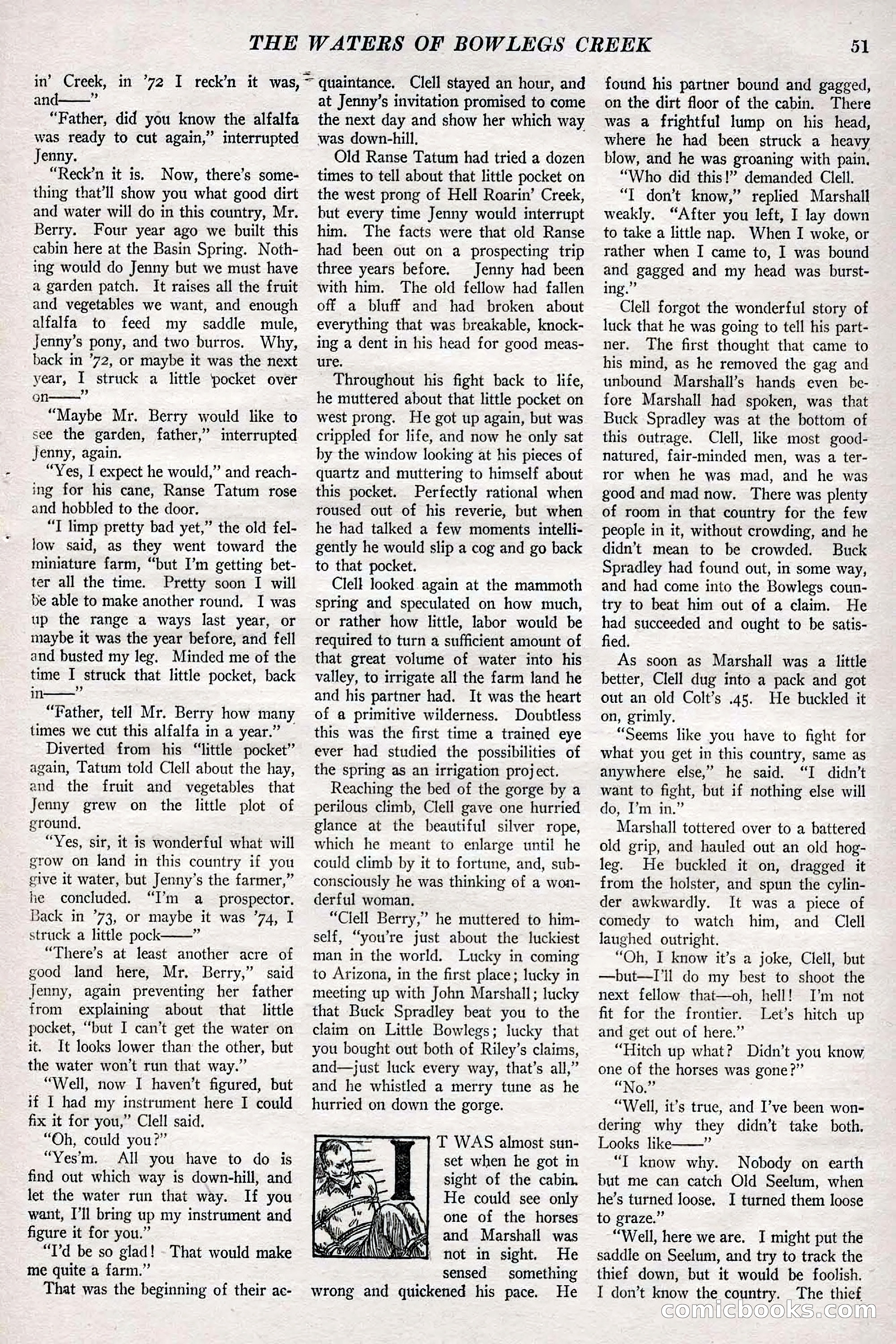
# "The Waters of Bowlegs Creek," Page 51 This page contains prose fiction text from what appears to be a Western story. The narrative describes characters discussing frontier life, water management for farming, and prospecting for gold or minerals. There is a small illustration embedded within the text showing what appears to be a man's face in profile. The story involves dialogue between characters named Clell, Marshall, Mr. Berry, and Jenny, discussing challenges of living in remote country, including finding water sources, acquiring claims, and general frontier hardships. The tone and subject matter suggest this is a Western pulp fiction story, likely from the early 20th century.
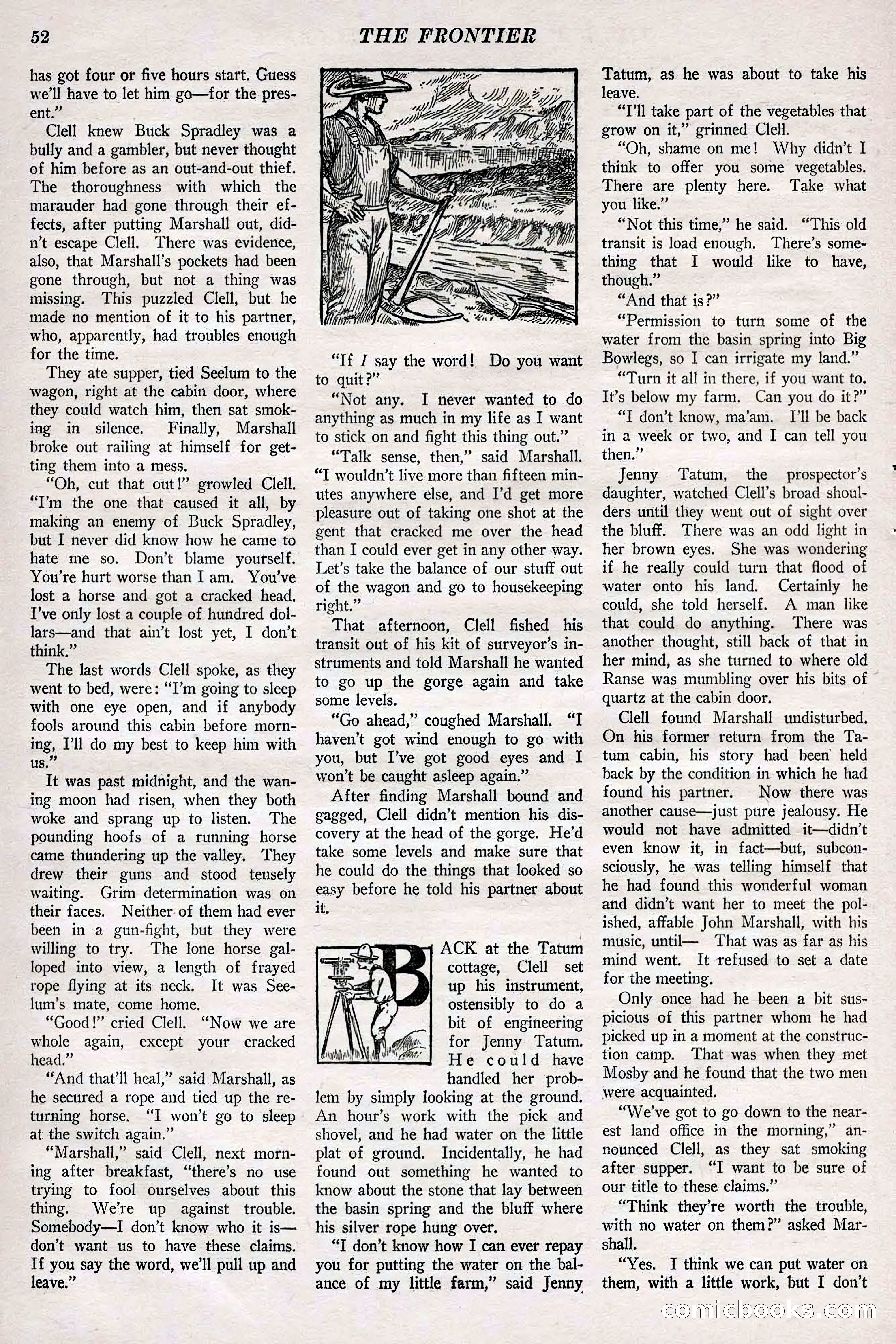
# Page 52 from "The Frontier" This page contains story prose with two black-and-white illustrations integrated into the text. The narrative appears to depict a conflict between frontier characters: Clell confronts Marshall about an encounter with Buck Spradley, a "bully and gambler," while they debate whether to abandon their claims and leave the area. The story involves surveying instruments, water rights from a basin spring, and jealousy regarding a woman named Jenny Tatum. The dialogue and action suggest a Western adventure story focused on land disputes and interpersonal tensions among prospectors or settlers in a frontier setting.
# Page 54 from "The Frontier" This page contains story prose with a single embedded illustration. The text depicts a Western scene where a character named Cell negotiates with armed men outside a cabin. Cell and another character named Marshall prepare for gunfire as six mounted men approach. The narrative describes a tense standoff involving a dispute over land and water rights in a valley, with references to State Rangers attempting to drive settlers from the area. The small illustration shows what appears to be a decorative initial letter beginning a paragraph. The page is numbered 54 and appears to be from the middle of a longer serialized Western story.
# Page 55: Story Prose with Small Illustration This page contains story prose from "The Waters of Bowlegs Creek," with a small illustration showing what appears to be a dead body being examined. The text describes a ranger investigating a murder victim named Marshall and discusses a claim on Little Bowlegs. The narrative then shifts to characters named Clell and Jenny discovering Marshall's will in a cabin, which leaves his estate to McClellan Berry. The passage concludes with discussion of mining claims and blasting in the Bowlegs area. The page is entirely text-based storytelling typical of pulp fiction, with one small embedded illustration of the crime scene.
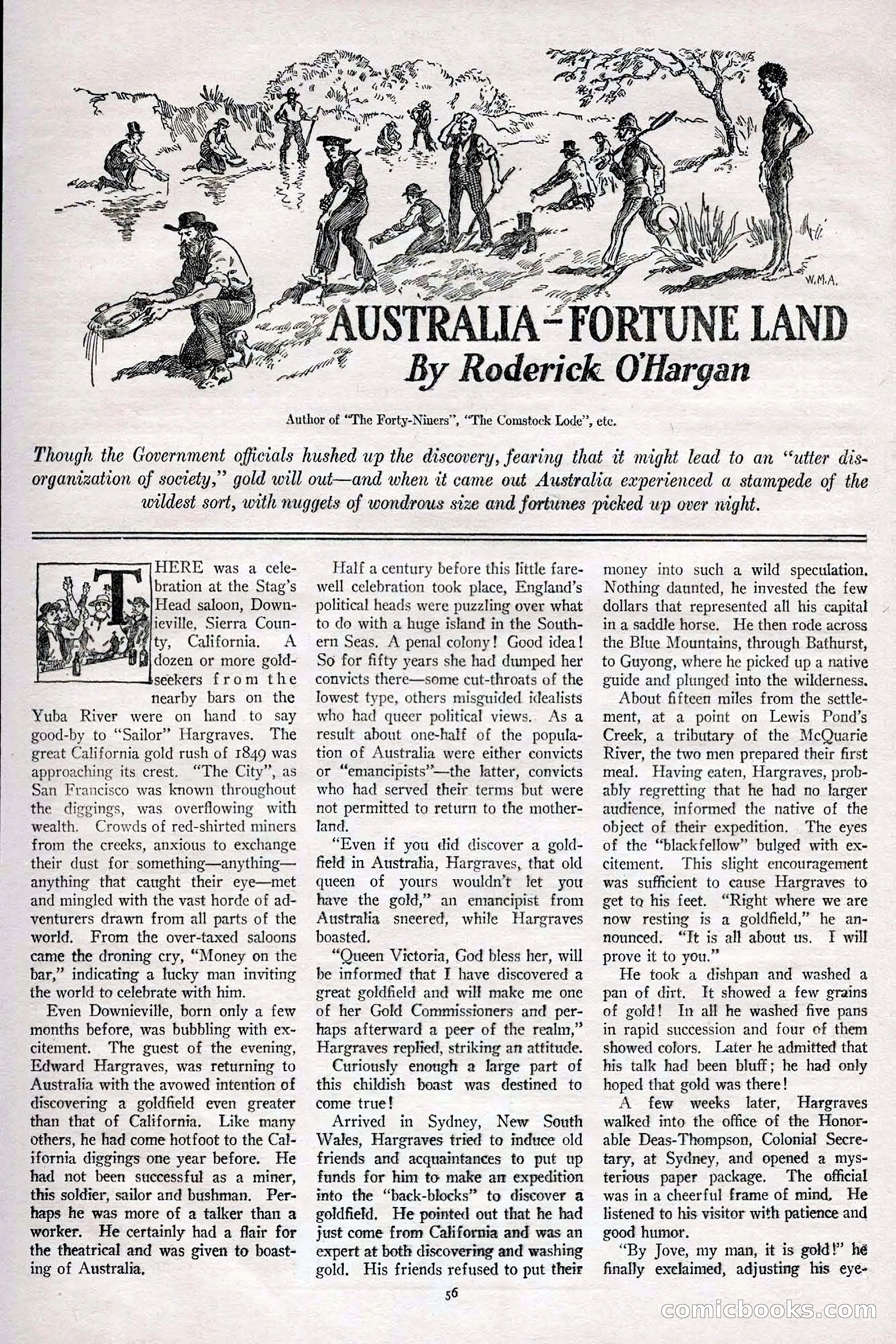
This is a story page from a pulp magazine featuring "Australia—Fortune Land" by Roderick O'Hargan. The page displays an illustration at the top showing multiple figures in period dress engaged in gold-panning activities near water and trees. Below the illustration is the story title and author credit, followed by a subtitle indicating the story concerns gold discoveries in Australia that caused societal disruption. The bulk of the page contains the beginning of the story text in two columns, describing a celebration in California and a man named Hargraves who claims to have discovered gold in Australia. The narrative voice is that of early-20th-century adventure fiction.
# Page 57: Australia—Fortune Land This is a prose story page with a two-panel illustration at mid-page. The text describes the discovery of gold in Australia during the 1850s, beginning with Hargraves' discovery of gold-bearing quartz near Botany Bay. The narrative details how news of these strikes spread rapidly, causing mass migration to the goldfields and severe social disruption—including the abandonment of ships in harbors, closure of businesses, and departure of workers from their jobs. The passage emphasizes both the "windfall" effect on officials and the chaotic impact on colonial society, particularly the sudden depopulation of towns like Melbourne and Sydney as fortune-seekers rushed to newly discovered gold sites.
This is a page of story prose from *The Frontier* magazine (page 58). The text describes the Australian gold rush of the 1850s, detailing how discoveries of gold nuggets attracted immigrants and transformed Australian society and economy. The narrative focuses on specific large nuggets found—including the "Welcome Stranger," "Blanche Barkly," and nuggets discovered by Edward Hargraves—and their values in dollars. The passage also mentions how gold discoveries disrupted the social order by elevating poor miners to wealth and prominence, and notes government rewards given to notable discoverers. A small decorative illustration appears in the lower left corner.
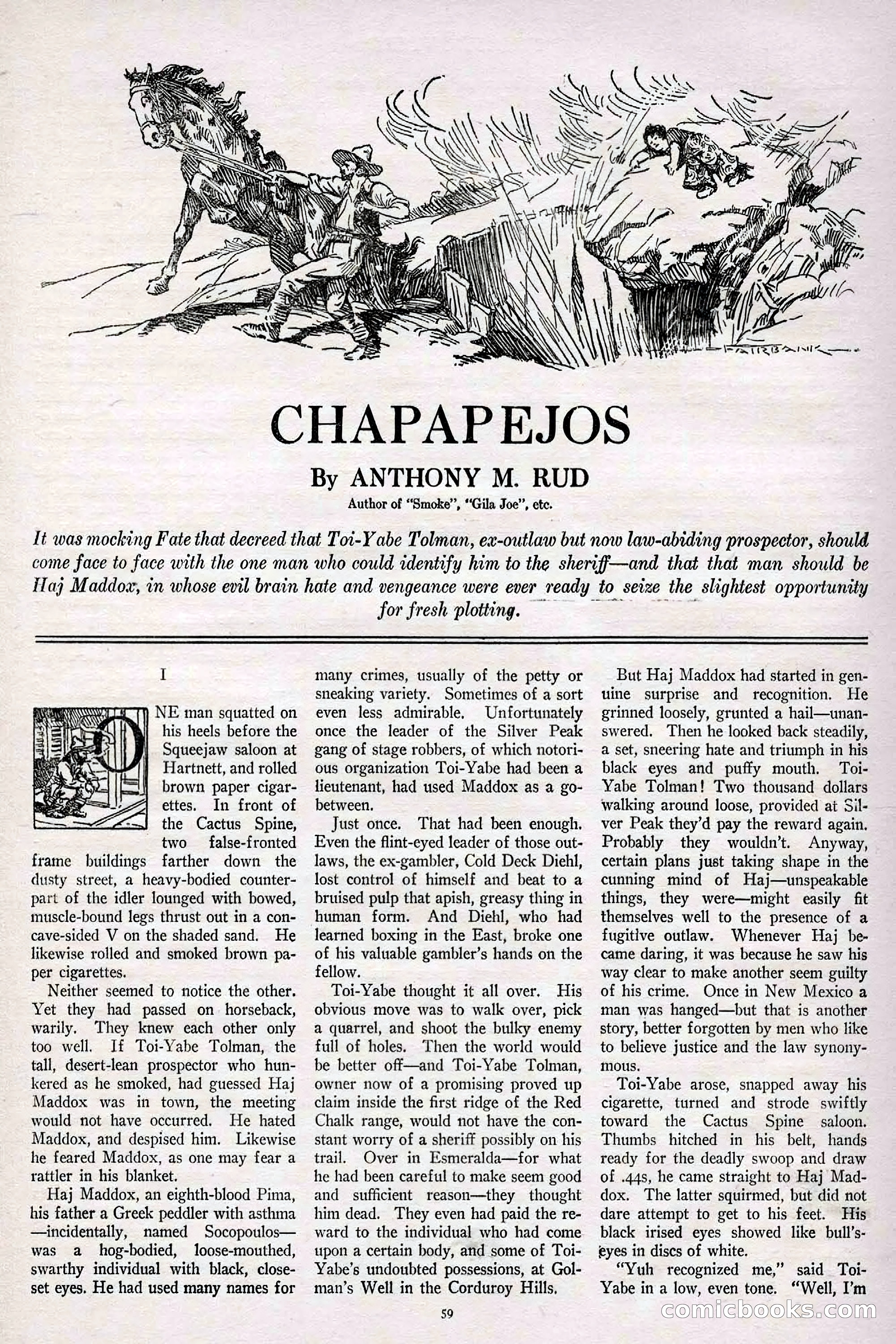
# Page Analysis This is a story page from a pulp magazine featuring "Chapapejos" by Anthony M. Rud. The page includes a decorative illustration at the top showing a cowboy on horseback with armed figures, rendered in black ink line art. The visible text is the opening of the story's prose, introducing Toi-Yabe Tolman, a desert prospector, and Haj Maddox, an antagonist described as having "evil brain hate and vengeance." The narrative, set in what appears to be the American Southwest, describes their chance meeting near the Cactus Spine saloon in a dusty frontier town. The passage establishes conflict between these two characters and hints at criminal history and outstanding grievances.
# Page 60 of "The Frontier" This page contains story prose with a small decorative initial capital letter (ornate "S"). The text appears to be a Western narrative involving characters named Stone Bellinger (a sheriff), Haj Maddox, Toi-Yabe, and others. The visible story discusses Bellinger's background as a former Mormon who became sheriff of Nye County, Nevada, and his marriage to a woman named Genevar whose death profoundly affected him. The narrative then shifts to describe a widow caring for a child named Dickie and her interactions with other frontier settlers, including a Scandinavian miner named Thorgesson. The story explores themes of frontier life, religious conflict, and domestic relationships in the American West.
# Page Analysis This page contains story prose from a pulp fiction magazine, specifically from a section titled "CHAPAREJOS" (page 61). The text describes a scene involving a young boy named Dickie who, hungry and desperate, steals money from a broken tomato packing case and ventures to Chong Yen's restaurant to buy food. The narrative follows Dickie's interactions with the Chinese restaurant owner Chong Yen, detailing the meal preparation and their transaction. The page includes two small illustrations—decorative initial letters—but is predominantly prose text. The story appears to be an adventure or crime-oriented pulp narrative set in what seems to be a frontier or settlement town.
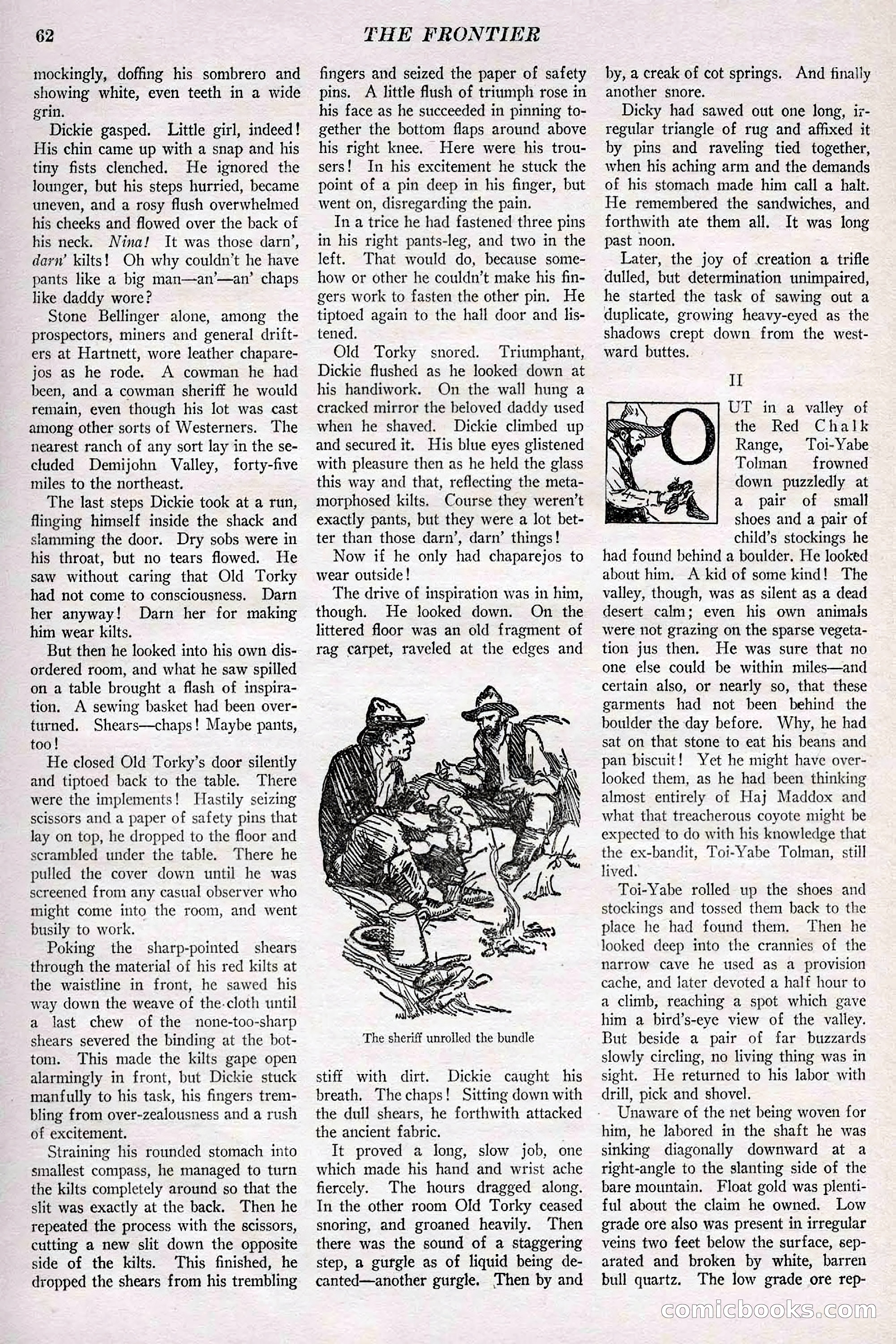
# Page Analysis This page contains story prose from a pulp fiction magazine titled "The Frontier" (visible in the header). The text describes a character named Dickie working with safety pins and shears, apparently mending or altering clothing in what appears to be a frontier setting. A section break introduces a new scene in "a valley of the Red Chalk Range," where a character examines found items including shoes and stockings, contemplates local dangers (mentioning "Haj Maddox" and a "treacherous coyote"), and prepares to return to mining work. The page includes one illustration showing what appears to be two frontier-era figures examining or discussing something. The narrative suggests a hardboiled Western adventure story.
# Page Analysis This is a text page (page 63) from a pulp fiction story titled "CHAPAREJOS." The page contains primarily prose narrative with a single illustration embedded within the text column. The story follows a character named Toi-Yabe, a prospector in a desert setting. The visible text describes Toi-Yabe discovering a water source near his mining claim and subsequently hearing gunfire. After hearing explosions from blasting work, he investigates a shaft and discovers water—a significant find that could aid his mining operation. The embedded illustration shows what appears to be miners or workers in an underground or confined space. The narrative concerns itself with prospecting, mining operations, and desert survival in what appears to be an American Western setting.
# Page 64 from "The Frontier" This page contains story prose from what appears to be an adventure or western narrative titled "The Frontier." The text describes two men—Toi-Yabe and Dickie—in a dangerous underground situation involving a collapse or cave-in. Toi-Yabe is attempting to rescue the injured Dickie from a subterranean river with treacherous currents. The passage emphasizes physical peril, with descriptions of falling rock debris, cold water, and the struggle against natural forces. A small decorative illustration appears at the start of a new section (marked "III"), showing what seems to be a figure in distress. The narrative focuses on survival and rescue amid environmental hazards.
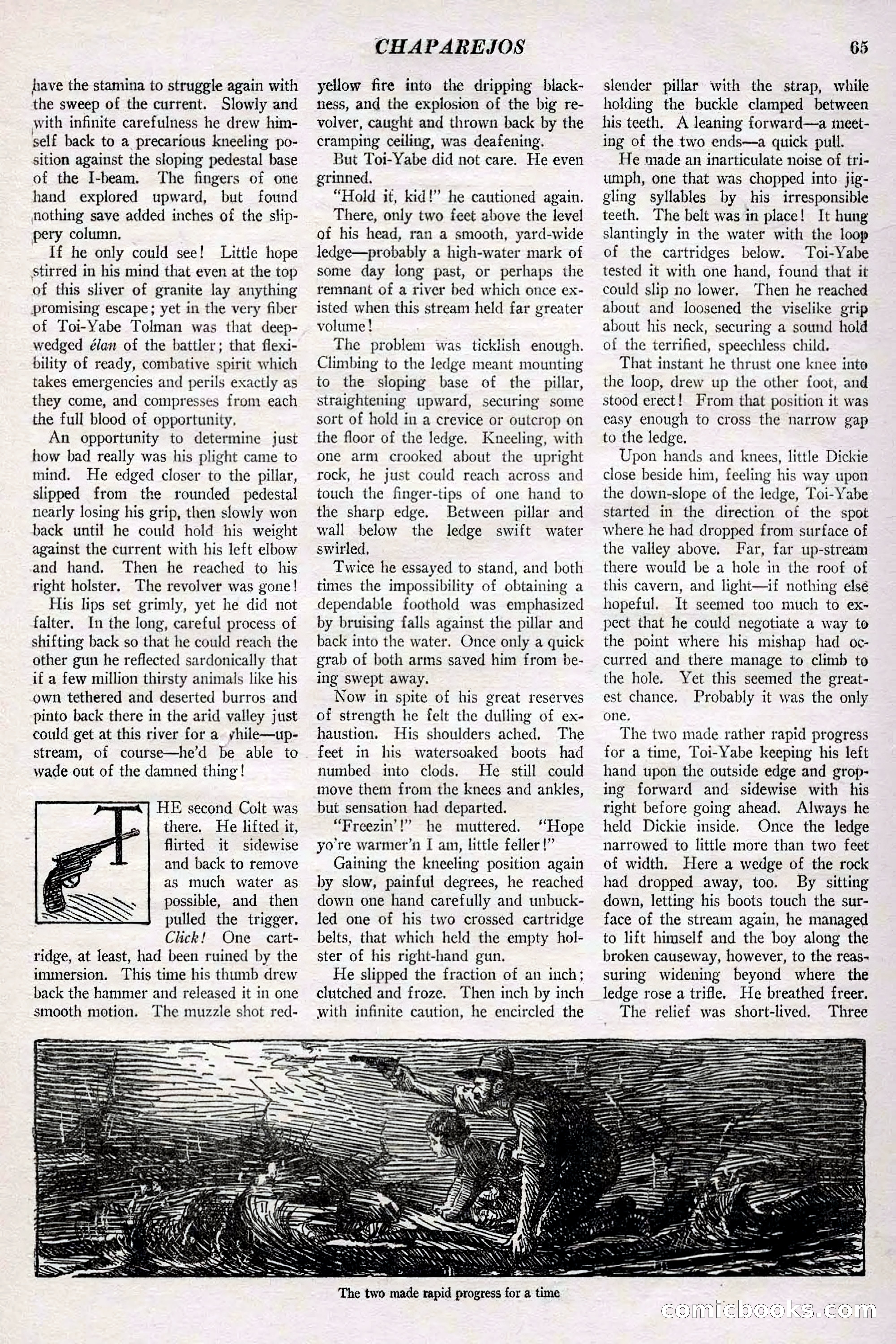
# Page Analysis: "Chaparejos" This is a **story page with illustration** from page 65 of what appears to be a Western pulp fiction magazine. The text describes two characters—Toi-Yabe and a boy named Dickie—navigating a treacherous cave passage beside a river. They're attempting to climb across a narrow ledge while water swirls below, with Toi-Yabe having lost his revolver and now trying to retrieve it. The passage emphasizes physical danger, exhaustion, and determination. The black-and-white illustration at page bottom shows the two figures making their way across the perilous terrain, matching the narrative's tense climbing sequence.
# Page Analysis This is a **story prose page** from *The Frontier* magazine (page 66), featuring two columns of text with a small illustration embedded in the left column. The visible narrative concerns two men—apparently named Toi-Yabe and Dickie—in a dangerous underground or cave setting. They appear to be trapped or hunted, navigating through a narrow passage with a stream while pursued by gunfire. The text describes their attempts to escape through difficult terrain, reloading weapons, and strategizing against an opponent. The embedded illustration, showing what appears to be a crouching figure, likely depicts a moment from this tense confrontation. The story appears to be an action-adventure narrative, likely from the early 20th century based on the typography and style.
# Page Analysis This is a text-heavy story page from a pulp magazine, numbered 67, titled "CHAPAREJOS" (visible at top). The page contains primarily prose narrative with one small illustration embedded in the left column showing what appears to be a figure in action. The visible text describes an intense confrontation scene involving characters named Toi-Yabe, Bellinger (apparently a sheriff), and others. The narrative involves gunfire, pursuit, and physical conflict in what appears to be a Western setting, with references to a cave and rocky terrain. The prose concerns itself with the aftermath of a shooting incident and the characters' reactions and escape attempts.
# Page 68 from "The Frontier" This page contains story prose with a decorative initial letter ("K") at the beginning. The narrative follows a character named Toi-Yabe during what appears to be a Western frontier conflict. The visible text depicts an ambush near a canyon, with gunfire between Toi-Yabe and an adversary named Haj Maddox. The passage describes the action of the confrontation, Toi-Yabe's tactical positioning, and subsequent dialogue where characters discuss their injuries and plans to move camp. The story involves themes of frontier survival, combat, and character relationships in what appears to be a hardboiled Western narrative.
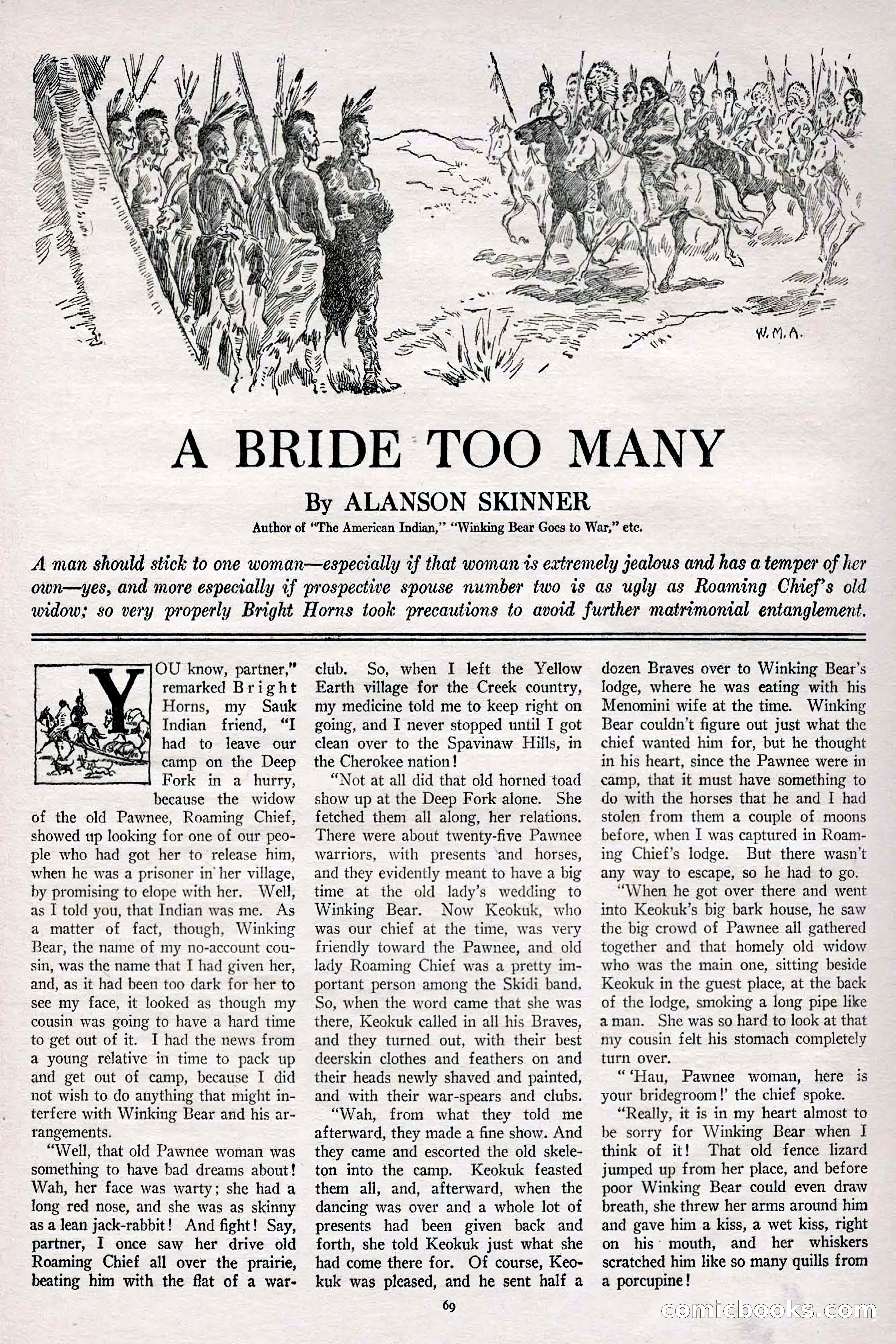
# Page Content Description This is a story page from a pulp magazine featuring "A Bride Too Many" by Alanson Skinner. The page includes a sketch illustration at the top showing two groups of Native American figures facing each other across open ground, apparently depicting a tense encounter. The main text is prose fiction beginning with a first-person narrator's account. The story involves Native American characters, specifically mentioning Pawnee and Cherokee tribes, with plot elements involving a man named Winking Bear, a woman named Roaming Chief (described as jealous), and complications arising from polygamy or multiple romantic entanglements. The narrative voice suggests this is a Western or frontier adventure story set among indigenous peoples.
# Page 70 from "The Frontier" This page contains story prose with a small illustration embedded within the text. The narrative appears to be a first-person account by a Native American character (likely Keouk, a Pawnee chief based on context) recounting conflicts and romantic entanglements involving stolen women, tribal disputes, and encounters with other tribes. The visible text discusses a woman who eloped from a Skidi village, her recapture, and various complications involving Winking Bear and other named characters. The small illustration shows what appears to be a figure in period dress. The prose is dense with dialogue and backstory typical of early pulp western fiction.
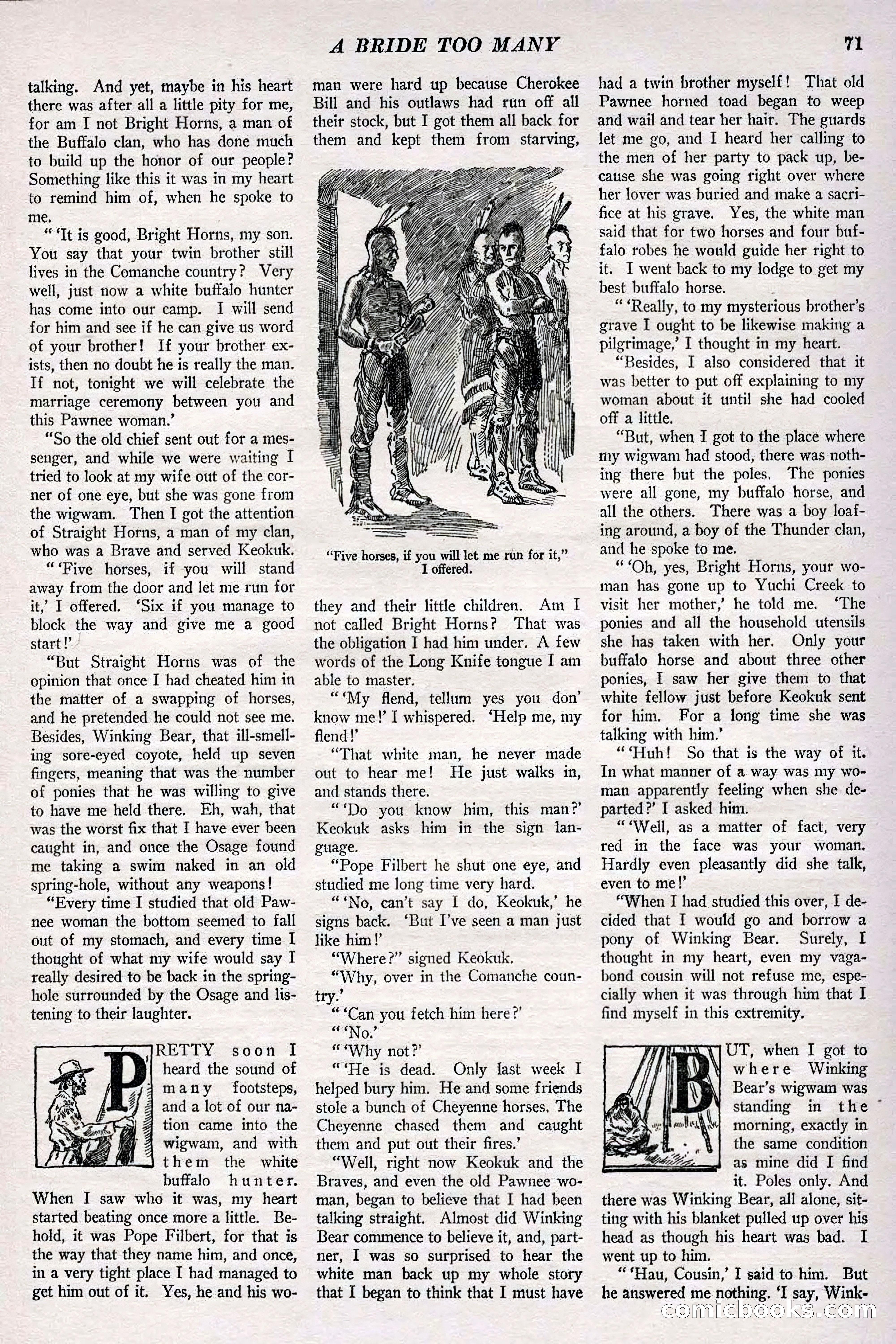
# A Bride Too Many — Page 71 This is a story page from a pulp magazine featuring prose narrative with one central illustration. The illustration depicts several figures in what appears to be a Native American encampment scene, with the caption "'Five horses, if you will let me run for it,' I offered." The text describes a narrator's dealings with Native American characters, including negotiations over horses and references to a woman who has departed. The narrator appears to be recounting past events involving tribal members, a white buffalo hunter, and complications arising from a marital or romantic situation. The story involves themes of honor, obligation, and frontier-era conflicts between different groups.
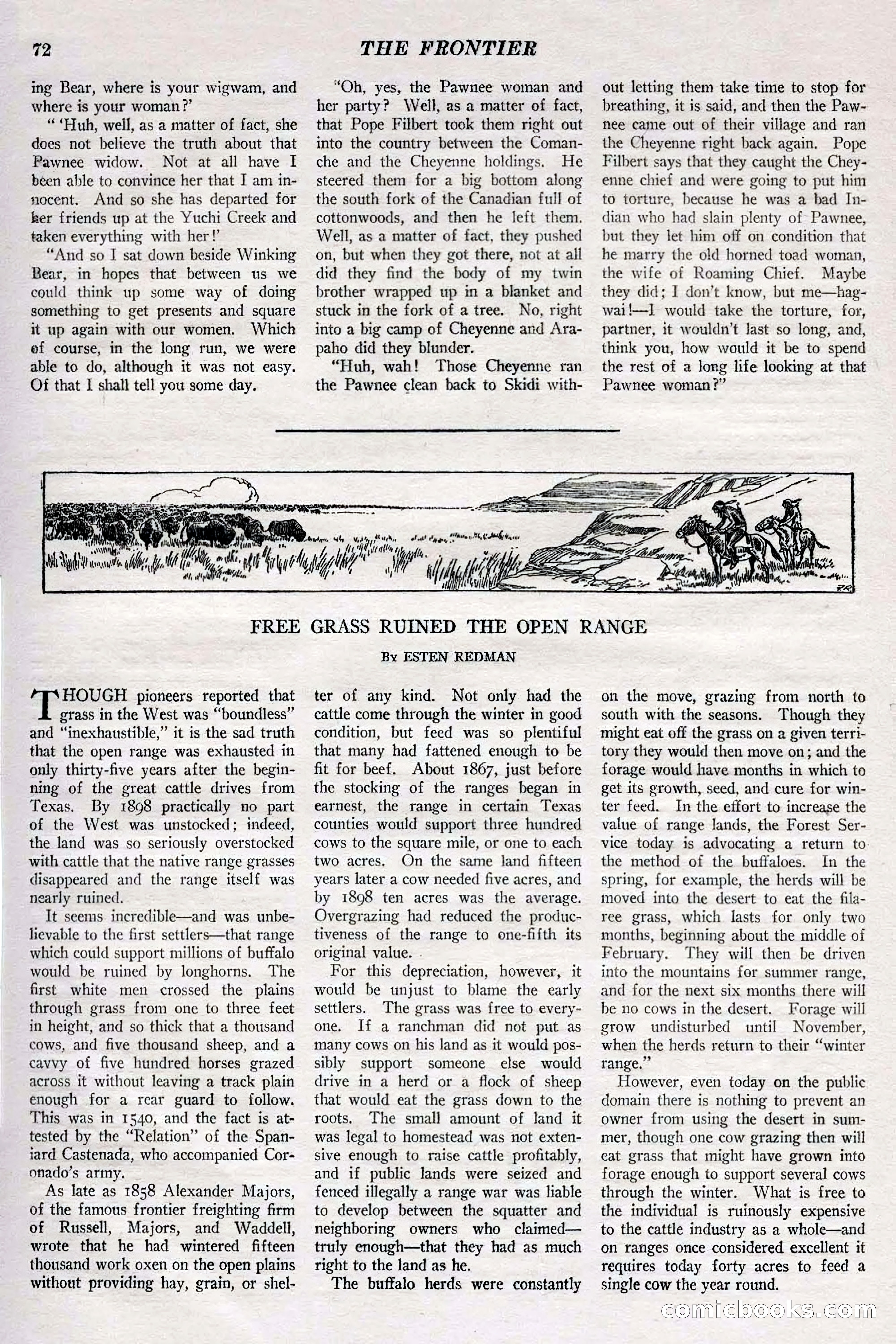
# Page 72 from "The Frontier" This page contains prose fiction and a landscape illustration. The top half continues a story about interactions between Native Americans (Pawnee and Cheyenne) and settlers, involving a woman and a man named Winking Bear discussing past events and kidnappings. Below the prose is a horizontal illustration showing a frontier landscape with grassland, hills, and figures on horseback. The bottom half begins a new article titled "Free Grass Ruined the Open Range" by Esten Redman, which discusses the historical overgrazing and depletion of Western rangeland in the 19th century, explaining how excessive cattle and livestock exhausted the prairie's natural resources.
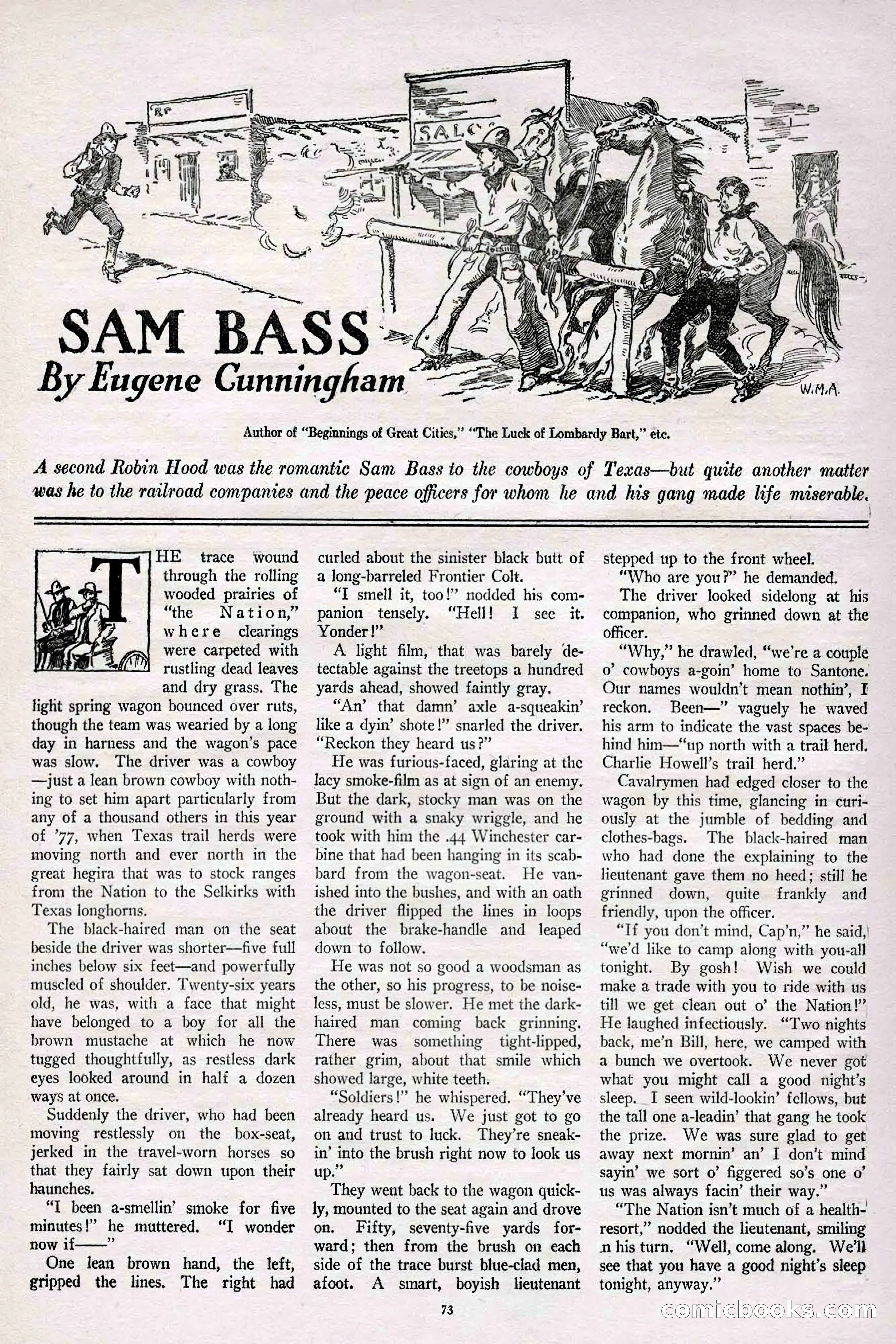
# Page 73: Story Text with Illustration This is a story page featuring "Sam Bass" by Eugene Cunningham. At the top is a sketch illustration showing a Western scene with multiple figures around a wagon and campsite, with period-appropriate clothing and equipment. The bulk of the page contains prose narrative text in two columns. The story depicts a scene on the frontier involving cowboys and a wagon journey, with dialogue between characters discussing travel plans and encounters. The narrative describes Western landscape, horse-drawn transportation, and interactions between what appear to be cowboy characters, with references to Texas and trail herding. The writing style and subject matter are consistent with early-20th-century Western pulp fiction.
# Page 74 of "The Frontier" This is a story prose page from a pulp magazine titled "The Frontier." The narrative concerns a lieutenant speaking with cowboys about train robbers who held up a U.P. train near Ogalala, Nebraska. The discussion involves two deaths from that robbery and mentions a subsequent incident at Buffalo Stage in Kansas. The cowboys, particularly one named Sam Bass (described as black-haired with a distinctive appearance), discuss whether to pursue the robbers toward Denton. The conversation reveals that some of the robbers may have been involved in earlier crimes, and there's mention of gold-pieces and potential connections to larger criminal enterprises. The page contains no illustrations, only two-column text layout typical of pulp magazines.
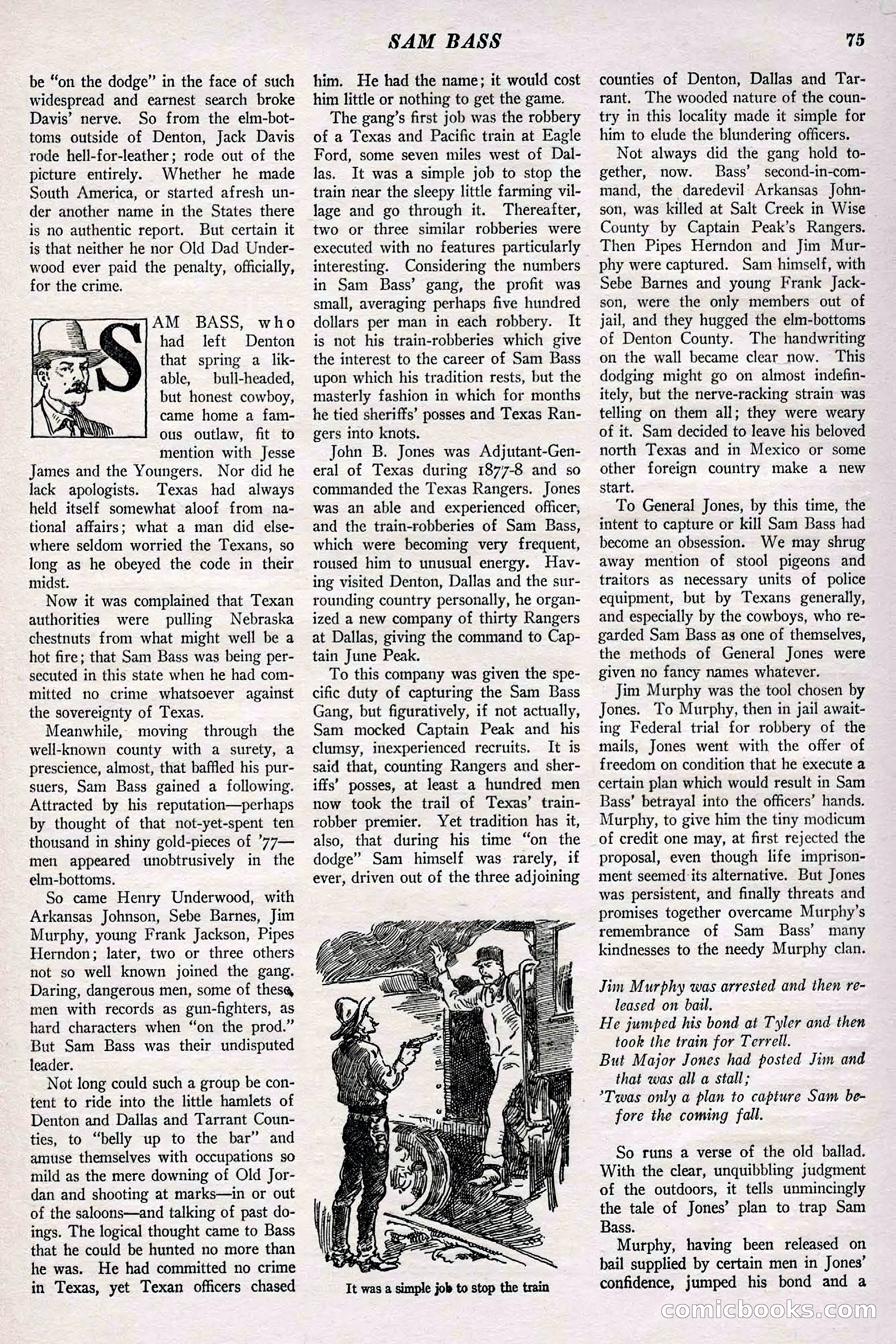
# Analysis of Page 75: "Sam Bass" This is a **story prose page** from a pulp fiction magazine featuring the narrative of Sam Bass, a historical outlaw figure. The page recounts Bass's criminal career in Texas, describing his train robberies and his pursuit by Texas Rangers under General John B. Jones. It includes an inset illustration showing what appears to be a train robbery scene. The text discusses how Bass and his gang operated across counties near Dallas and Denton, their eventual capture, and Jones's pursuit. A brief verse appears at the bottom, suggesting this is a serialized account or ballad about the outlaw's exploits and eventual downfall.
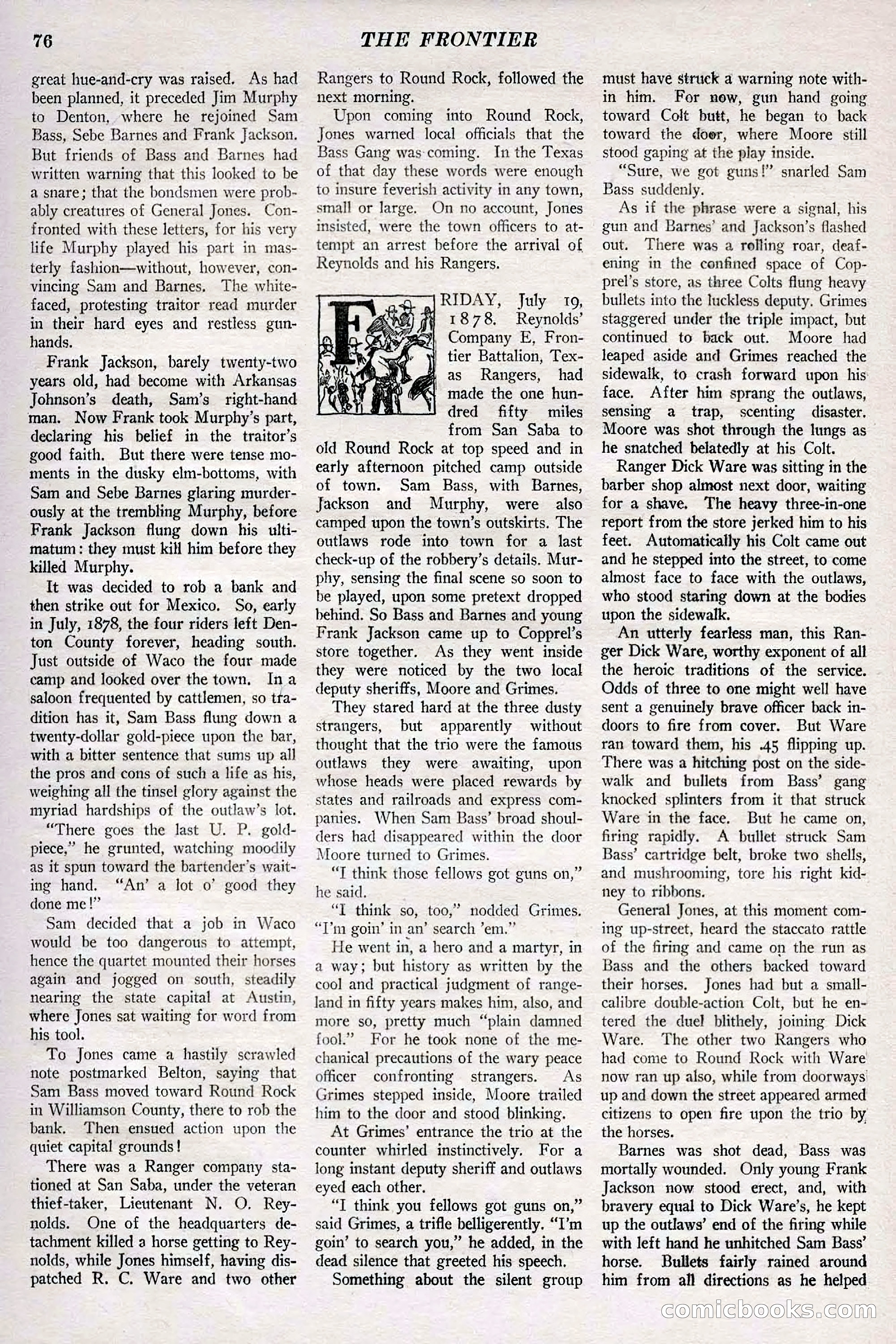
# Page Analysis This is a page of story prose from a pulp magazine titled "THE FRONTIER" (visible at top). The page number is 76. The text describes what appears to be a Western gunfight in a town, likely Round Rock, Texas, dated July 19, 1878 (as indicated by a decorative header). The narrative involves lawmen confronting outlaws, including characters named Sam Bass, Frank Jackson, and Dick Ware. The passage details a shootout where Bass and his gang attempt robbery, leading to gunfire in the street and store. A decorative initial letter "F" marks a section break within the prose. The story reads as historical Western fiction, recounting an apparent real historical event involving bank robbers and Rangers.
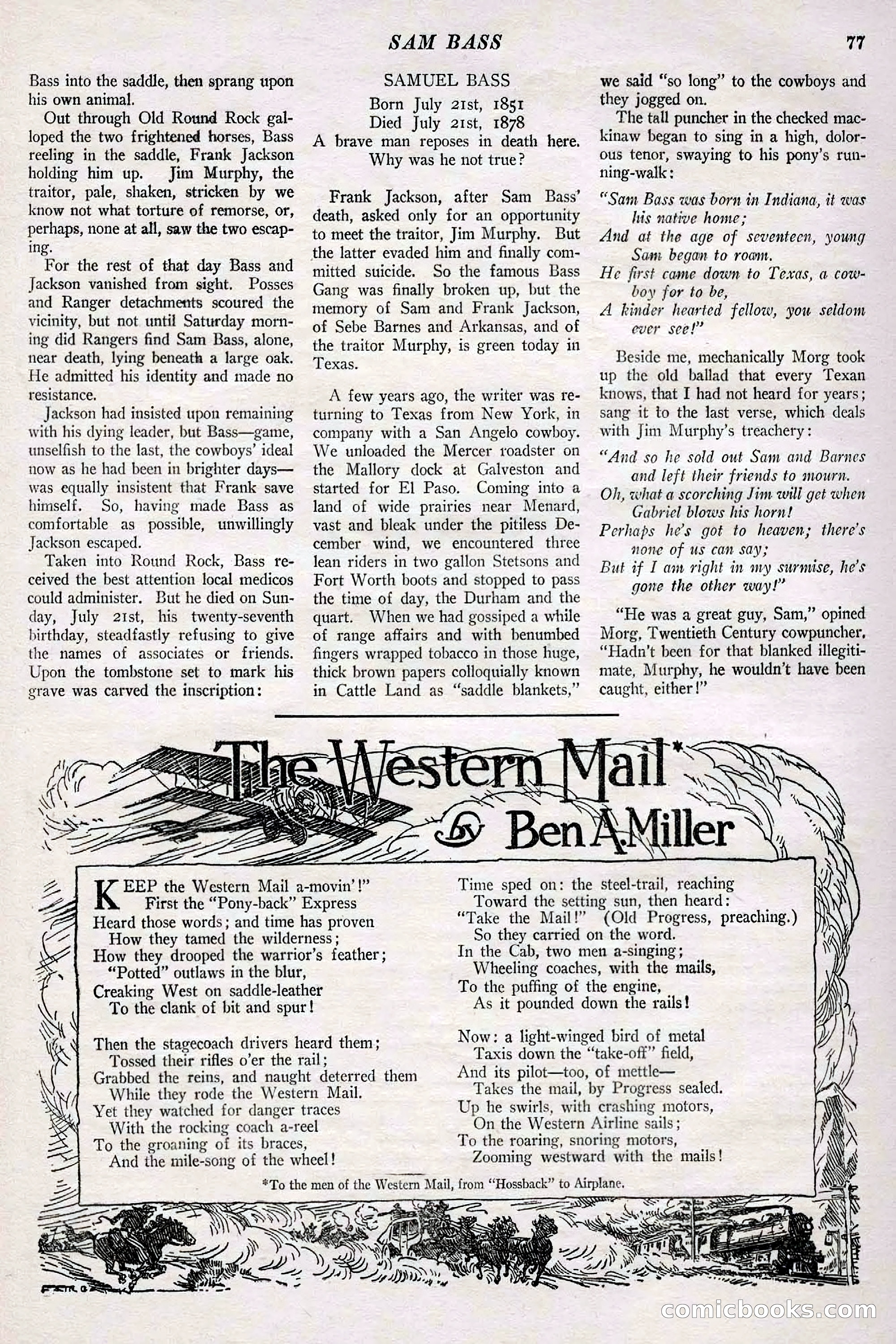
This is a text page from a pulp magazine containing two stories. The upper portion concludes "Sam Bass," a biographical narrative about the outlaw Samuel Bass (born 1851, died July 21, 1878), describing his death and the betrayal by associate Jim Murphy. The lower half features "The Western Mail," a poem by Ben A Miller, celebrating the evolution of mail delivery from stagecoaches to modern trains and airplanes. The page includes decorative illustrations bracketing the poem, depicting horses, stagecoaches, and trains. The content emphasizes American frontier history and technological progress in transportation and communication.
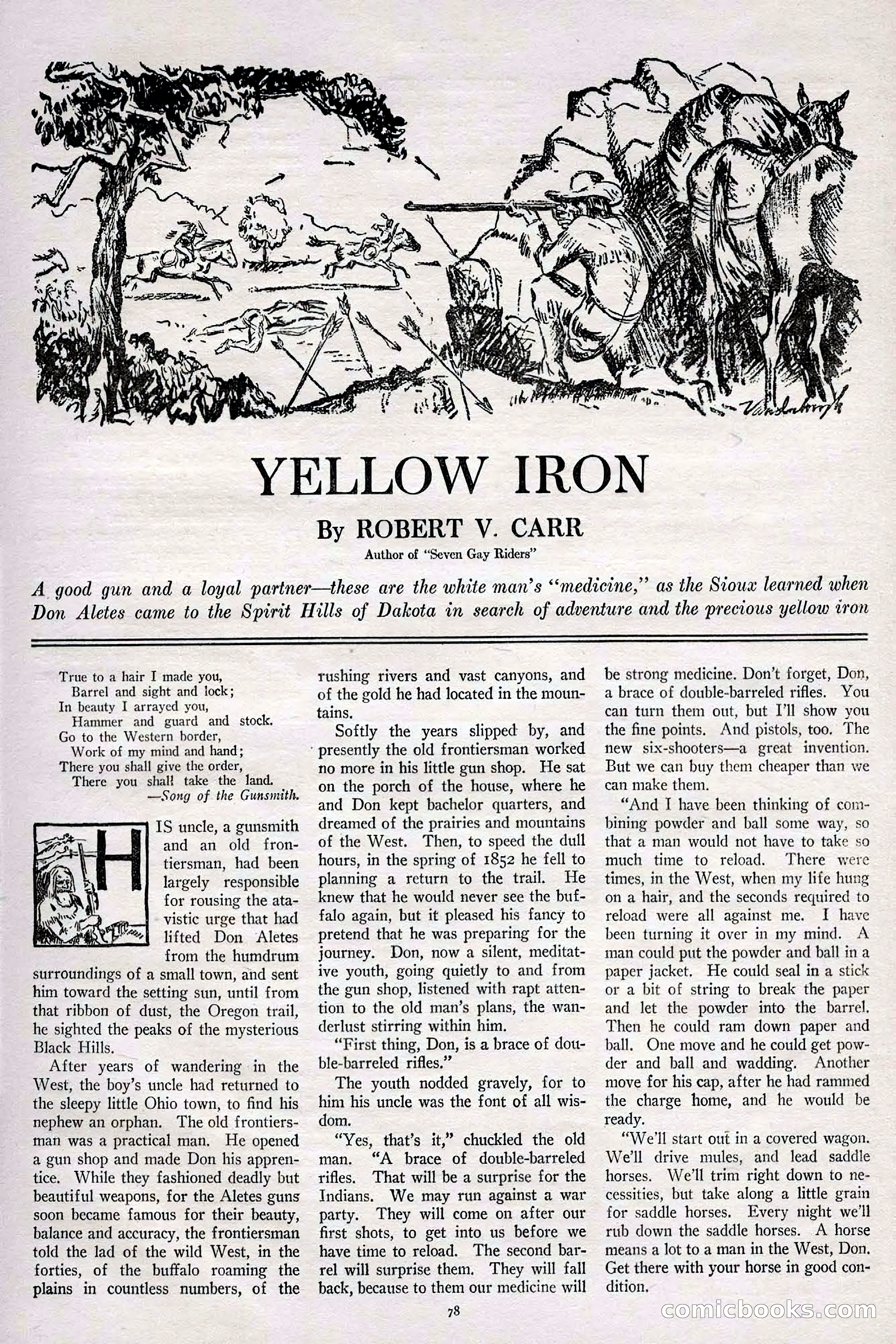
# Yellow Iron by Robert V. Carr This is a story opening page from an early pulp magazine featuring both an illustration and prose text. The illustration depicts a Western frontier scene with armed figures, horses, and what appears to be a gunfight or tense standoff. The story, by Robert V. Carr (author of "Seven Gay Riders"), concerns Don Aletes seeking a valuable yellow iron (likely gold) in the Spirit Hills of Dakota. An old gunsmith uncle mentors the young protagonist, teaching him to manufacture firearms and prepare for a journey westward. The narrative emphasizes frontier adventure, weapons craftsmanship, and the dangers of the Old West.
# Page 79 of "Yellow Iron" This is a text page from a pulp fiction story containing two illustrated drop caps. The narrative follows a young man preparing for a dangerous expedition into the Spirit Hills to seek gold, after his uncle's death. The prose describes his decision to abandon civilization, his journey by wagon and mule through wilderness, his plans to build a remote camp, and a tense moment when he spots mysterious riders emerging from the forest. The story emphasizes frontier hardship, isolation, and mounting danger as the protagonist ventures deeper into hostile territory.
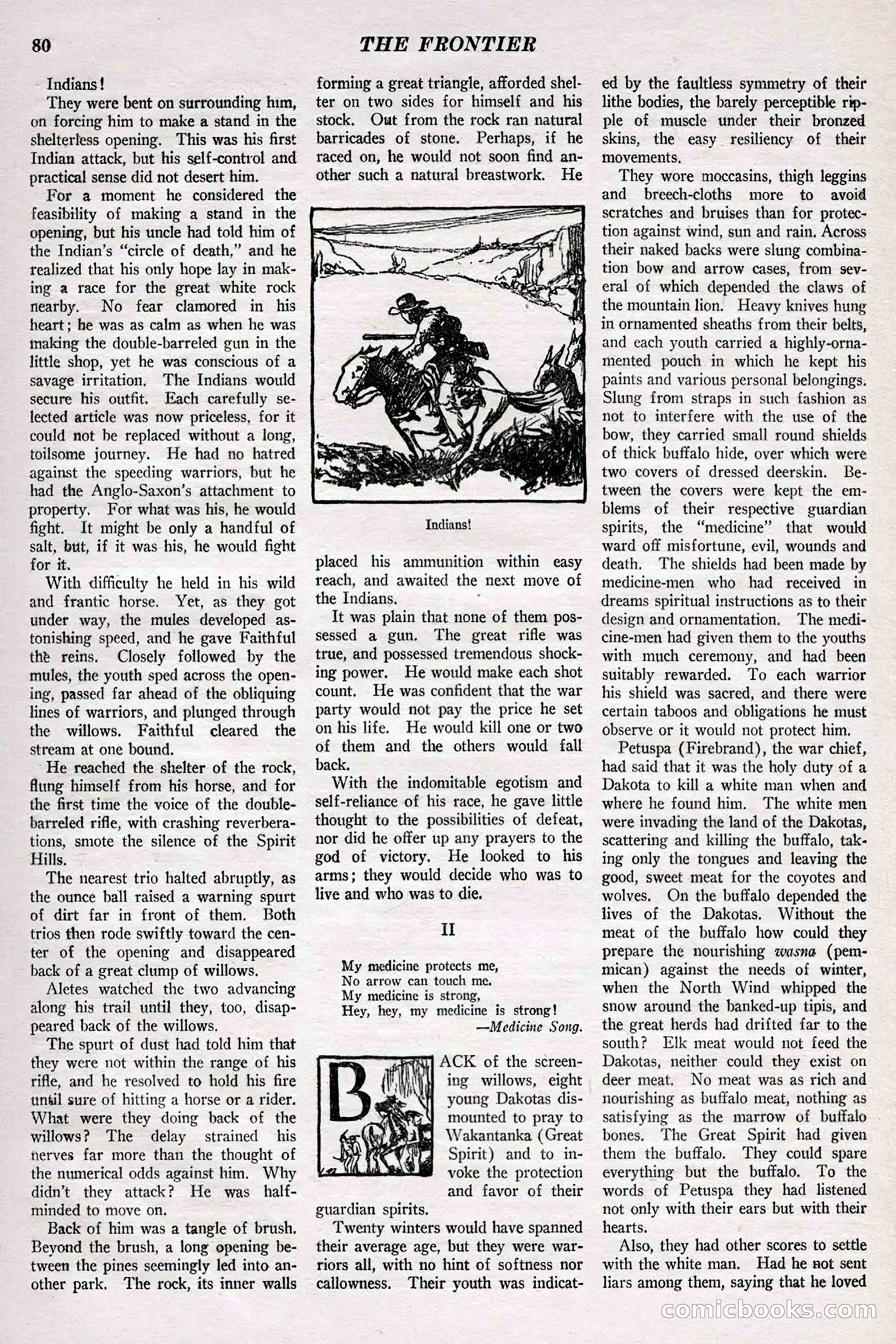
# Page Analysis This is story prose from a pulp fiction magazine titled "THE FRONTIER" (visible in the header). The page contains two text sections separated by a small illustration showing a rider on horseback in dramatic action. The narrative depicts a tense frontier scene where a white man takes shelter in rocks while Native American warriors approach. The text describes his strategic positioning, his rifle, and his confidence in his ability to fight. The second section begins with a "Medicine Song" and shifts perspective to discuss Native American warriors' preparations, their spiritual beliefs about protection, and their conflict with white settlers over buffalo hunting rights and territorial invasion. The content appears to be a Western adventure story emphasizing frontier conflict and cultural clash.
# Page Analysis This is a story prose page from a pulp magazine titled "Yellow Iron" (page 81). The text depicts a Native American warrior named Aletes engaging in combat with a white soldier, with the warrior initially hesitating before attacking despite his comrades' encouragement. The page includes Aletes's death song and spiritual reflections as he faces defeat. There are two small decorative illustrations—one at the top showing a warrior's face in profile, and another midway down showing what appears to be a fallen warrior. The narrative explores themes of honor, warfare, and indigenous spirituality during what appears to be a frontier conflict.
# Page 82 from "The Frontier" This is a text-only page of prose fiction containing two columns of dense narrative. The story appears to involve a conflict on a mountainous frontier landscape, depicting warriors on horseback engaged in combat with a white man who possesses a rifle. The text describes action scenes including gunfire, horses being shot, and warriors pursuing the armed man through rocky terrain and pine forests. There's an ornamental capital letter "S" with decorative illustration at the start of one paragraph. The prose emphasizes the tactical advantages of the rifle against traditional weapons and the dramatic geography of the landscape where this confrontation occurs.
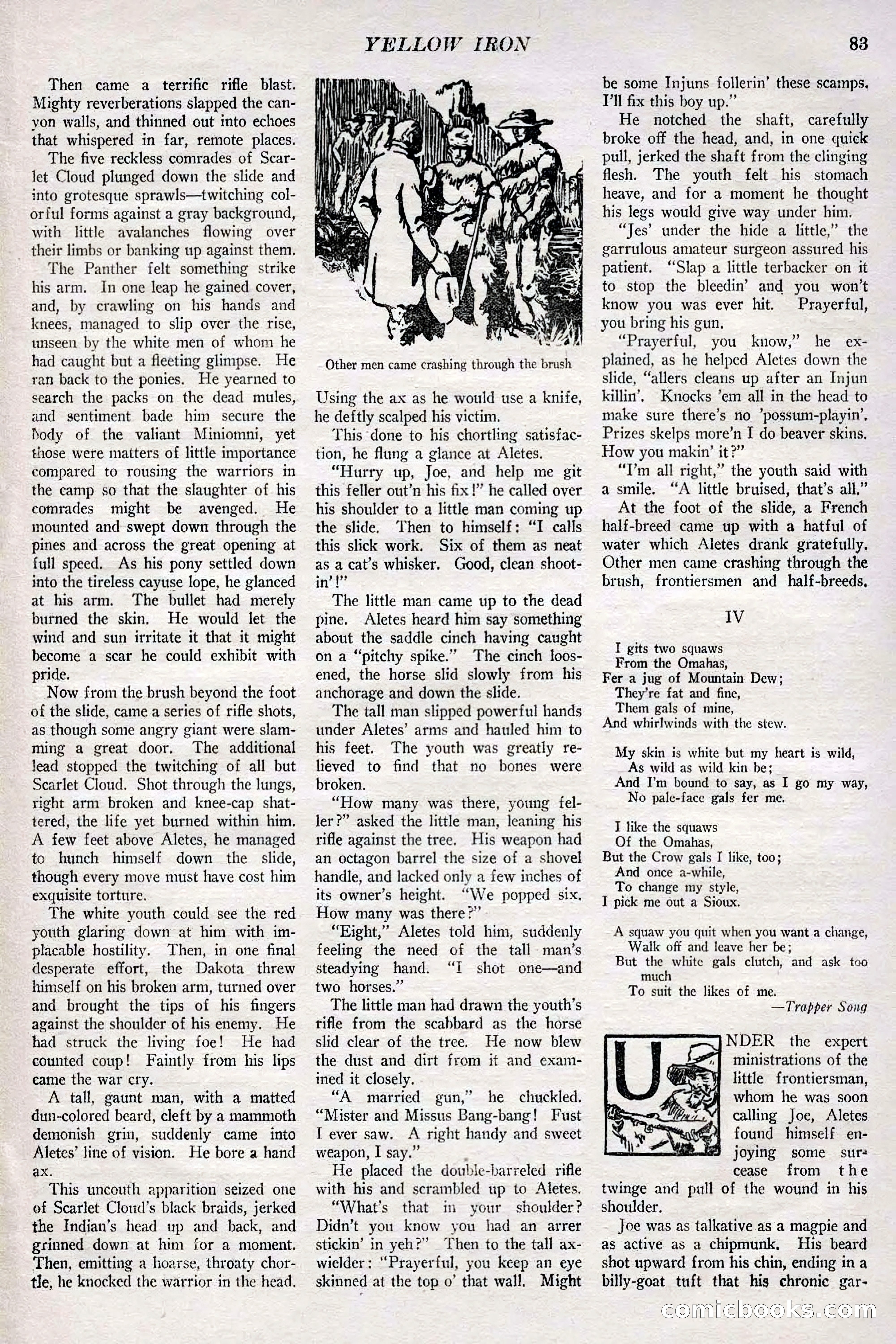
# Page 83: "Yellow Iron" This is a story page from a pulp magazine featuring both prose text and an illustration. The illustration shows several men in what appears to be a frontier or Western setting, with one man appearing to examine or work on something while others gather around. The visible prose describes a violent frontier conflict. The text recounts a rifle battle where men are killed, including detailed descriptions of casualties and combat. The narrative focuses on characters named Aletes and Scarlet Cloud, with dialogue about weapons ("a married gun"), horses, and survival in what appears to be an Indian conflict scenario. The page includes verse titled "Trapper Song" at the bottom.
# Page 84 from "The Frontier" This is a story prose page from what appears to be a Western pulp magazine. The visible text depicts a confrontation between frontier characters, including Joe, Aletes, Musbley (described as a former actor and trader), and others. The narrative involves disagreement over party membership and loyalty, with Joe and his companion apparently planning to leave Musbley's group to strike out independently in the mountains. There's tension regarding the treatment of Native Americans and references to gold-seeking. A small illustration near the top shows a thin man in a coat of Musbley pattern. The page number is 84, with the magazine title "THE FRONTIER" at the header.
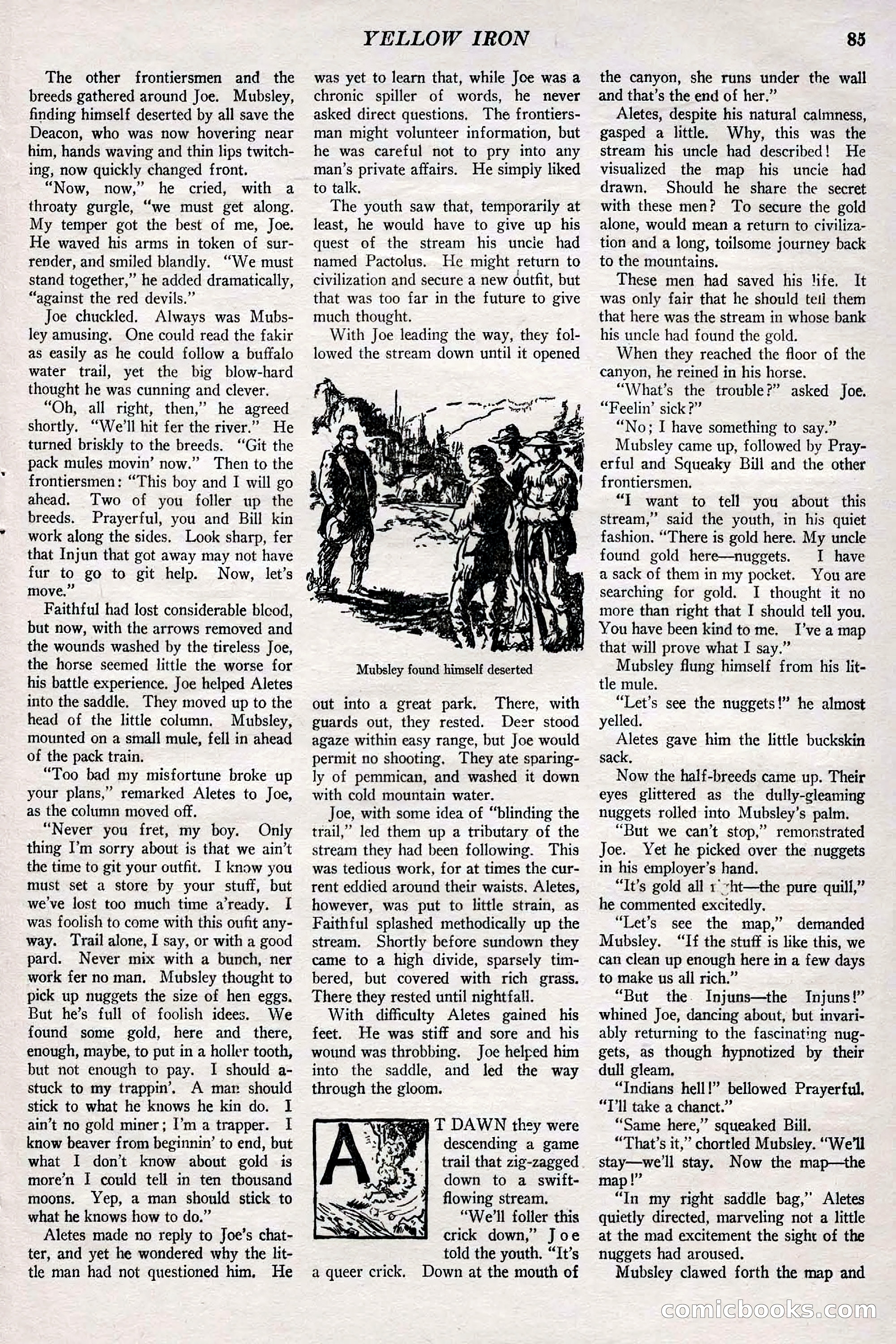
# Page 85: Yellow Iron This is a text page from a pulp fiction story titled "Yellow Iron." The page contains two columns of prose narrative and a single illustration positioned between them. The story follows a group of frontiersmen, led by a character named Joe and including figures like Aletes and Mubsley, who have discovered gold nuggets in a mountain stream. The visible narrative describes their decision to locate the stream's source, their journey down a canyon, and their discovery of gold, with dialogue revealing tensions about securing the wealth and returning to civilization. The illustration shows Mubsley mounted on a horse or mule, apparently deserted by his companions in a mountainous landscape.
# Page Analysis This is a story prose page numbered 86 from a publication titled "THE FRONTIER." The page contains two distinct sections: the continuation of a narrative about gold prospectors discussing a discovery near a canyon, and a poem titled "Song of Paclous" beginning with "I am the stream of which men dream." The prose depicts Joe, Aletes, Musley, and Prayerful debating how to divide gold findings and manage their partnership, with tensions rising over work distribution and fair shares. The decorative initial letter begins the poem section, which personifies a stream as a narrator reflecting on human desires for wealth and the consequences of greed.
# Page 87 of "Yellow Iron" This is a story prose page from an early-20th-century pulp magazine. The page shows two columns of dense text with a decorative drop cap at the beginning. The narrative appears to involve frontier characters named Joe, Squeaky, Aletes, and Mubsley engaged in a conflict over gold prospecting. The visible text discusses a confrontation where Joe shoots Squeaky's hand, and the men debate whether to continue mining or move on to bedrock to search for gold and nuggets. The dialogue and descriptions focus on the hardships of frontier mining life and interpersonal tensions among the prospectors. The story contains period-appropriate rough language and depicts violence typical of pulp-fiction westerns or frontier adventure tales.
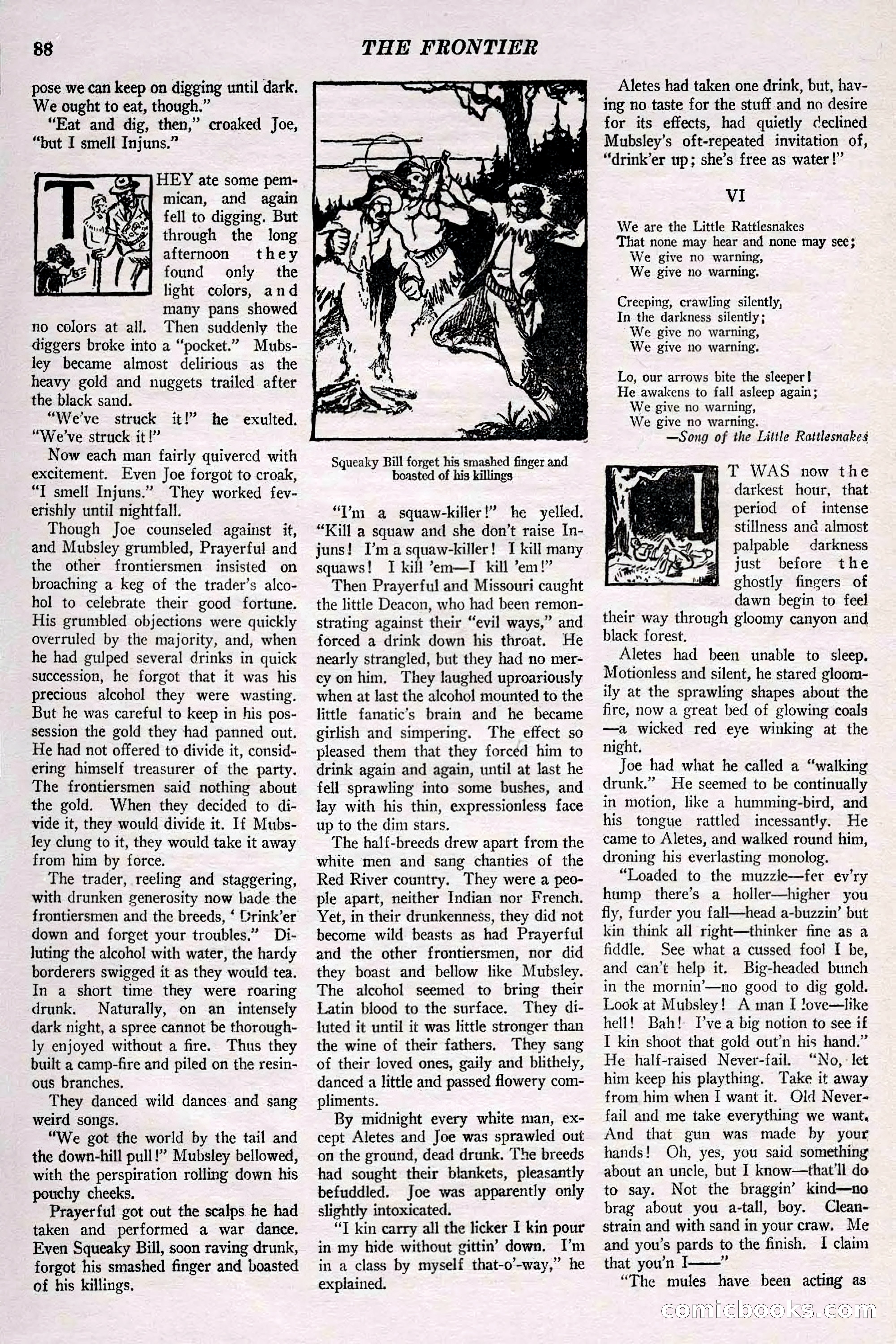
# Page 88 of "The Frontier" This is a story page containing prose fiction with two black-and-white illustrations integrated into the text. The narrative describes frontier prospectors who have discovered gold and are celebrating their strike with alcohol. The visible text focuses on their wild behavior—dancing, singing, and becoming intoxicated—as well as tensions over dividing their newfound wealth. One illustration shows figures around a campfire, while another depicts what appears to be a nighttime scene. The prose includes dialogue between characters named Joe, Mubsley, Prayerful, and others engaged in frontier activities and conflicts over their gold discovery.
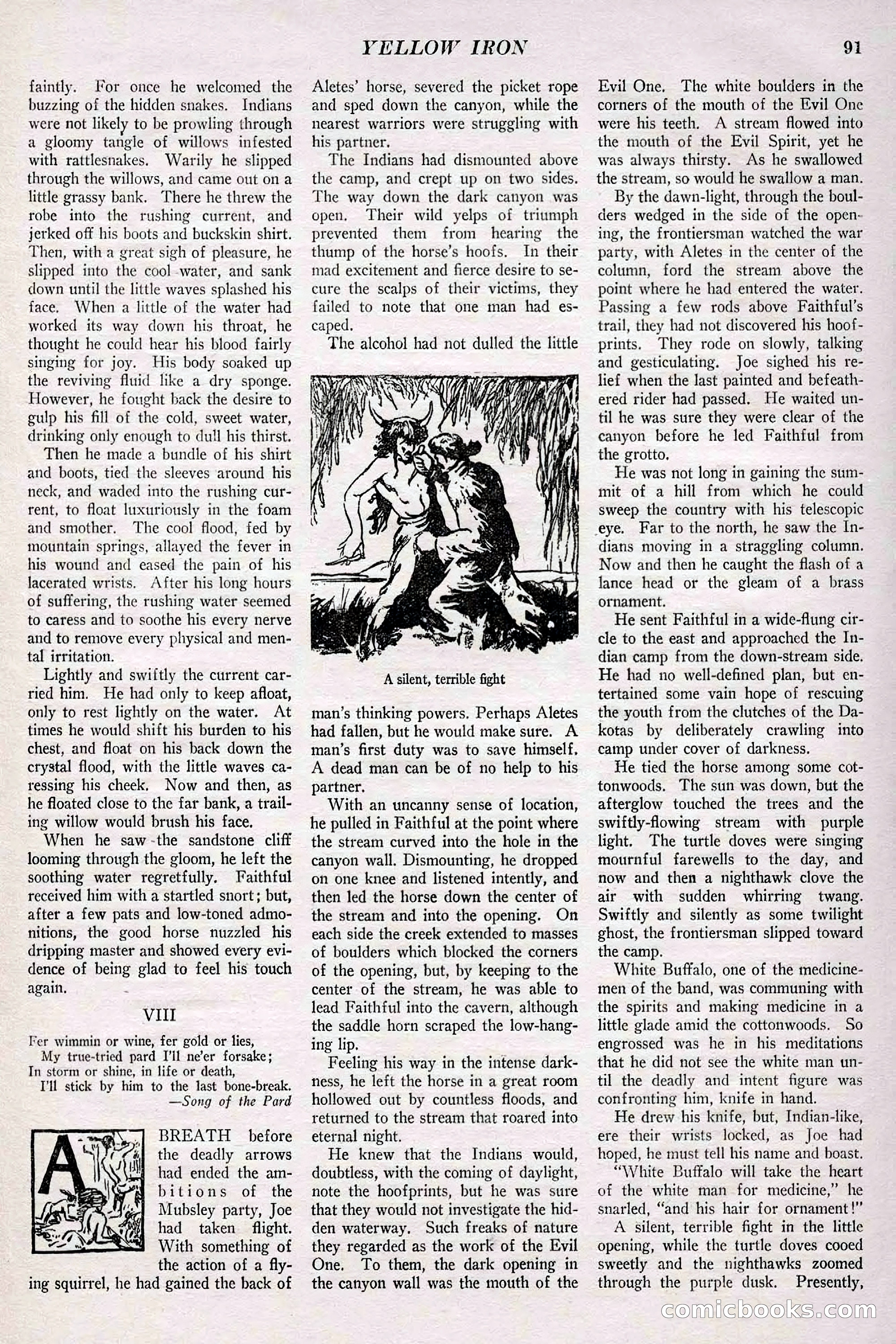
# Page 89 from "Yellow Iron" This page contains story prose with one small illustration. The narrative depicts a tense scene where a white captive (Aletes) is held by Native American warriors led by a war chief named Petuspa. After brutal treatment, Aletes is bound and faces potential torture or death. The text describes the warriors' deliberation over his fate, their consumption of alcohol, and Aletes' internal struggle to maintain composure. A poem titled "Song of the Medicine Man" appears mid-page. The single illustration shows what appears to be a figure in distress. The page number is 89, and the story involves frontier conflict and Native American warfare.
# Page Analysis This is a text page (page 90) from a pulp fiction magazine titled "THE FRONTIER." The page contains story prose with a single embedded illustration showing what appears to be a Native American figure in an interior scene. The visible text describes a captive frontiersman named Aletes held prisoner by Dakota Indians. The narrative details his suffering, thirst, and psychological endurance while bound in a tepee, along with interactions between the captive, his captors, and various camp activities including a medicine man's visit and a young squaw's romantic interest in him. The story emphasizes themes of survival, cultural conflict, and frontier life during what appears to be a historical period of Indian-settler encounters.
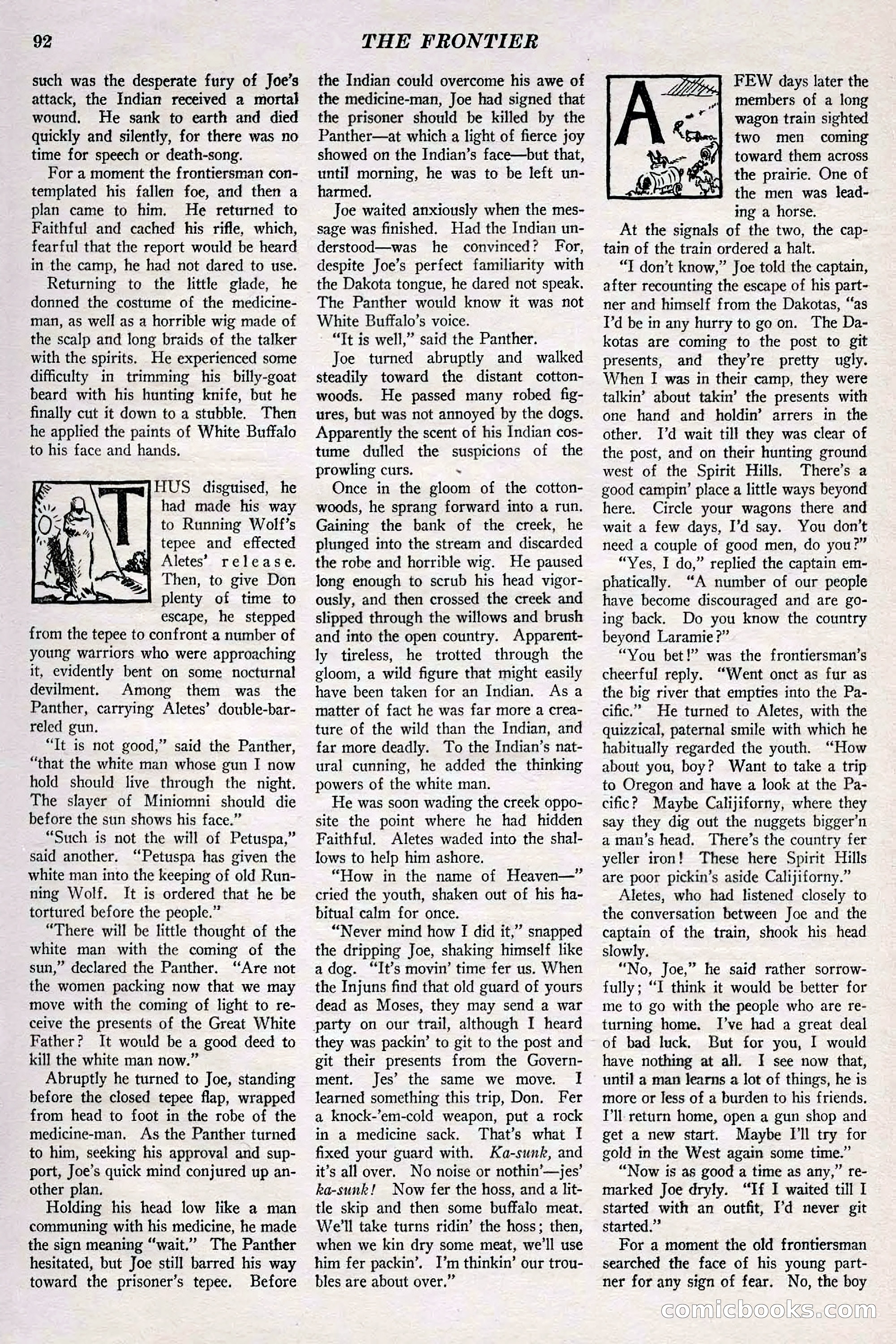
# Page 92: Story Prose with Illustrations This is a story page from "The Frontier" pulp magazine, containing two illustrations embedded within narrative text. The illustrations appear to show frontier/Western scenes with Native American and settler characters. The visible text describes a tense encounter between a white man in disguise (painted as "White Buffalo") and a Native American character named Joe, along with discussions among frontier settlers about incoming Dakota tribes and possible danger to their wagon train. The narrative involves themes of escape, disguise, and frontier survival. A captain of the wagon train discusses whether to move camp or wait out the perceived threat, ultimately deciding to relocate away from the immediate area for safety.
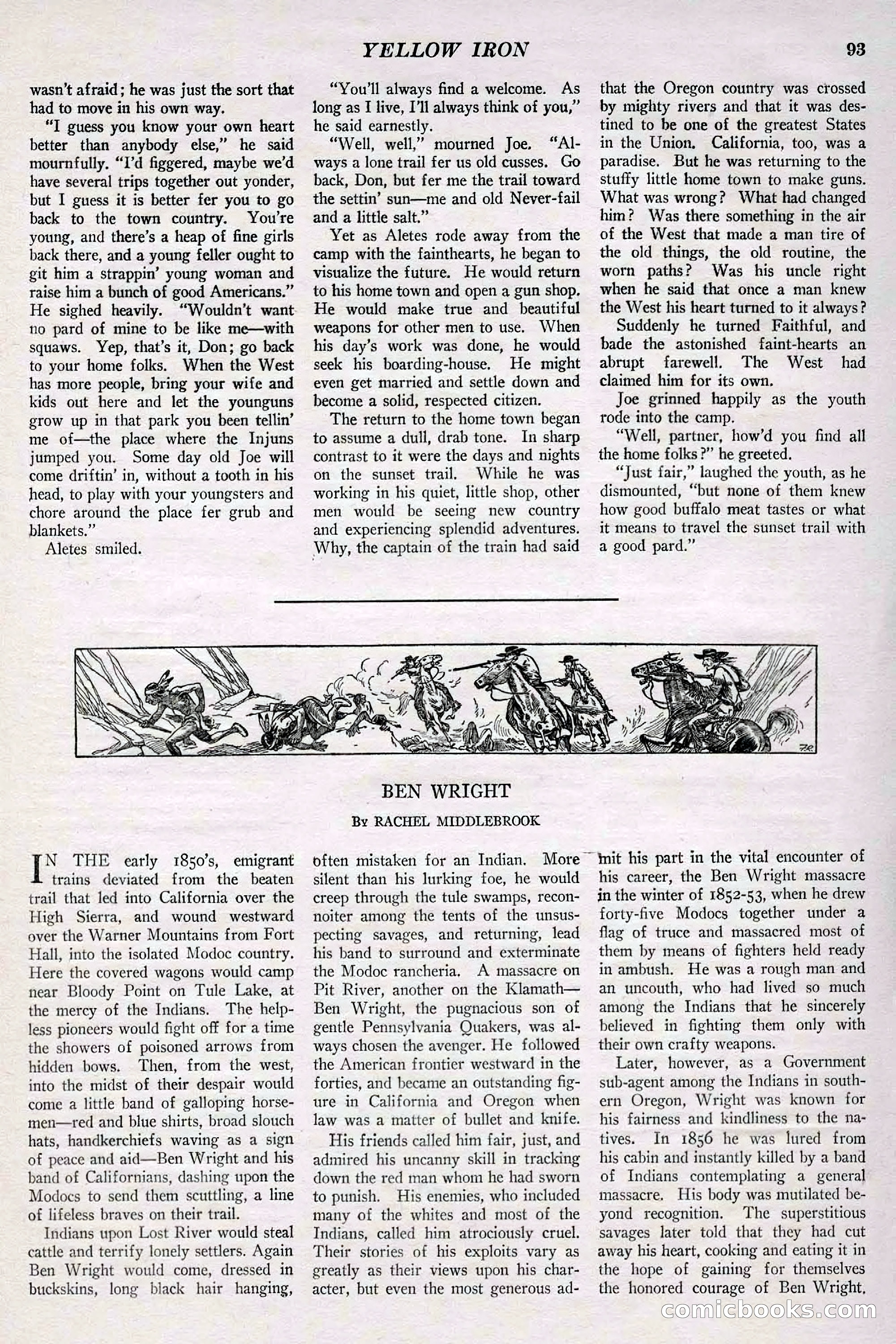
# Page 93 of "Yellow Iron" / Page 1 of "Ben Wright" This page contains the conclusion of a story called "Yellow Iron" (top section) followed by the opening page of a new story titled "Ben Wright" by Rachel Middlebrook (bottom section). The top portion concludes a narrative about frontier life, with dialogue about settling in the American West and opening a gun shop. The bottom section introduces a new story set in the 1850s about an emigrant often mistaken for a Native American, describing early California frontier conflicts. An illustration of horsemen in action appears between the two stories.
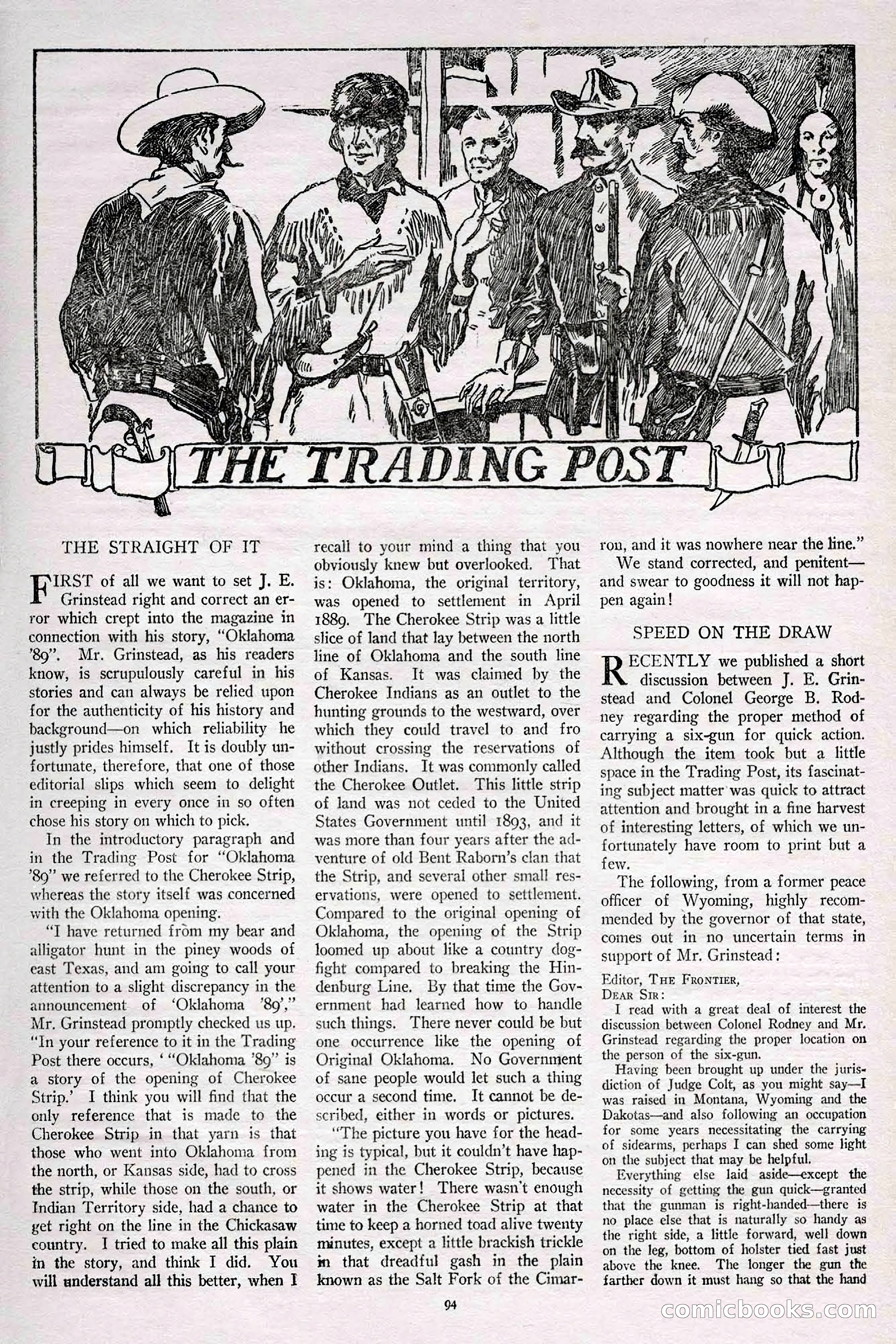
This page features an illustration at the top labeled "THE TRADING POST," depicting several men in Western attire gathered in conversation. Below the illustration is prose text discussing corrections to a previous story about "Oklahoma '89" and the Cherokee Strip. J. E. Grinstead addresses an error in his account of the Cherokee Strip's opening in 1889, clarifying details about its location between Oklahoma and Kansas. The page also includes a section titled "Speed on the Draw" containing a letter from a former Wyoming peace officer supporting Grinstead's historical accuracy regarding proper methods of carrying a six-gun.
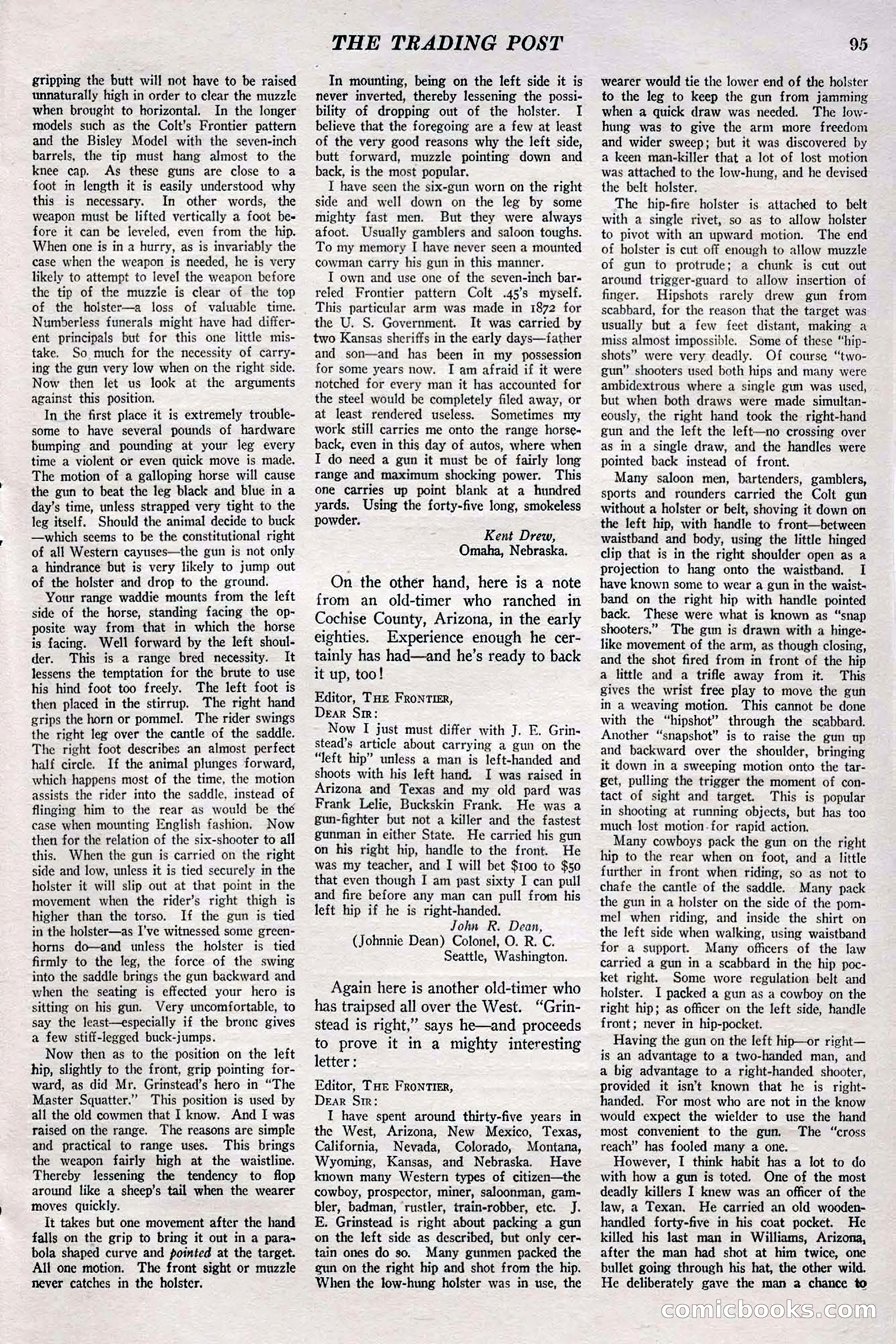
# Page Description This page contains story prose from *The Trading Post* section (page 95), featuring reader letters and editorial responses about Old West firearms and gun-handling techniques. The visible text discusses various methods of carrying and drawing pistols—including hip holsters, waistband carries, and cross-draw positions—with contributions from readers identifying themselves as ranchers and old-timers from Arizona, Texas, and Washington. The letters debate the practical advantages of different gun-carry methods for cowboys and frontier lawmen. No illustrations are visible on this page.
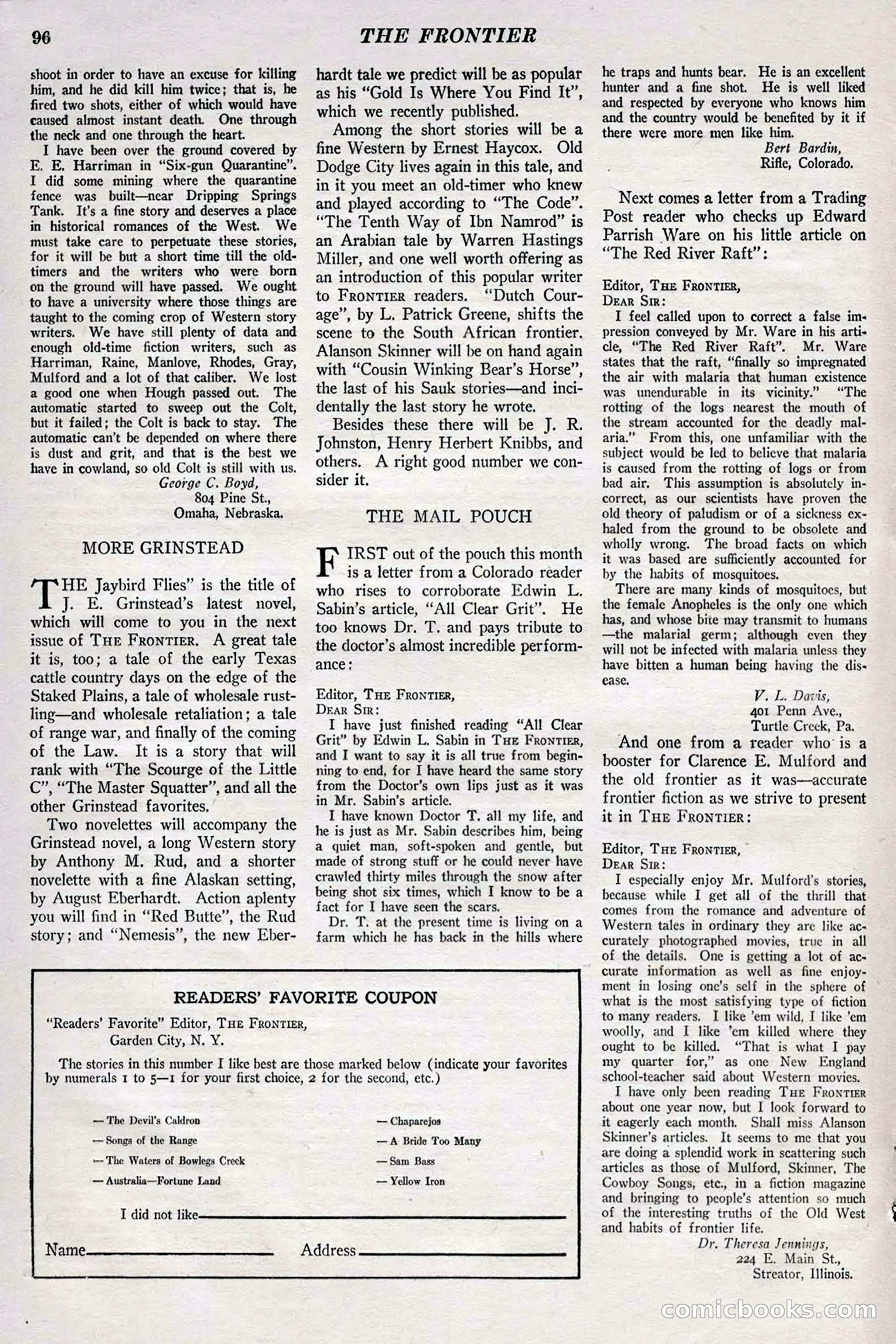
# Page 90 from *The Frontier* This page contains editorial letters and reader correspondence addressing recent stories published in the magazine. The top section discusses upcoming Western fiction, including works by Ernest Haycox and L. Patrick Greene, and praises previous stories by E. E. Harriman and others. "The Mail Pouch" section features reader letters responding to Edwin L. Sabin's "All Clear Grit!" and praising Clarence E. Mulford's Western stories for their accurate frontier details and engaging narratives. The page concludes with a "Readers' Favorite Coupon" allowing subscribers to indicate their preferred stories from the current issue.

This page is a full-page advertisement for Tuxedo brand pipe tobacco, appearing in *The Frontier Advertiser*. The ad features a stylized profile illustration of a woman's head in black and white with a large green silhouette of a man's head smoking a pipe overlaid behind it. The quote "I love the fragrance of good pipe tobacco" is attributed to someone named Julia Holt (signature visible). The advertisement emphasizes that Tuxedo tobacco is "good and fragrant—and always fresh," claims it's "fresh from factory," and promotes the product at a price of 12¢. The ad includes the American Tobacco Company's guarantee at the bottom.
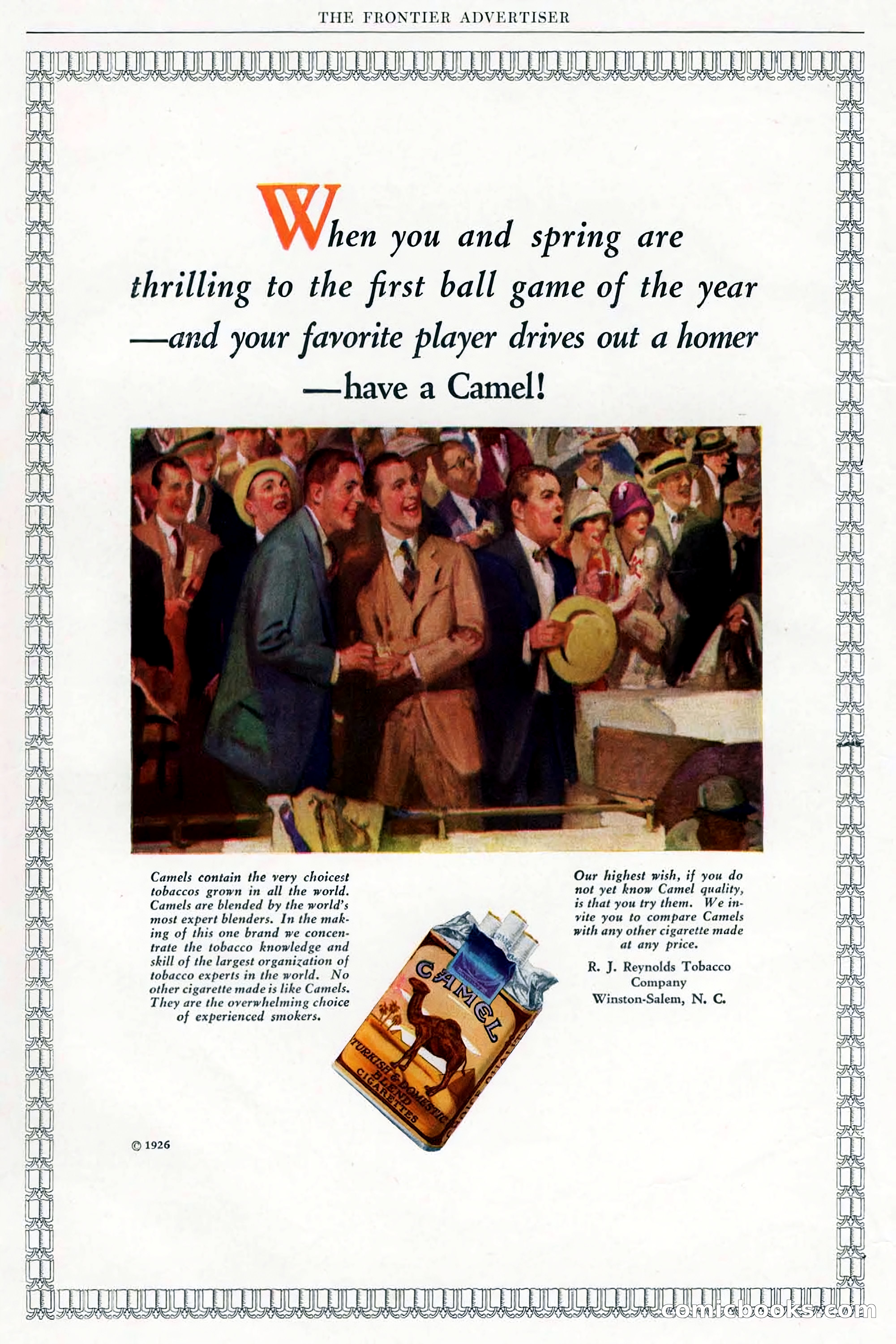
This is an advertisement page from *The Frontier Advertiser*, dated 1926. It features a Camel cigarette advertisement depicting an excited crowd of men in suits and hats at what appears to be a baseball game, with the tagline "When you and spring are thrilling to the first ball game of the year—and your favorite player drives out a homer—have a Camel!" Below the crowd scene is an image of a Camel cigarette package. The ad emphasizes that Camels contain "the very choicest tobaccos" and claims they are "the overwhelming choice of experienced smokers," with a challenge to compare Camels to any other cigarette brand. The advertiser is R. J. Reynolds Tobacco Company of Winston-Salem, North Carolina.
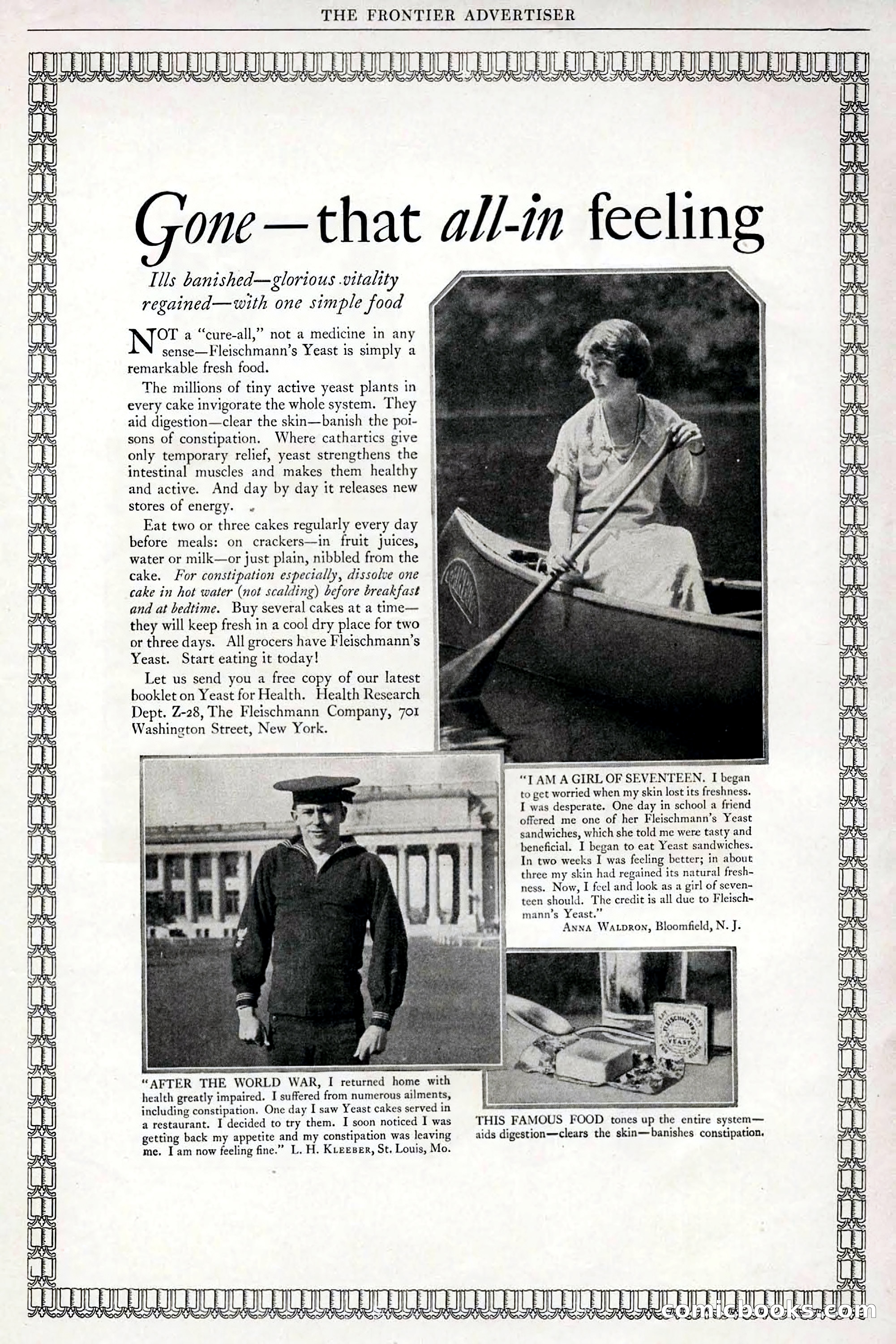
# Analysis This is an **advertisement page**, not story content or fiction. The page advertises Fleischmann's Yeast as a health food product. The main headline claims "Gone—that all-in feeling," promoting yeast cakes as a remedy for digestive issues, constipation, and low energy. The ad includes testimonials from two people: Anna Waldron of Bloomfield, N.J., who credits yeast cakes with restoring her skin's freshness, and L. H. Kleeber of St. Louis, Missouri, who reports improved appetite and digestion after World War I. Instructions explain how to consume the yeast cakes (with water before meals or dissolved in hot water). The Fleischmann Company offers a free health booklet from their New York address.
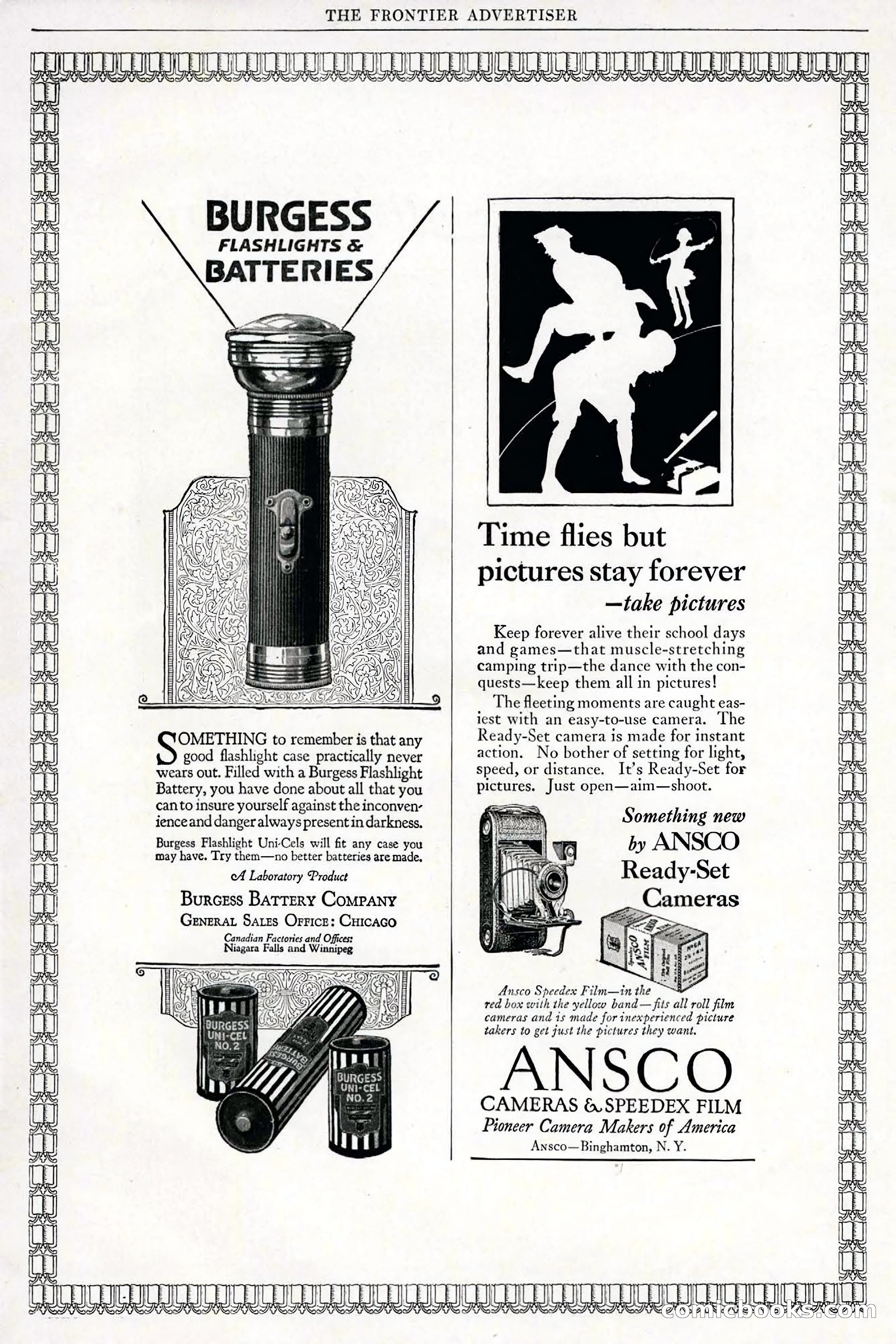
# Advertisement Page This is an advertising page from *The Frontier Advertiser* (a pulp magazine publication). It contains two distinct advertisements: on the left, Burgess Flashlights & Batteries promotes their products as essential safety equipment against darkness, emphasizing the reliability of their Uni-Cells batteries. On the right, Ansco advertises their Ready-Set Cameras and Speedex Film, promoting easy snapshot photography for capturing memorable moments. Both ads use period-appropriate design with illustrations—a detailed flashlight on the left and a camera with film box on the right. The page is bordered with decorative typographic elements typical of early-20th-century magazine design.
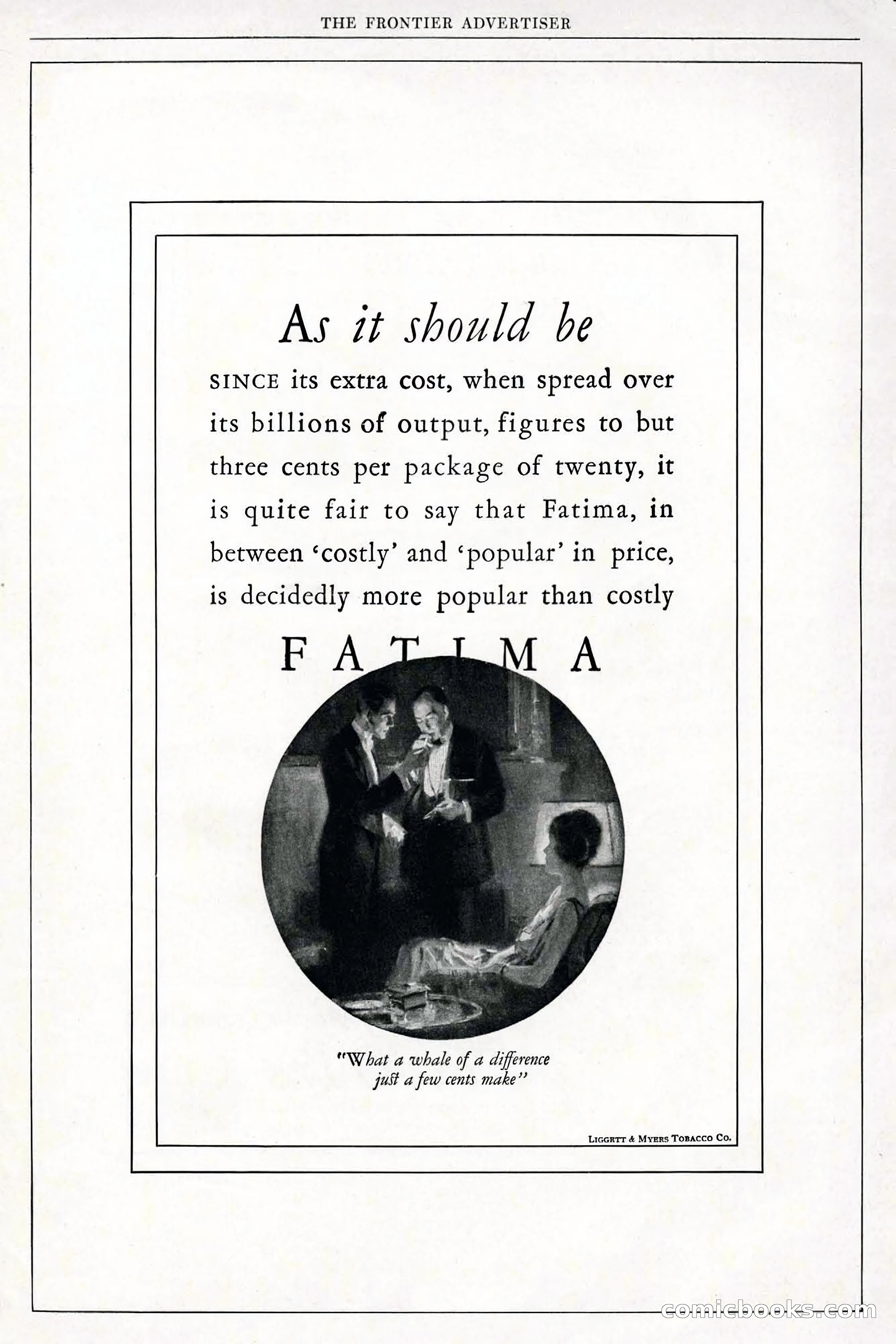
# Analysis This page is an advertisement for Fatima cigarettes, published in *The Frontier Advertiser*. The ad features a circular photograph showing what appears to be a social scene with well-dressed figures, with the tagline "What a whale of a difference just a few cents make" below it. The text above argues that Fatima cigarettes, costing only about three cents more per package of twenty than cheaper brands, represents good value and occupies a desirable middle position between "costly" and "popular" in price. The advertisement is credited to Liggett & Myers Tobacco Co. at the bottom.
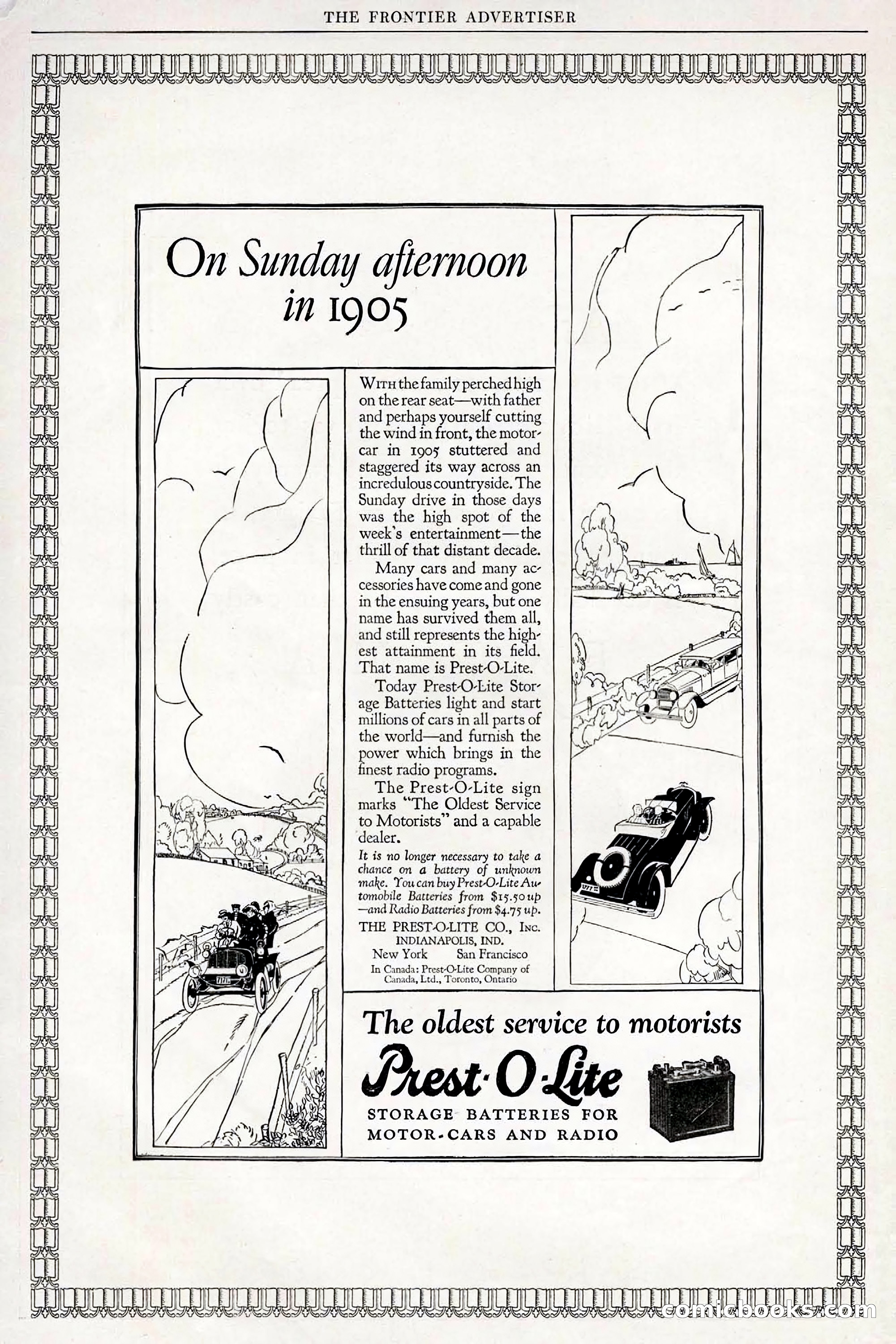
# Page Description This is a **full-page advertisement** from *The Frontier Advertiser*, not story content or fiction. The ad depicts a nostalgic scene titled "On Sunday afternoon in 1905," showing early automobiles on a country road. The text describes how motor-car ownership has evolved and promotes **Prest-O-Lite**, a storage battery brand for automobiles and radios. According to the copy, Prest-O-Lite batteries power car ignition systems and radio receivers. The ad emphasizes the brand's longevity and reliability, claiming it "marks 'The Oldest Service to Motorists." Contact information lists Indianapolis, Indiana as headquarters, with offices in New York and San Francisco, and a Canadian subsidiary in Toronto.
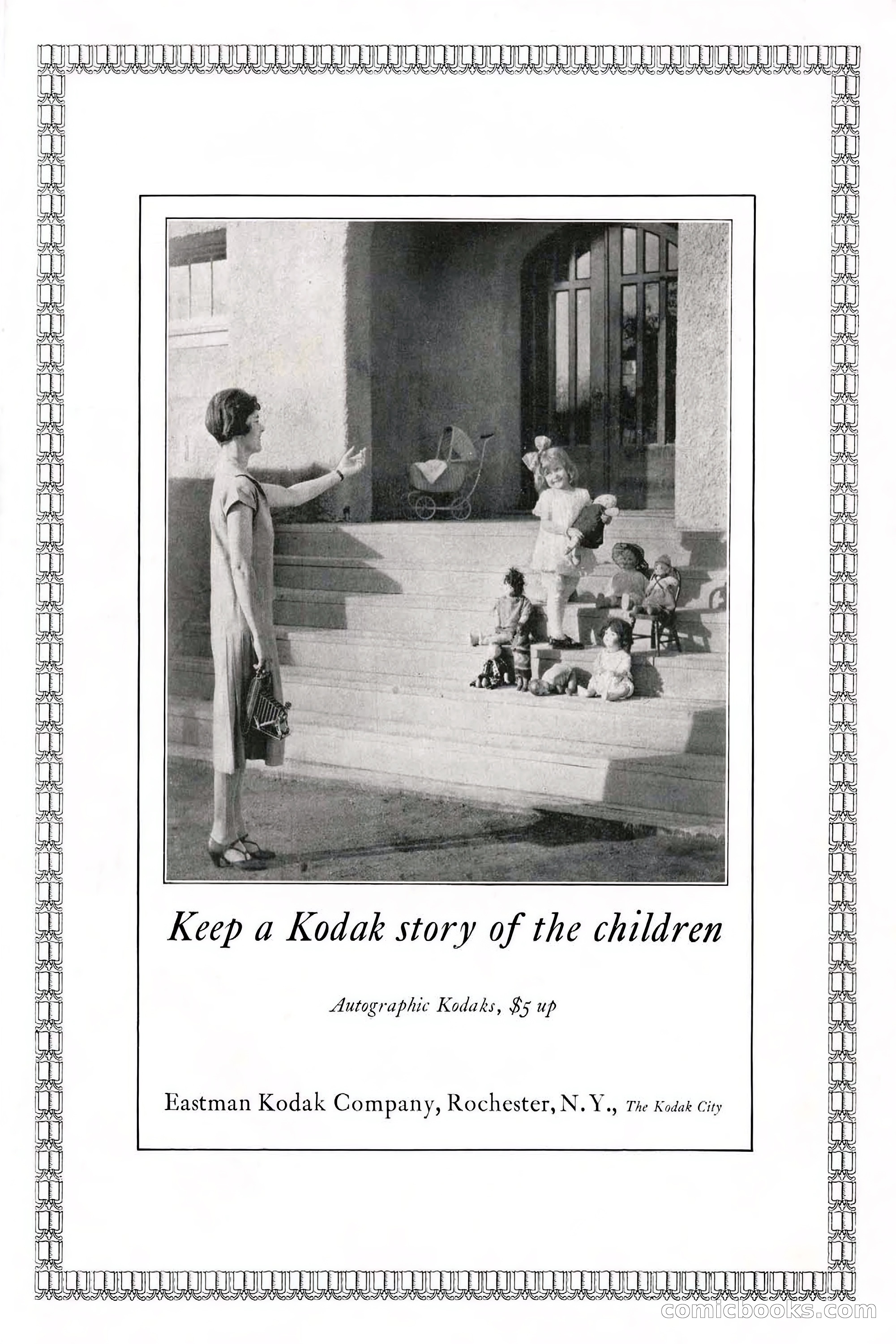
This page is an advertisement for Eastman Kodak Company, featuring a photograph rather than pulp fiction content. The image shows a woman standing on steps watching several children play below, with a baby carriage visible in the background. The advertisement's headline reads "Keep a Kodak story of the children," promoting Autographic Kodaks priced at $5 and up. The text identifies the advertiser as "Eastman Kodak Company, Rochester, N.Y., The Kodak City." The ad encourages customers to document family moments through photography, typical of early-20th-century marketing that positioned cameras as tools for preserving domestic memories.
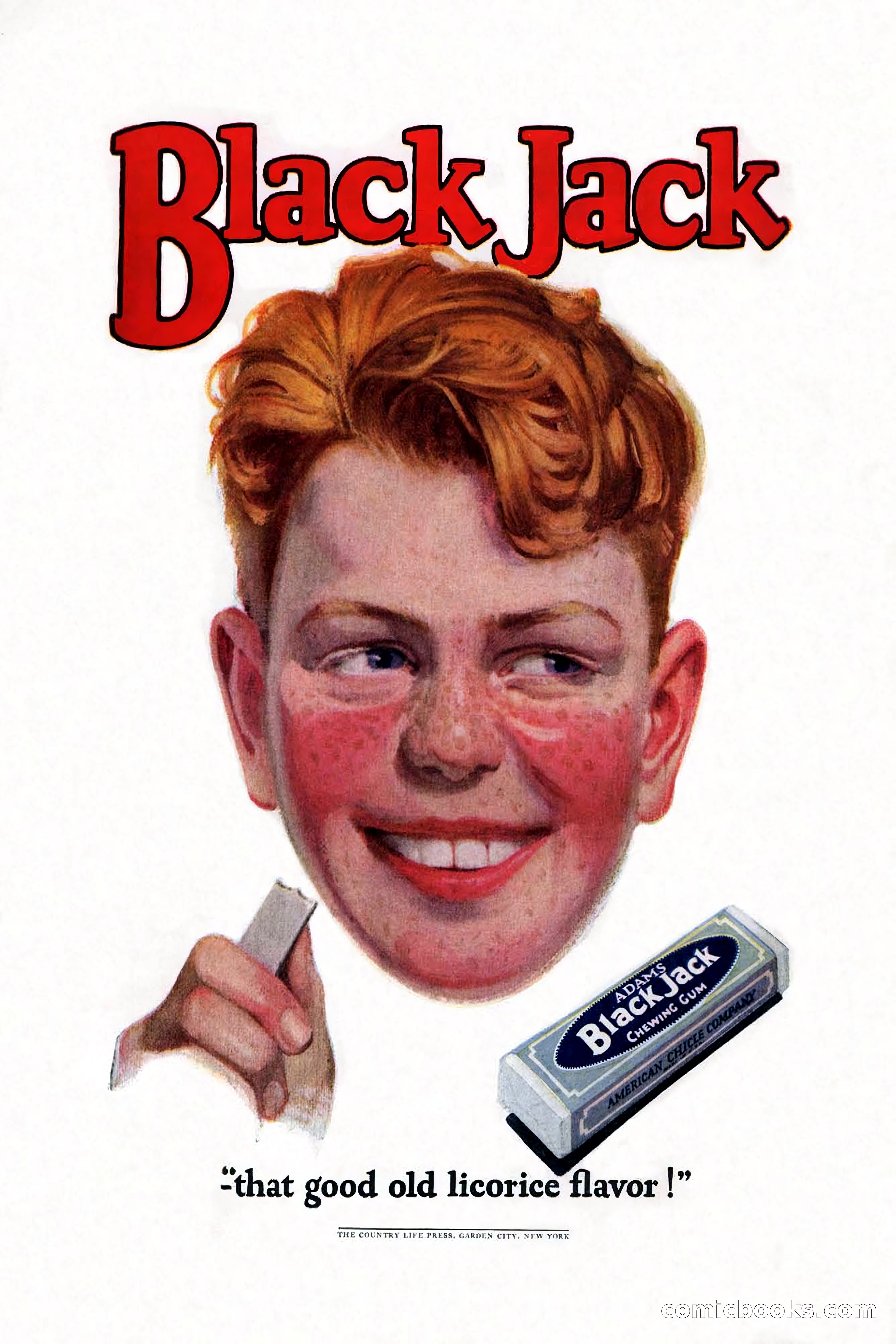
This is a vintage **advertisement**, not a pulp magazine story page. It features a stylized illustration of a smiling man with reddish hair and rosy cheeks, holding a package of Black Jack chewing gum. The large red text reads "Black Jack" at the top, with the tagline below stating "that good old licorice flavor!" The ad promotes Black Jack brand chewing gum, emphasizing its licorice flavor as a selling point. The publisher credit reads "THE COUNTRY LIFE PRESS, GARDEN CITY, NEW YORK." The illustration style and design suggest this advertisement dates to the early-to-mid twentieth century.