
Pulp Fiction, 1926 · page 25 of 114
The Frontier, May 1926 — page 25: what you’re looking at
What you’re looking at
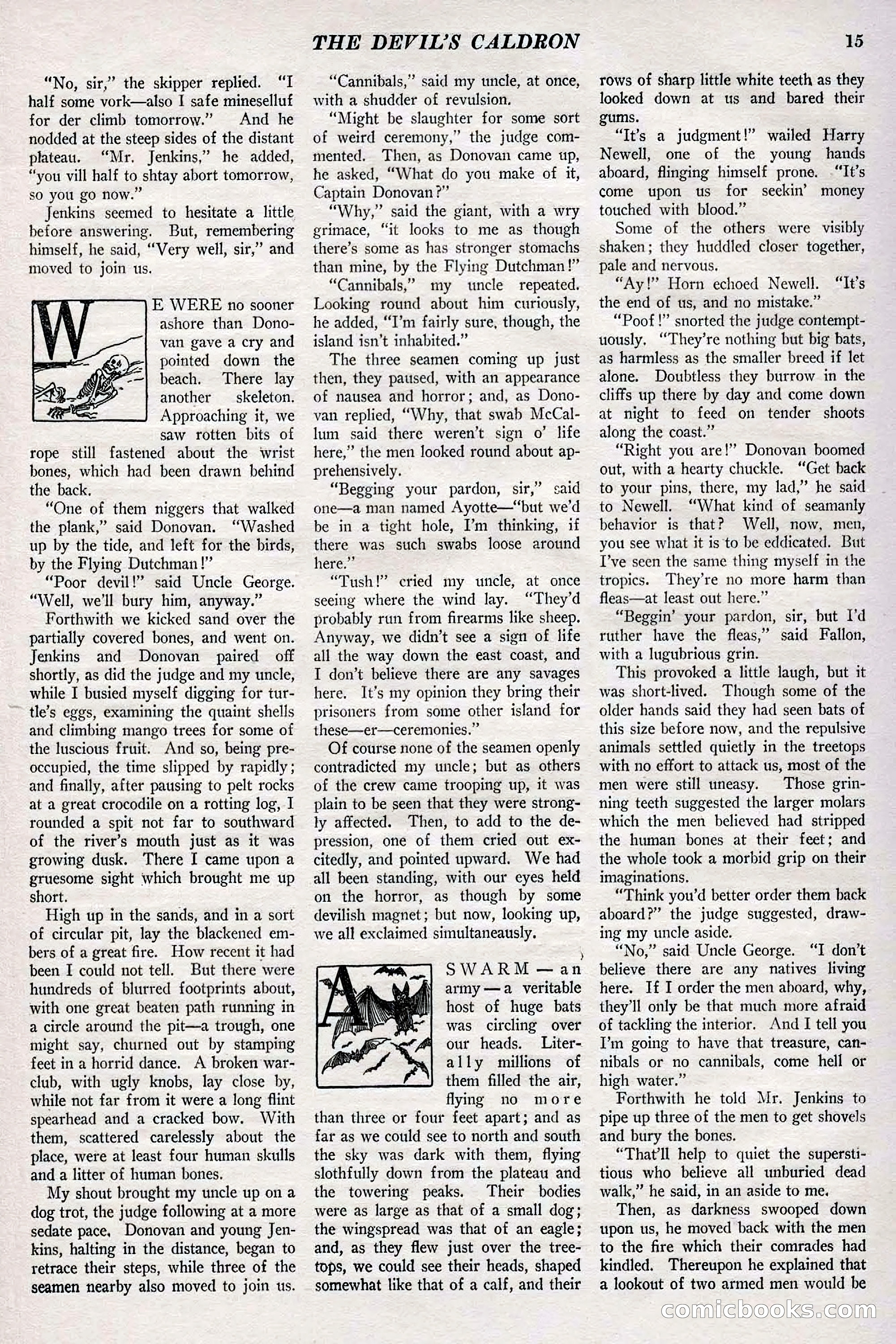
# Page Analysis This is story prose from a pulp fiction magazine, specifically page 15 of "The Devil's Caldron." The text describes an adventure involving sailors discovering a mysterious island with evidence of human habitation and remains. The narrative involves characters named Donovan, Jenkins, the judge, and Uncle George investigating what appears to be an abandoned settlement with skeletal remains and signs of past violence. The crew encounters large bats circling overhead and discusses whether the island harbors dangerous inhabitants. Two small illustrations—one showing a skeletal figure and another depicting a swarm of bats—accompany the text, breaking up the dense prose columns typical of pulp magazine formatting.
📄 Transcribed text from this page (OCR, searchable)
Machine-transcribed from the original scan — historical spelling and the odd misread are preserved.
“No, sir,” the skipper replied. “I half some vork—also I safe mineselluf for der climb tomorrow.” And he nodded at the steep sides of the distant plateau. “Mr. Jenkins,” he added, “you vill half to shtay abort tomorrow, so you go now.” Jenkins seemed to hesitate a little before answering. But, remembering himself, he said, “Very well, sir,” and moved to join us. E WERE no sooner ashore than Dono- van gave a cry and pointed down the beach. There lay another skeleton. Approaching it, we saw rotten bits of rope still fastened about the wrist bones, which had been drawn behind the back. “One of them niggers that walked the plank,” said Donovan. “Washed up by the tide, and left for the birds, by the Flying Dutchman!” “Poor devil!” said Uncle George. “Well, we'll bury him, anyway.” Forthwith we kicked sand over the partially covered bones, and went on. Jenkins and Donovan paired off shortly, as did the judge and my uncle, while I busied myself digging for tur- tle’s eggs, examining the quaint shells and climbing mango trees for some of the luscious fruit. And so, being pre- occupied, the time slipped by rapidly ; and finally, after pausing to pelt rocks at a great crocodile on a rotting log, IJ rounded a spit not far to southward of the river’s mouth just as it was growing dusk. There I came upon a gruesome sight which brought me up short. High up in the sands, and in a sort of circular pit, lay the blackened em- bers of a great fire. How recent it had been I could not tell. But there were hundreds of blurred footprints about, with one great beaten path running in a circle around the pit—a trough, one might say, churned out by stamping feet in a horrid dance. A broken war- club, with ugly knobs, lay close by, while not far from it were a long flint spearhead and a cracked bow. With them, scattered carelessly about the place, were at least four human skulls and a litter of human bones. My shout brought my uncle up on a dog trot, the judge following at a more sedate pace, Donovan and young Jen- kins, halting in the distance, began to retrace their steps, while three of the seamen nearby also moved to join us. THE DEVIL’S CALDRON “Cannibals,” said my tnele, at once, with a shudder of revulsion. “Might be slaughter for some sort of weird ceremony,” the judge com- mented. Then, as Donovan came wp, he asked, “What do you make of it, Captain Donovan ?” “Why,” said the giant, with a wry grimace, “it looks to me as though there’s some as has stronger stomachs than mine, by the Flying Dutchman!’ “Cannibals,” my uncle repeated. Looking round about him curiously, he added, “I’m fairly sure, though, the island isn’t inhabited.” The three seamen coming up just then, they paused, with an appearance of nausea and horror; and, as Dono- van replied, “Why, that swab McCal- lum said there weren’t sign o’ life here,” the men looked round about ap- prehensively. “Begging your pardon, sir,” said one—a man named Ayotte—“but we'd be in a tight hole, I’m thinking, if there was such swabs loose around here.”’ “Tush!” eried my uncle, at once seeing where the wind lay. “They'd probably run from firearms like sheep. Anyway, we didn’t see a sign of life all the way down the east coast, and I don’t believe there are any savages here. It's my opinion they bring their prisoners from some other island for these—er—ceremonies.” Of course none of the seamen openly contradicted my uncle; but as others of the crew came trooping up, it was plain to be seen that they were strong- ly affected. Then, to add to the de- pression, one of them cried out ex- citedly, and pointed upward. We had all been standing, with our eyes held on the horror, as though by some devilish magnet; but now, looking up, we all exclaimed simultaneausly. army —a_ veritable host of huge bats was circling over our heads. Liter- ally millions of them filled the air, flying no more than three or four feet apart; and as far as we could see to north and south the sky was dark with them, flying slothfully down from the plateau and the towering peaks. Their bodies were as large as that of a small dog; the wingspread was that of an eagle; and, as they flew just over the tree- tops, we could see their heads, shaped somewhat like that of a calf, and their ) SWARM —an 15 rows of sharp little white teeth as they looked down at us and bared their S. “It’s a judgment!” wailed Harry Newell, one of the young hands aboard, flinging himself prone. “It’s come upon us for seckin’ money touched with blood.” Some of the others were visibly shaken; they huddled closer together, pale and nervous, “Ay!” Horn echoed Newell. the end of us, and no mistake.” “Poof!” snorted the judge contempt- uously, “They’re nothing but big bats, as harmless as the smaller breed if let alone. Doubtless they burrow in the cliffs up there by day and come down at night to feed on tender shoots along the coast.” “Right you are!’ Donovan boomed out, with a hearty chuckle. “Get back to your pins, there, my lad,” he said to Newell. “What kind of seamanly behavior is that? Well, now, men, you see what it is to be eddicated. But I’ve seen the same thing myself in the tropics. They’re no more harm than fleas—at least out here.” “Beggin’ your pardon, sir, but I'd ruther have the fleas,’ said Fallon, with a lugubrious grin. This provoked a little laugh, but it was short-lived. Though some of the older hands said they had seen bats of this size before now, and the repulsive animals settled quietly in the treetops with no effort to attack us, most of the men were still uneasy. Those grin- ning teeth suggested the larger molars which the men believed had stripped the human bones at their feet; and the whole took a morbid grip on their imaginations, “Think you’d better order them back aboard?” the judge suggested, draw- ing my uncle aside. “No,” said Uncle George. “I don’t believe there are any natives living here. If I order the men aboard, why, they'll only be that much more afraid of tackling the interior. And I tell you I’m going to have that treasure, can- nibals or no cannibals, come hell or high water.” Forthwith he told Mr. Jenkins to pipe up three of the men to get shovels and bury the bones. “That'll help to quiet the supersti- tious who believe all unburied dead walk,” he said, in an aside to me. Then, as darkness swooped down upon us, he moved back with the men to the fire which their comrades had kindled. Thereupon he explained that a lookout of two armed men would be COnniclboooKkS. com *Tt’s