
Pulp Fiction, 1926 · page 66 of 114
The Frontier, May 1926 — page 66: what you’re looking at
What you’re looking at
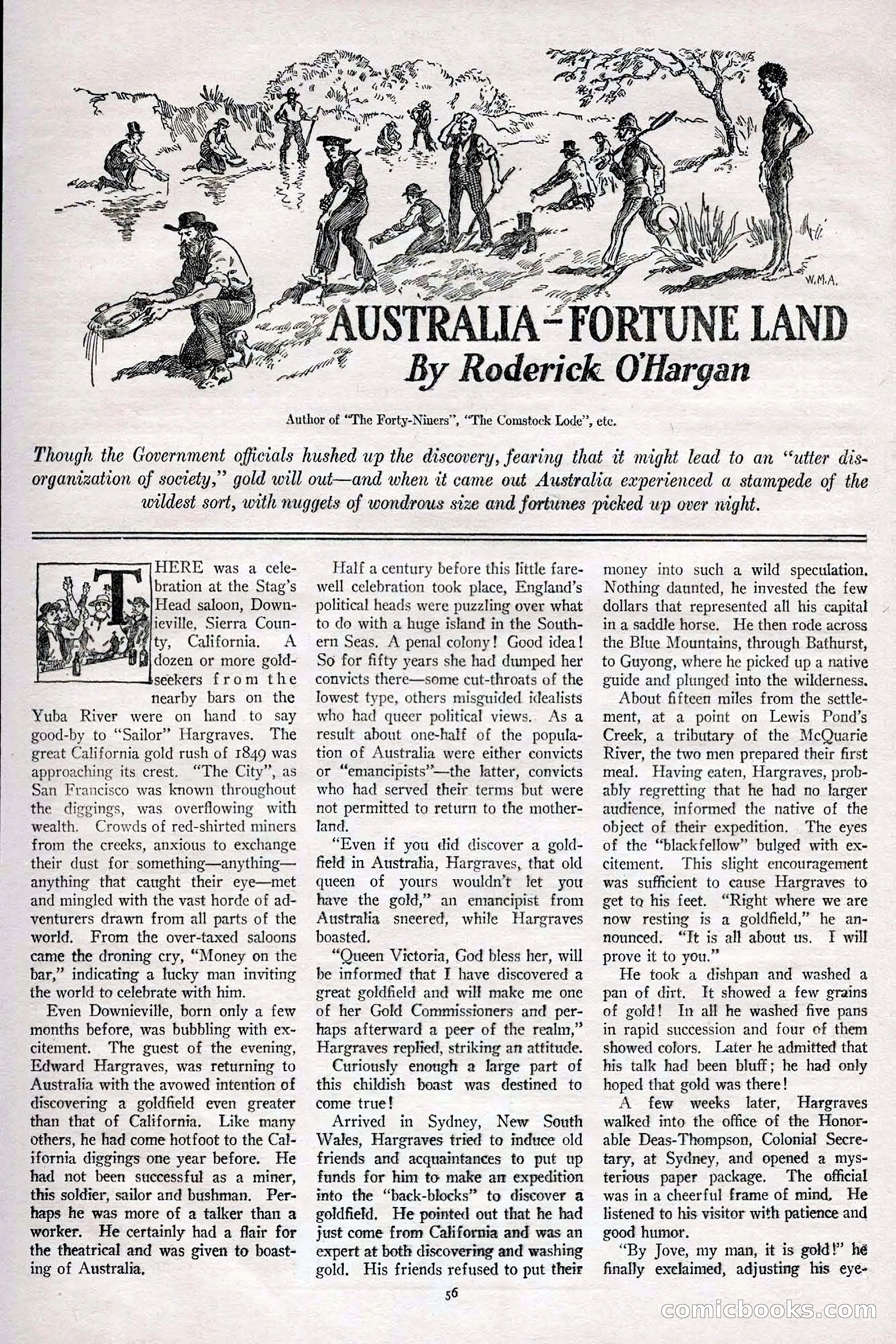
This is a story page from a pulp magazine featuring "Australia—Fortune Land" by Roderick O'Hargan. The page displays an illustration at the top showing multiple figures in period dress engaged in gold-panning activities near water and trees. Below the illustration is the story title and author credit, followed by a subtitle indicating the story concerns gold discoveries in Australia that caused societal disruption. The bulk of the page contains the beginning of the story text in two columns, describing a celebration in California and a man named Hargraves who claims to have discovered gold in Australia. The narrative voice is that of early-20th-century adventure fiction.
📄 Transcribed text from this page (OCR, searchable)
Machine-transcribed from the original scan — historical spelling and the odd misread are preserved.
, Can uy Py ots ay MK Seedy ' <7 NUSTRALL Ot ny aay he iy ES x ssi ev 7p = “FORTUNE LAND By Roderick. OHargan Author of “The Forty-Niners”, “The Comstock Lode’, etc. Though the Government officials hushed up the discovery, fearing that tt might lead to an “utter dis- organization of society,” gold will out—and when it came out Australia experienced a stampede of the wildest sort, with nuggets of wondrous size and fortunes picked wp over night. HERE was a cele- bration at the Stag’s «| Elead saloon, Down- Hepieville, Sierra Coun- i f ty, California. A ‘Lakers ar the nearby bars on the Yuba River were on hand to say good-by to “Sailor” Hargraves. The great California gold rush of 1849 was approaching its crest. “The City’, as San Francisco was known throughout the diggings, was overflowing with wealth. Crowds of red-shirted miners from the creeks, anxious to exchange their dust for something—anything— anything that caught their eye—met and mingled with the vast horde of ad- venturers drawn from all parts of the world. From the over-taxed saloons came the droning cry, “Money on the bar,” indicating a lucky man inviting the world to celebrate with him. Even Downieville, born only a few months before, was bubbling with ex- citement. The guest of the evening, Edward Hargraves, was returning to Australia with the avowed intention of discovering a goldfteld even greater than that of California. Like many others, he had come hotfoot to the Cal- fornia diggings one year before. He had not been successful as a miner, this soldier, sailor and bushman. Per- haps he was more of a talker than a worker. He certainly had a flair for the theatrical and was given to boast- ing of Australia, Half a century before this little fare- well celebration took place, England’s political heads were puzzling over what to do with a huge island in the South- ern Seas. A penal colony! Good idea! So for fifty years she had dumped her convicts there—some cut-throats of the lowest type, others misguided idealists who had queer political views.. As a result about one-half of the popula- tion of Australia were either convicts or “emancipists’—the latter, convicts who had served their terms but were not permitted to return to the mother- land. “Even if you did discover a gold- fteld in Australia, Hargraves, that old queen of yours wouldn't let you have the gold,” an emancipist from Australia sneered, while Hargraves boasted. “Queen Victoria, God bless her, will he informed that I have discovered a great goldfield and will make me one of her Gold Commissioners and per- haps afterward a peer of the realm,” Hargraves rephed, striking an attitude. Curiously enough a large part of this childish boast was destined to come true! Arrived in Sydney, New South Wales, Hargraves tried to induce old friends and acquaintances to put up funds for him to make an expedition mto the “back-blocks” to discover a goldfield. He pointed out that he had just come from California and was an expert at both discovering and washing gold. His friends refused to put their 56 money into such a wild speculation, Nothing daunted, he invested the few dollars that represented all his capital in a saddle horse. He then rode across the Blue Mountains, through Bathurst, to Guyong, where he picked up a native guide and plunged into the wilderness. About fifteen miles from the settle- ment, at a point on Lewis Pond’s Creek, a tributary of the McQuarie River, the two men prepared their first meal. Having eaten, Hargraves, prob- ably regretting that he had no larger audience, informed the native of the object of their expedition. The eyes of the “blackfellow” bulged with ex- citement. This slight encouragement was sufficient to cause Hargraves to get ta his feet. “Right where we are now resting is a goldfield,” he an- nounced. “It is all about us. IT will prove it to you.” He took a dishpan and washed a pan of dirt. It showed a few grains of gold! In all he washed five pans in rapid succession and four ef them showed colors. Later he admitted that his talk had been bluff; he had only hoped that gold was there! A few weeks later, Hargraves walked into the office of the Honor- able Deas-Thompson, Colonial Secre- tary, at Sydney, and opened a mys- ferious paper package, The official was in a cheerful frame of mind, He listened to his visitor with patience and good humor. ‘By Jove, my man, it is gold!’ hé finally exelaimed, adjusting his eye- C@OMiclboooksS. com 6S