
Pulp Fiction, 1926 · page 57 of 114
The Frontier, May 1926 — page 57: what you’re looking at
What you’re looking at
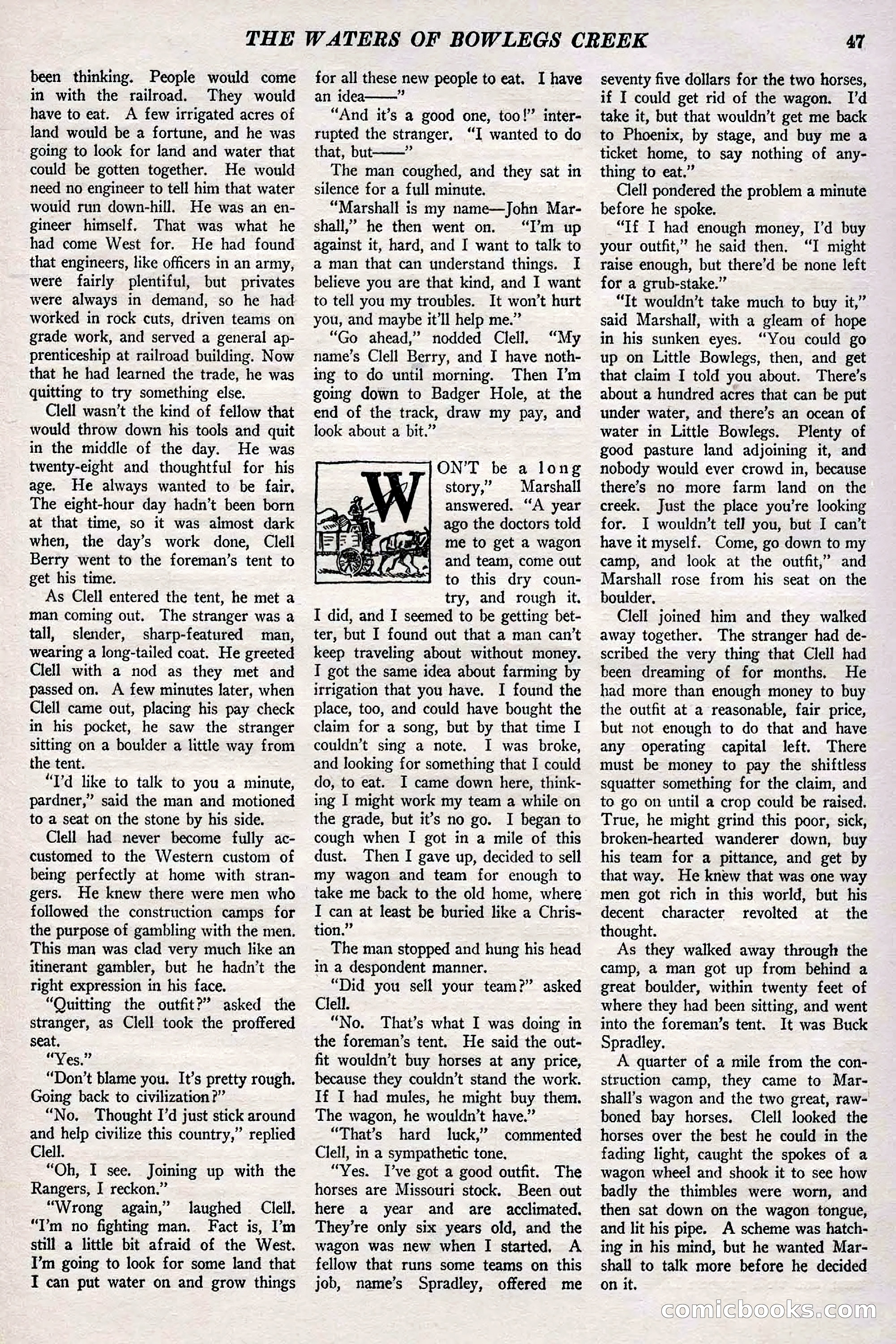
# Page Analysis This is a story prose page from "The Waters of Bowlegs Creek" (page 47). The text depicts a conversation between a railroad worker named Cell Berry and a stranger who approaches him in a camp. The stranger, introducing himself as John Marshall, seeks Cell's advice about starting a farm. Marshall explains he has limited funds and asks about obtaining land and water rights near Little Bowlegs. Cell becomes interested in Marshall's proposal and agrees to show him an outfit in the area. The page contains a small decorative initial letter "W" but no full illustrations. The narrative focuses on dialogue and character interaction rather than action.
📄 Transcribed text from this page (OCR, searchable)
Machine-transcribed from the original scan — historical spelling and the odd misread are preserved.
THE WATERS OF BOWLEGS CREEK been thinking. People would come in with the railroad. They would have to eat. A few irrigated acres of land would be a fortune, and he was going to look for land and water that could be gotten together. He would need no engineer to tell him that water would run down-hill. He was an en- gineer himself. That was what he had come West for. He had found that engineers, like officers in an army, were fairly plentiful, but privates were always in demand, so he had worked in rock cuts, driven teams on grade work, and served a general ap- prenticeship at railroad building. Now that he had learned the trade, he was quitting to try something else. Clell wasn’t the kind of fellow that would throw down his tools and quit in the middle of the day. He was twenty-eight and thoughtful for his age, He always wanted to be fair, The eight-hour day hadn’t been born at that time, so it was almost dark when, the day’s work done, Clell Berry went to the foreman’s tent to get his time. As Clell entered the tent, he met a man coming out. The stranger was a tall, slender, sharp-featured man, wearing a long-tailed coat. He greeted Clell with a nod as they met and passed on. A few minutes later, when Clell came out, placing his pay check in his pocket, he saw the stranger sitting on a boulder a little way from the tent. “I’d like to talk to you a minute, pardner,” said the man and motioned to a seat on the stone by his side. Clell had never become fully ac- customed to the Western custom of being perfectly at home with stran- gers. He knew there were men who followed the construction camps for the purpose of gambling with the men. This man was clad very much like an itinerant gambler, but he hadn’t the right expression in his face. “Quitting the outfit?’ asked the stranger, as Clell took the proffered seat. “Ves.” “Don’t blame you. It’s pretty rough. Going back to civilization?” “No. Thought I’d just stick around and help civilize this country,” replied Clell. “Oh, I see. Joining up with the Rangers, I reckon.” “Wrong again,’ laughed Cell. “Y’m no fighting man. Fact is, I’m still a little bit afraid of the West. I’m going to look for some land that I can put water on and grow things for all these new people to eat. I have an idea——” “And it’s a good one, too!’’ inter- rupted the stranger. “I wanted to do that, but——” The man coughed, and they sat in silence for a full minute. “Marshall is my name—John Mar- shall,” he then went on. “I’m up against it, hard, and I want to talk to a man that can understand things. I believe you are that kind, and I want to tell you my troubles. It won’t hurt you, and maybe it'll help me.” “Go ahead,” nodded Clell. “My name’s Clell Berry, and I have noth- ing to do until morning. Then I’m going down to Badger Hole, at the end of the track, draw my pay, and look about a bit.” ON’T be a long story,’ Marshall answered. “A year ago the doctors told me to get a wagon and team, come out to this dry coun- try, and rough it. I did, and I seemed to be getting bet- ter, but I found out that a man can’t keep traveling about without money. I got the same idea about farming by irrigation that you have. I found the place, too, and could have bought the claim for a song, but by that time I couldn't sing a note. I was broke, and looking for something that I could do, to eat. I came down here, think- ing I might work my team a while on the grade, but it’s no go. I began to cough when I got in a mile of this dust. Then I gave up, decided to sell my wagon and team for enough to take me back to the old home, where I can at least be buried like a Chris- tion.” The man stopped and hung his head in a despondent manner. “Did you sell your team?” asked Clell. “No. That’s what I was doing in the foreman’s tent. He said the out- fit wouldn’t buy horses at any price, because they couldn’t stand the work. If I had mules, he might buy them. The wagon, he wouldn’t have.” “That’s hard luck,” commented Clell, in a sympathetic tone, “Yes. I’ve got a good outfit. The horses are Missouri stock. Been out here a year and are acclimated. They’re only six years old, and the wagon was new when IJ started. A fellow that runs some teams on this job, name’s Spradley, offered me 47 seventy five dollars for the two horses, if I could get rid of the wagon. I’d take it, but that wouldn’t get me back to Phoenix, by stage, and buy me a ticket home, to say nothing of any- thing to eat.” Clell pondered the problem a minute before he spoke. “If I had enough money, I’d buy your outfit,” he said then. “I might raise enough, but there’d be none left for a grub-stake.” “It wouldn’t take much to buy it,” said Marshall, with a gleam of hope in his sunken eyes. “You could go up on Little Bowlegs, then, and get that claim I told you about. There’s about a hundred acres that can be put under water, and there’s an ocean of water in Little Bowlegs. Plenty of good pasture land adjoining it, and nobody would ever crowd in, because there’s no more farm land on the creek. Just the place you’re looking for. I wouldn’t tell you, but I can’t have it myself. Come, go down to my camp, and look at the outfit,” and Marshall rose from his seat on the boulder, Clell joined him and they walked away together. The stranger had de- scribed the very thing that Clell had been dreaming of for months, He had more than enough money to buy the outfit at a reasonable, fair price, but not enough to do that and have any operating capital left. There must be money to pay the shiftless squatter something for the claim, and to go on until a crop could be raised. True, he might grind this poor, sick, broken-hearted wanderer down, buy his team for a pittance, and get by that way. He knew that was one way men got rich in this world, but his decent character revolted at the thought. As they walked away through the camp, a man got up from behind a great boulder, within twenty feet of where they had been sitting, and went into the foreman’s tent. It was Buck Spradley. A quarter of a mile from the con- struction camp, they came to Mar- shall’s wagon and the two great, raw- boned bay horses. Clell looked the horses over the best he could in the fading light, caught the spokes of a wagon wheel and shook it to see how badly the thimbles were worn, and then sat down on the wagon tongue, and lit his pipe. A scheme was hatch- ing in his mind, but he wanted Mar- shall to talk more before he decided on it. Gomicbooksacom