
Pulp Fiction, 1926 · page 40 of 114
The Frontier, May 1926 — page 40: what you’re looking at
What you’re looking at
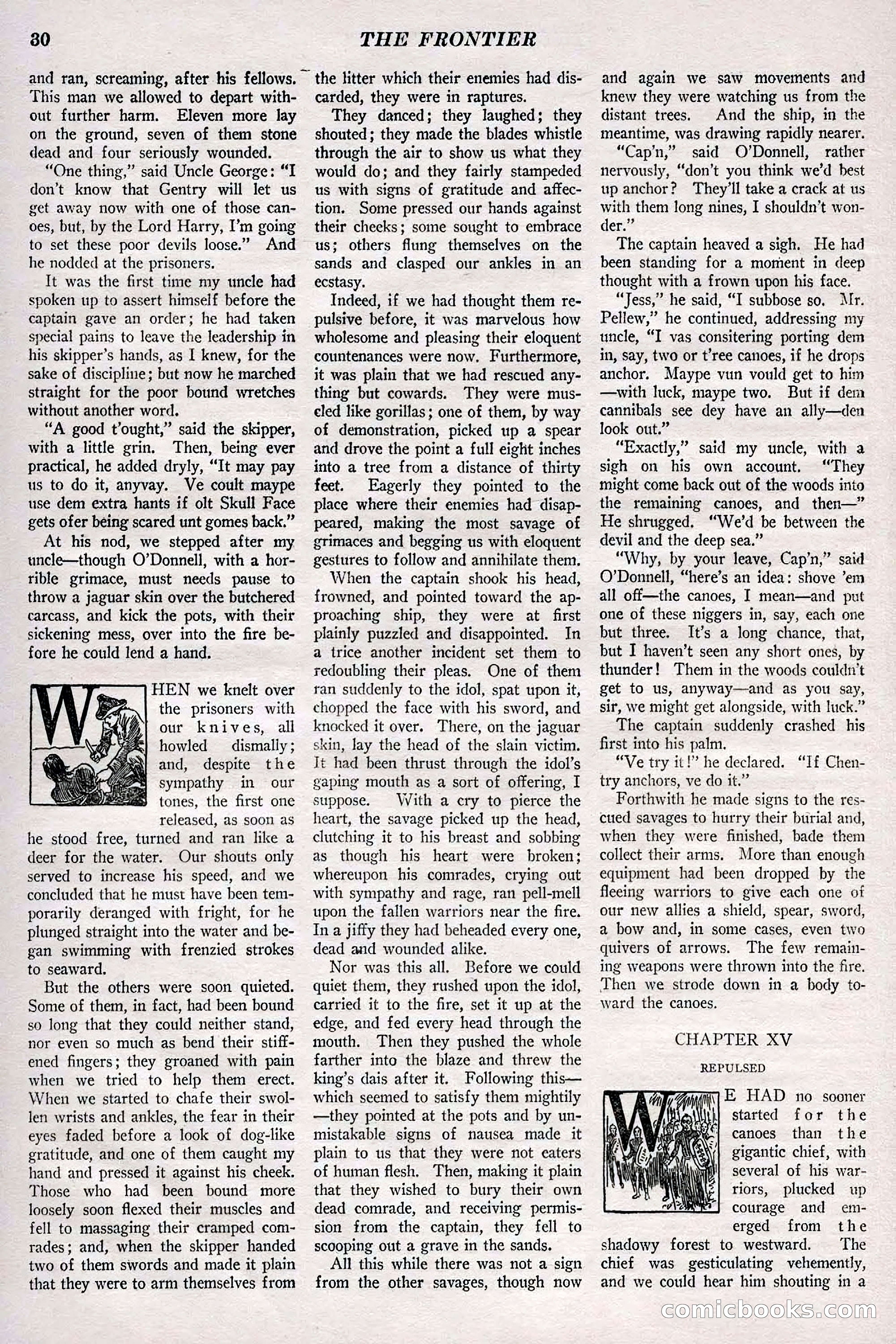
# Page 30 from "The Frontier" This page contains story prose with two small illustrations embedded in the text. The narrative depicts a scene where the narrator's group has captured and released enemy prisoners, who subsequently perform a celebratory dance. The text describes the prisoners' joy, their ritual treatment of a fallen idol, and preparations for burial. The passage concludes with a new chapter ("Chapter XV: Repulsed") beginning at the bottom, where a chief apparently leads warriors away from a shadowy forest toward the west. The prose appears to be from an adventure or exploration narrative, though the specific story title and author are not visible on this page.
📄 Transcribed text from this page (OCR, searchable)
Machine-transcribed from the original scan — historical spelling and the odd misread are preserved.
30 and ran, screaming, after his fellows. — This man we allowed to depart with- out further harm. Eleven more lay on the ground, seven of them stone dead and four seriously wounded. “One thing,” said Uncle George: “I don’t know that Gentry will let us get away now with one of those can- oes, but, by the Lord Harry, I’m going to set these poor devils loose.” And he nodded at the prisoners. It was the first time my uncle had spoken up to assert himself before the captain gave an order; he had taken special pains to leave the leadership in his skipper’s hands, as I knew, for the sake of discipline; but now he marched straight for the poor bound wretches without another word. “A good t’ought,” said the skipper, with a little grin. Then, being ever practical, he added dryly, “It may pay us to do it, anyvay. Ve coult maype use dem extra hants if olt Skull Face gets ofer being scared unt gomes back.” At his nod, we stepped after my uncle—though O’Donnell, with a hor- rible grimace, must needs pause to throw a jaguar skin over the butchered carcass, and kick the pots, with their sickening mess, over into the fire be- fore he could lend a hand. HEN we knelt over the prisoners with our knives, all howled _ dismally ; and, despite the sympathy in our tones, the first one released, as soon as he stood free, turned and ran like a deer for the water. Our shouts only served to increase his speed, and we concluded that he must have been tem- porarily deranged with fright, for he plunged straight into the water and be- gan swimming with frenzied strokes to seaward. But the others were soon quieted. Some of them, in fact, had been bound so long that they could neither stand, nor even so much as bend their stiff- ened fingers; they groaned with pain when we tried to help them erect. When we started to chafe their swol- len wrists and ankles, the fear in their eyes faded before a look of dog-like gratitude, and one of them caught my hand and pressed it against his cheek. Those who had been bound more loosely soon flexed their muscles and fell to massaging their cramped com- rades; and, when the skipper handed two of them swords and made it plain that they were to arm themselves from THE FRONTIER the litter which their enemies had dis- carded, they were in raptures. They danced; they laughed; they shouted ; they made the blades whistle through the air to show us what they would do; and they fairly stampeded us with signs of gratitude and affec- tion. Some pressed our hands against their cheeks; some sought to embrace us; others flung themselves on the sands and clasped our ankles in an ecstasy. Indeed, 1f we had thought them re- pulsive before, it was marvelous how wholesome and pleasing their eloquent countenances were now. Furthermore, it was plain that we had rescued any- thing but cowards. They were mus- eled like gorillas; one of them, by way of demonstration, picked up a spear and drove the point a full eight inches into a tree from a distance of thirty feet. Eagerly they pointed to the place where their enemies had disap- peared, making the most savage of grimaces and begging us with eloquent gestures to follow and annihilate them. When the captain shook his head, frowned, and pointed toward the ap- proaching ship, they were at first plainly puzzled and disappointed. In a trice another incident set them to redoubling their pleas. One of them ran suddenly to the idol, spat upon it, chopped the face with his sword, and knocked it over. There, on the jaguar skin, lay the head of the slain victim. Jt had been thrust through the idol’s gaping mouth as a sort of offering, I suppose. With a cry to pierce the heart, the savage picked up the head, clutching it to his breast and sobbing as though his heart were broken; whereupon his comrades, crying out with sympathy and rage, ran pell-mell upon the fallen warriors near the fire. In a jiffy they had beheaded every one, dead and wounded alike. | Nor was this all. Before we could quiet them, they rushed upon the idol, carried it to the fire, set it up at the edge, and fed every head through the mouth. Then they pushed the whole farther into the blaze and threw the king’s dais after it. Following this— which seemed to satisfy them mightily —they pointed at the pots and by un- mistakable signs of nausea made it plain to us that they were not eaters of human flesh, Then, making it plain that they wished to bury their own dead comrade, and receiving permis- sion from the captain, they fell to scooping out a grave in the sands. All this while there was not a sign from the other savages, though now and again we saw movements and knew they were watching us from the distant trees. And the ship, m the meantime, was drawing rapidly nearer. “Cap’n,” said O’Donnell, rather nervously, “don’t you think we'd best up anchor? They’ll take a crack at us with them long nines, I shouldn’t won- der.” The captain heaved a sigh. He had been standing for a moment in deep thought with a frown upon his face. “Jess,” he said, “IT subbose so. Mr. Pellew,” he continued, addressing my uncle, “I vas consitering porting dem in, say, two or t’ree canoes, if he drops anchor. Maype vun vould get to him —with luck, maype two. But if dem cannibals see dey have an ally—den look out.” “Exactly,” said my uncle, with a sigh on his own account. “They might come back out of the woods into the remaining canoes, and then—” He shrugged, ‘We'd be between the devil and the deep sea.” “Why, by your leave, Cap’n,” said O’Donnell, “here’s an idea: shove ’em all off—the canoes, I mean—and put one of these niggers in, say, each one but three. It’s a long chance, that, but I haven’t seen any short ones, by thunder! Them in the woods couldn’t get to us, anyway—and as you say, sir, we might get alongside, with luck.” The captain suddenly crashed his first into his palm. “Ve try it!” he declared. “I£ Chen- try anchors, ve do it.” Forthwith he made signs to the res- cued savages to hurry their burial and, when they were finished, bade them collect their arms. More than enough equipment had been dropped by the fleeing warriors to give each one of our new allies a shield, spear, sword, a bow and, in some cases, even two quivers of arrows. The few remain- ing weapons were thrown into the fire. Then we strode down in a body to- ward the canoes. CHAPTER XV REPULSED E HAD no sooner started for the canoes than the gigantic chief, with several of his war- riors, plucked up courage and em- erged from the shadowy forest to westward. The chief was gesticulating vehemently, and we could hear him shouting in a Gomicbooksacom