
Pulp Fiction, 1926 · page 36 of 114
The Frontier, May 1926 — page 36: what you’re looking at
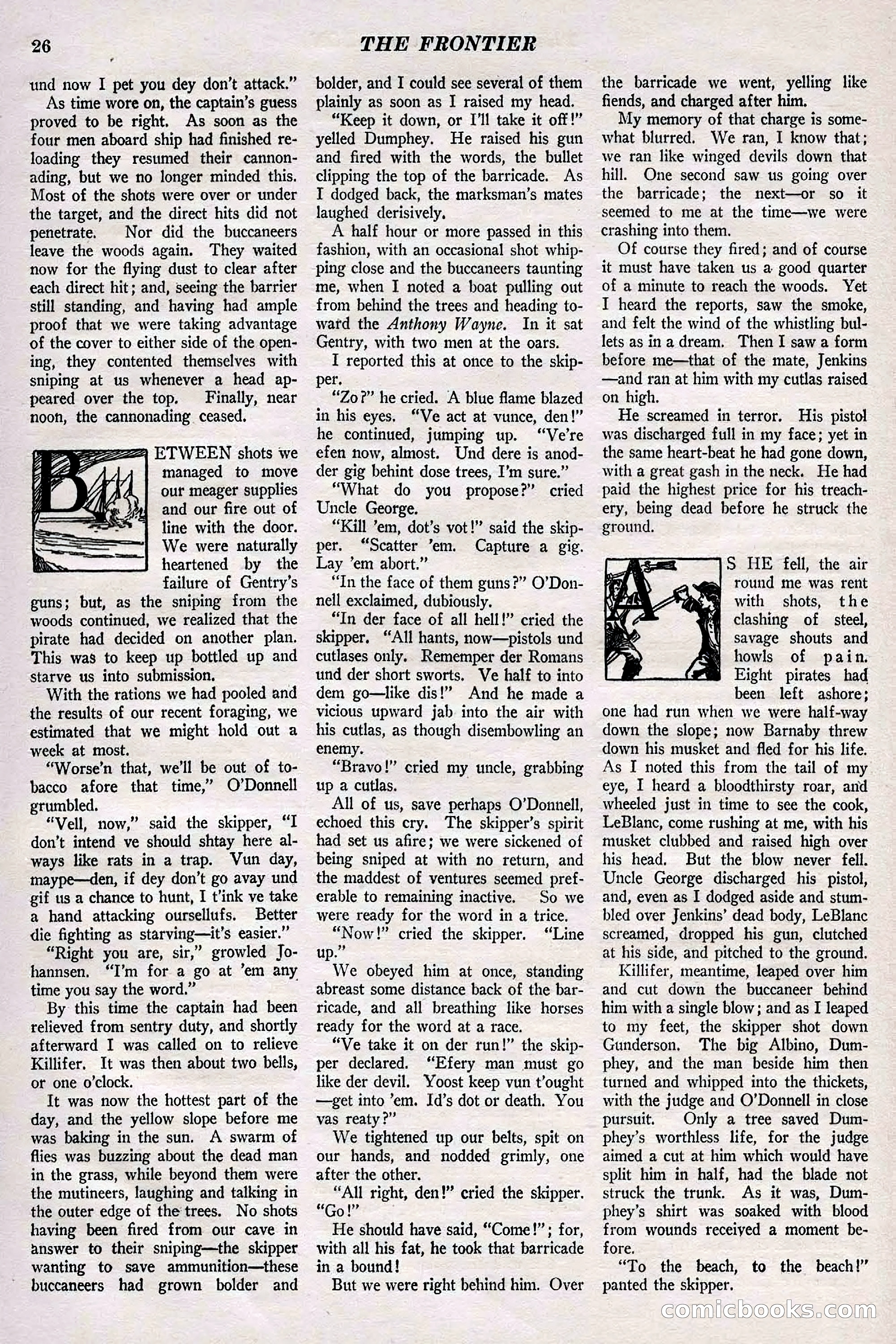
A restored page from Pulp Fiction, 1926. Page through the whole issue in the reader above.
📄 Transcribed text from this page (OCR, searchable)
Machine-transcribed from the original scan — historical spelling and the odd misread are preserved.
26 und now I pet you dey don’t attack.” As time wore on, the captain’s guess proved to be right. As soon as the four men aboard ship had finished re- loading they resumed their cannon- ading, but we no longer minded this. Most of the shots were over or under the target, and the direct hits did not penetrate. Nor did the buccaneers leave the woods again. They waited now for the flying dust to clear after each direct hit; and, seeing the barrier still standing, and having had ample proof that we were taking advantage of the cover to either side of the open- ing, they contented themselves with sniping at us whenever a head ap- peared over the top. Finally, near noon, the cannonading ceased. ZA E:TWEEN shots we managed to tmove our meager supplies and our fire out of line with the door. We were naturally heartened by the failure of Gentry’s guns; but, as the sniping from the woods continued, we realized that the pirate had decided on another plan. This was to keep up bottled up and starve us into submission. | With the rations we had pooled and the results of our recent foraging, we estimated that we might hold out a week at most. “Worse’n that, we'll be out of to- bacco afore that time,” O’Donnell grumbled. “Vell, now,” said the skipper, “I don’t intend ve should shtay here al- ways like rats in a trap. Vun day, maype—den, if dey don’t go avay und gif us a chance to hunt, I t’ink ve take a hand attacking oursellufs. Better die fighting as starving—it’s easier.” “Right you are, sir,” growled Jo- hannsen. “I’m for a go at ’em any time you say the word.” By this time the captain had been relieved from sentry duty, and shortly afterward I was called on to relieve Killifer. It was then about two bells, or one o'clock. It was now the hottest part of the day, and the yellow slope before me was baking in the sun. A swarm of flies was buzzing about the dead man in the grass, while beyond them were the mutineers, laughing and talking in the outer edge of the'trees. No shots having been fired from our cave in answer to their sniping—the skipper wanting to save ammunition—these buccaneers had grown bolder and THE FRONTIER bolder, and I could see several of them plainly as soon as I raised my head. “Keep it down, or I'll take it off!” yelled Dumphey. He raised his gun and fired with the words, the bullet clipping the top of the barricade. As I dodged back, the marksman’s mates laughed derisively. A half hour or more passed in this fashion, with an occasional shot whip- ping close and the buccaneers taunting me, when I noted a boat pulling out from behind the trees and heading to- watd the Anthony Wayne. In it sat Gentry, with two men at the oars. I reported this at once to the skip- per. “Zo?” he cried. A blue flame blazed in his eyes, Ve act at vunce, den!” he continued, jumping up. “Ve’re efen now, almost. Und dere is anod- der gig behint dose trees, I’m sure.” “What do you propose?” cried Uncle George. “Kill ’em, dot’s vot!” said the skip- per. “Scatter ’em. Capture a gig. Lay ’em abort.” “In the face of them guns?” O’Don- nell exclaimed, dubiously. “In der face of all hell!” cried the skipper, “All hants, now—pistols und cutlases only. Rememper der Romans und der short sworts. Ve half to into dem go—like dis!” And he made a vicious upward jab into the air with his cutlas, as though disembowling an enemy. “Bravo!” cried my uncle, grabbing up a cutlas. All of us, save perhaps O’Donnell, echoed this cry. The skipper’s spirit had set us afire; we were sickened of being sniped at with no return, and the maddest of ventures seemed pref- erable to remaining inactive. So we were ready for the word in a trice. “Now!” cried the skipper. “Line up.” We obeyed him at once, standing abreast some distance back of the bar- ricade, and all breathing like horses ready for the word at a race. “Ve take it on der run!” the skip- per declared. “Efery man must go like der devil. Yoost keep vun t’ought —get into ’em. Id’s dot or death. You vas reaty ?” We tightened up our belts, spit on our hands, and nodded grimly, one after the other. “All right, den!” cried the skipper. Go Kis He should have said, “Come!”; for, with all his fat, he took that barricade in a bound! But we were right behind him. Over the barricade we went, yelling like fiends, and charged after him. My memory of that charge is some- what blurred. We ran, I know that; we ran like winged devils down that hill. One second saw us going over the barricade; the next—or so it seemed to me at the time—we were crashing into them. Of course they fired; and of course it must have taken us a good quarter of a minute to reach the woods. Yet I heard the reports, saw the smoke, and felt the wind of the whistling bul- lets as ina dream. Then I saw a form before me—that of the mate, Jenkins —and ran at him with my cutlas raised on high. He screamed in terror. His pistol was discharged full in my face; yet in the same heart-beat he had gone down, with a great gash in the neck. He had paid the highest price for his treach- ery, being dead before he struck the ground. 15 HE fell, the air | round me was rent poe «with shots, the | clashing of steel, savage shouts and howls of pain. Eight pirates had been left ashore; one had run when we were half-way down the slope; now Barnaby threw down his musket and fled for his life. As I noted this from the tail of my eye, I heard a bloodthirsty roar, and wheeled just in time to see the cook, LeBlanc, come rushing at me, with his musket clubbed and raised high over his head. But the blow never fell. Uncle George discharged his pistol, and, even as I dodged aside and stum- bled over Jenkins’ dead body, LeBlanc screamed, dropped his gun, clutched at his side, and pitched to the ground. Killifer, meantime, leaped over him and cut down the buccaneer behind him with a single blow; and as I leaped to my feet, the skipper shot down Gunderson. The big Albino, Dum- phey, and the man beside him then turned and whipped into the thickets, with the judge and O’Donnell in close pursuit. Only a tree saved Dum- phey’s worthless life, for the judge aimed a cut at him which would have split him in half, had the blade not struck the trunk. As it was, Dum- phey’s shirt was soaked with blood from wounds receiyed a moment be- fore. “To the beach, to the beach!” panted the skipper. CORnNIELOOO® S COM