
Pulp Fiction, 1926 · page 54 of 114
The Frontier, May 1926 — page 54: what you’re looking at
What you’re looking at
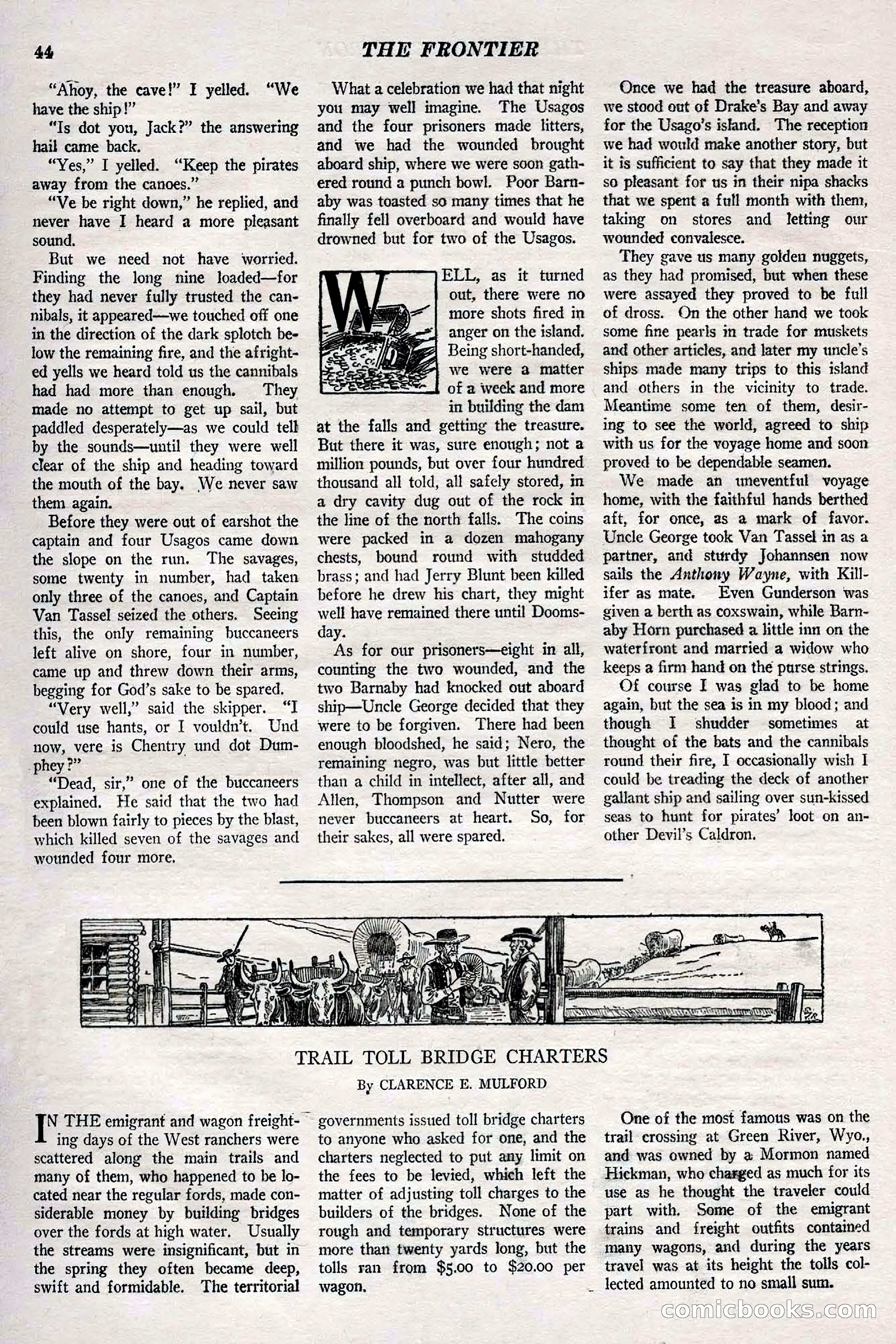
# Page Analysis This is page 44 from *The Frontier*, a pulp magazine. It contains two separate stories in prose format. The upper section concludes a narrative about a ship crew encountering pirates and discovering treasure on an island inhabited by the Usagos people. The narrator describes their eventual return home and reflections on life at sea. Below that is a new story titled "Trail Toll Bridge Charters" by Clarence E. Mulford. It discusses the historical practice of toll bridge charters issued to emigrants and freight operators along American trails during westward expansion. The text mentions specific tolls ($5–$20 per wagon) and references a notable bridge operated by a Mormon named Hickman on the Green River in Wyoming. There is a small illustration of frontier figures with wagons and horses between the two stories.
📄 Transcribed text from this page (OCR, searchable)
Machine-transcribed from the original scan — historical spelling and the odd misread are preserved.
44 “Ahoy, the cave!” I yelled. “We have the ship!’ “Ts dot you, Jack?” the answering hail came back. “Ves,” I yelled. ‘Keep the pirates away from the canoes.” “Ve be right down,” he replied, and never have I heard a more pleasant sound, But we need not have worried. Finding the long nine loaded—for they had never fully trusted the can- nibals, it appeared—we touched off one in the direction of the dark splotch be- low the remaining fire, and the afright- ed yells we heard told us the cannibals had had more than enough. They made no attempt to get up sail, but paddled desperately—as we could tell by the sounds—until they were well clear of the ship and heading toward the mouth of the bay. We never saw them again. Before they were out of earshot the captain and four Usagos came down the slope on the run. The savages, some twenty in number, had taken only three of the canoes, and Captain Van Tassel seized the others. Seeing this, the only remaining buccaneers left alive on shore, four in number, came up and threw down their arms, begging for God’s sake to be spared. “Very well,” said the skipper. “I could tse hants, or I vouldn’t. Und now, vere is Chentry und dot Dum- “Dead, sir,” one of the buccaneers explained. He said that the two had been blown fairly to pieces by the blast, which killed seven of the savages and wounded four more, THE FRONTIER What a celebration we had that night you may well imagine. The Usagos and the four prisoners made litters, and we had the wounded brought aboard ship, where we were soon gath- ered round a punch bowl. Poor Barn- aby was toasted so many times that he finally fell overboard and would have drowned but for two of the Usagos. ELL, as it turned out, there were no more shots fired in w-*} anger on the island. ieiee| Being short-handed, Mer| we were a matter of a week and more in building the dam at the falls and getting the treasure. But there it was, sttre enough; not a million pounds, but over four hundred thousand all told, all safely stored, in a dry cavity dug out of the rock in the line of the north falls. The coins were packed in a dozen mahogany chests, bound round with studded brass; and had Jerry Blunt been killed before he drew his chart, they might well have remained there until Dooms- day. As for our prisoners—eight in all, counting the two wounded, and the two Barnaby had knocked out aboard ship—Uncle George decided that they were to be forgiven. There had been enough bloodshed, he said; Nero, the remaining negro, was but little better than a child in intellect, after all, and Allen, Thompson and Nutter were never buccaneers at heart. So, for their sakes, all were spared. Once we had the treasure aboard, we stood out of Drake’s Bay and away for the Usago’s island. The reception we had would make another story, but it is sufficient to say that they made it so pleasant for us in their nipa shacks that we spent a full month with them, taking on stores and letting our wounded convalesce. They gave us many golden nuggets, as they had promised, but when these were assayed they proved to be full of dross. On the other hand we took some fine pearls im trade for muskets and other articles, and later my uncle’s ships made many trips to this island and others in the vicinity to trade. Meantime some ten of them, desir- ing to see the world, agreed to ship with us for the voyage home and soon proved to be dependable seamen. We made an tneventful voyage home, with the faithful hands berthed ait, for once, as a mark of favor. Uncle George took Van Tassel in as a partner, and sturdy Johannsen now sails the Anthony Wayne, with Kill- ifer as mate. Even Gunderson was given a berth as coxswain, while Barn- aby Horn purchased a little inn on the waterfront and married a widow who keeps a firm hand on the purse strings. Of course I was glad to be home again, but the sea is in my blood; and though J shudder sometimes at thought of the bats and the cannibals round their fire, I occasionally wish I could be treading the deck of another gallant ship and sailing over sun-kissed seas to hunt for pirates’ loot on an- other Devil’s Caldron. TRAIL TOLL BRIDGE CHARTERS By CLARENCE E. MULFORD I’ THE emigrant and wagon freight- ~ ing days of the West ranchers were scattered along the main trails and many of them, who happened to be lo- cated near the regular fords, made con- siderable money by building bridges over the fords at high water, Usually the streams were insignificant, but in the spring they often became deep, swift and formidable. The territorial governments issued toll bridge charters to anyone who asked for one, and the charters neglected to put any limit on the fees to be levied, which left the matter of adjusting toll charges to the builders of the bridges. None of the rough and temporary structures were more than twenty yards long, but the tolls ran from $5.00 to $20.00 per wagon. One of the most famous was on the trail crossing at Green River, Wyo., and was owned by a Mormon named Hickman, who charged as much for its use as he thought the traveler could part with. Seme of the emigrant trains and freight outfits contamed many wagons, and during the years travel was at its height the tolls col- lected amounted to no small sum. Gomichbooksacom