
Pulp Fiction, 1926 · page 87 of 114
The Frontier, May 1926 — page 87: what you’re looking at
What you’re looking at
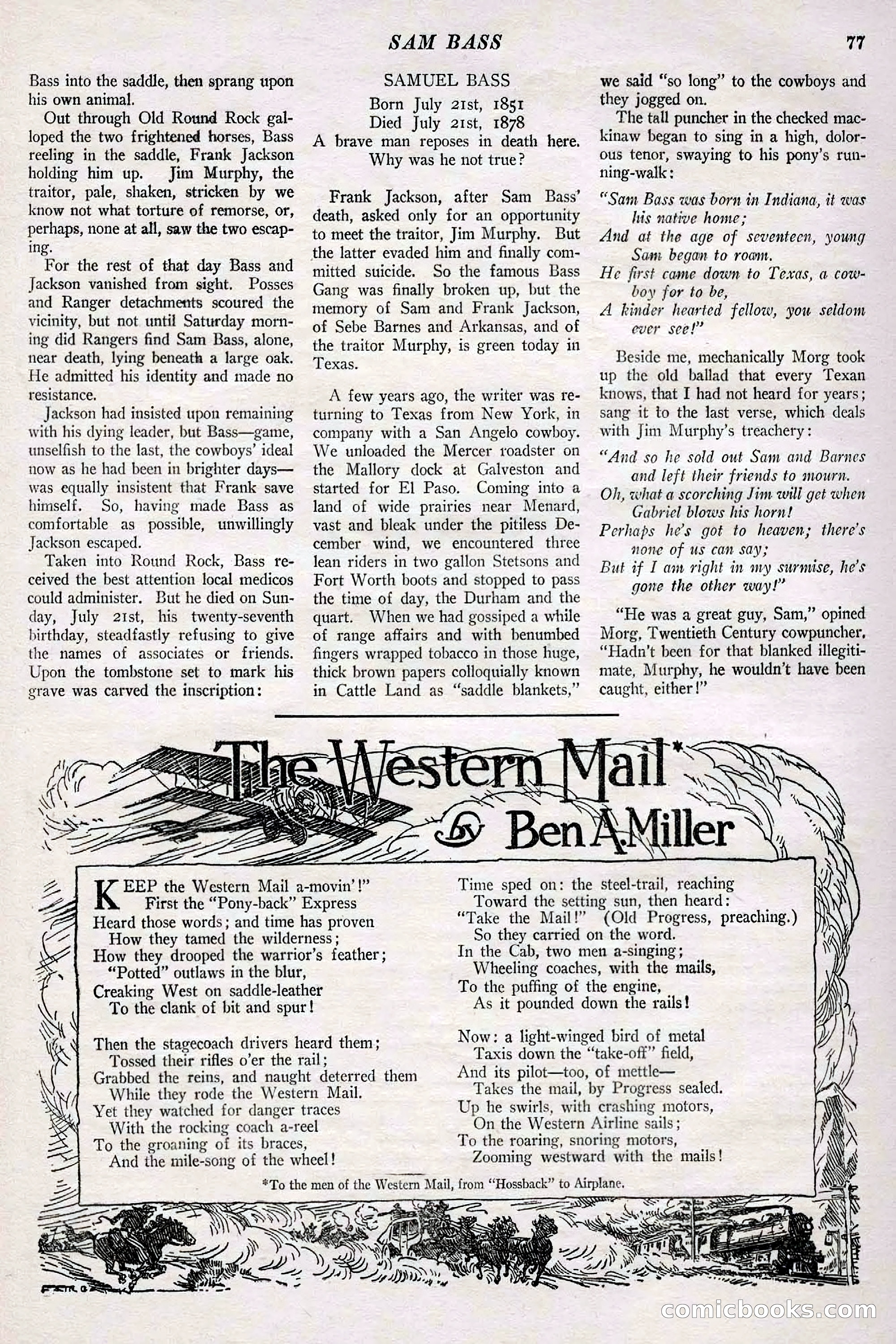
This is a text page from a pulp magazine containing two stories. The upper portion concludes "Sam Bass," a biographical narrative about the outlaw Samuel Bass (born 1851, died July 21, 1878), describing his death and the betrayal by associate Jim Murphy. The lower half features "The Western Mail," a poem by Ben A Miller, celebrating the evolution of mail delivery from stagecoaches to modern trains and airplanes. The page includes decorative illustrations bracketing the poem, depicting horses, stagecoaches, and trains. The content emphasizes American frontier history and technological progress in transportation and communication.
📄 Transcribed text from this page (OCR, searchable)
Machine-transcribed from the original scan — historical spelling and the odd misread are preserved.
Bass into the saddle, then sprang upon his own animal. Out through Old Round Rock gal- loped the two frightened horses, Bass reeling in the saddle, Frank Jackson holding him up. Jim Murphy, the traitor, pale, shaken, stricken by we know not what torture of remorse, or, perhaps, none at all, saw the two escap- ing. For the rest of that day Bass and Jackson vanished from sight. Posses and Ranger detachments scoured the vicinity, but not until Saturday morn- ing did Rangers find Sam Bass, alone, near death, lying beneath a large oak. He admitted his identity and made no resistance. Jackson had insisted upon remaining with his dying leader, but Bass—game, unselfish to the last, the cowboys’ ideal now as he had been in brighter days— was equally insistent that Frank save himself. So, having made Bass as comfortable as possible, unwillingly Jackson escaped. Taken into Round Rock, Bass re- ceived the best attention local medicos could administer. But he died on Sun- day, July 2ist, his twenty-seventh birthday, steadfastly refusing to give the names of associates or friends. Upon the tombstone set to mark his grave was carved the inscription: —_ SAM BASS SAMUEL BASS Born July 21st, 1851 Died July 21st, 1878 A brave man reposes in death here. Why was he not true? Frank Jackson, after Sam Bass’ death, asked only for an opportunity to meet the traitor, Jim Murphy. But the latter evaded him and finally com- mitted suicide. So the famous Bass Gang was finally broken up, but the memory of Sam and Frank Jackson, of Sebe Barnes and Arkansas, and of the traitor Murphy, is green today in Texas. A few years ago, the writer was re- turning to Texas from New York, in company with a San Angelo cowboy. We unloaded the Mercer roadster on the Mallory dock at Galveston and started for El Paso. Coming into a land of wide prairies near Menard, vast and bleak under the pitiless De- cember wind, we encountered three lean riders in two gallon Stetsons and Fort Worth boots and stopped to pass the time of day, the Durham and the quart. When we had gossiped a while of range affairs and with benumbed fingers wrapped tobacco in those huge, thick brown papers colloquially known in Cattle Land as “saddle blankets,” 77 we said “so long” to the cowboys and they jogged on. The tall puncher in the checked mac- kinaw began to sing in a high, dolor- ous tenor, swaying to his pony’s run- ning-walk : “Sam Bass was born in Indiana, it was lus native home; And at the age of seventecn, young Sam began to roant. He first came down to Texas, a cow- boy for to be, A kinder hearted fellow, you seldom ever see!” Beside me, mechanically Morg took up the old ballad that every Texan knows, that I had not heard for years; sang it to the last verse, which deals with Jim Murphy’s treachery : “And so he sold out Sam and Barnes and left their friends to mourn. Oh, what a scorching Jim wii get when Gabriel blows his horn! Perhaps he’s got to heaven; there's none of us can say; But if I am right in my surnuse, he’s gone the other way!” “He was a great guy, Sam,” opined More, Twentieth Century cowpuncher, “Hadn't been for that blanked illegiti- mate, Murphy, he wouldn’t have been caught, either!” EEP the Western Mail a-movin’!” First the “Pony-back” Express Heard those words; and time has proven How they tamed the wilderness ; How they drooped the warrior’s feather ; “Potted” outlaws in the blur, Creaking West on saddle-leather To the clank of bit and spur! Then the stagecoach drivers heard them; Tossed their rifles o’er the rail; Grabbed the reins, and naught deterred them While they rode the Western Mail. Yet they watched for danger traces With the rocking coach a-reel To the groaning of its braces, And the mile-song of the wheel! Time sped on: the steel-trail, reaching Toward the setting sun, then heard: “Take the Mail!” (Old Progress, preaching.) So they carried on the word. In the Cab, two men a-singing ; Wheeling coaches, with the mails, To the puffing of the engine, As it pounded down the rails! Now: a light-winged bird of metal Taxis down the “take-off” field, And its pilot—too, of mettle— Takes the mail, by Progress sealed. Up he swirls, with crashing motors, On the Western Airline sails ; To the roaring, snoring motors, Zooming westward with the mails! *To the men of the Western Mail, from ‘‘Hossback” to Airplane. COonmicloool<Ss