
Pulp Fiction, 1926 · page 47 of 114
The Frontier, May 1926 — page 47: what you’re looking at
What you’re looking at
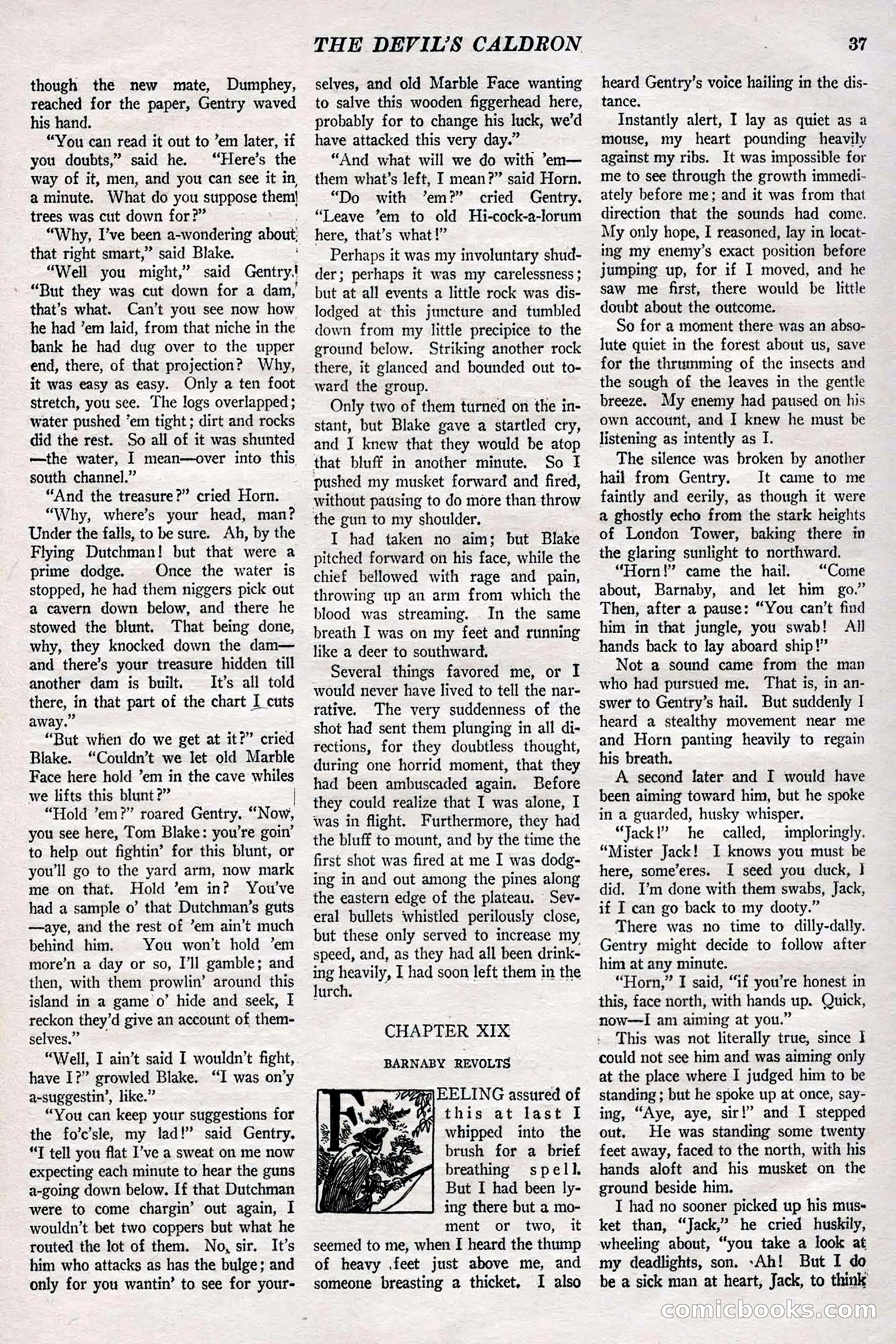
# Page 37 of "The Devil's Caldron" This page contains story prose from Chapter XIX, titled "Barnaby Revolts." The text depicts an action sequence where the narrator, apparently hiding in a forest, observes an armed confrontation between pursuers. Characters named Gentry, Horn, Blake, and Dumphey are engaged in a conflict involving gunfire and pursuit across terrain with rocks and water features. The narrator describes his strategic position and his observation of the action, then receives a whispered message from someone named Horn, who appears to be one of the combatants. The prose emphasizes suspense and the narrator's attempts to remain concealed while monitoring the dangerous situation unfolding nearby.
📄 Transcribed text from this page (OCR, searchable)
Machine-transcribed from the original scan — historical spelling and the odd misread are preserved.
though the new mate, Dumphey, reached for the paper, Gentry waved his hand. “You can read it out to ’em later, 1 you doubts,” said he. “Here’s the way of it, men, and you can see it in, a minute. What do you suppose them! trees was cut down for?” “Why, I’ve been a-wondering about; that right smart,” said Blake. “Well you might,” said Gentry! “But they was cut down for a dam, that’s what. Can’t you see now how he had ’em laid, from that niche in the bank he had dug over to the upper end, there, of that projection? Why, it was easy as easy. Only a ten foot stretch, you see. The logs overlapped; water pushed ‘em tight; dirt and rocks did the rest. So all of it was shunted —the water, I mean—over into this south channel.” “And the treasure?” cried Horn. “Why, where’s your head, man? Under the falls, to be sure. Ah, by the Flying Dutchman! but that were a prime dodge. Once the water is stopped, he had them niggers pick out a cavern down below, and there he stowed the blunt. That being done, why, they knocked down the dam— and there’s your treasure hidden till another dam is built. It’s all told there, in that part of the chart I cuts away.” “But when do we get at it?” cried Blake. “Couldn’t we let old Marble Face here hold ’em in the cave whiles we lifts this blunt?” | “Hold ’em?” roared Gentry. “Now, you see here, Tom Blake: you’re goin’ to help out fightin’ for this blunt, or you'll go to the yard arm, now mark me on that. Hold ’em in? You've had a sample o’ that Dutchman’s guts —aye, and the rest of ’em ain’t much behind him. You won’t hold ‘em more’n a day or so, I'll gamble; and then, with them prowlin’ around this island in a game o’ hide and seek, | reckon they’d give an account of them- selves.” “Well, I ain’t said I wouldn’t fight, have 1?” growled Blake. “I was on’y a-suggestin’, like.” “Vou can keep your suggestions for the fo’c’sle, my lad!” said Gentry, “T tell you flat I’ve a sweat on me now expecting each minute to hear the guns a-going down below. If that Dutchman were to come chargin’ out again, I wouldn’t bet two coppers but what he routed the lot of them. No, sir. It’s him who attacks as has the bulge; and only for you wantin’ to see for your- THE DEVIL'S CALDRON selves, and old Marble Face wanting to salve this wooden figgerhead here, probably for to change his luck, we'd have attacked this very day.” “And what will we do with ’°en— them what’s left, I mean?” said Horn. “Do with ’em?”’ cried Gentry. “Leave ’em to old Hi-cock-a-lorum here, that’s what!” Perhaps it was my involuntary shud- der; perhaps it was my carelessness; but at all events a little rock was dis- lodged at this juncture and tumbled down from my little precipice to the ground below. Striking another rock there, it glanced and bounded out to- ward the group. Only two of them turned on the in- stant, but Blake gave a startled cry, and I knew that they would be atop that bluff in another minute. So [ pushed my musket forward and fired, without pausing to do more than throw the gun to my shoulder, I had taken no aim; but Blake pitched forward on his face, while the chief bellowed with rage and pain, throwing up an arm from which the blood was streaming. In the same breath I was on my feet and running like a deer to southward. Several things favored me, or I would never have lived to tell the nar- rative. The very suddenness of the shot had sent them plunging in all di- rections, for they doubtless thought, during one horrid moment, that they had been ambuscaded again. Before they could realize that I was alone, I was in flight. Furthermore, they had the bluff to mount, and by the time the first shot was fired at me I was dodg- ing in and out among the pines along the eastern edge of the plateau. Sev- eral bullets whistled perilously close, but these only served to increase my speed, and, as they had all been drink- ing heavily, I had soon left them in the lurch. CHAPTER XIX BARNABY REVOLTS | EELING assured of 1 this at last I whipped into the brush for a brief breathing spell. But I had been ly- ing there but a mo- ment or two, it seemed to me, when I heard the thump of heavy feet just above me, and someone breasting a thicket, I also 37 heard Gentry’s voice hailing in the dis- tance. Instantly alert, I lay as quiet as a mouse, my heart pounding heavily against my ribs. It was impossible for me to see through the growth immedi- ately before me; and it was from that direction that the sounds had come. My only hope, I reasoned, lay in locat- ing my enemy’s exact position before jumping up, for if I moved, and he saw me first, there would be httle doubt about the outcome. So for a moment there was an abso- lute quiet in the forest about us, save for the thrumming of the insects and the sough of the leaves in the gentle breeze. My enemy had paused on his own account, and I knew he must be listening as intently as I. The silence was broken by another hail from Gentry. It came to me faintly and eerily, as though it were a ghostly echo from the stark heights of London Tower, baking there in the glaring sunlight to northward. “Horn! came the hail. “Come about, Barnaby, and let him go.” Then, after a pause: “You can’t find him in that jungle, you swab! All hands back to lay aboard ship!” Not a sound came from the man who had purstied me. That is, in an- swer to Gentry’s hail. But suddenly | heard a stealthy movement near me and Horn panting heavily to regain his breath. A second later and I would have been aiming toward him, but he spoke in a guarded, husky whisper. “Jack!” he called, imploringly. “Mister Jack! I knows you must be here, some’eres. I seed you duck, } did. I’m done with them swabs, Jack, if I can go back to my dooty.” There was no time to dilly-dally. Gentry might decide to follow after him at any minute. “Horn,” I said, “if you’re honest in this, face north, with hands up. Quick, now—I am aiming at you.” This was not literally true, since | could not see him and was aiming only at the place where I judged him to be standing ; but he spoke up at once, say- ing, “Aye, aye, sir!” and I stepped out, He was standing some twenty feet away, faced to the north, with his hands aloft and his musket on the ground beside him. I had no sooner picked up his mus« ket than, “Jack,’ he cried huskily, wheeling about, “you take a look at my deadlights, son. -Ah! But I do be a sick man at heart, Jack, to think COMICMOoOokKS. Conn