
Pulp Fiction, 1926 · page 48 of 114
The Frontier, May 1926 — page 48: what you’re looking at
What you’re looking at
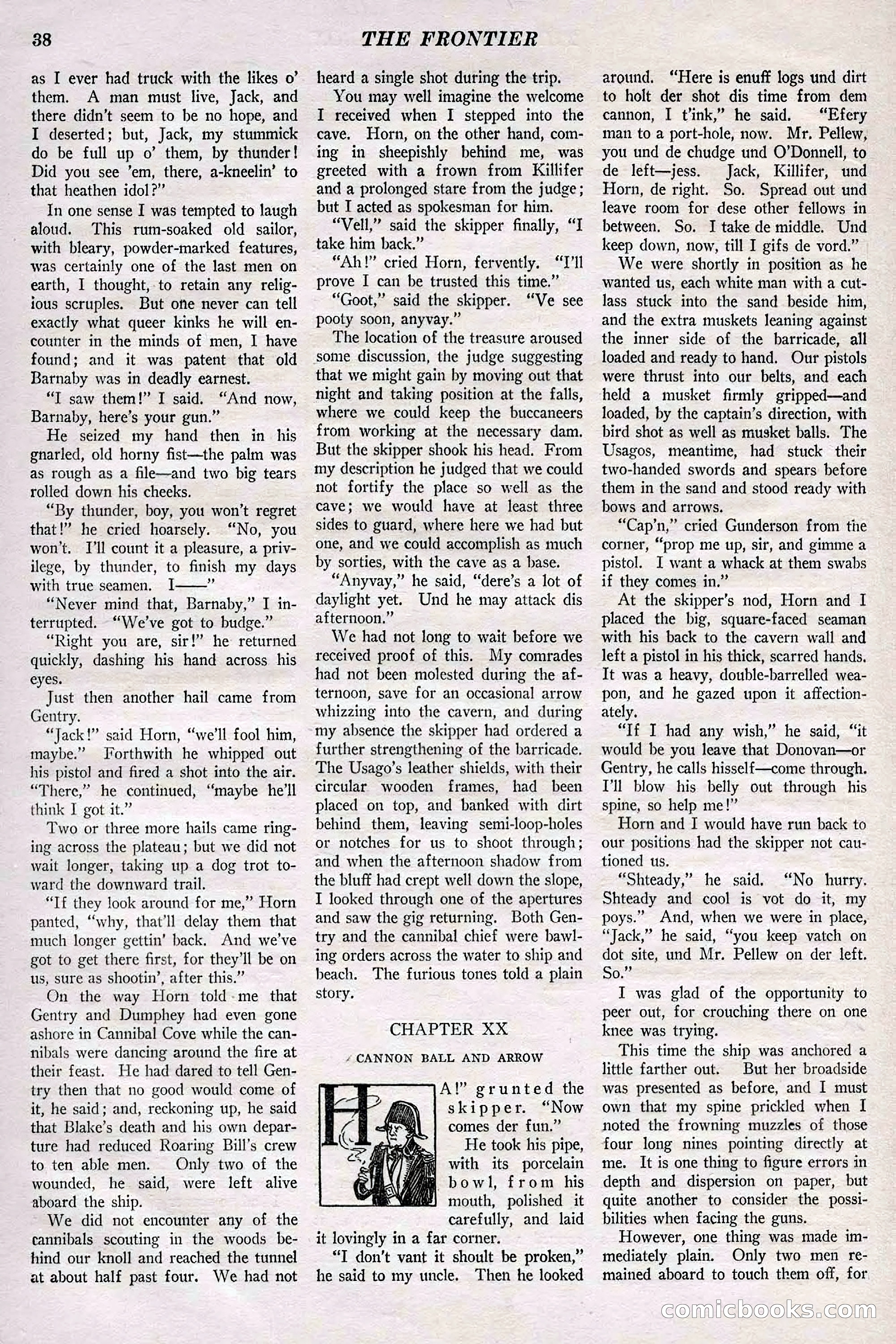
# Page Analysis This is story prose from a pulp magazine titled "THE FRONTIER" (visible at page top). The page contains two chapters: the end of a chapter involving negotiations over treasure location and military strategy at a fortified position, and the beginning of Chapter XX titled "Cannon Ball and Arrow," which features a small illustration of a pipe-smoking man's face. The narrative describes a conflict involving characters named Horn, Gentry, Barnaby, and others who are defending against cannibal attackers. The text discusses defensive positions, weapons (muskets and arrows), and a skipper's orders to prepare fortifications. The prose is adventure fiction typical of early-20th-century pulp magazines.
📄 Transcribed text from this page (OCR, searchable)
Machine-transcribed from the original scan — historical spelling and the odd misread are preserved.
38 as I ever had truck with the likes o’ them. A man must live, Jack, and there didn’t seem to be no hope, and I deserted; but, Jack, my stummick do be full up o’ them, by thunder! Did you see ’em, there, a-kneelin’ to that heathen idol?” In one sense I was tempted to laugh aloud. This rum-soaked old sailor, with bleary, powder-marked features, was certainly one of the last men on earth, I thought,-to retain any relig- ious scruples. But ofe never can tell exactly what queer kinks he will en- counter in the minds of men, I have found; and it was patent that old Barnaby was in deadly earnest. “T saw them!” I said. “And now, Barnaby, here’s your gun.” He seized my hand then in_ his gnarled, old horny fist—the palm was as rough as a file—and two big tears rolled down his cheeks. “By thunder, boy, you won’t regret that!” he cried hoarsely. “No, you won't. I'll count it a pleasure, a priv- ilege, by thunder, to finish my days with true seamen, I——” “Never mind that, Barnaby,” I in- terrupted. ‘We've got to budge.” “Right you are, sir!’ he returned quickly, dashing his hand across his eyes. Just then another hail came from Gentry. “Jack!” said Horn, “we'll fool him, maybe.” forthwith he whipped out his pistol and fired a shot into the air. “There,” he continued, “maybe he'll think I got it.” Two or three more hails came ring- ing across the plateau; but we did not wait longer, taking up a dog trot to- ward the downward trail. “Tf they look around for me,” Horn panted, ‘why, that'll delay them that much longer gettin’ back. And we've got to get there first, for they'll be on us, sure as shootin’, after this.” On the way Horn told-me that Gentry and Dumphey had even gone ashore in Cannibal Cove while the can- nibals were dancing around the fire at their feast. He had dared to tell Gen- try then that no good would come of it, he said; and, reckoning up, he said that Blake’s death and his own depar- ture had reduced Roaring Bill’s crew to ten able men. Only two of the wounded, he said, were left alive aboard the ship. We did not encounter any of the cannibals scouting in the woods be- hind our knoll and reached the tunnel at about half past four. We had not THE FRONTIER heard a single shot during the trip. You may well imagine the welcome I received when I stepped into the cave. Horn, on the other hand, com- ing in sheepishly behind me, was greeted with a frown from Killifer and a prolonged stare from the judge; but I acted as spokesman for him. “Vell,” said the skipper finally, “I take him back.” “Ah!” cried Horn, fervently. “T’ll prove I can be trusted this time.” “Goot,” said the skipper. “Ve see pooty soon, anyvay.” The location of the treasure aroused some discussion, the judge suggesting that we might gain by moving out that night and taking position at the falls, where we could keep the buccaneers from working at the necessary dam. But the skipper shook his head. From my description he judged that we could not fortify the place so well as the cave; we would have at least three sides to guard, where here we had but one, and we could accomplish as much by sorties, with the cave as a base. “‘Anyvay,” he said, “dere’s a lot of daylight yet. Und he may attack dis afternoon.” We had not long to wait before we received proof of this. My comrades had not been molested during the af- ternoon, save for an occasional arrow whizzing into the cavern, and during my absence the skipper had ordered a further strengthening of the barricade. The Usago’s leather shields, with their circular wooden frames, had been placed on top, and banked with dirt behind them, leaving semi-loop-holes or notches for us to shoot through; and when the afternoon shadow from the bluff had crept well down the slope, I looked through one of the apertures and saw the gig returning. Both Gen- try and the cannibal chief were bawl- ing orders across the water to ship and beach. The furious tones told a plain story. CHAPTER XX CANNON BALL AND ARROW A!” grunted the | skipper. “Now comes der fun.” Ke He took his pipe, | fa with its porcelain Wye bowl, from his mouth, polished it carefully, and laid it lovingly in a far corner. “T don’t vant it shoult be proken,” he said to my uncle. Then he looked around. “Here is enuff logs und dirt to holt der shot dis time from dem cannon, I t'ink,” he said. “Efery man to a port-hole, now. Mr. Pellew, you und de chudge und O’Donnell, to de left—jess. Jack, Killifer, und Horn, de right. So. Spread out und leave room for dese other fellows in between. So. J take de middle. Und keep down, now, till I gifs de vord.” We were shortly in position as he wanted us, each white man with a cut- lass stuck into the sand beside hit, and the extra muskets leaning against the inner side of the barricade, all loaded and ready to hand. Our pistols were thrust into our belts, and each held a musket firmly gripped—and loaded, by the captain’s direction, with bird shot as well as musket balls. The Usagos, meantime, had stuck their two-handed swords and spears before them in the sand and stood ready with bows and arrows. “Cap’n,” cried Gunderson from the corner, “prop me up, sir, and gimme a pistol. I want a whack at them swabs if they comes in.” At the skipper’s nod, Horn and I placed the big, square-faced seaman with his back to the cavern wall and left a pistol in his thick, scarred hands. It was a heavy, double-barrelled wea- pon, and he gazed upon it affection- ately, “If I had any wish,” he said, “it would be you leave that Donovan—or Gentry, he calls hisself—come through. I'll blow his belly out through his spine, so help me!” Horn and I would have run back to our positions had the skipper not cau- tioned us. “Shteady,” he said. “No hurry. Shteady and cool is vot do it, my poys.” And, when we were in place, “Jack,” he said, “you keep vatch on dot site, und Mr. Pellew on der left. S ou I was glad of the opportunity to peer out, for crouching there on one knee was trying. This time the ship was anchored a little farther out. But her broadside was presented as before, and I must own that my spine prickled when I noted the frowning muzzles of those four long nines pointing directly at me. It is one thing to figure errors in depth and dispersion on paper, but quite another to consider the possi- bilities when facing the guns. However, one thing was made im- mediately plain. Only two men re- mained aboard to touch them off, for Gomicbooksacom