
Pulp Fiction, 1926 · page 105 of 114
The Frontier, May 1926 — page 105: what you’re looking at
What you’re looking at
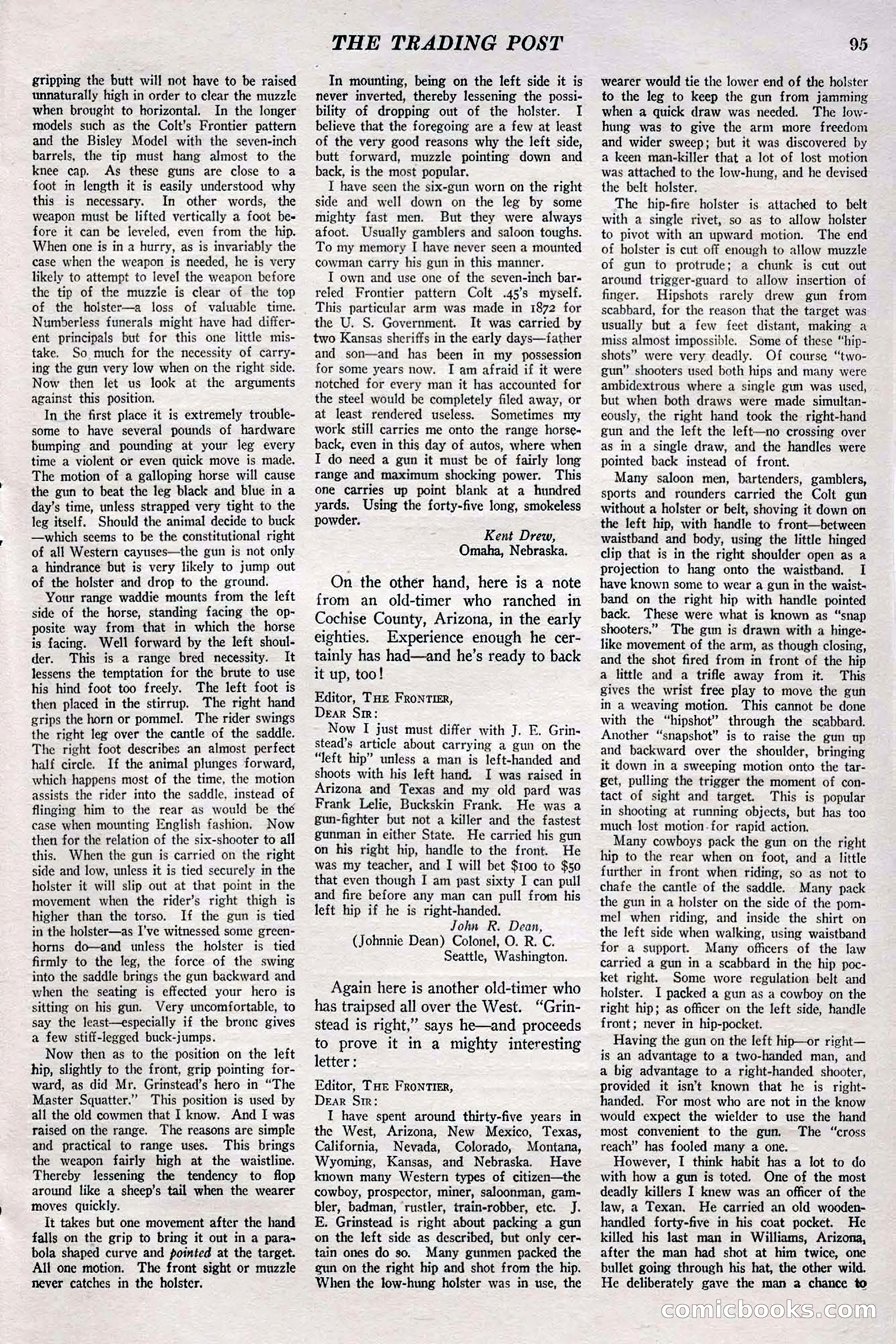
# Page Description This page contains story prose from *The Trading Post* section (page 95), featuring reader letters and editorial responses about Old West firearms and gun-handling techniques. The visible text discusses various methods of carrying and drawing pistols—including hip holsters, waistband carries, and cross-draw positions—with contributions from readers identifying themselves as ranchers and old-timers from Arizona, Texas, and Washington. The letters debate the practical advantages of different gun-carry methods for cowboys and frontier lawmen. No illustrations are visible on this page.
📄 Transcribed text from this page (OCR, searchable)
Machine-transcribed from the original scan — historical spelling and the odd misread are preserved.
gripping the butt will not have to be raised unnaturally high in order to clear the muzzle when brought to horizontal. In the longer models such as the Colt’s Frontier pattern and the Bisley Model with the seven-inch barrels, the tip must hang almost to the knee cap. As these guns are close to a foot in length it is easily understood why this is necessary. In other words, the weapon must be lifted vertically a foot be- fore it can be leveled, even from the hip. When one is in a hurry, as is invariably the case when the weapon is needed, he is very likely to attempt to level the weapon before the tip of the muzzle is clear of the top of the holster—a loss of valuable time. Numberless funerals might have had differ- ert principals but for this one little mis- take. So much for the necessity of carry- ing the gun very low when on the right side. Now then let us look at the arguments against this position. In the first place it is extremely trouble- some to have several pounds of hardware bumping and pounding at your leg every time a violent or even quick move is made. The motion of a galloping horse will cause the gun to beat the leg black and blue in a day’s time, unless strapped very tight to the leg itself. Should the animal decide to buck —which seems to be the constitutional right of all Western cayuses—the gun is not only a hindrance but is very likely to jump out of the holster and drop to the ground. Your range waddie mounts from the left side of the horse, standing facing the op- posite way from that in which the horse is facing. Well forward by the left shoul- der. This is a range bred necessity. It lessens the temptation for the brute to use his hind foot too freely. The left foot is then placed in the stirrup. The right hand grips the horn or pommel. The rider swings the right leg over the cantle of the saddle. The right foot describes an almost perfect half circle. If the animal plunges forward, which happens most of the time, the motion assists the rider into the saddle, instead of flinging him to the rear as would be thé case when mounting English fashion. Now then for the relation of the six-shooter to all this. When the gun is carried on the right side and low, unless it is tied securely in the holster it will slip out at that point in the movement when the rider’s right thigh is higher than the torso. If the gun is tied in the holster—as I’ve witnessed some green- horns do—and unless the holster is tied firmly to the leg, the force of the swing into the saddle brings the gun backward and when the seating is effected your hero is sitting on his gun. Very uncomfortable, to say the least—especially if the bronc gives a few stiff-legged buck-jumps. Now then as to the position on the left hip, slightly to the front, grip pointing for- ward, as did Mr, Grinstead’s hero in “The Master Squatter.” This position is used by all the old cowmen that I know. And I was raised on the range. The reasons are simple and practical to range uses. This brings the weapon fairly high at the waistline. Thereby lessening the tendency to flop around like a sheep’s tail when the wearer moves quickly. It takes but one movement after the hand falls on the grip to bring it out in a para- bola shaped curve and pointed at the target. All one motion. The front sight or muzzle never catches in the holster. THE TRADING POST In mounting, being on the left side it is never inverted, thereby lessening the possi- bility of dropping out of the holster. I believe that the foregoing are a few at least of the very good reasons why the left side, butt forward, muzzle pointing down and back, is the most popular. I have seen the six-gun worn on the right side and well down on the leg by some mighty fast men. But they were always afoot. Usually gamblers and saloon toughs. To my memory I have never seen a mounted cowman carry his gun in this manner. I own and use one of the seven-inch bar- reled Frontier pattern Colt .45’s myself. This particular arm was made in 1872 for the U. S. Government. It was carried by two Kansas sheriffs in the early days—father and son—and has been in my possession for some years now. I am afraid if it were notched for every man it has accounted for the steel would be completely filed away, or at least rendered useless. Sometimes my work still carries me onto the range horse- back, even in this day of autos, where when T do need a gun it must be of fairly long range and maximum shocking power. This one carries up point blank at a hundred yards, Using the forty-five long, smokeless powder. Kent Drew, Omaha, Nebraska, On the other hand, here is a note from an old-timer who ranched in Cochise County, Arizona, in the early eighties. Experience enough he cer- tainly has had—and he’s ready to back it up, too! Editor, THe Frontier, Dear Sr: Now I just must differ with J. E. Grin- stead’s article about carrying a gun on the “left hip” unless a man is left-handed and shoots with his left hand. I was raised in Arizona and Texas and my old pard was Frank Lelie, Buckskin Frank. He was a gun-fighter but not a killer and the fastest gunman in either State. He carried his gun on his right hip, handle to the front. He was my teacher, and I will bet $100 to $50 that even though I am past sixty I can pull and fire before any man can pull from his left hip if he is right-handed. John R. Dean, (Johnnie Dean) Colonel, O. R. C. Seattle, Washington. Again here is another old-timer who has traipsed all over the West. “Grin- stead is right,” says he—and proceeds to prove it in a mighty interesting letter : Editor, THE FRONTIER, Dear Str: I have spent around thirty-five years in the West, Arizona, New Mexico, Texas, California, Nevada, Colorado, Montana, Wyoming, Kansas, and Nebraska. Have known many Western types of citizen—the cowboy, prospector, miner, saloonman, gam- bler, badman, rustler, train-robber, etc. J. E. Grinstead is right about packing a gun on the left side as described, but only cer- tain ones do so. Many gunmen packed the gun on the right hip and shot from the hip. When the low-hung holster was in use, the 95 wearer would tie the lower end of the holster to the leg to keep the gun from jamming when a quick draw was needed. The low- hung was to give the arm more freedom and wider sweep; but it was discovered by a keen man-killer that a lot of lost motion was attached to the low-hung, and he devised the belt holster. The hip-fire holster is attached to belt with a single rivet, so as to allow holster to pivot with an upward motion. The end of holster is cut off enough to allow muzzle of gun to protrude; a chunk is cut out around trigger-guard to allow insertion of finger. Hipshots rarely drew gun from scabbard, for the reason that the target was usually but a few feet distant, making a miss almost impossible. Some of these “hip- shots” were very deadly. Of course “two- gun” shooters used both hips and many were ambidextrous where a single gum was used, but when both draws were made simultan- eously, the right hand took the right-hand gun and the left the left—no crossing over as in a single draw, and the handles were pointed back instead of front. Many saloon men, bartenders, gamblers, sports and rounders carried the Colt gun without a holster or belt, shoving it down on the left hip, with handle to front—between waistband and body, using the little hinged clip that is in the right shoulder open as a projection to hang onto the waistband. I have known some to wear a gun in the waist- band on the right hip with handle pointed back. These were what is known as “snap shooters.” The gun is drawn with a hinge- like movement of the arm, as though closing, and the shot fired from in front of the hip a little and a trifle away from it. This gives the wrist free play to move the gun in a weaving motion. This cannot be done with the “hipshot” through the scabbard. Another “snapshot” is to raise the gun up and backward over the shoulder, bringing it down in a sweeping motion onto the tar- get, pulling the trigger the moment of con- tact of sight and target. This is popular in shooting at running objects, but has too much lost motion. for rapid action. Many cowboys pack the gun on the right hip to the rear when on foot, and a little further in front when riding, so as not to chafe the cantle of the saddle. Many pack the gun in a holster on the side of the pom- mel when riding, and inside the shirt on the left side when walking, using waistband for a support. Many officers of the law carried a gun in a scabbard in the hip poc- ket right. Some wore regulation belt and holster. I packed a gun as a cowboy on the right hip; as officer on the left side, handle front; never in hip-pocket. Having the gun on the left hip—or right— is an advantage to a two-handed man, and a big advantage to a right-handed shooter, provided it isn’t known that he is right- handed. For most who are not in the know would expect the wielder to use the hand most convenient to the gun. The “cross reach” has fooled many a one. However, I think habit has a lot to do with how a gun is toted. One of the most deadly killers I knew was an officer of the law, a Texan. He carried an old wooden- handled forty-five in his coat pocket. He killed his last man in Williams, Arizona, after the man had shot at him twice, one bullet going through his hat, the other wild. He deliberately gave the man a chance to Comicbooksrcom