
Pulp Fiction, 1926 · page 78 of 114
The Frontier, May 1926 — page 78: what you’re looking at
What you’re looking at
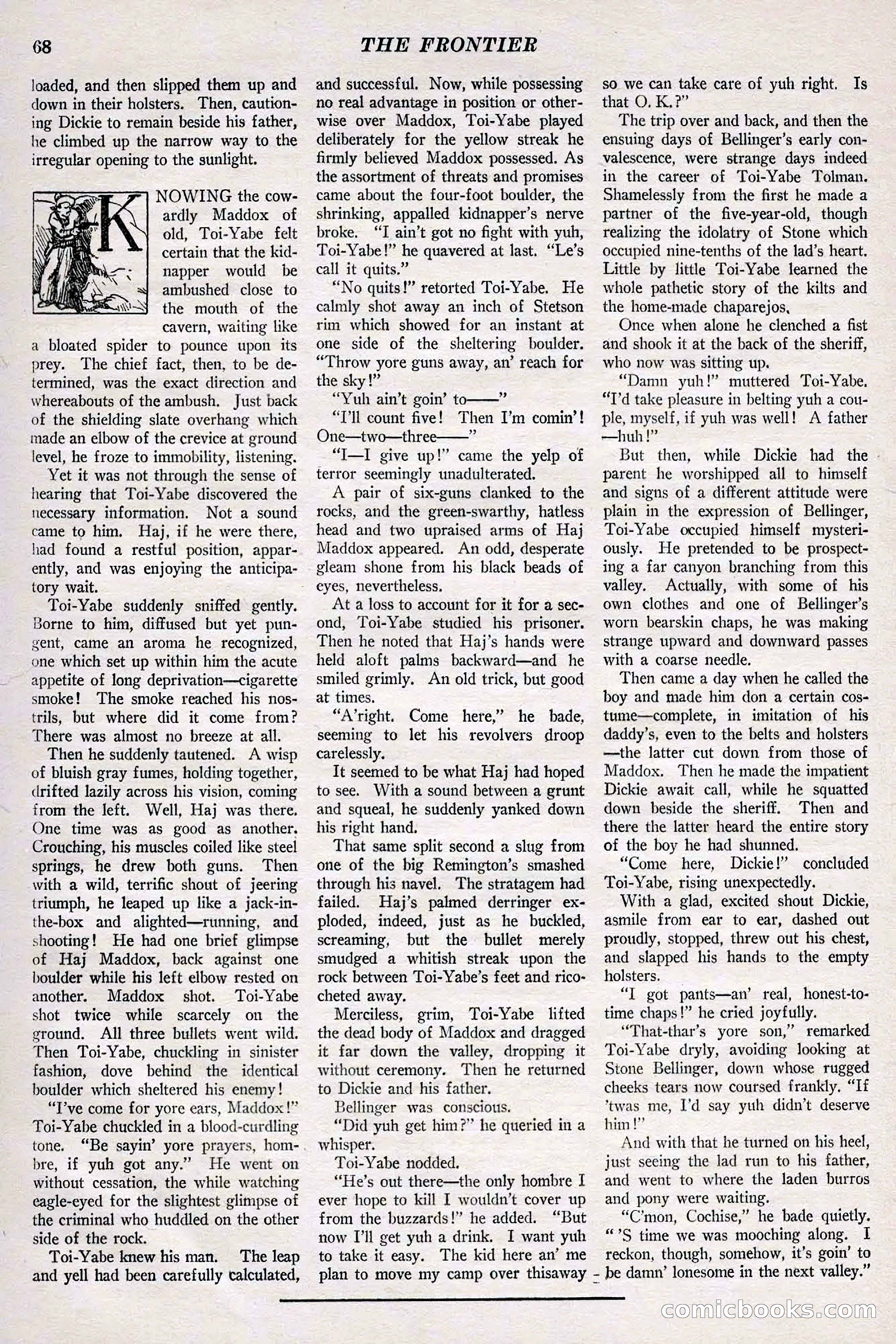
# Page 68 from "The Frontier" This page contains story prose with a decorative initial letter ("K") at the beginning. The narrative follows a character named Toi-Yabe during what appears to be a Western frontier conflict. The visible text depicts an ambush near a canyon, with gunfire between Toi-Yabe and an adversary named Haj Maddox. The passage describes the action of the confrontation, Toi-Yabe's tactical positioning, and subsequent dialogue where characters discuss their injuries and plans to move camp. The story involves themes of frontier survival, combat, and character relationships in what appears to be a hardboiled Western narrative.
📄 Transcribed text from this page (OCR, searchable)
Machine-transcribed from the original scan — historical spelling and the odd misread are preserved.
68 loaded, and then slipped them up and down in their holsters. Then, caution- ing Dickie to remain beside his father, he climbed up the narrow way to the irregular opening to the sunlight. - NOWING the cow- ardly Maddox of old, Toi-Yabe felt certain that the kid- napper would be ambushed close to the mouth of the cavern, waiting like a bloated spider to pounce upon its prey. The chief fact, then, to be de- termined, was the exact direction and whereabouts of the ambush. Just back of the shielding slate overhang which made an elbow of the crevice at ground level, he froze to immobility, listening. Yet it was not through the sense of hearing that Toi-Yabe discovered the necessary information. Not a sound came to him. Haj, if he were there, had found a restful position, appar- ently, and was enjoying the anticipa- tory wait. Toi-Yabe suddenly sniffed gently. Borne to him, diffused but yet pun- gent, came an aroma he recognized, one which set up within him the acute appetite of long deprivation—cigarette smoke! ‘The smoke reached his nos- trils, but where did it come from? There was almost no breeze at all. Then he suddenly tautened. A wisp of bluish gray fumes, holding together, drifted lazily across his vision, coming from the left. Well, Haj was there. One time was as good as another. Crouching, his muscles coiled like steel springs, he drew both guns. Then with a wild, terrific shout of jeering triumph, he leaped up like a jack-in- the-box and alighted—running, and shooting! He had one brief glimpse of Haj Maddox, back against one boulder while his left elbow rested on another. Maddox shot. Toi-Yabe shot twice while scarcely on the ground. All three bullets went wild. Then Toi-Yabe, chuckling in sinister fashion, dove behind the identical boulder which sheltered his enemy ! “T’ve come for yore ears, Maddox!” Toi-Yabe chuckled in a blood-curdling tone. “Be sayin’ yore prayers, hom- bre, if yuh got any.” He went on without cessation, the while watching eagle-eyed for the slightest glimpse of the criminal who huddled on the other side of the rock. Toi-Yabe knew his man. The leap and yell had been carefully calculated, THE FRONTIER and successful. Now, while possessing no real advantage in position or other- wise over Maddox, Toi-Yabe played deliberately for the yellow streak he firmly believed Maddox possessed. As the assortment of threats and promises came about the four-foot boulder, the shrinking, appalled kidnapper’s nerve broke. “I ain’t got no fight with yuh, Toi-Yabe!” he quavered at last. “Le’s call it quits.” “No quits!” retorted Toi-Yabe. He calmly shot away an inch of Stetson rim which showed for an instant at one side of the sheltering boulder. “Throw yore guns away, an’ reach for the sky!” “Yuh ain’t goin’ to——” “Tl count five! Then I’m comin’! One—two—three——” “I—I give up!” came the yelp of terror seemingly unadulterated. A pair of six-guns clanked to the rocks, and the green-swarthy, hatless head and two upraised arms of Haj Maddox appeared. An odd, desperate gleam shone from his black beads of - eyes, nevertheless. At a loss to account for it for a sec- ond, Toi-Yabe studied his prisoner. Then he noted that Haj’s hands were held aloft palms backward—and he smiled grimly. An old trick, but good at times. “A’right. Come here,” he bade, seeming to let his revolvers droop carelessly. It seemed to be what Haj had hoped to see. With a sound between a grunt and squeal, he suddenly yanked down his right hand. That same split second a slug from one of the big Remington’s smashed through his navel. The stratagem had failed. Haj’s palmed derringer ex- ploded, indeed, just as he buckled, screaming, but the bullet merely smudged a whitish streak upon the rock between Toi-Yabe’s feet and rico- cheted away. Merciless, grim, Toi-Yabe lifted the dead body of Maddox and dragged it far down the valley, dropping it without ceremony. Then he returned to Dickie and his father. Bellinger was conscious. “Did yuh get him?” he queried in a whisper. Toi-Yabe nodded. “He’s out there—the only hombre I ever hope to kill I wouldn’t cover up from the buzzards!” he added. “But now I'll get yuh a drink. I want yuh to take it easy. The kid here an’ me so we can take care of yuh right. Is that O. K.?” The trip over and back, and then the ensuing days of Bellinger’s early con- valescence, were strange days indeed in the career of Toi-Yabe Tolman. shamelessly from the first he made a partner of the five-year-old, though realizing the idolatry of Stone which occupied nine-tenths of the lad’s heart. Little by little Toi-Yabe learned the whole pathetic story of the kilts and the home-made chaparejos, Once when alone he clenched a fist and shook it at the back of the sheriff, who now was sitting up. “Damn yuh!” muttered Toi-Yabe. “T’d take pleasure in belting yuh a cou- ple, myself, if yuh was well! A father —huh!” But then, while Dickie had the - parent he worshipped all to himself and signs of a different attitude were plain in the expression of Bellinger, Toi-Yabe occupied himself mysteri- ously. He pretended to be prospect- ing a far canyon branching from this valley. Actually, with some of his own clothes and one of Bellinger’s worn bearskin chaps, he was making strange upward and downward passes with a coarse needle. Then came a day when he called the boy and made him don a certain cos- tume—complete, in imitation of his daddy’s, even to the belts and holsters —the latter cut down from those of Maddox. Then he made the impatient Dickie await call, while he squatted down beside the sheriff. Then and there the latter heard the entire story of the boy he had shunned. “Come here, Dickie!” concluded Toi-Yabe, rising unexpectedly, With a glad, excited shout Dickie, asmile from ear to ear, dashed out proudly, stopped, threw out his chest, and slapped his hands to the empty holsters. “I got pants—an’ real, honest-to- time chaps!” he cried joyfully. “That-thar’s yore son,” remarked Toi-Yabe dryly, avoiding looking at Stone Bellinger, down whose rugged cheeks tears now coursed frankly, “Ti ‘twas me, I’d say yuh didn’t deserve him !”’ And with that he turned on his heel, just seeing the lad run to his father, and went to where the laden burros and pony were waiting. “C'mon, Cochise,” he bade quietly. “’S time we was mooching along. 1 reckon, though, somehow, it’s goin’ to plan to move my camp over thisaway - be damn’ lonesome in the next valley.” Gomicbdoo <SriGOin