
Pulp Fiction, 1926 · page 56 of 114
The Frontier, May 1926 — page 56: what you’re looking at
What you’re looking at
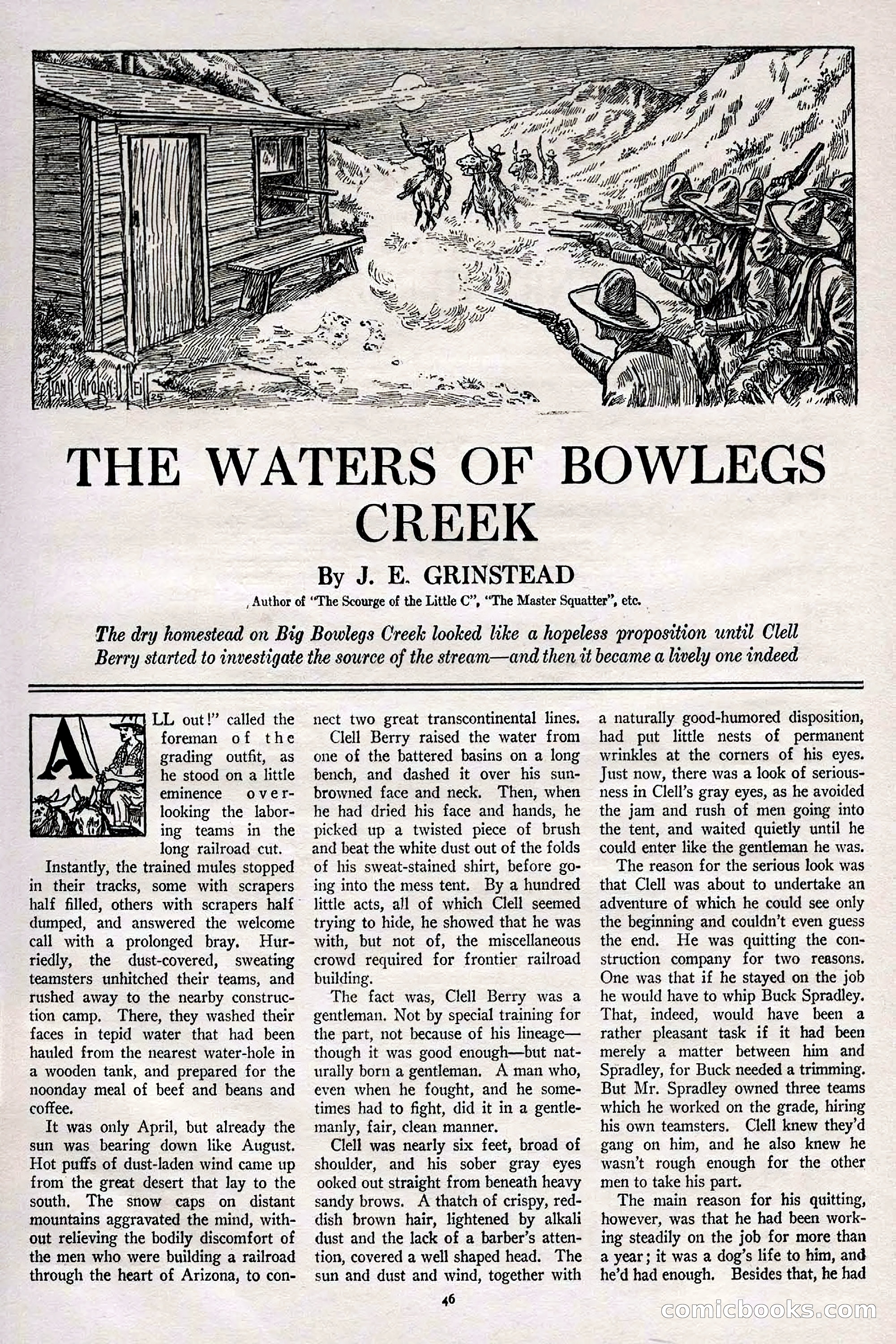
# "The Waters of Bowlegs Creek" This is the opening page of a short story by J. E. Grinstead, featuring an illustration at the top depicting a frontier scene with armed men, horses, and a cabin in a mountainous landscape under moonlight. The story begins by describing a dry homestead on Big Bowlegs Creek and introduces the character Clell Berry, a foreman for a railroad grading outfit. The text explains how Clell investigates the source of a stream and becomes involved in what promises to be an eventful adventure. The passage establishes a Western setting involving railroad construction through Arizona, establishing the hardboiled frontier tone typical of pulp fiction.
📄 Transcribed text from this page (OCR, searchable)
Machine-transcribed from the original scan — historical spelling and the odd misread are preserved.
x SSS S*s L ll} “<= SSS, bil 2 oy, : aT, Le, he ad a ¢ a 4Z, 7d 7S Eo iN Y “=. = | = — =— =» es = : are et 6 ‘ —r INT Sah ‘ 4 '] é * Ih ANNAN | | i \\ PENLETKR! \ \ oot. bes G ——— oe = = : Se ee : I i oe a sf " birt CALEY 4k ' SE y = ti Say Pe eee SS ee ee a ge SS SS=S = mS i/ 6 ~ Taj Ml oes) 7 Sto jane Ad Se My, op a LA ay Q ue 4 LZ a at oT) THE WATERS OF BOWLEGS CREEK By J. E. GRINSTEAD , Author of “The Scourge of the Little C”, “The Master Squatter”, ete. _ The dry homestead on Big Bowlegs Creek looked like a hopeless proposition until Clell Berry started to investigate the source of the stream—and then tt became a lively one indeed zu} LL out!” called the %s| foreman of the grading outfit, as he stood on a little eminence over- looking the labor- ing teams in the long railroad cut. Instantly, the trained mules stopped in their tracks, some with scrapers half filled, others with scrapers half— dumped, and answered the welcome call with a prolonged bray. Hur- riedly, the dust-covered, sweating teamsters unhitched their teams, and rushed away to the nearby construc- tion camp. There, they washed their faces in tepid water that had been hauled from the nearest water-hole in a wooden tank, and prepared for the noonday meal of beef and beans and coffee. It was only April, but already the sun was bearing down like August. Hot puffs of dust-laden wind came up from the great desert that Jay to the south, The snow caps on distant mountains aggravated the mind, with- out relieving the bodily discomfort of the men who were building a railroad through the heart of Arizona, to con- nect two great transcontinental lines. Clell Berry raised the water from one of the battered basins on a long bench, and dashed it over his sun- browned face and neck. Then, when he had dried his face and hands, he picked up a twisted piece of brush and beat the white dust out of the folds of his sweat-stained shirt, before go- ing into the mess tent. By a hundred little acts, all of which Clell seemed trying to hide, he showed that he was with, but not of, the miscellaneous crowd required for frontier railroad building. The fact was, Clell Berry was a gentleman. Not by special training for the part, not because of his lineage— though it was good enough—but nat- urally born a gentleman. A man who, even when he fought, and he some- times had to fight, did it in a gentle- manly, fair, clean manner. Clell was nearly six feet, broad of shoulder, and his sober gray eyes ooked out straight from beneath heavy sandy brows. A thatch of crispy, red- dish brown hair, lightened by alkali dust and the lack of a barber’s atten- tion, covered a well shaped head. The sun and dust and wind, together with 46 a naturally good-humored disposition, had put little nests of permanent wrinkles at the corners of his eyes. Just now, there was a look of serious- ness in Clell’s gray eyes, as he avoided the jam and rush of men going into the tent, and waited quietly until he could enter like the gentleman he was. The reason for the serious look was that Clell was about to undertake an adventure of which he could see only the beginning and couldn't even guess the end. He was quitting the con- struction company for two reasons. One was that if he stayed on the job he would have to whip Buck Spradley. That, indeed, would have been a rather pleasant task if it had been merely a matter between him and Spradley, for Buck needed a trimming. But Mr. Spradley owned three teams which he worked on the grade, hiring his own teamsters. Clell knew they'd gang on him, and he also knew he wasn’t rough enough for the other men to take his part. The main reason for his quitting, however, was that he had been work- ing steadily on the job for more than a year; it was a dog’s life to him, and he’d had enough. Besides that, he had CoOnniclooo® <SEiGOiM