
Pulp Fiction, 1926 · page 91 of 114
The Frontier, May 1926 — page 91: what you’re looking at
What you’re looking at
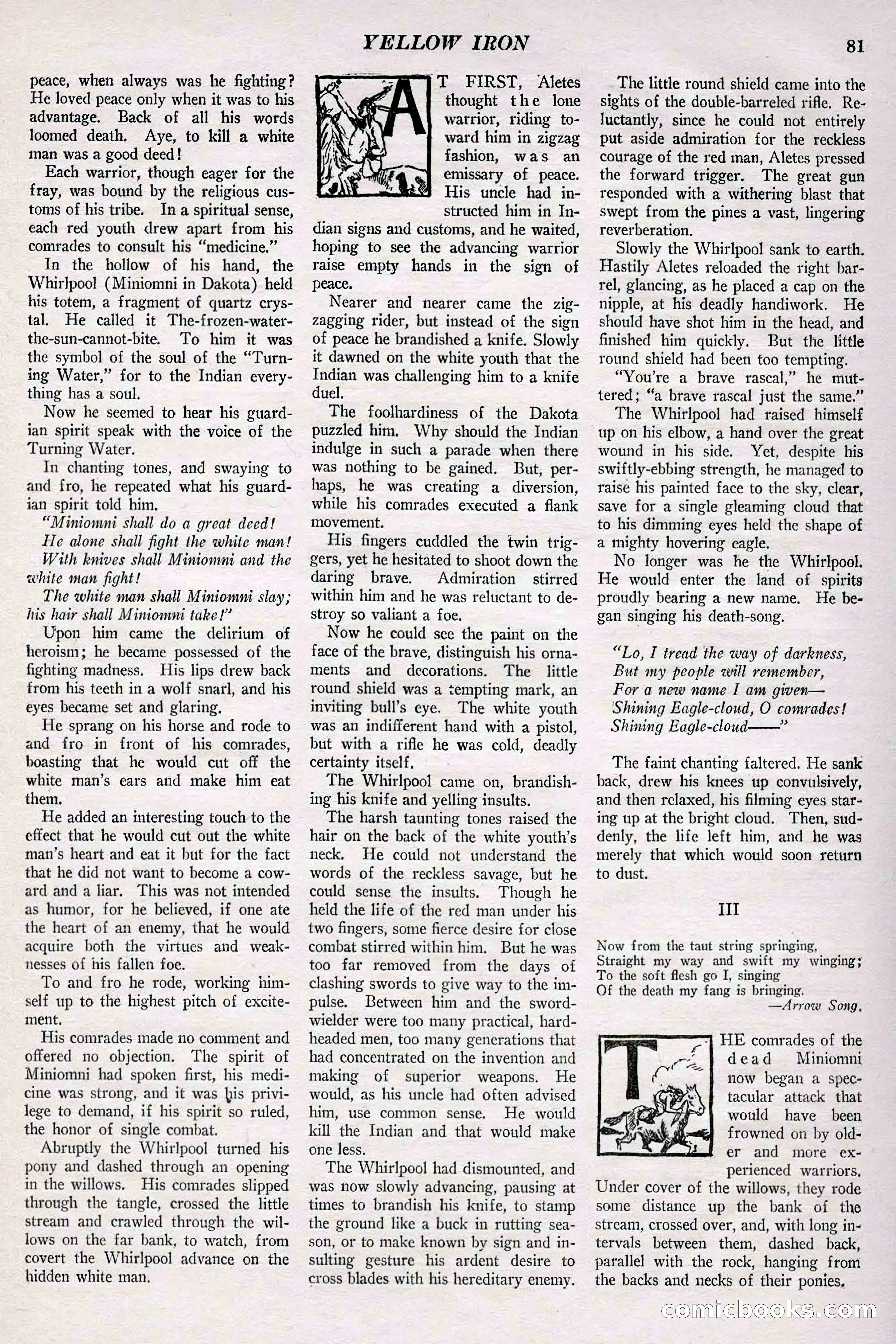
# Page Analysis This is a story prose page from a pulp magazine titled "Yellow Iron" (page 81). The text depicts a Native American warrior named Aletes engaging in combat with a white soldier, with the warrior initially hesitating before attacking despite his comrades' encouragement. The page includes Aletes's death song and spiritual reflections as he faces defeat. There are two small decorative illustrations—one at the top showing a warrior's face in profile, and another midway down showing what appears to be a fallen warrior. The narrative explores themes of honor, warfare, and indigenous spirituality during what appears to be a frontier conflict.
📄 Transcribed text from this page (OCR, searchable)
Machine-transcribed from the original scan — historical spelling and the odd misread are preserved.
peace, when always was he fighting? He loved peace only when it was to his advantage. Back of all his words loomed death. Aye, to kill a white man was a good deed! Each warrior, though eager for the fray, was bound by the religious cus- toms of his tribe. In a spiritual sense, each red youth drew apart from his comrades to consult his “medicine.” In the hollow of his hand, the Whirlpool (Miniomni in Dakota) held his totem, a fragment of quartz crys- tal. He called it The-frozen-water- the-sun-cannot-bite. To him it was the symbol of the soul of the “Turn- ing Water,” for to the Indian every- thing has a soul. Now he seemed to hear his guard- lan spirit speak with the voice of the Turning Water. In chanting tones, and swaying to and fro, he repeated what his guard- ian spirit told him. “Miniomni shall do a great deed! He alone shall fight the white man! With knives shall Miniomni and the white man fight! The white man shall Miniomni slay; his hair shall Miniomni take!” Upon him came the delirium of heroism; he became possessed of the fighting madness. His lips drew back from his teeth in a wolf snarl, and his eyes became set and glaring, He sprang on his horse and rode to and fro in front of his comrades, boasting that he would cut off the white man’s ears and make him eat them. He added an interesting touch to the effect that he would cut out the white man’s heart and eat it but for the fact that he did not want to become a cow- ard and a liar. This was not intended as humor, for he believed, if one ate the heart of an enemy, that he would acquire both the virtues and weak- nesses of his fallen foe. To and fro he rode, working him- self up to the highest pitch of excite- ment, His comrades made no comment and offered no objection. The spirit of Miniomni had spoken first, his medi- cine was strong, and it was bis privi- lege to demand, if his spirit so ruled, the honor of single combat. Abruptly the Whirlpool turned his pony and dashed through an opening in the willows. His comrades slipped through the tangle, crossed the little stream and crawled through the wil- lows on the far bank, to watch, from covert the Whirlpool advance on the hidden white man. YELLOW IRON 11 FIRST, Aletes thought the lone watrior, riding to- ward him in zigzag fashion, was an emissary of peace. His uncle had in- structed him in In- dian signs and customs, and he waited, hoping to see the advancing warrior raise empty hands in the sign of peace. Nearer and nearer came the zig- zagging rider, but instead of the sign of peace he brandished a knife. Slowly it dawned on the white youth that the Indian was challenging him to a knife duel. The foolhardiness of the Dakota puzzled him. Why should the Indian indulge in such a parade when there was nothing to be gained. But, per- haps, he was creating a diversion, while his comrades executed a flank movement. Flis fingers cuddled the twin trig- gers, yet he hesitated to shoot down the daring brave. Admiration — stirred within him and he was reluctant to de- stroy so valiant a foe. Now he could see the paint on the face of the brave, distinguish his orna- ments and decorations. The little round shield was a tempting mark, an inviting bull’s eye. The white youth was an indifferent hand with a pistol, but with a rifle he was cold, deadly certainty itself, The Whirlpool came on, brandish- ing his knife and yelling insults. The harsh taunting tones raised the hair on the back of the white youth’s neck, He could not understand the words of the reckless savage, but he could sense the insults. Though he held the life of the red man under his two fingers, some fierce desire for close combat stirred within him. But he was too far removed from the days of clashing swords to give way to the im- pulse. Between him and the sword- wielder were too many practical, hard- headed men, too many generations that had concentrated on the invention and making of superior weapons. He would, as his uncle had often advised him, use common sense. He would kill the Indian and that would make one less. The Whirlpool had dismounted, and was now slowly advancing, pausing at times to brandish his knife, to stamp the ground like a buck in rutting sea- son, or to make known by sign and in- sulting gesture his ardent desire to cross blades with his hereditary enemy. 81 The little round shield came into the sights of the double-barreled rifle. Re- luctantly, since he could not entirely put aside admiration for the reckless courage of the red man, Aletes pressed the forward trigger. The great gun responded with a withering blast that swept from the pines a vast, lingering reverberation. Slowly the Whirlpool sank to earth. Hastily Aletes reloaded the right bar- rel, glancing, as he placed a cap on the nipple, at his deadly handiwork. He should have shot him in the head, and finished him quickly. But the little round shield had been too tempting. “You’re a brave rascal,” he mut- tered; “a brave rascal just the same.” The Whirlpool had raised himself up on his elbow, a hand over the great wound in his side. Yet, despite his swiftly-ebbing strength, he managed to raise his painted face to the sky, clear, save for a single gleaming cloud that to his dimming eyes held the shape of a mighty hovering eagle. No longer was he the Whirlpool. He would enter the land of spirits proudly bearing a new name. He be- gan singing his death-song. “Lo, I tread the way of darkness, But my people will remember, For a new name I am given— Shining Eagle-cloud, O comrades! Shining Eagle-clond——” The faint chanting faltered. He sank back, drew his knees up convulsively, and then relaxed, his filming eyes star- ing up at the bright cloud. Then, sud- denly, the life left him, and he was merely that which would soon return to dust. iil Now from the taut string springing, Straight my way and swift my winging; To the soft flesh go I, singing Of the death my fang is bringing. —Arrow Song. 7 HE comrades of the ; dead Muiniomni now began a spec- tacular attack that would have been frowned on by old- er and more ex- perienced warriors, Under cover of the willows, they rode some distance up the bank of the stream, crossed over, and, with long in- tervals between them, dashed back, parallel with the rock, hanging from the backs and necks of their ponies, GOMmiGcdooks COLM