
Pulp Fiction, 1926 · page 68 of 114
The Frontier, May 1926 — page 68: what you’re looking at
What you’re looking at
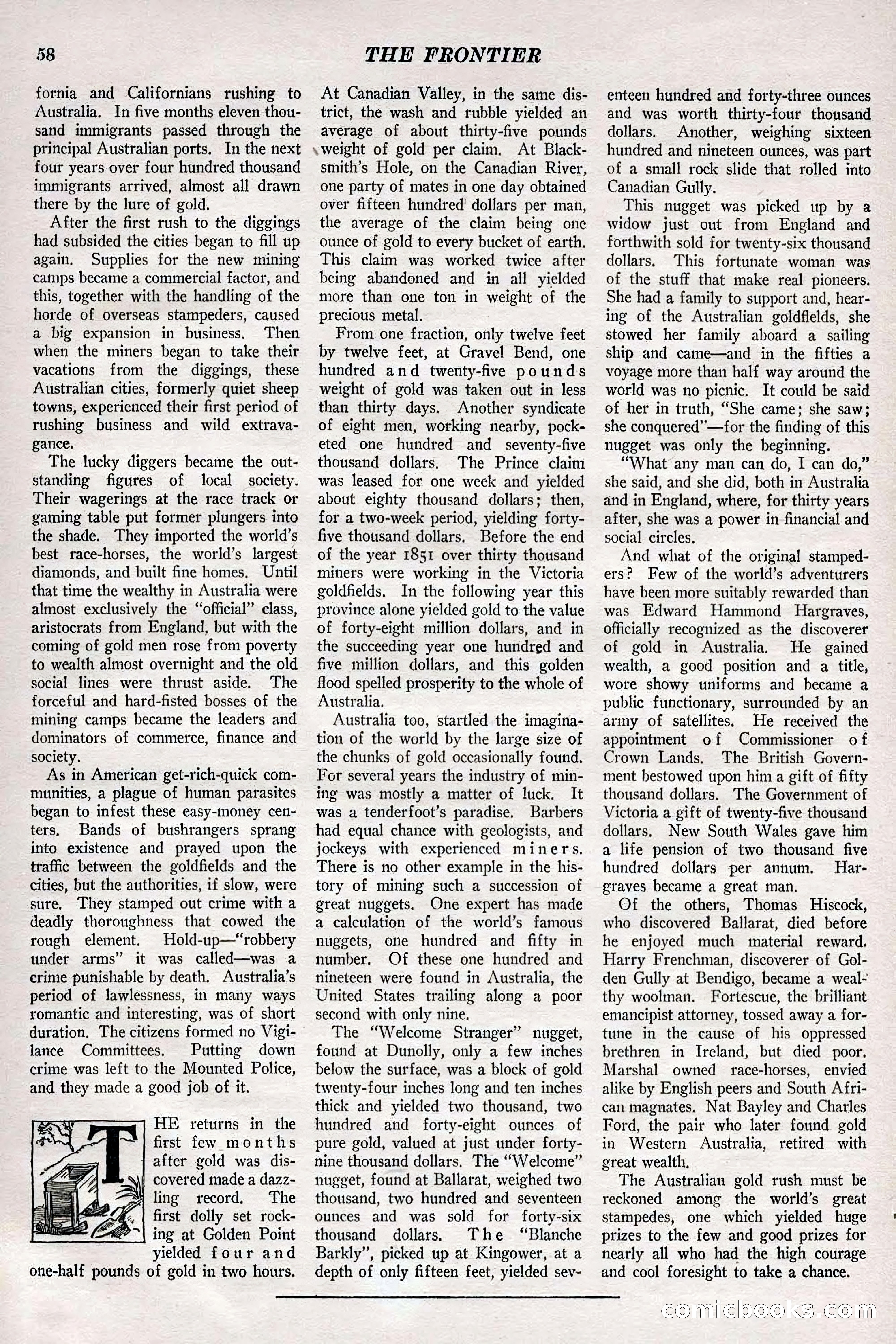
This is a page of story prose from *The Frontier* magazine (page 58). The text describes the Australian gold rush of the 1850s, detailing how discoveries of gold nuggets attracted immigrants and transformed Australian society and economy. The narrative focuses on specific large nuggets found—including the "Welcome Stranger," "Blanche Barkly," and nuggets discovered by Edward Hargraves—and their values in dollars. The passage also mentions how gold discoveries disrupted the social order by elevating poor miners to wealth and prominence, and notes government rewards given to notable discoverers. A small decorative illustration appears in the lower left corner.
📄 Transcribed text from this page (OCR, searchable)
Machine-transcribed from the original scan — historical spelling and the odd misread are preserved.
38 fornia and Californians rushing to Australia. In five months eleven thou- sand immigrants passed through the principal Australian ports. In the next four years over four hundred thousand immigrants arrived, almost all drawn there by the lure of gold. After the first rush to the diggings had subsided the cities began to fill up again. Supplies for the new mining camps became a commercial factor, and this, together with the handling of the horde of overseas stampeders, caused a big expansion in business. Then when the miners began to take their vacations from the diggings, these Australian cities, formerly quiet sheep towns, experienced their first period of rushing business and wild extrava- gance. The lucky diggers became the out- standing figures of local society. Their wagerings at the race track or gaming table put former plungers into the shade. They imported the world’s best race-horses, the world’s largest diamonds, and built fine homes. Until that time the wealthy in Australia were almost exclusively the “official” class, aristocrats from England, but with the coming of gold men rose from poverty to wealth almost overnight and the old social lines were thrust aside, The forceful and hard-fisted bosses of the mining camps became the leaders and dominators of commerce, finance and society. As in American get-rich-quick com- munities, a plague of human parasites began to infest these easy-money cen- ters. Bands of bushrangers sprang into existence and prayed upon the traffic between the goldfields and the cities, but the authorities, if slow, were sure, They stamped out crime with a deadly thoroughness that cowed the rough element. Hold-up—‘robbery under arms” it was called—was a crime punishable by death. Australia’s period of lawlessness, in many ways romantic and interesting, was of short duration. The citizens formed no Vigi- lance Committees. Putting down crime was left to the Mounted Police, and they made a good job of it. HE returns in the first few months after gold was dis- \\j covered made a dazz- Sling record, The | first dolly set rock- ’™\ ing at Golden Point yielded four and one-half pounds of gold in two hours. THE FRONTIER At Canadian Valley, in the same dis- trict, the wash and rubble yielded an average of about thirty-five pounds .weight of gold per claim. At Black- smith’s Hole, on the Canadian River, one party of mates in one day obtained over fifteen hundred dollars per man, the average of the claim being one ounce of gold to every bucket of earth. This claim was worked twice after being abandoned and in all yielded more than one ton in weight of the precious metal. From one fraction, only twelve feet by twelve feet, at Gravel Bend, one hundred and twenty-five pounds weight of gold was taken out in less than thirty days. Another syndicate of eight men, working nearby, pock- eted one hundred and _ seventy-five thousand dollars. The Prince claim was leased for one week and yielded about eighty thousand dollars; then, for a two-week period, yielding forty- five thousand dollars. Before the end of the year 1851 over thirty thousand miners were working in the Victoria goldfields. In the following year this province alone yielded gold to the value of forty-eight million dollars, and in the succeeding year one hundred and five million dollars, and this golden flood spelled prosperity to the whole of Australia. Australia too, startled the imagina- tion of the world by the large size of the chunks of gold occasionally found. For several years the industry of min- ing was mostly a matter of luck. It was a tenderfoot’s paradise. Barbers had equal chance with geologists, and jockeys with experienced miners. There is no other example in the his- tory of mining such a succession of great nuggets. One expert has made a calculation of the world’s famous nuggets, one hundred and fifty in number. Of these one hundred and nineteen were found in Australia, the United States trailing along a poor second with only nine. The “Welcome Stranger” nugget, found at Dunolly, only a few inches below the surface, was a block of gold twenty-four inches long and ten inches thick and yielded two thousand, two hundred and forty-eight ounces of pure gold, valued at just under forty- nine thousand dollars. The “Welcome” nugget, found at Ballarat, weighed two thousand, two hundred and seventeen ounces and was sold for forty-six thousand dollars. The “Blanche Barkly”, picked up at Kingower, at a depth of only fifteen feet, yielded sev- enteen hundred and forty-three ounces and was worth thirty-four thousand dollars. Another, weighing sixteen hundred and nineteen ounces, was part of a small rock slide that rolled into Canadian Gully. This nugget was picked up by a widow just out from England and forthwith sold for twenty-six thousand dollars. This fortunate woman was of the stuff that make real pioneers, She had a family to support and, hear- ing of the Australian goldflelds, she stowed her family aboard a sailing ship and came—and in the fifties a voyage more than half way around the world was no picnic. It could be said of her in truth, “She came; she saw; she conquered’’—for the finding of this nugget was only the beginning. “What any man can do, I can do,” she said, and she did, both in Australia and in England, where, for thirty years after, she was a power in financial and social circles, And what of the original stamped- ers? Few of the world’s adventurers have been more suitably rewarded than was Edward Hammond Hargraves, Officially recognized as the discoverer of gold in Australia. He gained wealth, a good position and a title, wore showy uniforms and became a public functionary, surrounded by an army of satellites. He received the appointment of Commissioner o f Crown Lands. The British Govern- ment bestowed upon him a gift of fifty thousand dollars. The Government of Victoria a gift of twenty-five thousand dollars. New South Wales gave him a life pension of two thousand five hundred dollars per annum. Har- graves became a great man. Of the others, Thomas Hiscock, who discovered Ballarat, died before he enjoyed much material reward. Harry Frenchman, discoverer of Gol- den Gully at Bendigo, became a weal- thy woolman. Fortescue, the brilliant emancipist attorney, tossed away a for- tune in the cause of his oppressed brethren in Ireland, but died poor. Marshal owned race-horses, envied alike by English peers and South A fri- can magnates. Nat Bayley and Charles Ford, the pair who later found gold in Western Australia, retired with great wealth. The Australian gold rush must be reckoned among the world’s great stampedes, one which yielded huge prizes to the few and good prizes for nearly all who had the high courage and cool foresight to take a chance. SaCOnnl CONnniclooo