
Pulp Fiction, 1926 · page 88 of 114
The Frontier, May 1926 — page 88: what you’re looking at
What you’re looking at
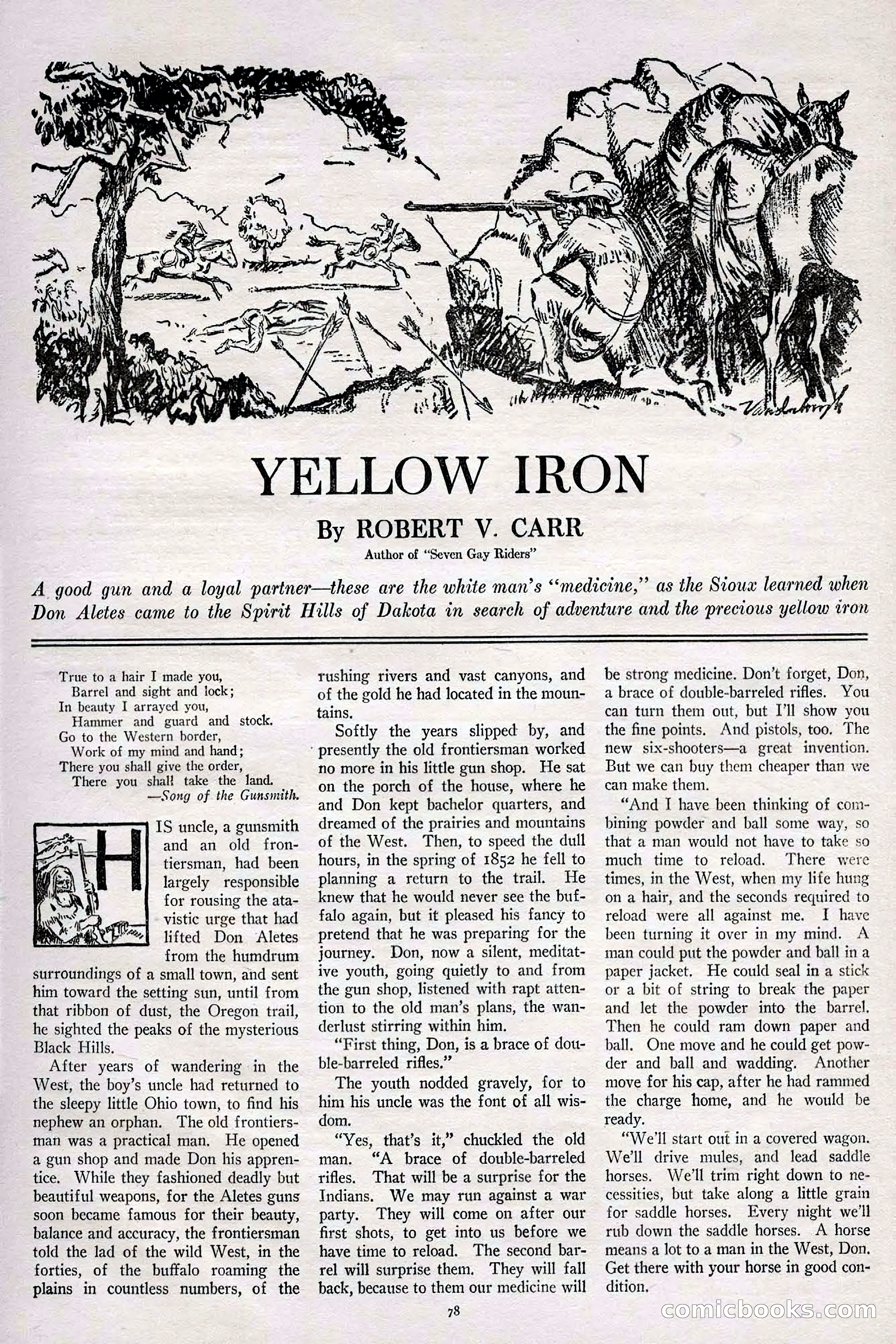
# Yellow Iron by Robert V. Carr This is a story opening page from an early pulp magazine featuring both an illustration and prose text. The illustration depicts a Western frontier scene with armed figures, horses, and what appears to be a gunfight or tense standoff. The story, by Robert V. Carr (author of "Seven Gay Riders"), concerns Don Aletes seeking a valuable yellow iron (likely gold) in the Spirit Hills of Dakota. An old gunsmith uncle mentors the young protagonist, teaching him to manufacture firearms and prepare for a journey westward. The narrative emphasizes frontier adventure, weapons craftsmanship, and the dangers of the Old West.
📄 Transcribed text from this page (OCR, searchable)
Machine-transcribed from the original scan — historical spelling and the odd misread are preserved.
YELLOW IRON By ROBERT V. CARR Author of “Seven Gay Riders” A good gun and a loyal partner—these are the white man’s “medicine,” as the Sioux learned when Don Aletes came to the Spirit Hills of Dakota in search of adventure and the precious yellow iron True to a hair I made you, Barrel and sight and lock; In beauty I arrayed you, Hammer and guard and _ stock. Go to the Western border, Work of my mind and hand; There you shall give the order, There you shal! take the land. —Song of the Gunsmith. IS uncle, a gunsmith and an old fron- tiersman, had been largely responsible for rousing the ata- vistic urge that had lifted Don Aletes from the humdrum surroundings of a small town, and sent him toward the setting sun, until from that ribbon of dust, the Oregon trail, he sighted the peaks of the mysterious Black Hills. After years of wandering in the West, the boy’s uncle had returned to the sleepy little Ohio town, to find his nephew an orphan. The old frontiers- man was a practical man. He opened a gun shop and made Don his appren- tice. While they fashioned deadly but beautiful weapons, for the Aletes guns soon became famous for their beauty, balance and accuracy, the frontiersman told the lad of the wild West, in the forties, of the buffalo roaming the plains in countless numbers, of the rushing rivers and vast canyons, and of the gold he had located in the moun- tains. Softly the years slipped by, and ‘ presently the old frontiersman worked no more in his little gun shop. He sat on the porch of the house, where he and Don kept bachelor quarters, and dreamed of the prairies and mountains of the West. Then, to speed the dull hours, in the spring of 1852 he fell to planning a return to the trail. He knew that he would never see the buf- falo again, but it pleased his fancy to pretend that he was preparing for the journey. Don, now a silent, meditat- ive youth, going quietly to and from the gun shop, listened with rapt atten- tion to the old man’s plans, the wan- derlust stirring within him. “First thing, Don, is a brace of dou- ble-barreled rifles.” The youth nodded gravely, for to him his uncle was the font of all wis- dom. “Yes, that’s it,” chuckled the old man. “A brace of double-barreled rifles. That will be a surprise for the Indians. We may run against a war party. They will come on after our first shots, to get into us before we have time to reload. The second bar- rel will surprise them, They will fall back, because to them our medicine will 78 be strong medicine. Don’t forget, Don, a brace of double-barreled rifles. You can turn them out, but I'll show you the fine points. And pistols, too. The new six-shooters—a great invention. But we can buy them cheaper than we can make them. “And I have been thinking of com- bining powder and ball some way, so that a man would not have to take so much time to reload. There were times, in the West, when my life hung on a hair, and the seconds required to reload were all against me. [ have been turning it over in my mind. A man could put the powder and ball in a paper jacket. He could seal in a stick or a bit of string to break the paper and let the powder into the barrel, Then he could ram down paper and ball. One move and he could get pow- der and ball and wadding. Another move for his cap, after he had rammed the charge home, and he would be ready. “We'll start out in a covered wagon. We'll drive mules, and lead saddle horses. We'll trim right down to ne- cessities, but take along a little grain for saddle horses. Every night we'll rub down the saddle horses. A horse means a lot to a man in the West, Don. Get there with your horse in good con- dition, GOmMiIiGchdoo SaCOwnn