
Pulp Fiction, 1926 · page 49 of 114
The Frontier, May 1926 — page 49: what you’re looking at
What you’re looking at
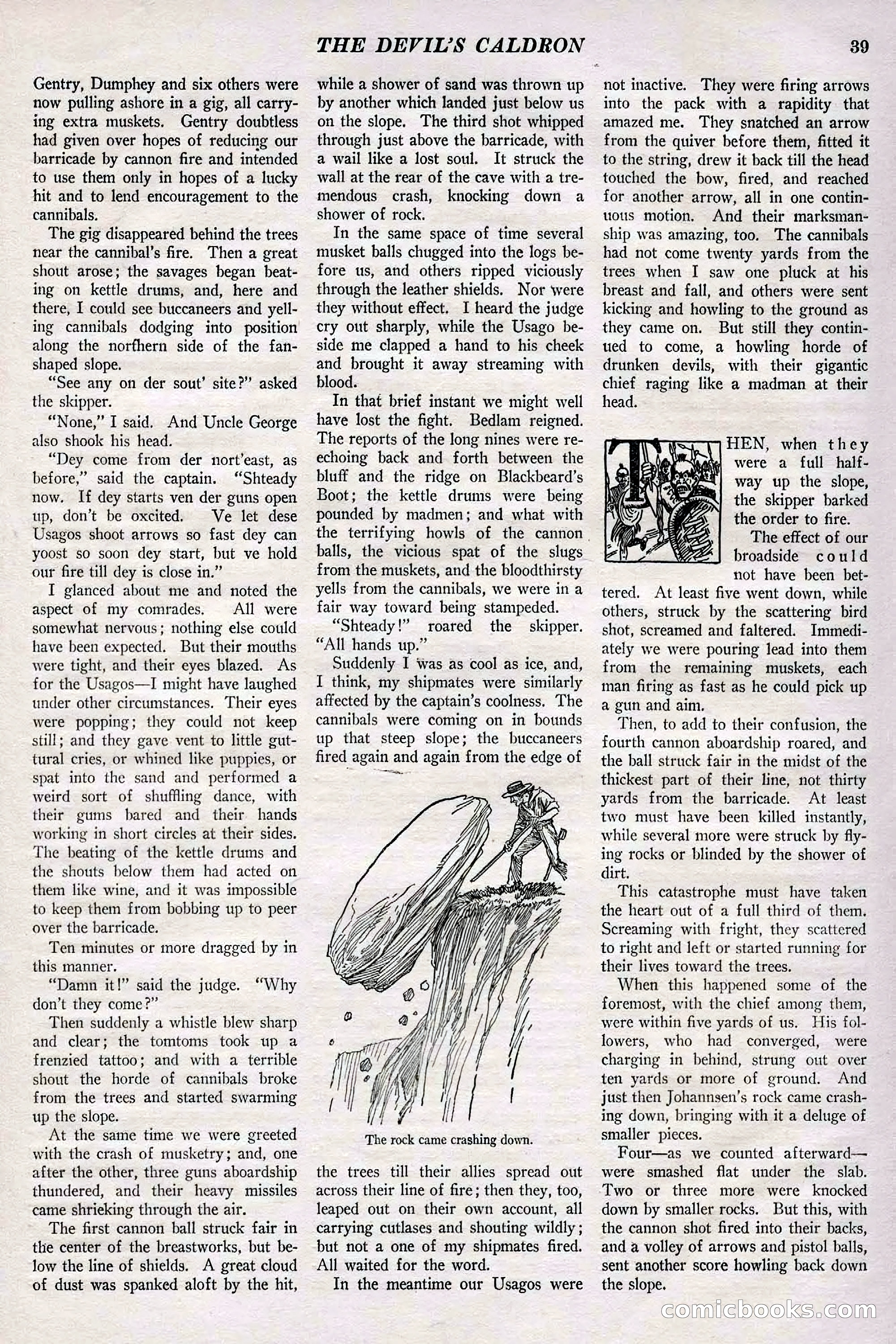
# Page Analysis This is page 39 of story prose from a pulp fiction magazine titled "The Devil's Caldron." The text describes an intense battle scene where characters (apparently sailors or military personnel) are defending a barricade against attacking forces. The passage details cannon fire, musket shots, arrows, and hand-to-hand combat on a slope, with vivid descriptions of casualties and the chaos of battle. A small illustration appears mid-page showing what appears to be a figure falling or being thrown. The narrative emphasizes the rapid succession of attacks, the effectiveness of the defenders' weapons, and the mounting casualties on both sides of the conflict.
📄 Transcribed text from this page (OCR, searchable)
Machine-transcribed from the original scan — historical spelling and the odd misread are preserved.
Gentry, Dumphey and six others were now pulling ashore in a gig, all carry- ing extra muskets. Gentry doubtless had given over hopes of reducing our barricade by cannon fire and intended to use them only in hopes of a lucky hit and to lend encouragement to the cannibals. The gig disappeared behind the trees near the cannibal’s fire. Then a great shout arose; the savages began beat- ing on kettle drums, and, here and there, I could see buccaneers and yell- ing cannibals dodging into position along the norfhern side of the fan- shaped slope. “See any on der sout’ site?’ asked the skipper. “None,” I said. And Uncle George also shook his head. “Dey come from der nort’east, as before,” said the captain. “Shteady now. If dey starts ven der guns open up, don’t be oxcited. Ve let dese Usagos shoot arrows so fast dey can yoost so soon dey start, but ve hold our fire till dey is close in.” I glanced about me and noted the aspect of my comrades. All were somewhat nervous; nothing else could have been expected. But their mouths were tight, and their eyes blazed. As for the Usagos—I might have laughed under other circumstances. Their eyes were popping; they could not keep still; and they gave vent to little gut- tural cries, or whined like puppies, or spat into the sand and performed a weird sort of shuffling dance, with their gums bared and their hands working in short circles at their sides. The beating of the kettle drums and the shouts below them had acted on them like wine, and it was impossible to keep them from bobbing up to peer over the barricade. Ten minutes or more dragged by in this manner. “Damn it!” said the judge. “Why don’t they come?” Then suddenly a whistle blew sharp and clear; the tomtoms took up a frenzied tattoo; and with a terrible shout the horde of cannibals broke from the trees and started swarming up the slope. At the sane time we were greeted with the crash of musketry; and, one after the other, three guns aboardship thundered, and their heavy missiles came shrieking through the air. The first cannon ball struck fair in the center of the breastworks, but be- low the line of shields. A great cloud of dust was spanked aloft by the hit, THE DEVIL'S CALDRON while a shower of sand was thrown up by another which landed just below us on the slope. The third shot whipped through just above the barricade, with a wail like a lost soul. It struck the wall at the rear of the cave with a tre- mendous crash, knocking down a shower of rock. In the same space of time several musket balls chugged into the logs be- fore us, and others ripped viciously through the leather shields. Nor were they without effect. I heard the judge cry out sharply, while the Usago be- side me clapped a hand to his cheek and brought it away streaming with blood. In that brief instant we might well have lost the fight. Bedlam reigned. The reports of the long nines were re- echoing back and forth between the bluff and the ridge on Blackbeard’s Boot; the kettle drums were being pounded by madmen; and what with the terrifying howls of the cannon. balls, the vicious spat of the slugs from the muskets, and the bloodthirsty yells from the cannibals, we were in a fair way toward being stampeded. “Shteady!” roared the skipper. “All hands up.” Suddenly I was as cool as ice, and, I think, my shipmates were similarly affected by the captain’s coolness. The cannibals were coming on in bounds up that steep slope; the buccaneers fired again and again from the edge of The rock came crashing down. the trees till their allies spread out across their line of fire; then they, too, leaped out on their own account, all carrying cutlases and shouting wildly; but not a one of my shipmates fired. All waited for the word. In the meantime our Usagos were 39 not inactive. They were firing arrows into the pack with a rapidity that amazed me. They snatched an arrow from the quiver before them, fitted it to the string, drew it back till the head touched the bow, fired, and reached for another arrow, all in one contin- uous motion. And their marksman- ship was amazing, too. The cannibals had not come twenty yards from the trees when I saw one pluck at his breast and fall, and others were sent kicking and howling to the ground as they came on. But still they contin- ued to come, a howling horde of drunken devils, with their gigantic chief raging like a madman at their head. HEN, when they were a full half- way up the slope, the skipper barked the order to fire. The effect of our broadside could not have been bet- tered. At least five went down, while others, struck by the scattering bird shot, screamed and faltered. Immedi- ately we were pouring lead into them from the remaining muskets, each man firing as fast as he could pick up a gun and aim. Then, to add to their confusion, the fourth cannon aboardship roared, and the ball struck fair in the midst of the thickest part of their line, not thirty yards from the barricade. At least two must have been killed instantly, while several more were struck by fly- ing rocks or blinded by the shower of dirt. This catastrophe must have taken the heart out of a full third of them. Screaming with fright, they scattered to right and left or started running for their lives toward the trees. When this happened some of the foremost, with the chief among them, were within five yards of us. His fol- lowers, who had converged, were charging in behind, strung out over ten yards or more of ground. And just then Johannsen’s rock came crash- ing down, bringing with it a deluge of smaller pieces. Four—as we counted afterward— were smashed flat under the slab. Two or three more were knocked down by smaller rocks. But this, with the cannon shot fired into their backs, and a volley of arrows and pistol balls, sent another score howling back down the slope. Gomi VOO| KS CO @)