
Pulp Fiction, 1926 · page 59 of 114
The Frontier, May 1926 — page 59: what you’re looking at
What you’re looking at
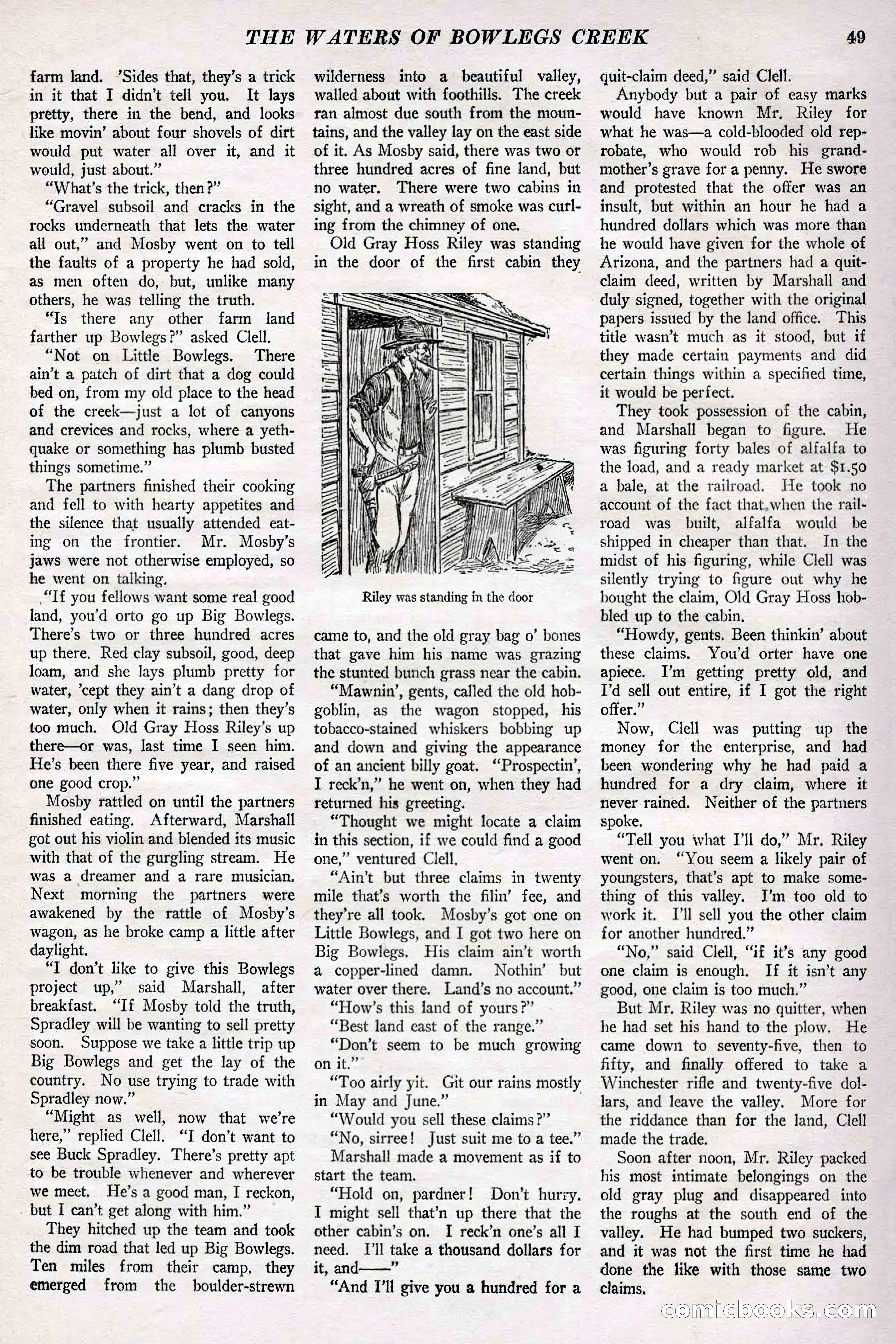
# Page Analysis: "The Waters of Bowlegs Creek" This is a **story prose page with an embedded illustration**. The page shows the continuation of a narrative about frontier land claims and disputes. A black-and-white illustration depicts an old man (identified in the text as Riley) standing in a cabin doorway beside an aged horse. The visible text concerns characters discussing the acquisition and valuation of land claims in what appears to be the American West. Characters named Clell, Marshall, Mosby, and Mr. Riley debate the worth of various claims, with Riley ultimately offering to sell his claim and leave the valley for a sum of money. The dialogue suggests themes of frontier settlement and land disputes, typical of pulp-fiction Western stories from the early 20th century.
📄 Transcribed text from this page (OCR, searchable)
Machine-transcribed from the original scan — historical spelling and the odd misread are preserved.
THE WATERS OF BOWLEGS CREEK farm land. ’Sides that, they’s a trick in it that I didn’t tell you. It lays pretty, there in the bend, and looks like movin’ about four shovels of dirt would put water all over it, and it would, just about.” “What’s the trick, then?’ “Gravel subsoil and cracks in the rocks underneath that lets the water all out,” and Mosby went on to tell the faults of a property he had sold, as men often do, but, unlike many others, he was telling the truth. “Is there any other farm land farther up Bowlegs?” asked Clell. “Not on Little Bowlegs. There ain’t a patch of dirt that a dog could bed on, from my old place to the head of the creek—just a lot of canyons and crevices and rocks, where a yeth- quake or something has plumb busted things sometime.” The partners finished their cooking and fell to with hearty appetites and the silence that usually attended eat- ing on the frontier. Mr. Mosby’s jaws were not otherwise employed, so he went on talking. “T£ you fellows want some real good land, you'd orto go up Big Bowlegs. There’s two or three hundred acres up there. Red clay subsoil, good, deep loam, and she lays plumb pretty for water, ‘cept they ain’t a dang drop of water, only when it rains; then they’s too much. Old Gray Hoss Riley’s up there—or was, last time I seen him. He’s been there five year, and raised one good crop.” Mosby rattled on until the partners finished eating. Afterward, Marshall got out his violin and blended its music with that of the gurgling stream. He was a dreamer and a rare musician. Next morning the partners were awakened by the rattle of Mosby’s wagon, as he broke camp a little after daylight. “I don’t like to give this Bowlegs project up,’ said Marshall, after breakfast. “If Mosby told the truth, Spradley will be wanting to sell pretty soon. Suppose we take a little trip up Big Bowlegs and get the lay of the country. No use trying to trade with Spradley now.” “Might as well, now that we're here,” replied Clell, “I don’t want to see Buck Spradley. There’s pretty apt to be trouble whenever and wherever we meet, He’s a good man, I reckon, - but I can’t get along with him.” They hitched up the team and took the dim road that led up Big Bowlegs. Ten miles from their camp, they emerged from the boulder-strewn wilderness into a beautiful valley, walled about with foothills. The creek ran almost due south from the moun- tains, and the valley lay on the east side of it, As Mosby said, there was two or three hundred acres of fine land, but no water. There were two cabins in sight, and a wreath of smoke was curl- ing from the chimney of one. Old Gray Hoss Riley was standing in the door of the first cabin they Wty] rill Th } A ———— ANON | ht ’ : | Tas > ANA Ll ZZ ANI <2 Zz) “i WN ee PSS fa ' HA } =-- —Sa XY Riley was standing in the door came to, and the old gray bag o’ bones that gave him his name was grazing the stunted bunch grass near the cabin. “Mawnin’, gents, called the old hob- goblin, as the wagon stopped, his tobacco-stained whiskers bobbing up and down and giving the appearance of an ancient billy goat. “Prospectin’, I reck’n,” he went on, when they had returned his greeting. “Thought we might locate a claim in this section, if we could find a good one,” ventured Clell, “Ain’t but three claims in twenty mile that’s worth the filin’ fee, and they’re all took. Mosby’s got one on Little Bowlegs, and I got two here on Big Bowlegs. His claim ain’t worth a copper-lined damn. Nothin’ but water over there. Land’s no account.” “How’s this land of yours?” “Best land east of the range.” “Don’t seem to be much growing on it.” “Too airly yit. Git our rains mostly in May and June.” 7 “Would you sell these claims?” “No, sirree! Just suit me to a tee.” Marshall made a movement as if to start the team. “Hold on, pardner! Don’t hurvy. I might sell that’n up there that the other cabin’s on. I reck’n one’s all I need. I'll take a thousand dollars for it, and——” “And Til give you a hundred for a 49 quit-claim deed,” said Clell, Anybody but a pair of easy marks would have known Mr, Riley for what he was—a cold-blooded old rep- robate, who would rob his grand- mother’s grave for a penny. He swore and protested that the offer was an insult, but within an hour he had a hundred dollars which was more than he would have given for the whole of Arizona, and the partners had a quit- claim deed, written by Marshall and duly signed, together with the original papers issued by the land office. This title wasn’t much as it stood, but if they made certain payments and did certain things within a specified time, it would be perfect. They took possession of the cabin, and Marshall began to figure. He was figuring forty bales of alfalfa to the load, and a ready market at $1.50 a bale, at the railroad. He took no account of the fact that,when the rail- road was built, alfalfa would be shipped in cheaper than that. In the midst of his figuring, while Clell was silently trying to figure out why he bought the claim, Old Gray Hoss hob- bled up to the cabin. “Howdy, gents. Been thinkin’ about these claims. You'd orter have one apiece. I’m getting pretty old, and I’d sell out entire, if I got the right offer.” Now, Clell was putting up the money for the enterprise, and had been wondering why he had paid a hundred for a dry claim, where it never rained. Neither of the partners spoke. “Tell you what I'll do,” Mr, Riley went on. “You seem a likely pair of youngsters, that’s apt to make some- thing of this valley. I’m too old to work it. I'll sell you the other claim for another hundred.” “No,” said Clell, “af it’s any good one claim is enough, If it isn’t any good, one claim is too much,” But Mr. Riley was no quitter, when he had set his hand to the plow. He came down to seventy-five, then to fifty, and finally offered to take a Winchester rifle and twenty-five dol- lars, and leave the valley. More for the riddance than for the land, Clell made the trade. Soon after noon, Mr. Riley packed his most intimate belongings on the old gray plug and disappeared into the roughs at the south end of the valley. He had bumped two suckers, and it was not the first time he had done the like with those same two claims, GOMmMiIiGooo <SnGOim