
Pulp Fiction, 1926 · page 60 of 114
The Frontier, May 1926 — page 60: what you’re looking at
What you’re looking at
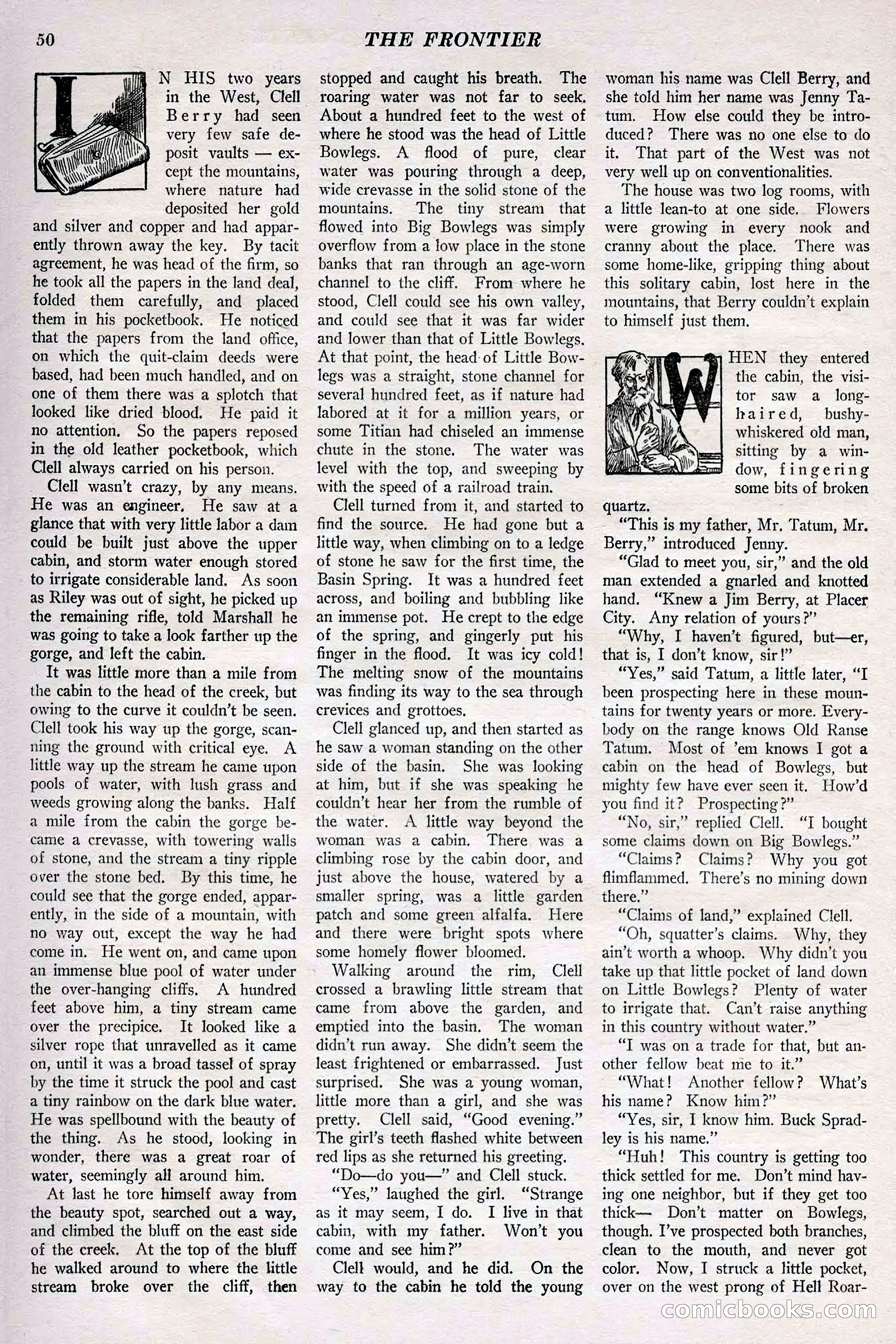
# Page Analysis This is a text page from a pulp fiction story titled "The Frontier" (visible in the header). The page contains two columns of prose narrative with a single illustration embedded in the right column. The story concerns a character named Crell Berry, an engineer, who discovers a remote mountain cabin while prospecting for gold and silver. He encounters a young woman named Jenny Tatum and her elderly father at the cabin. The narrative details Crell's observations of the landscape, a natural spring, and his initial meeting with the inhabitants. The illustration shows what appears to be a bearded man in the cabin doorway—likely the father character. The text focuses on dialogue and character introductions as Crell learns about the family's isolated life on the frontier.
📄 Transcribed text from this page (OCR, searchable)
Machine-transcribed from the original scan — historical spelling and the odd misread are preserved.
50 N HIS two years Berry had seen very few safe de- posit vaults — ex- cept the mountains, where nature had deposited her gold and silver and copper and had appar- ently thrown away the key. By tacit agreement, he was head of the firm, so he took all the papers in the land deal, folded them carefully, and placed them in his pocketbook. He noticed that the papers from the land office, on which the quit-claim deeds were based, had been much handled, and on one of them there was a splotch that looked like dried blood. He paid it no attention. So the papers reposed in the old leather pocketbook, which Clell always carried on his person. Clell wasn’t crazy, by any means. He was an engineer, He saw at a glance that with very little labor a dam could be built just above the upper cabin, and storm water enough stored to irrigate considerable land. As soon as Riley was out of sight, he picked up the remaining rifle, told Marshall he was going to take a look farther up the gorge, and left the cabin. It was little more than a mile from the cabin to the head of the creek, but owing to the curve it couldn’t be seen. Clell took his way up the gorge, scan- ning the ground with critical eye. A little way up the stream he came upon pools of water, with lush grass and weeds growing along the banks. Half a mile from the cabin the gorge be- came a crevasse, with towering walls of stone, and the stream a tiny ripple over the stone bed. By this time, he could see that the gorge ended, appar- ently, in the side of a mountain, with no way out, except the way he had come in. He went on, and came upon an immense blue pool of water under the over-hanging cliffs, A hundred feet above him, a tiny stream came over the precipice. It looked like a silver rope that unravelled as it came on, until it was a broad tassel of spray by the time it struck the pool and cast a tiny rainbow on the dark blue water. He was spellbound with the beauty of the thing. As he stood, looking in wonder, there was a great roar of water, seemingly all around him. At last he tore himself away from the beauty spot, searched out a way, and climbed the bluff on the east side of the creek. At the top of the bluff he walked around to where the little stream broke over the cliff, then in the West, Clell THE FRONTIER stopped and caught his breath. The roaring water was not far to seek. About a hundred feet to the west of where he stood was the head of Little Bowlegs. A flood of pure, clear water was pouring through a deep, wide crevasse in the solid stone of the mountains. The tiny stream that flowed into Big Bowlegs was simply overflow from a low place in the stone banks that ran through an age-worn channel to the cliff. From where he stood, Clell could see his own valley, and could see that it was far wider and lower than that of Little Bowlegs. At that point, the head: of Little Bow- legs was a straight, stone channel for several hundred feet, as if nature had labored at it for a million years, or some Titian had chiseled an immense chute in the stone. The water was level with the top, and sweeping by with the speed of a railroad train. Clell turned from it, and started to find the source. He had gone but a little way, when climbing on to a ledge of stone he saw for the first time, the Basin Spring. It was a hundred feet across, and boiling and bubbling like an immense pot. He crept to the edge of the spring, and gingerly put his finger in the flood. It was icy cold! The melting snow of the mountains was finding its way to the sea through crevices and grottoes. Clell glanced up, and then started as he saw a woman standing on the other side of the basin. She was looking at him, but if she was speaking he couldn’t hear her from the rumble of the water. A little way beyond the woman was a cabin, There was a climbing rose by the cabin door, and just above the house, watered by a smaller spring, was a little garden patch and some green alfalfa. Here and there were bright spots where some homely flower bloomed. Walking around the rim, Clell crossed a brawling little stream that came from above the garden, and emptied into the basin. The woman didn’t run away. She didn’t seem the least frightened or embarrassed. Just surprised. She was a young woman, little more than a girl, and she was pretty. Clell said, “Good evening.” The girl’s teeth flashed white between red lips as she returned his greeting. “Do—do you—” and Clell stuck. “Yes,” laughed the girl. “Strange as it may seem, I do. I live in that cabin, with my father. Won't you come and see him?” Clelt would, and he did. On the way to the cabin he told the young woman his name was Clell Berry, and she told him her name was Jenny Ta- tum. How else could they be intro- duced? There was no one else to do it. That part of the West was not very well up on conventionalities. The house was two log rooms, with a little lean-to at one side. Flowers were growing in every nook and cranny about the place. There was some home-like, gripping thing about this solitary cabin, lost here in the mountains, that Berry couldn’t explain to himself just them. HEN they entered the cabin, the visi- tor saw a_long- haired, bushy- whiskered old man, sitting by a win- dow, fingering some bits of broken A a a 7S ite . ae a bef . < — i ahd ns | ie TTTTTT quartz. “This is my father, Mr. Tatum, Mr. Berry,” introduced Jenny. “Glad to meet you, sir,” and the old man extended a gnarled and knotted hand. “Knew a Jim Berry, at Placer City. Any relation of yours?” “Why, I haven’t figured, but—er, that is, I don’t know, sir!” “Yes,” said Tatum, a little later, “I been prospecting here in these moun- tains for twenty years or more. Every- body on the range knows Old Ranse Tatum. Most of ’em knows I got a cabin on the head of Bowlegs, but mighty few have ever seen it. How’d you find it? Prospecting ?” “No, sir,” replied Clell. “I bought some claims down on Big Bowlegs.” “Claims? Claims? Why you got flimflammed, There’s no mining down there.” “Claims of land,” explained Clell. “Oh, squatter’s claims. Why, they ain’t worth a whoop. Why didn’t you take up that little pocket of land down on Little Bowlegs? Plenty of water to irrigate that. Can’t raise anything in this country without water.” “T was on a trade for that, but an- other fellow beat me to it.” “What! Another fellow? What’s his name? Know him?” “Yes, sir, I know him. Buck Sprad- ley is his name.” “Huh! This country is getting too thick settled for me. Don’t mind hav- ing one neighbor, but if they get too thick— Don’t matter on Bowlegs, though. I’ve prospected both branches, clean to the mouth, and never got color. Now, I struck a little pocket, over on the west prong of Hell Roar- COmicboooxks. com