
Pulp Fiction, 1926 · page 13 of 114
The Frontier, May 1926 — page 13: what you’re looking at
What you’re looking at
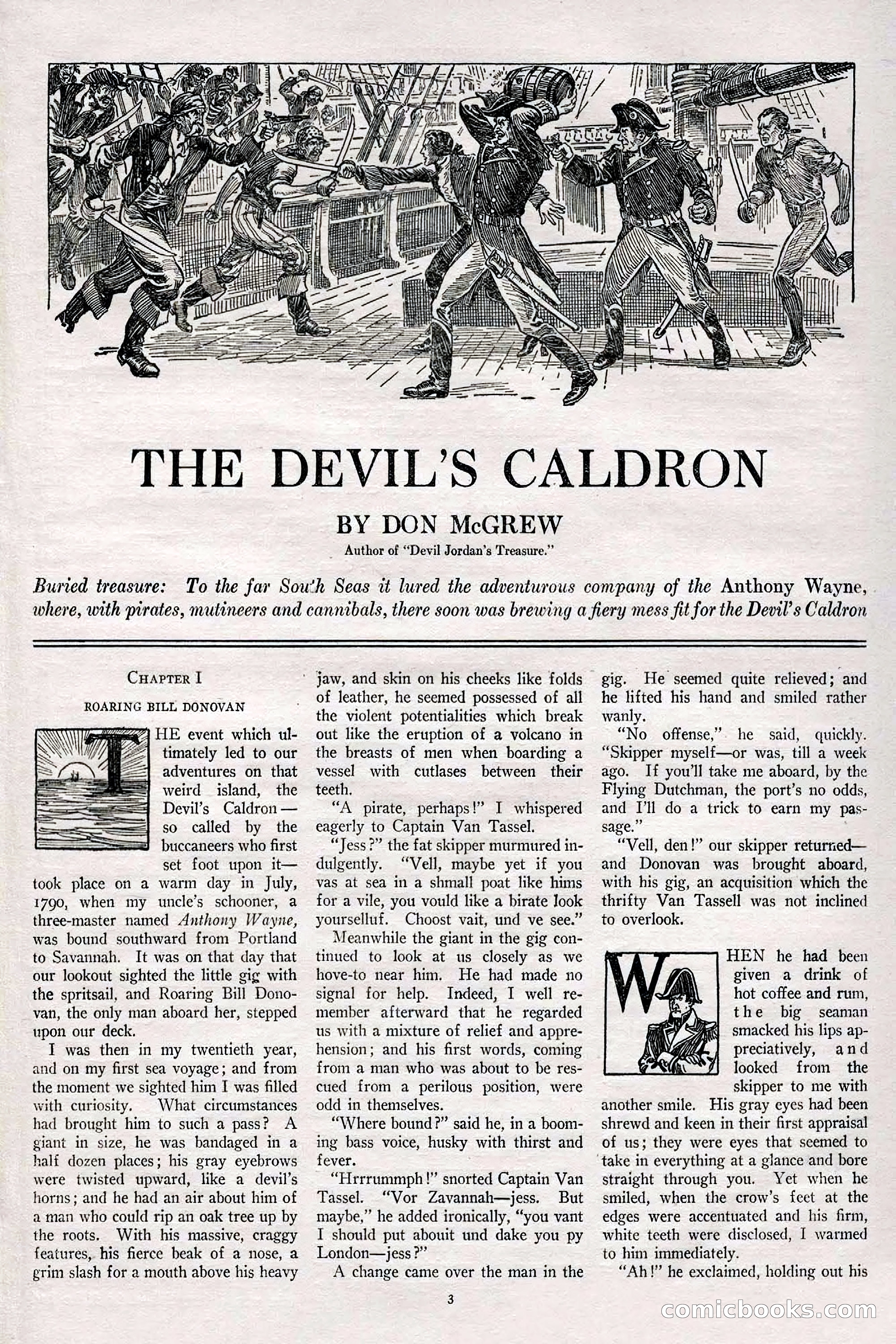
# Page Analysis This page contains the opening of a serialized adventure story titled "The Devil's Caldron" by Don McGrew. The top features a dramatic woodcut illustration depicting armed figures in what appears to be a ship's deck, with some men fighting or struggling. Below the illustration is the story's opening, labeled "Chapter 1: Roaring Bill Donovan," which begins with the narrator recounting an event involving a ship called the *Anthony Wayne* and a mysterious island called the Devil's Caldron. The text describes the narrator's first sea voyage at age twenty and an encounter with a giant pirate captain named Bill Donovan. This appears to be a typical pulp adventure story from an early-twentieth-century magazine.
📄 Transcribed text from this page (OCR, searchable)
Machine-transcribed from the original scan — historical spelling and the odd misread are preserved.
} : a) Bias — \\ EA\\\\ _* \ —— % ZA ery Yi ; THE DEVIL’S CALDRON Buried treasure: BY DON McGREW Author of “Devil Jordan’s Treasure.” To the far South Seas wt lured the adventurous company of the Anthony Wayne, where, with pirates, mutineers and cannibals, there soon was brewing a fiery mess fit for the Devil’s Caldron CHAPTER I ROARING BILL DONOVAN parma) LIE event which ul- in| timately led to our adventures on that weird island, the Devil’s Caldron — so called by the buccaneers who first set foot upon it— took place on a warm day in July, 1790, when my uncle’s schooner, a three-master named Anthony Wayne, was bound southward from Portland to Savannah. It was on that day that our lookout sighted the little gig with the spritsail, and Roaring Bill Dono- van, the only man aboard her, stepped upon our deck. I was then in my twentieth year, and on my first sea voyage; and from the moment we sighted him I was filled with curiosity. What circumstances had brought him to such a pass? A giant in size, he was bandaged in a hali dozen places; his gray eyebrows were twisted upward, like a devil’s horns; and he had an air about him of a man who could rip an oak tree up by the roots. With his massive, craggy features, his fierce beak of a nose, a grim slash for a mouth above his heavy ‘ jaw, and skin on his cheeks like folds of leather, he seemed possessed of all the violent potentialities which break out like the eruption of a volcano in the breasts of men when boarding a vessel with cutlases between their teeth. “A pirate, perhaps!” I whispered eagerly to Captain Van Tassel. “Jess?” the fat skipper murmured in- dulgently. “Vell, maybe yet if you vas at sea in a shmall poat like hims for a vile, you vould like a birate look yourselluf. Choost vait, und ve see.” Meanwhile the giant in the gig con- tinued to look at us closely as we hove-to near him. He had made no signal for help. Indeed, I well re- member afterward that he regarded us with a mixture of relief and appre- hension; and his first words, coming from a man who was about to be res- cued from a perilous position, were odd in themselves. “Where bound?” said he, in a boom- ing bass voice, husky with thirst and fever. “Hrrrummph!” snorted Captain Van Tassel. “Vor Zavannah—jess. But maybe,” he added ironically, “you vant I should put abouit und dake you py London—jess ?” A change came over the man in the 3 gig. He seemed quite relieved; and he lifted his hand and smiled rather wanly. “No. offense,”. he said, quickly. “Skipper myself—or was, till a week ago. If you'll take me aboard, by the Flying Dutchman, the port’s no odds, and I'll do a trick to earn my pas- sage.” ; “Vell, den!” our skipper returried— and Donovan was brought aboard, with his gig, an acquisition which the thrifty Van Tassell was not inclined to overlook. HEN he had been given a drink of hot coffee and rum, the big seaman smacked his lips ap- preciatively, and looked from _ the skipper to me with another smile. His gray eyes had been shrewd and keen in their first appraisal of us; they were eyes that seemed to ‘take in everything at a glance and bore straight through you. Yet when he smiled, when the crow’s feet at the edges were accentuated and his firm, white teeth were disclosed, I warmed to him immediately. “Ah!” he exclaimed, holding out his GOMmMmiGchdoo <SriGOim