
Pulp Fiction, 1926 · page 86 of 114
The Frontier, May 1926 — page 86: what you’re looking at
What you’re looking at
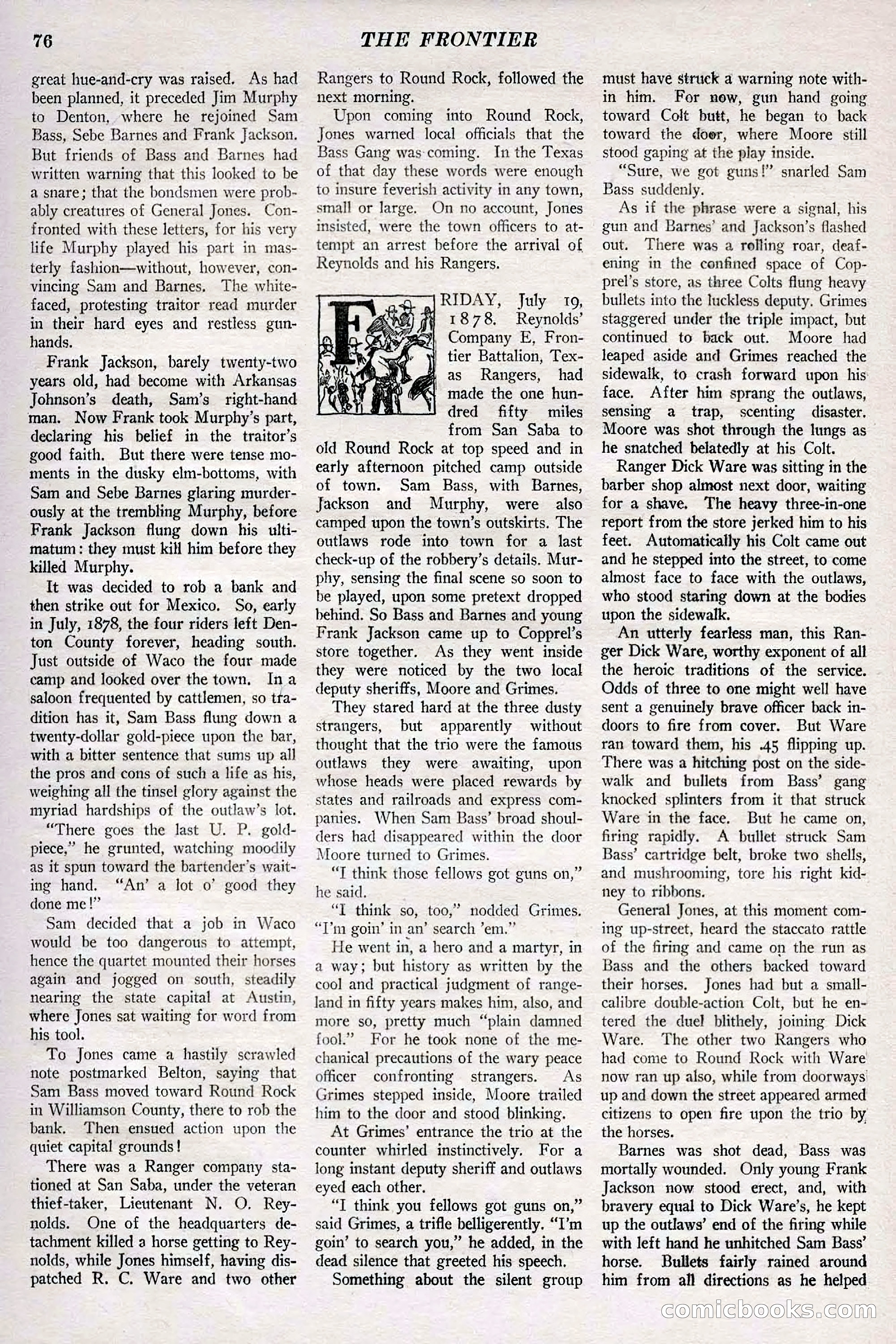
# Page Analysis This is a page of story prose from a pulp magazine titled "THE FRONTIER" (visible at top). The page number is 76. The text describes what appears to be a Western gunfight in a town, likely Round Rock, Texas, dated July 19, 1878 (as indicated by a decorative header). The narrative involves lawmen confronting outlaws, including characters named Sam Bass, Frank Jackson, and Dick Ware. The passage details a shootout where Bass and his gang attempt robbery, leading to gunfire in the street and store. A decorative initial letter "F" marks a section break within the prose. The story reads as historical Western fiction, recounting an apparent real historical event involving bank robbers and Rangers.
📄 Transcribed text from this page (OCR, searchable)
Machine-transcribed from the original scan — historical spelling and the odd misread are preserved.
716 great hue-and-cry was raised. As had been planned, it preceded Jim Murphy to Denton, where he rejoined Sam Bass, Sebe Barnes and Frank Jackson. But friends of Bass and Barnes had written warning that this looked to be a snare; that the bondsmen were prob- ably creatures of General Jones. Con- fronted with these letters, for his very life Murphy played his part in mas- terly fashion—without, however, con- vincing Sam and Barnes, The white- faced, protesting traitor read murder in their hard eyes and restless gun- hands. Frank Jackson, barely twenty-two years old, had become with Arkansas Johnson’s death, Sam’s right-hand man. Now Frank took Murphy’s part, declaring his belief in the traitor’s good faith. But there were tense mo- ments in the dusky elm-bottoms, with Sam and Sebe Barnes glaring murder- ously at the trembling Murphy, before Frank Jackson flung down his ulti- matum: they must kill him before they killed Murphy. It was decided to rob a bank and then strike out for Mexico. So, early in July, 1878, the four riders left Den- ton County forever, heading south. Just outside of Waco the four made camp and looked over the town. Ina saloon frequented by cattlemen, so tta- dition has it, Sam Bass flung down a twenty-dollar gold-piece upon the bar, with a bitter sentence that sums up all the pros and cons of such a life as his, weighing all the tinsel glory against the myriad hardships of the outlaw’s lot. “There goes the last U. P. gold- piece,” he grunted, watching moodily as it spun toward the bartender’s wait- ing hand. “An’ a lot o’ good they done me!” Sam decided that a job in Waco would be too dangerous to attempt, hence the quartet mounted their horses again and jogged on south, steadily nearing the state capital at Austin, where Jones sat waiting for word from his tool. To Jones came a hastily scrawled note postmarked Belton, saying that Sam Bass moved toward Round Rock in Williamson County, there to rob the bank. Then ensued action upon the quiet capital grounds! There was a Ranger company sta- tioned at San Saba, under the veteran thief-taker, Lieutenant N. O. Rey- nolds. One of the headquarters de- tachment killed a horse getting to Rey- nolds, while Jones himself, having dis- patched R. C. Ware and two other THE FRONTIER Rangers to Round Rock, followed the next morning. Upon coming into Round Rock, Jones warned local officials that the Bass Gang was coming. In the Texas of that day these words were enough to insure feverish activity in any town, small or large. On no account, Jones insisted, were the town officers to at- tempt an arrest before the arrival of Reynolds and his Rangers. 1RIDAY, July 10, # 1878. Reynolds’ Company E, Fron- ! tier Battalion, Tex- Als <# as Rangers, had made the one hun- dred fifty miles from San Saba to old Round Rock at top speed and in early afternoon pitched camp outside of town. Sam Bass, with Barnes, Jackson and Murphy, were also camped upon the town’s outskirts. The outlaws rode into town for a last check-up of the robbery’s details. Mur- phy, sensing the final scene so soon to be played, upon some pretext dropped behind. So Bass and Barnes and young Frank Jackson came up to Copprel’s store together. As they went inside they were noticed by the two local deputy sheriffs, Moore and Grimes. They stared hard at the three dusty strangers, but apparently without thought that the trio were the famous outlaws they were awaiting, upon whose heads were placed rewards by states and railroads and express com- panies. When Sam Bass’ broad shoul- ders had disappeared within the door Moore turned to Grimes. “T think those fellows got guns on,” he said. “T think so, too,” nodded Grimes. “T’m goin’ in an’ search “em.” He went in, a hero and a martyr, in a way; but history as written by the cool and practical judgment of range- land in fifty years makes him, also, and more so, pretty much “plain damned fool.” For he took none of the me- chanical precautions of the wary peace officer confronting strangers. As Grimes stepped inside, Moore trailed him to the door and stood blinking. At Grimes’ entrance the trio at the counter whirled instinctively. For a long instant deputy sheriff and outlaws eyed each other. “I think you fellows got guns on,” said Grimes, a trifle belligerently. “I’m goin’ to search you,” he added, in the dead silence that greeted his speech. Something about the silent group must have struck a warning note with- in him. For new, gun hand going toward Colt butt, he began to back toward the doer, where Moore still stood gaping at the play inside. “Sure, we got guns!” snarled Sam Bass suddenly. As if the phrase were a signal, his gun and Barnes’ and Jackson’s flashed out. There was a rolling roar, deaf- ening in the confined space of Cop- prel’s store, as three Colts flung heavy bullets into the luckless deputy. Grimes staggered under the triple impact, but continued to back out. Moore had leaped aside and Grimes reached the sidewalk, to crash forward upon his face. After him sprang the outlaws, sensing a trap, scenting disaster. Moore was shot through the lungs as he snatched belatedly at his Colt. Ranger Dick Ware was sitting in the barber shop almost next door, waiting for a shave. The heavy three-in-one report from the store jerked him to his feet. Automatically his Colt came out and he stepped into the street, to come almost face to face with the outlaws, who stood staring down at the bodies upon the sidewalk. An utterly fearless man, this Ran- ger Dick Ware, worthy exponent of all the heroic traditions of the service. Odds of three to one might well have sent a genuinely brave officer back in- doors to fire from cover. But Ware ran toward them, his .45 flipping up. There was a hitching post on the side- walk and bullets from Bass’ gang knocked splinters from it that struck Ware in the face. But he came on, firing rapidly. A bullet struck Sam Bass’ cartridge belt, broke two shells, and mushrooming, tore his right kid- ney to ribbons. General Jones, at this moment com- ing up-street, heard the staccato rattle of the firing and came on the run as Bass and the others backed toward their horses. Jones had but a small- calibre double-action Colt, but he en- tered the duel blithely, joining Dick Ware. The other two Rangers who had come to Round Rock with Ware now ran up also, while from doorways’ up and down the street appeared armed citizens to open fire upon the trio by the horses. Barnes was shot dead, Bass was mortally wounded. Only young Frank Jackson now stood erect, and, with bravery equal to Dick Ware’s, he kept up the outlaws’ end of the firing while with left hand he unhitched Sam Bass’ horse. Bullets fairly rained around him from all directions as he helped COMmMicboookxs.com