
Pulp Fiction, 1926 · page 102 of 114
The Frontier, May 1926 — page 102: what you’re looking at
What you’re looking at
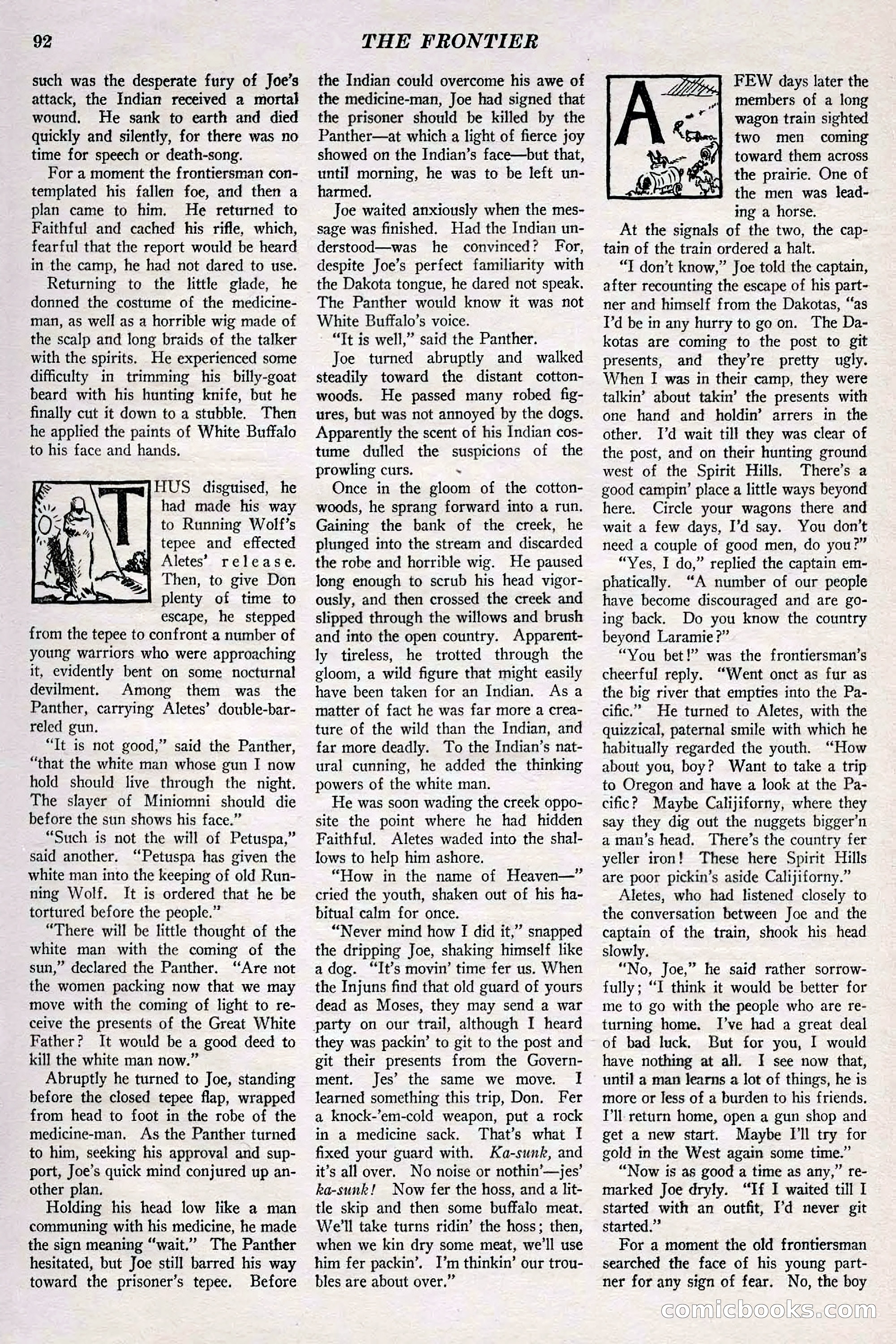
# Page 92: Story Prose with Illustrations This is a story page from "The Frontier" pulp magazine, containing two illustrations embedded within narrative text. The illustrations appear to show frontier/Western scenes with Native American and settler characters. The visible text describes a tense encounter between a white man in disguise (painted as "White Buffalo") and a Native American character named Joe, along with discussions among frontier settlers about incoming Dakota tribes and possible danger to their wagon train. The narrative involves themes of escape, disguise, and frontier survival. A captain of the wagon train discusses whether to move camp or wait out the perceived threat, ultimately deciding to relocate away from the immediate area for safety.
📄 Transcribed text from this page (OCR, searchable)
Machine-transcribed from the original scan — historical spelling and the odd misread are preserved.
92 such was the desperate fury of Joe’s attack, the Indian received a mortal wound. He sank to earth and died quickly and silently, for there was no time for speech or death-song. For a moment the frontiersman con- templated his fallen foe, and then a plan came to him. He returned to Faithful and cached his rifle, which, fearful that the report would be heard in the camp, he had not dared to use. Returning to the little glade, he donned the costume of the medicine- man, as well as a horrible wig made of the scalp and long braids of the talker with the spirits. He experienced some difficulty in trimming his billy-goat beard with his hunting knife, but he finally cut it down to a stubble. Then he applied the paints of White Buffalo to his face and hands. HUS disguised, he had made his way to Running Wolf’s tepee and effected Aletes’ release. Then, to give Don plenty of time to escape, he stepped from the tepee to confront a number of young warriors who were approaching it, evidently bent on some nocturnal devilment. Among them was the Panther, carrying Aletes’ double-bar- reled gun. “It is not good,” said the Panther, “that the white man whose gun I now hold should live through the night. The slayer of Miniomni should die before the sun shows his face.” “Such is not the will of Petuspa,” said another. “Petuspa has given the white man into the keeping of old Run- ning Wolf. It is ordered that he be tortured before the people.” “There will be little thought of the white man with the coming of the sun,” declared the Panther. “Are not the women packing now that we may move with the coming of light to re- ceive the presents of the Great White Father? It would be a good deed to kill the white man now.” Abruptly he turned to Joe, standing before the closed tepee flap, wrapped from head to foot in the robe of the medicine-man. As the Panther turned to him, seeking his approval and sup- port, Joe’s quick mind conjured up an- other plan. Holding his head low like a man communing with his medicine, he made the sign meaning “wait.” The Panther hesitated, but Joe still barred his way toward the prisoner’s tepee. Before THE FRONTIER the Indian could overcome his awe of the medicine-man, Joe had signed that the prisoner should be killed by the Panther—at which a light of fierce joy showed on the Indian’s face—but that, until morning, he was to be left un- harmed. Joe waited anxiously when the mes- sage was finished. Had the Indian un- derstood—was he convinced? For, despite Joe’s perfect familiarity with the Dakota tongue, he dared not speak. The Panther would know it was not White Buffalo’s voice. “Tt is well,” said the Panther. Joe turned abruptly and walked steadily toward the distant cotton- woods. He passed many robed fig- ures, but was not annoyed by the dogs. Apparently the scent of his Indian cos- tume dulled the suspicions of the prowling curs. . Once in the gloom of the cotton- woods, he sprang forward into a run. Gaining the bank of the creek, he plunged into the stream and discarded the robe and horrible wig. He paused long enough to scrub his head vigor- ously, and then crossed the creek and slipped through the willows and brush and into the open country. Apparent- ly tireless, he trotted through the gloom, a wild figure that might easily have been taken for an Indian. Asa matter of fact he was far more a crea- ture of the wild than the Indian, and far more deadly. To the Indian’s nat- ural cunning, he added the thinking powers of the white man. He was soon wading the creek oppo- site the point where he had hidden Faithful. Aletes waded into the shal- lows to help him ashore. “How in the name of Heaven—” cried the youth, shaken out of his ha- bitual calm for once. “Never mind how I did it,” snapped the dripping Joe, shaking himself like adog. “It’s movin’ time fer us. When the Injuns find that old guard of yours dead as Moses, they may send a war party on our trail, although I heard they was packin’ to git to the post and git their presents from the Govern- ment. Jes’ the same we move. I learned something this trip, Don. Fer a knock-’em-cold weapon, put a rock in a medicine sack. That’s what I fixed your guard with. Ka-sunk, and it’s all over. No noise or nothin’—jes’ ka-sunk! Now fer the hoss, and a lit- tle skip and then some buffalo meat. We'll take turns ridin’ the hoss; then, when we kin dry some meat, we'll use him fer packin’, I’m thinkin’ our trou- bles are about over.” FEW days later the members of a long wagon train sighted two men coming toward them across the prairie. One of the men was lead- ing a horse. At the signals of the two, the cap- tain of the train ordered a halt. “I don’t know,” Joe told the captain, after recounting the escape of his part- ner and himself from the Dakotas, “as I’d be in any hurry to goon. The Da- kotas are coming to the post to git presents, and they’re pretty ugly. When I was in their camp, they were talkin’ about takin’ the presents with one hand and holdin’ arrers in the other. I’d wait till they was clear of the post, and on their hunting ground west of the Spirit Hills. There’s a good campin’ place a little ways beyond here. Circle your wagons there and wait a few days, I’d say. You don’t need a couple of good men, do you?” “Yes, I do,” replied the captain em- phatically. “A number of our people have become discouraged and are go- ing back. Do you know the country beyond Laramie ?” “You bet!” was the frontiersman’s cheerful reply. “Went onct as fur as the big river that empties into the Pa- cific.” He turned to Aletes, with the quizzical, paternal smile with which he habitually regarded the youth. “How about you, boy? Want to take a trip to Oregon and have a look at the Pa- cific? Maybe Calijiforny, where they say they dig out the nuggets bigger’n a man’s head. There’s the country fer yeller iron! These here Spirit Hills are poor pickin’s aside Calijiforny.” Aletes, who had listened closely to the conversation between Joe and the captain of the train, shook his head slowly. “No, Joe,” he said rather sorrow- fully; “I think it would be better for me to go with the people who are re- turning home. I’ve had a great deal of bad luck. But for you, I would have nothing at all. I see now that, until a man learns a lot of things, he is more or less of a burden to his friends. Pll. return home, open a gun shop and get a new start. Maybe I'll try for gold in the West again some time.” “Now is as good a time as any,” re- marked Joe dryly. “If I waited till I started with an outfit, Pd never git started.” For a moment the old frontiersman searched the face of his young part- ner for any sign of fear. No, the boy COMMicoookks.CcoOn