
Pulp Fiction, 1926 · page 104 of 114
The Frontier, May 1926 — page 104: what you’re looking at
What you’re looking at
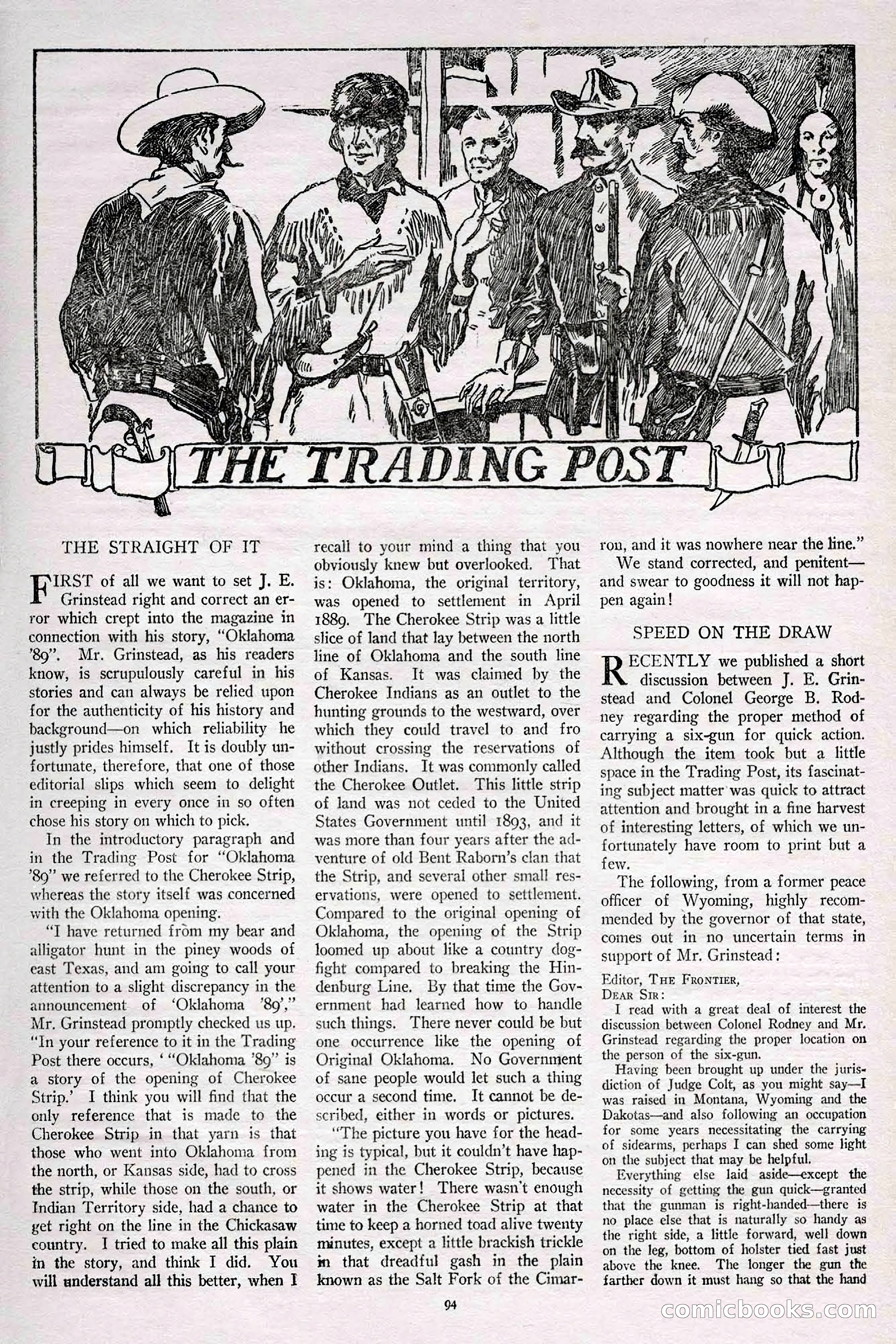
This page features an illustration at the top labeled "THE TRADING POST," depicting several men in Western attire gathered in conversation. Below the illustration is prose text discussing corrections to a previous story about "Oklahoma '89" and the Cherokee Strip. J. E. Grinstead addresses an error in his account of the Cherokee Strip's opening in 1889, clarifying details about its location between Oklahoma and Kansas. The page also includes a section titled "Speed on the Draw" containing a letter from a former Wyoming peace officer supporting Grinstead's historical accuracy regarding proper methods of carrying a six-gun.
📄 Transcribed text from this page (OCR, searchable)
Machine-transcribed from the original scan — historical spelling and the odd misread are preserved.
THE STRAIGHT OF IT IRST of all we want to set J. E. Grinstead right and correct an er- ror which crept into the magazine in connection with his story, “Oklahoma 89”. Mr. Grinstead, as his readers know, is scrupulously careful in his stories and can always be relied upon for the authenticity of his history and background—on which reliability he justly prides himself. It is doubly un- fortunate, therefore, that one of those editorial slips which seem to delight in creeping in every once in so often chose his story on which to pick. In the introductory paragraph and in the Trading Post for “Oklahoma 89” we referred to the Cherokee Strip, whereas the story itself was concerned with the Oklahoma opening. “T have returned from my bear and alligator hunt in the piney woods of east Texas, and am going to call your attention to a slight discrepancy in the announcement of ‘Oklahoma ‘89’,” Mr. Grinstead promptly checked us up. “In your reference to it in the Trading Post there occurs, ‘ “Oklahoma ’89” is a story of the opening of Cherokee Strip.’ I think you will find that the only reference that is made to the Cherokee Strip in that yarn is that those who went into Oklahoma from the north, or Kansas side, had to cross the strip, while those on the south, or Indian Territory side, had a chance to get right on the line in the Chickasaw country. I tried to make all this plain in the story, and think I did. You will understand all this better, when I i> be eet recall to your mind a thing that you obviously knew but overlooked. That is: Oklahoma, the original territory, was opened to settlement in April 1889. The Cherokee Strip was a little slice of land that lay between the north line of Oklahoma and the south line of Kansas. It was claimed by the Cherokee Indians as an outlet to the hunting grounds to the westward, over which they could travel to and fro without crossing the reservations of other Indians. It was commonly called the Cherokee Outlet. This little strip of land was not ceded to the United States Government until 1893, and it was more than four years after the ad- venture of old Bent Raborn’s clan that the Strip, and several other small res- ervations, were opened to settlement. Compared to the original opening of Oklahoma, the opening of the Strip loomed up about like a country dog- fight compared to breaking the Hin- denburg Line. By that time the Gov- ernment had learned how to handle such things. There never could be but one occurrence like the opening of Original Oklahoma. No Government of sane people would let such a thing occur a second time. It cannot be de- scribed, either in words or pictures. ‘The picture you have for the head- ing is typical, but it couldn’t have hap- pened in the Cherokee Strip, because it shows water! There wasn't enough water in the Cherokee Strip at that time to keep a horned toad alive twenty minutes, except a little brackish trickle m that dreadful gash in the plain known as the Salt Fork of the Cimar- 04 rou, and it was nowhere near the line.” We stand corrected, and penitent— and swear to goodness it will not hap- pen again! SPEED ON THE DRAW Re we published a short discussion between J. E. Grin- stead and Colonel George B. Rod- ney regarding the proper method of carrying a six-gun for quick action. Although the item took but a little space in the Trading Post, its fascinat- ing subject matter was quick to attract attention and brought in a fine harvest of interesting letters, of which we un- fortunately have room to print but a few. The following, from a former peace officer of Wyoming, highly recom- mended by the governor of that state, comes out in no uncertain terms in support of Mr. Grinstead: Editor, THe Frontier, DEAR Sir: I read with a great deal of interest the discussion between Colonel Rodney and Mr. Grinstead regarding the proper location on the person of the six-gun. Having been brought up under the juris« diction of Judge Colt, as you might say—I was raised in Montana, Wyoming and the Dakotas—and also following an occupation for some years necessitating the carrying of sidearms, perhaps I can shed some light on the subject that may be helpful. Everything else laid aside—except the necessity of getting the gun quick—granted that the gunman is right-handed—there 1s no place else that is naturally so handy as the right side, a little forward, well down on the leg, bottom of holster tied fast just above the knee. The longer the gun the farther down it must hang so that the hand COnmniclbooks. com