
Pulp Fiction, 1926 · page 70 of 114
The Frontier, May 1926 — page 70: what you’re looking at
What you’re looking at
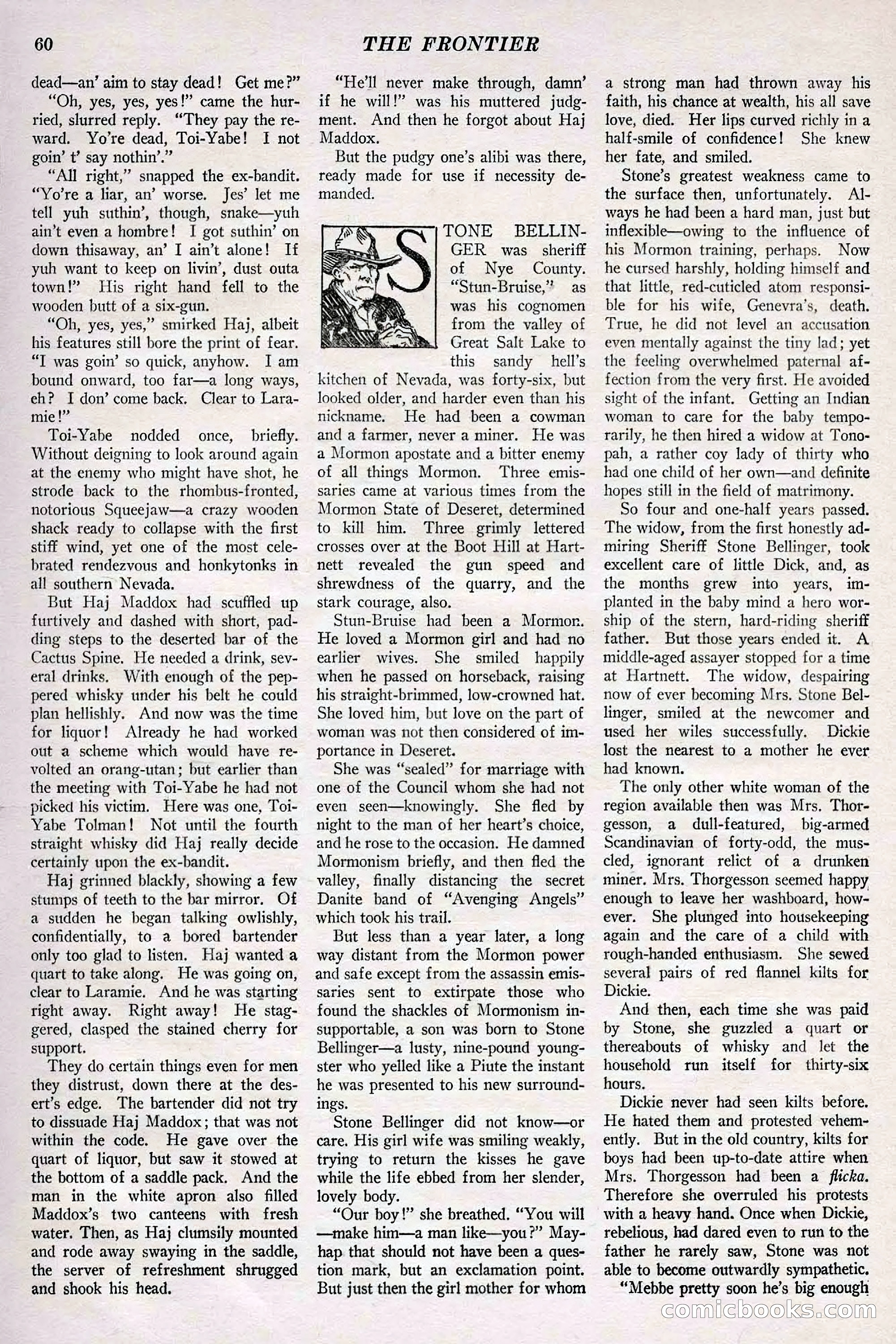
# Page 60 of "The Frontier" This page contains story prose with a small decorative initial capital letter (ornate "S"). The text appears to be a Western narrative involving characters named Stone Bellinger (a sheriff), Haj Maddox, Toi-Yabe, and others. The visible story discusses Bellinger's background as a former Mormon who became sheriff of Nye County, Nevada, and his marriage to a woman named Genevar whose death profoundly affected him. The narrative then shifts to describe a widow caring for a child named Dickie and her interactions with other frontier settlers, including a Scandinavian miner named Thorgesson. The story explores themes of frontier life, religious conflict, and domestic relationships in the American West.
📄 Transcribed text from this page (OCR, searchable)
Machine-transcribed from the original scan — historical spelling and the odd misread are preserved.
60 dead—an’ aim to stay dead! Get me?” “Oh, yes, yes, yes!” came the hur- ried, slurred reply. “They pay the re- ward. Yo’re dead, Toi-Yabe! I not goin’ t’ say nothin’.” “All right,’ snapped the ex-bandit. “Yo’re a liar, an’ worse. Jes’ let me tell yuh suthin’, though, snake—yuh ain't even a hombre! I got suthin’ on down thisaway, an’ I ain’t alone! If yuh want to keep on livin’, dust outa town!” His right hand fell to the wooden butt of a six-gun. “Oh, yes, yes,” smirked Haj, albeit his features still bore the print of fear. “I was goin’ so quick, anyhow. I am bound onward, too far—a long ways, eh? I don’ come back. Clear to Lara- mie!” Toi-Yabe nodded once, briefly. Without deigning to look around again at the enemy who might have shot, he strode back to the rhombus-fronted, notorious Squeejaw—a crazy wooden shack ready to collapse with the first stiff wind, yet one of the most cele- brated rendezvous and honkytonks in all southern Nevada. But Haj Maddox had scuffled up furtively and dashed with short, pad- ding steps to the deserted bar of the Cactus Spine. He needed a drink, sev- eral drinks. With enough of the pep- pered whisky under his belt he could plan hellishly. And now was the time for liquor! Already he had worked out a scheme which would have re- volted an orang-utan; but earlier than the meeting with Toi-Yabe he had not picked his victim. Here was one, Toi- Yabe Tolman! Not until the fourth straight whisky did Haj really decide certainly upon the ex-bandit. Haj grinned blackly, showing a few stumps of teeth to the bar mirror. Of a sudden he began talking owlishly, confidentially, to a bored bartender only too glad to listen. Haj wanted a quart to take along. He was going on, clear to Laramie. And he was starting right away. Right away! He stag- gered, clasped the stained cherry for support, They do certain things even for men they distrust, down there at the des- ert’s edge. The bartender did not try to dissuade Haj Maddox; that was not within the code. He gave over the quart of liquor, but saw it stowed at the bottom of a saddle pack. And the man in the white apron also filled Maddox’s two canteens with fresh water. Then, as Haj clumsily mounted and rode away swaying in the saddle, the server of refreshment shrugged and shook his head. THE FRONTIER “He'll never make through, damn’ if he will!” was his muttered judg- ment. And then he forgot about Haj Maddox. But the pudgy one’s alibi was there, ready made for use if necessity de- manded. TONE BELLIN- GER was. sheriff of Nye County. “Stun-Bruise,? as was his cognomen from the valley of Great Salt Lake to this sandy hell’s kitchen of Nevada, was forty-six, but looked older, and harder even than his nickname. He had been a cowman and a farmer, never a miner. He was a Mormon apostate and a bitter enemy of all things Mormon. Three emis- saries came at various times from the Mormon State of Deseret, determined to kill him. Three grimly lettered crosses over at the Boot Hill at Hart- nett revealed the gun speed and shrewdness of the quarry, and the stark courage, also. Stun-Bruise had been a Mormon. He loved a Mormon girl and had no earlier wives. She smiled happily when he passed on horseback, raising his straight-brimmed, low-crowned hat. She loved him, but love on the part of woman was not then considered of im- portance in Deseret. She was “sealed” for marriage with one of the Council whom she had not even. seen—knowingly. She fled by night to the man of her heart’s choice, and he rose to the occasion. He damned Mormonism briefly, and then fled the valley, finally distancing the secret Danite band of “Avenging Angels” which took his trail. But less than a year later, a long way distant from the Mormon power and safe except from the assassin emis- Saries sent to extirpate those who found the shackles of Mormonism in- supportable, a son was born to Stone Bellinger—a lusty, nine-pound young- ster who yelled like a Piute the instant he was presented to his new surround- ings. Stone Bellinger did not know—or care. His girl wife was smiling weakly, trying to return the kisses he gave while the life ebbed from her slender, lovely body. “Our boy!” she breathed. “You will —make him—a man like—you?’”’ May- hap that should not have been a ques- tion mark, but an exclamation point. But just then the girl mother for whom a strong man had thrown away his faith, his chance at wealth, his all save love, died. Her lips curved richly in a half-smile of confidence! She knew her fate, and smiled. Stone’s greatest weakness came to the surface then, unfortunately. Al- ways he had been a hard man, just but inflexible—owing to the influence of his Mormon training, perhaps. Now he cursed harshly, holding himself and that little, red-cuticled atom responsi- ble for his wife, Genevra’s, death. True, he did not level an accusation even mentally against the tiny lad; yet the feeling overwhelmed paternal af- fection from the very first. He avoided sight of the infant. Getting an Indian woman to care for the baby tempo- rarily, he then hired a widow at Tono- pah, a rather coy lady of thirty who had one child of her own—and definite hopes still in the field of matrimony. So four and one-half years passed. The widow, from the first honestly ad- miring Sheriff Stone Bellinger, took excellent care of little Dick, and, as the months grew into years, im- planted in the baby mind a hero wor- ship of the stern, hard-riding sheriff father. But those years ended it. A middle-aged assayer stopped for a time at Hartnett. The widow, despairing now of ever becoming Mrs. Stone Bel- linger, smiled at the newcomer and used her wiles successfully. Dickie lost the nearest to a mother he ever had known. The only other white woman of the region available then was Mrs. Thor- gesson, a dull-featured, big-armed Scandinavian of forty-odd, the mus- cled, ignorant relict of a drunken miner. Mrs. Thorgesson seemed happy enough to leave her washboard, how- ever. She plunged into housekeeping again and the care of a child with rough-handed enthusiasm. She sewed several pairs of red flannel kilts for Dickie. And then, each time she was paid by Stone, she guzzled a quart or thereabouts of whisky and let the household run itself for thirty-six hours. Dickie never had seen kilts before. He hated them and protested vehem- ently. But in the old country, kilts for boys had been up-to-date attire when Mrs. Thorgesson had been a flicka. Therefore she overruled his protests with a heavy hand. Once when Dickie, rebelious, had dared even to run to the father he rarely saw, Stone was not able to become outwardly sympathetic. “Mebbe pretty soon he’s big enough ConnicloOoks.conm