
Pulp Fiction, 1926 · page 38 of 114
The Frontier, May 1926 — page 38: what you’re looking at
What you’re looking at
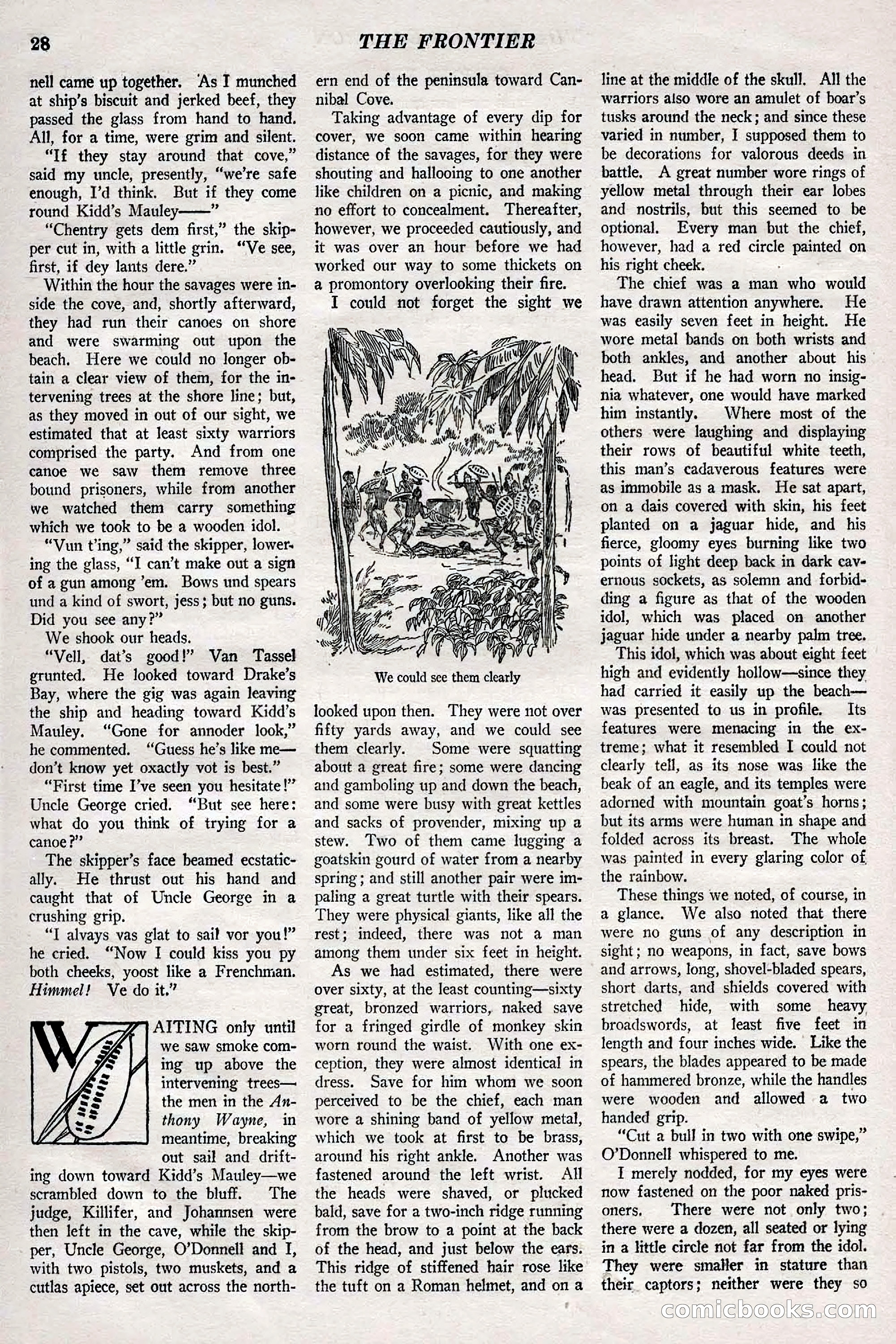
# Page Content Description This is **page 28 of story prose** from *The Frontier* magazine, featuring a narrative about an encounter with indigenous warriors. The text describes the narrator's party observing approximately sixty armed men on a beach near a cove. The passage details the warriors' physical appearance and adornments—including body paint, metal bands, boar-tusk necklaces, and rings—and describes a wooden idol positioned nearby. The narrative also mentions the capture of prisoners and discusses the group's cautious approach. An **illustration in the middle of the page** shows the cove and warriors mentioned in the text. The prose continues with dialogue between crew members debating strategy, appearing to be an adventure or exploration narrative set in an unfamiliar location.
📄 Transcribed text from this page (OCR, searchable)
Machine-transcribed from the original scan — historical spelling and the odd misread are preserved.
28 nell came up together. As I munched at ship’s biscuit and jerked beef, they passed the glass from hand to hand. All, for a time, were grim and silent. “If they stay around that cove,” said my uncle, presently, “we’re safe enough, I’d think. But if they come round Kidd’s Mauley——” “Chentry gets dem first,” the skip- per cut in, with a little grin. “Ve see, first, if dey lants dere.” Within the hour the savages were in- side the cove, and, shortly afterward, they had run their canoes on shore and were swarming out upon the beach. Here we could no Jonger ob- tain a clear view of them, for the in- tervening trees at the shore line; but, as they moved in out of our sight, we estimated that at least sixty warriors comprised the party. And from one canoe we saw them remove three bound prisoners, while from another we watched them carry something which we took to be a wooden idol. “Vun ting,” said the skipper, lower. ing the glass, “I can’t make out a sign of a gun among ’em. Bows und spears und a kind of swort, jess; but no guns. Did you see any?” We shook our heads. “Vell, dat’s good!’ Van Tassel grunted. He looked toward Drake’s Bay, where the gig was again leaving the ship and heading toward Kidd’s Mauley. “Gone for annoder look,” he commented. ‘Guess he’s like me— don’t know yet oxactly vot is best.” “First time I’ve seen you hesitate!” Uncle George cried. “But see here: what do you think of trying for a canoe ?” The skipper’s face beamed ecstatic- ally. He thrust out his hand and caught that of Uncle George in a crushing grip. “I alvays vas glat to sail vor you!” he cried. “Now I could kiss you py both cheeks, yoost like a Frenchman. Himmel! Ve do it.” | AITING only until we saw smoke com- ing up above the intervening trees— | the men in the An- thony Wayne, in meantime, breaking out sail and drift- ing down toward Kidd’s Mauley—we scrambled down to the bluff. The judge, Killifer, and Johannsen were then left in the cave, while the skip- per, Uncle George, O’Donnell and I, with two pistols, two muskets, and a cutlas apiece, set out across the north- THE FRONTIER ern end of the peninsula toward Can- nibal Cove. Taking advantage of every dip for cover, we soon came within hearing distance of the savages, for they were shouting and hallooing to one another like children on a picnic, and making no effort to concealment. Thereafter, however, we proceeded cautiously, and it was over an hour before we had worked our way to some thickets on a promontory overlooking their fire. I could not forget the sight we : H \ y / l it ait \ ate ay I y i fd | ¢ ‘ r i” er MN A A a WN ati. divi? ‘id Meat Ge Re 1A) wae a My} Mi ' ? 5 , v, ah? & fe6) t Pb a fi 53 ma \ / - “) ‘ We could see them clearly looked upon then. They were not over fifty yards away, and we could see them clearly. Some were squatting about a great fire; some were dancing and gamboling up and down the beach, and some were busy with great kettles and sacks of provender, mixing up a stew. Two of them came lugging a goatskin gourd of water from a nearby spring ; and still another pair were im- paling a great turtle with their spears. They were physical giants, like all the rest; indeed, there was not a man among them under six feet in height. As we had estimated, there were over sixty, at the least counting—sixty great, bronzed warriors, naked save for a fringed girdle of monkey skin worn round the waist. With one ex- ception, they were almost identical in dress. Save for him whom we soon perceived to be the chief, each man wore a shining band of yellow metal, which we took at first to be brass, around his right ankle. Another was fastened around the left wrist. All the heads were shaved, or plucked bald, save for a two-inch ridge running from the brow to a point at the back of the head, and just below the ears. This ridge of stiffened hair rose Itke the tuft on a Roman helmet, and on a line at the middle of the skull. All the warriors also wore an amulet of boar’s tusks around the neck; and since these varied in number, I supposed them to be decorations for valorous deeds in battle. A great number wore rings of yellow metal through their ear lobes and nostrils, but this seemed to be optional. Every man but the chief, however, had a red circle painted on his right cheek. The chief was a man who would have drawn attention anywhere. He was easily seven feet in height. He wore metal bands on both wrists and both ankles, and another about his head. But if he had worn no insig- nia whatever, one would have marked him instantly. Where most of the others were laughing and displaying their rows of beautiful white teeth, this man’s cadaverous features were as immobile as a mask. He sat apart, of. a dais covered with skin, his feet planted on a jaguar hide, and his fierce, gloomy eyes burning like two points of light deep back in dark cav- ernous sockets, as solemn and forbid- ding a figure as that of the wooden idol, which was placed on another jaguar hide under a nearby palm tree. This idol, which was about eight feet high and evidently hollow—since they had carried it easily up the beach— was presented toa us in profile. Its features were menacing in the ex- treme; what it resembled I could not clearly tefl, as its nose was like the beak of an eagle, and its temples were adorned with mountain goat’s horns; but its arms were human in shape and folded across its breast. The whole was painted in every glaring color of the rainbow. These things we noted, of course, in a glance. We also noted that there were no gts of any description in sight; no weapons, in fact, save bows and arrows, long, shovel-bladed spears, short darts, and shields covered with stretched hide, with some heavy broadswords, at least five feet in length and four inches wide. Like the spears, the blades appeared to be made of hammered bronze, while the handles were wooden and allowed a two handed grip. “Cut a bull in two with one swipe,” O’Donnell whispered to me. I merely nodded, for my eyes were now fastened on the poor naked pris- oners, | There were not only two; there were a dozen, all seated or lying in a little circle not far from the idol. They were smaifer in stature than their captors; neither were they so Gomicbooksacom