
Pulp Fiction, 1926 · page 85 of 114
The Frontier, May 1926 — page 85: what you’re looking at
What you’re looking at
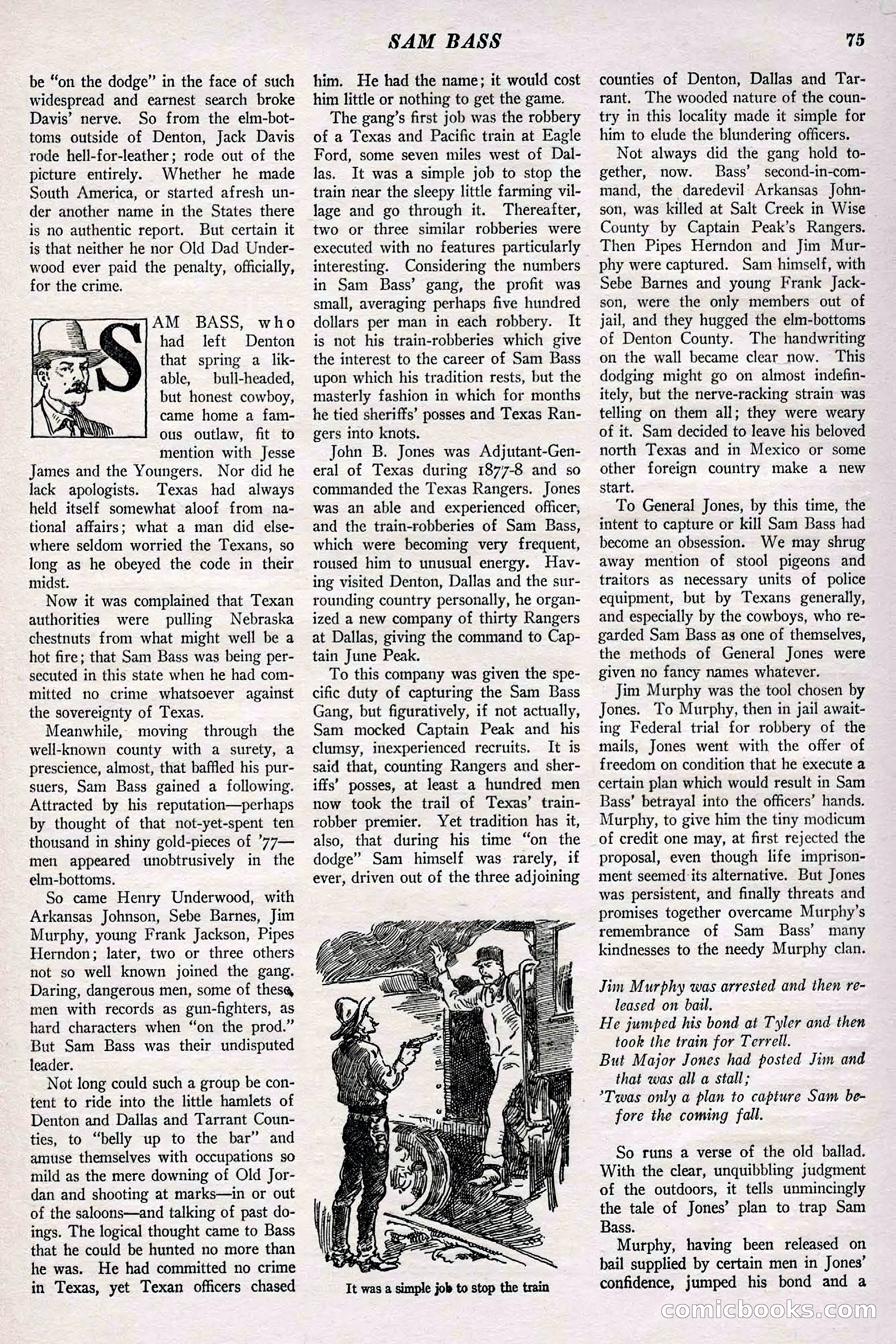
# Analysis of Page 75: "Sam Bass" This is a **story prose page** from a pulp fiction magazine featuring the narrative of Sam Bass, a historical outlaw figure. The page recounts Bass's criminal career in Texas, describing his train robberies and his pursuit by Texas Rangers under General John B. Jones. It includes an inset illustration showing what appears to be a train robbery scene. The text discusses how Bass and his gang operated across counties near Dallas and Denton, their eventual capture, and Jones's pursuit. A brief verse appears at the bottom, suggesting this is a serialized account or ballad about the outlaw's exploits and eventual downfall.
📄 Transcribed text from this page (OCR, searchable)
Machine-transcribed from the original scan — historical spelling and the odd misread are preserved.
be “on the dodge” in the face of such widespread and earnest search broke Davis’ nerve. So from the elm-bot- toms outside of Denton, Jack Davis rode hell-for-leather; rode out of the picture entirely. Whether he made South America, or started afresh un- der another name in the States there is no authentic report. But certain it is that neither he nor Old Dad Under- wood ever paid the penalty, officially, for the crime. AM BASS, who had left Denton that spring a lik- able, _ bull-headed, but honest cowboy, came home a fam- ous outlaw, fit to mention with Jesse James and the Youngers. Nor did he lack apologists. Texas had always held itself somewhat aloof from na- tional affairs; what a man did else- where seldom worried the Texans, so long as he obeyed the code in their midst. Now it was complained that Texan authorities were pulling Nebraska chestnuts from what might well be a hot fire; that Sam Bass was being per- secuted in this state when he had com- mitted no crime whatsoever against the sovereignty of Texas. Meanwhile, moving through the well-known county with a surety, a prescience, almost, that baffled his pur- suers, Sam Bass gained a following. Attracted by his reputation—perhaps by thought of that not-yet-spent ten thousand in shiny gold-pieces of ’77— men appeared unobtrusively in the elm-bottoms. So came Henry Underwood, with Arkansas Johnson, Sebe Barnes, Jim Murphy, young Frank Jackson, Pipes Herndon; later, two or three others not so well known joined the gang. Daring, dangerous men, some of these, men with records as gun-fighters, as hard characters when “on the prod.” But Sam Bass was their undisputed leader. Not long could such a group be con- tent to ride into the little hamlets of Denton and Dallas and Tarrant Coun- ties, to “belly up to the bar’ and amuse themselves with occupations so mild as the mere downing of Old Jor- dan and shooting at marks—in or out of the saloons—and talking of past do- ings. The logical thought came to Bass that he could be hunted no more than he was. He had committed no crime in Texas, yet Texan officers chased SAM BASS him. He had the name; it would cost him little or nothing to get the game. The gang’s first job was the robbery of a Texas and Pacific train at Eagle Ford, some seven miles west of Dal- las. It was a simple job to stop the train near the sleepy little farming vil- lage and go through it. Thereafter, two or three similar robberies were executed with no features particularly interesting. Considering the numbers in Sam Bass’ gang, the profit was small, averaging perhaps five hundred dollars per man in each robbery. It is not his train-robberies which give the interest to the career of Sam Bass upon which his tradition rests, but the masterly fashion in which for months he tied sheriffs’ posses and Texas Ran- gers into knots. John B. Jones was Adjutant-Gen- eral of Texas during 1877-8 and so commanded the Texas Rangers. Jones was an able and experienced officer, and the train-robberies of Sam Bass, which were becoming very frequent, roused him to unusual energy. Hav- ing visited Denton, Dallas and the sur- rounding country personally, he organ- ized a new company of thirty Rangers at Dallas, giving the command to Cap- tain June Peak. To this company was given the spe- cific duty of capturing the Sam Bass Gang, but figuratively, if not actually, Sam mocked Captain Peak and his clumsy, inexperienced recruits. It is said that, counting Rangers and sher- iffs’ posses, at least a hundred men now took the trail of Texas’ train- robber premier. Yet tradition has it, also, that during his time “on the dodge” Sam himself was rarely, if ever, driven out of the three adjoining =~ { ah ~ SN ‘ XX . It was a simple job to stop the train 75 counties of Denton, Dallas and Tar- rant. The wooded nature of the coun- try in this locality made it simple for him to elude the blundering officers. Not always did the gang hold to- gether, now. Bass’ second-in-com- mand, the daredevil Arkansas John- son, was killed at Salt Creek in Wise County by Captain Peak’s Rangers. Then Pipes Herndon and Jim Mur- phy were captured. Sam himself, with Sebe Barnes and young Frank Jack- son, were the only members out of jail, and they hugged the elm-bottoms of Denton County. The handwriting on the wall became clear now. This dodging might go on almost indefin- itely, but the nerve-racking strain was telling on them all; they were weary of it. Sam decided to leave his beloved north Texas and in Mexico or some other foreign country make a new start. To General Jones, by this time, the intent to capture or kill Sam Bass had become an obsession. We may shrug away mention of stool pigeons and traitors as necessary units of police equipment, but by Texans generally, and especially by the cowboys, who re- garded Sam Bass as one of themselves, the methods of General Jones were given no fancy names whatever. Jim Murphy was the tool chosen by Jones. To Murphy, then in jail await- ing Federal trial for robbery of the mails, Jones went with the offer of freedom on condition that he execute a certain plan which would result in Sam Bass’ betrayal into the officers’ hands. Murphy, to give him the tiny modicum of credit one may, at first rejected the proposal, even though life imprison- ment seemed: its alternative. But Jones was persistent, and finally threats and promises together overcame Murphy’s remembrance of Sam Bass’ many kindnesses to the needy Murphy clan. Jim Murphy was arrested and then re- leased on bail. He jumped his bond at Tyler and then took the train for Terrell. But Major Jones had posted Jim and that was all a stall; ‘Twas only a plan to capture Sam be- fore the coming fall. So runs a verse of the old ballad. With the clear, unquibbling judgment of the outdoors, it tells unmincingly the tale of Jones’ plan to trap Sam Bass. Murphy, having been released on bail supplied by certain men in Jones’ confidence, jumped his bond and a Gomicbooksacom