
Pulp Fiction, 1926 · page 82 of 114
The Frontier, May 1926 — page 82: what you’re looking at
What you’re looking at
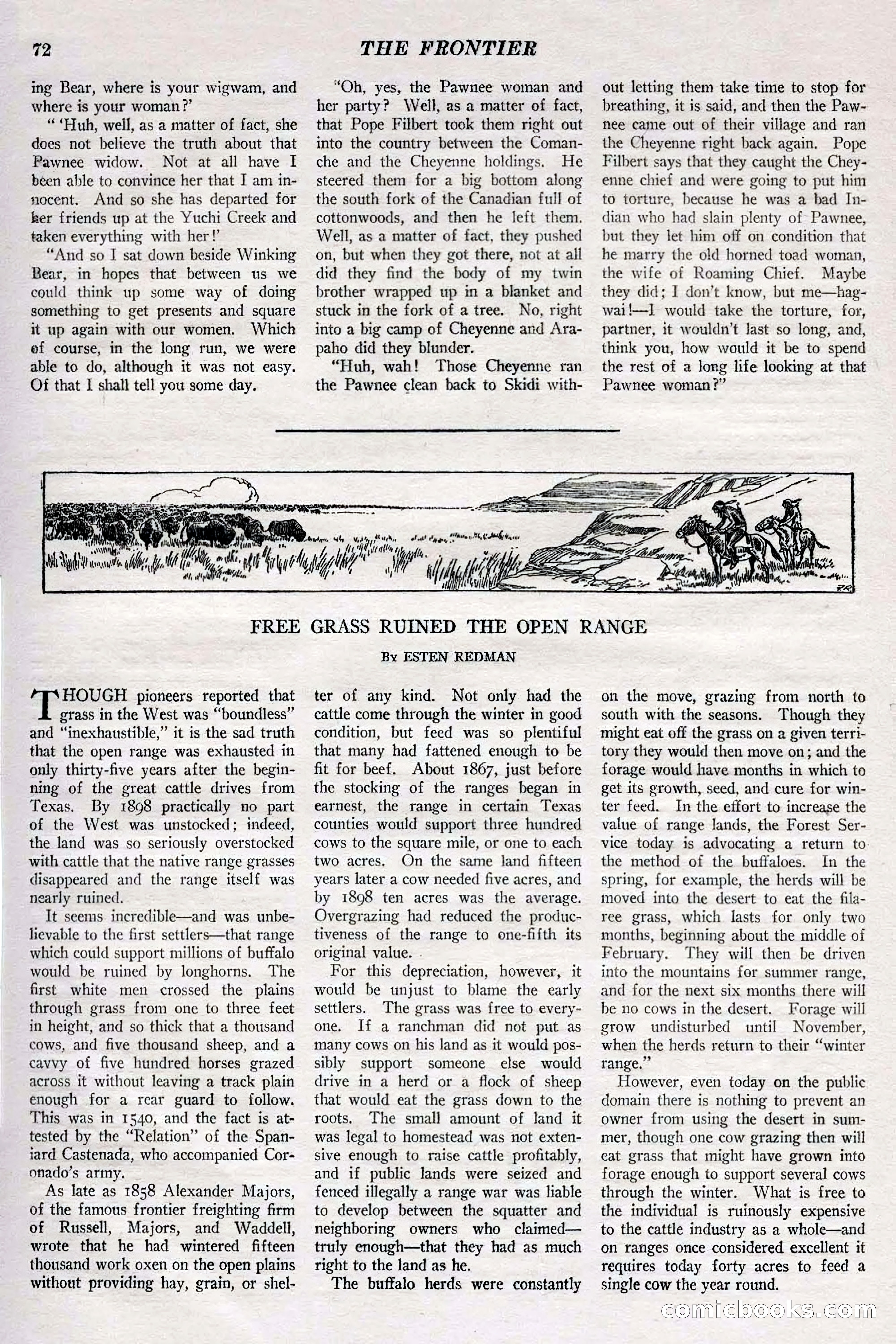
# Page 72 from "The Frontier" This page contains prose fiction and a landscape illustration. The top half continues a story about interactions between Native Americans (Pawnee and Cheyenne) and settlers, involving a woman and a man named Winking Bear discussing past events and kidnappings. Below the prose is a horizontal illustration showing a frontier landscape with grassland, hills, and figures on horseback. The bottom half begins a new article titled "Free Grass Ruined the Open Range" by Esten Redman, which discusses the historical overgrazing and depletion of Western rangeland in the 19th century, explaining how excessive cattle and livestock exhausted the prairie's natural resources.
📄 Transcribed text from this page (OCR, searchable)
Machine-transcribed from the original scan — historical spelling and the odd misread are preserved.
72 ing Bear, where is your wigwam, and where is your woman?’ “ “Huh, well, as a matter of fact, she does not believe the truth about that Pawnee widow. Not at all have I been able to convince her that I am in- nocent. And so she has departed for ker friends up at the Yuchi Creek and taken everything with her!’ “And so I sat down beside Winking Bear, in hopes that between us we could think up some way of doing something to get presents and square it up again with our women. Which ef course, in the long run, we were able to do, although it was not easy. Of that I shall tell you some day. THE FRONTIER “Oh, yes, the Pawnee woman and her party? Well, as a matter of fact, that Pope Filbert took them right out into the country between the Coman- che and the Cheyenne holdings. He steered them for a big bottom along the south fork of the Canadian full of cottonwoods, and then he left them. Well, as a matter of fact, they pushed on, but when they got there, not at all did they find the body of my twin brother wrapped up in a blanket and stuck in the fork of a tree. No, right into a big camp of Cheyenne and Ara- paho did they blunder. “Huh, wah! Those Cheyenne ran the Pawnee clean back to Skidi with- out letting them take time to stop for breathing, it is said, and then the Paw- nee caine out of their village and ran the Cheyenne right back again. Pope Filbert says that they caught the Chey- enne chief and were going to put him to torture, because he was a bad In- dian who had slain plenty of Pawnee, but they let him off on condition that he marry the old horned toad woman, the wife of Roaming Chief. Maybe they did; I don’t know, but me—hag- wai!—J would take the torture, for, partner, it wouldn’t last so long, and, think you, how would it be to spend the rest of a long life looking at that Pawnee woman?” wen btabygrts why “i i ties of at! poe is # Farts «, Me, Athi dn « TT meat vi ee a halle — ‘a Wile FREE GRASS RUINED THE OPEN RANGE HOUGH pioneers reported that grass in the West was “boundless” and “inexhaustible,” it is the sad truth that the open range was exhausted in only thirty-five years after the begin- ning of the great cattle drives from Texas. By 18098 practically no part of the West was unstocked; indeed, the land was so seriously overstocked with cattle that the native range grasses disappeared and the range itself was nearly ruined. It seems incredible—and was unbe- lievable to the first settlers—that range which could support millions of buffalo would be ruined by longhorns. The first white men crossed the plains through grass from one to three feet in height, and so thick that a thousand cows, and five thousand sheep, and a cavvy of five hundred horses grazed across it without leaving a track plain enough for a rear guard to follow. This was in 1540, and the fact is at- tested by the “Relation” of the Span- iard Castenada, who accompanied Cor- onado’s army. As late as 1858 Alexander Majors, of the famous frontier freighting firm of Russell, Majors, and Waddell, wrote that he had wintered fifteen thousand work oxen on the open plains without providing hay, grain, or shel- ter of any kind. Not only had the cattle come through the winter in good condition, but feed was so plentiful that many had fattened enough to be fit for beef. About 1867, just before the stocking of the ranges began in earnest, the range in certain Texas counties would support three hundred cows to the square mile, or one to each two acres. On the same land fifteen years later a cow needed five acres, and by 1898 ten acres was the average. Overgrazing had reduced the produc- tiveness of the range to one-fifth its original value. . For this depreciation, however, it would be unjust to blame the early settlers. The grass was free to every- one. If a ranchman did not put as many cows on his land as it would pos- sibly support someone else would drive in a herd or a flock of sheep that would eat the grass down to the roots. The small amount of land it was legal to homestead was not exten- sive enough to raise cattle profitably, and if public lands were seized and fenced illegally a range war was liable to develop between the squatter and neighboring owners who claimed— truly enough—that they had as much right to the land as he. The buffalo herds were constantly on the move, grazing from north to south with the seasons. Though they might eat off the grass on a given terri- tory they would then move on; and the forage would have months in which to get its growth, seed, and cure for win- ter feed. In the effort to increase the value of range lands, the Forest Ser- vice today is advocating a return to the method of the buffaloes. In the spring, for example, the herds will be moved into the desert to eat the fila- ree grass, which lasts for only two months, beginning about the middle of February. They will then be driven into the mountains for summer range, and for the next six months there will be no cows in the desert. Forage will grow undisturbed until November, when the herds return to their “winter range.” However, even today on the public domain there is nothing to prevent an owner from using the desert in sum- mer, though one cow grazing then will eat grass that might have grown into forage enough to support several cows through the winter. What is free to the individual is ruinously expensive to the cattle industry as a whole—and on ranges once considered excellent it requires today forty acres to feed a single cow the year round. GOMIGoOO CONN S