
Pulp Fiction, 1926 · page 90 of 114
The Frontier, May 1926 — page 90: what you’re looking at
What you’re looking at
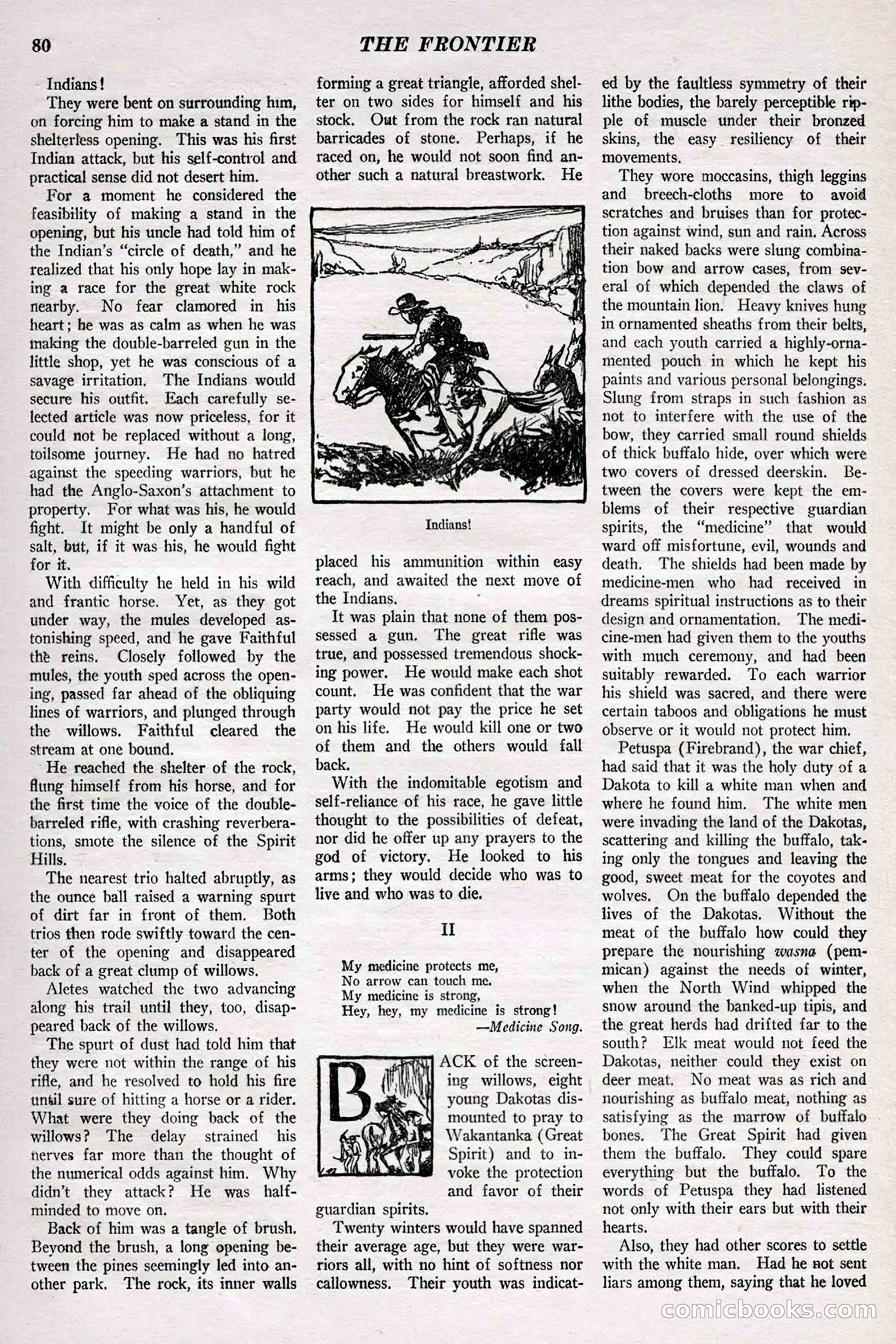
# Page Analysis This is story prose from a pulp fiction magazine titled "THE FRONTIER" (visible in the header). The page contains two text sections separated by a small illustration showing a rider on horseback in dramatic action. The narrative depicts a tense frontier scene where a white man takes shelter in rocks while Native American warriors approach. The text describes his strategic positioning, his rifle, and his confidence in his ability to fight. The second section begins with a "Medicine Song" and shifts perspective to discuss Native American warriors' preparations, their spiritual beliefs about protection, and their conflict with white settlers over buffalo hunting rights and territorial invasion. The content appears to be a Western adventure story emphasizing frontier conflict and cultural clash.
📄 Transcribed text from this page (OCR, searchable)
Machine-transcribed from the original scan — historical spelling and the odd misread are preserved.
80 - Indians! They were bent on surrounding him, on forcing him to make a stand in the shelterless opening. This was his first Indian attack, but his self-control and practical sense did not desert him. For a moment he considered the feasibility of making a stand in the opening, but his uncle had told him of the Indian’s “circle of death,” and he realized that his only hope lay in mak- ing a race for the great white rock nearby. No fear clamored in his heart; he was as calm as when he was inaking the double-barreled gun in the little shop, yet he was conscious of a savage irritation, The Indians would secure his outfit, Each carefully se- lected article was now priceless, for it could not be replaced without a long, toilsome journey. He had no hatred against the speeding warriors, but he had the Anglo-Saxon’s attachment to property. For what was his, he would fight. It might be only a handful of salt, but, if it was his, he would fight for it. With difficulty he held in his wild and frantic horse. Yet, as they got under way, the mules developed as- tonishing speed, and he gave Faithful the reins. Closely followed by the mules, the youth sped across the open- ing, passed far ahead of the obliquing lines of warriors, and plunged through the willows. Faithful cleared the stream at one bound. He reached the shelter of the rock, flung himself from his horse, and for the first time the voice of the double- barreled rifle, with crashing reverbera- tions, smote the silence of the Spirit Hills. The nearest trio halted abruptly, as the ounce ball raised a warning spurt of dirt far in front of them. Both trios then rode swiftly toward the cen- ter of the opening and disappeared back of a great clump of willows, Aletes watched the two advancing along his trail until they, too, disap- peared back of the willows. The spurt of dust had told him that they were not within the range of his rifle, and he resolved to hold his fire until sure of hitting a horse or a rider. What were they doing back of the willows? The delay strained his nerves far more than the thought of the numerical odds against him. Why didn’t they attack? He was _half- minded to move on. Back of him was a tangle of brush. Beyond the brush, a long opening be- tween the pines seemingly led into an- other park. The rock, its inner walls THE FRONTIER forming a great triangle, afforded shel- ter on two sides for himself and his stock, Out from the rock ran natural barricades of stone. Perhaps, if he raced on, he would not soon find an- other such a natural breastwork. He Indians! placed his ammunition within easy reach, and awaited the next move of the Indians. : It was plain that none of them pos- sessed a gun. The great rifle was true, and possessed tremendous shock- ing power. He would make each shot count. He was confident that the war party would not pay the price he set on his life. He would kill one or two of them and the others would fall back. With the indomitable egotism and self-reliance of his race, he gave little thought to the possibilities of defeat, nor did he offer up any prayers to the god of victory. He looked to his arms; they would decide who was to live and who was to die, il My medicine protects me, No arrow can touch me, My medicine is strong, Hey, hey, my medicine is strong! —Medicine Song. mM) ACK of the screen- WW ing willows, eight young Dakotas dis- mounted to pray to Wakantanka (Great Spirit) and to in- voke the protection and favor of their guardian spirits. Twenty winters would have spanned their average age, but they were war- riors all, with no hint of softness nor callowness. Their youth was indicat- ed by the faultless symmetry of their lithe bodies, the barely perceptible rip- ple of muscle under their bronzed skins, the easy resiliency of their movements, They wore moccasins, thigh leggins and breech-cloths more to avoid scratches and bruises than for protec- tion against wind, sun and rain, Across their naked backs were slung combina- tion bow and arrow cases, from sev- eral of which depended the claws of the mountain lion. Heavy knives hung in ornamented sheaths from their belts, and each youth carried a highly-orna- mented pouch in which he kept his paints and various personal belongings. Slung from straps in such fashion as not to interfere with the use of the bow, they carried small round shields of thick buffalo hide, over which were two covers of dressed deerskin. Be- tween the covers were kept the em- blems of their respective guardian spirits, the “medicine” that would ward off misfortune, evil, wounds and death. The shields had been made by medicine-men who had received in dreams spiritual instructions as to their design and ornamentation, The medi- cine-men had given them to the youths with much ceremony, and had been suitably rewarded. To each warrior his shield was sacred, and there were certain taboos and obligations he must observe or it would not protect him. Petuspa (Firebrand), the war chief, had said that it was the holy duty of a Dakota to kill a white man when and where he found him. The white men were invading the land of the Dakotas, scattering and killing the buffalo, tak- ing only the tongues and leaving the good, sweet meat for the coyotes and wolves. On the buffalo depended the lives of the Dakotas. Without the meat of the buffalo how could they prepare the nourishing wasna (pem- mican) against the needs of winter, when the North Wind whipped the snow around the banked-up tipis, and the great herds had drifted far to the south? Elk meat would not feed the Dakotas, neither could they exist on deer meat. No meat was as rich and nourishing as buffalo meat, nothing as satisfying as the marrow of buffalo bones. The Great Spirit had given them the buffalo. They could spare everything but the buffalo. To the words of Petuspa they had listened not only with their ears but with their hearts. Also, they had other scores to settle with the white man. Had he not sent liars among them, saying that he loved COmicboooxks. com