
Pulp Fiction, 1926 · page 92 of 114
The Frontier, May 1926 — page 92: what you’re looking at
What you’re looking at
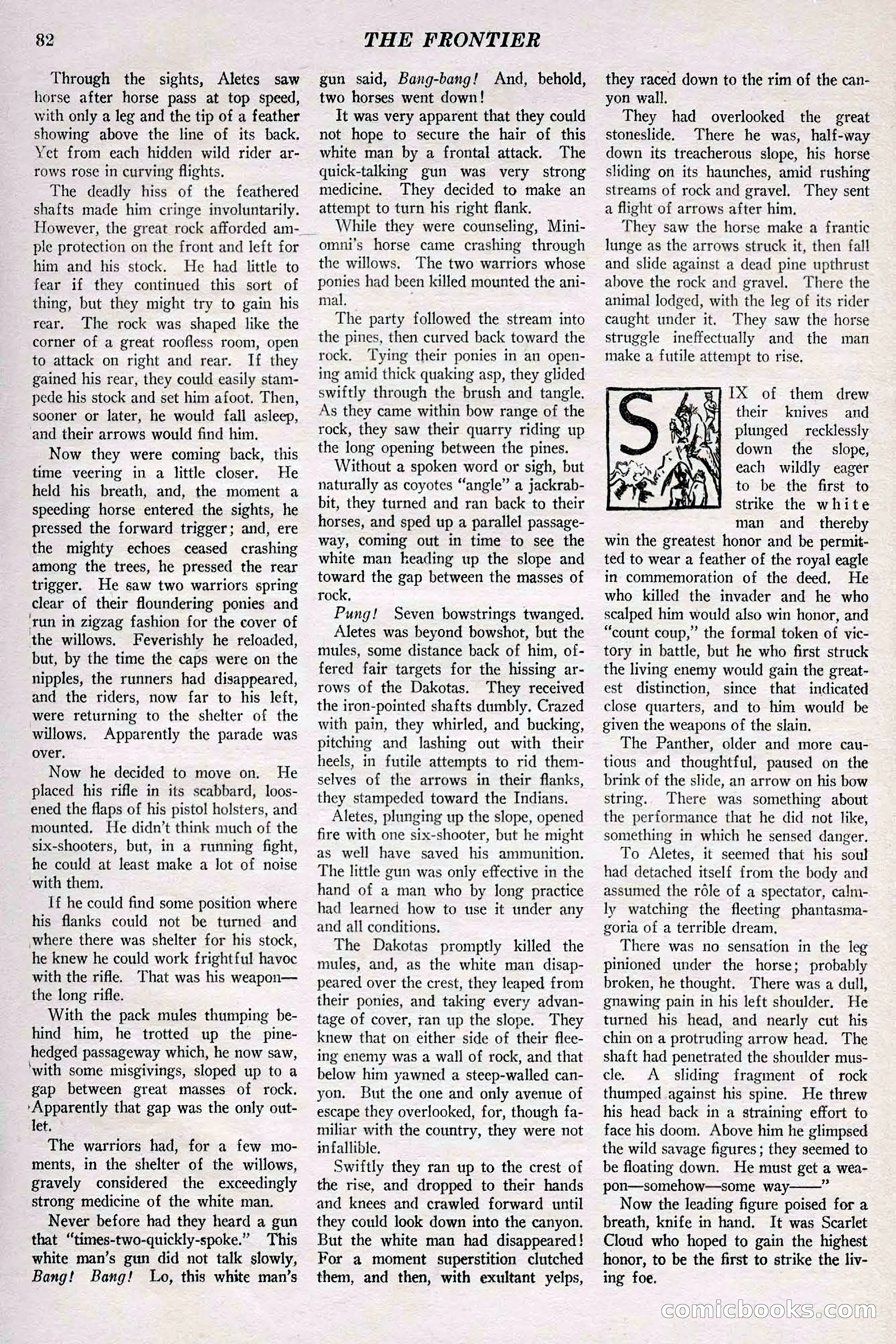
# Page 82 from "The Frontier" This is a text-only page of prose fiction containing two columns of dense narrative. The story appears to involve a conflict on a mountainous frontier landscape, depicting warriors on horseback engaged in combat with a white man who possesses a rifle. The text describes action scenes including gunfire, horses being shot, and warriors pursuing the armed man through rocky terrain and pine forests. There's an ornamental capital letter "S" with decorative illustration at the start of one paragraph. The prose emphasizes the tactical advantages of the rifle against traditional weapons and the dramatic geography of the landscape where this confrontation occurs.
📄 Transcribed text from this page (OCR, searchable)
Machine-transcribed from the original scan — historical spelling and the odd misread are preserved.
82 Through the sights, Aletes saw horse after horse pass at top speed, with only a leg and the tip of a feather showing above the line of its back. Yet from each hidden wild rider ar- rows rose in curving flights. The deadly hiss of the feathered shafts made him cringe involuntarily. However, the great rock afforded am- ple protection on the front and left for him and his stock. He had little to fear if they continued this sort of thing, but they might try to gain his rear. The rock was shaped like the corner of a great roofless room, open to attack on right and rear. If they gained his rear, they could easily stam- pede his stock and set him afoot. Then, sooner or later, he would fall asleep, and their arrows would find him. Now they were coming back, this time veering in a little closer. He held his breath, and, the moment a speeding horse entered the sights, he pressed the forward trigger; and, ere the mighty echoes ceased crashing among the trees, he pressed the rear trigger. He saw two warriors spring clear of their floundering ponies and tun in zigzag fashion for the cover of the willows. Feverishly he reloaded, but, by the time the caps were on the nipples, the runners had disappeared, and the riders, now far to his left, were returning to the shelter of the willows. Apparently the parade was over. Now he decided to move on. He placed his rifle in its scabbard, loos- ened the flaps of his pistol holsters, and mounted. He didn’t think much of the six-shooters, but, in a running fight, he could at least make a lot of noise with them. If he could find some position where his flanks could not be turned and where there was shelter for his stock, he knew he could work frightful havoc with the rifle. That was his weapon— the long rifle. With the pack mules thumping be- hind him, he trotted up the pine- hedged passageway which, he now saw, ‘with some misgivings, sloped up to a gap between great masses of rock. ‘Apparently that gap was the only out- let. The warriors had, for a few mo- ments, in the shelter of the willows, gravely considered the exceedingly strong medicine of the white man. Never before had they heard a gun that “times-two-quickly-spoke.” This white man’s gun did not talk slowly, Bang! Bang! Lo, this white man’s THE FRONTIER gun said, Bang-bang! And, behold, two horses went down! It was very apparent that they could not hope to secure the hair of this white man by a frontal attack. The quick-talking gun was very strong medicine. They decided to make an attempt to turn his right flank. While they were counseling, Mini- omni’s horse came crashing through the willows. The two warriors whose ponies had been killed mounted the ani- mal. The party followed the stream into the pines, then curved back toward the rock, Tying their ponies in an open- ing amid thick quaking asp, they glided swiftly through the brush and tangle. As they came within bow range of the rock, they saw their quarry riding up the long opening between the pines. Without a spoken word or sigh, but naturally as coyotes “angle” a jackrab- bit, they turned and ran back to their horses, and sped up a parallel passage- way, coming out in time to see the white man heading up the slope and toward the gap between the masses of rock, Pung! Seven bowstrings twanged. Aletes was beyond bowshot, but the mules, some distance back of him, of- fered fair targets for the hissing ar- rows of the Dakotas. They received the iron-pointed shafts dumbly. Crazed with pain, they whirled, and bucking, pitching and lashing out with their heels, in futile attempts to rid them- selves of the arrows in their flanks, they stampeded toward the Indians. Aletes, plunging up the slope, opened fire with one six-shooter, but he might as well have saved his ammunition. The little gun was only effective in the hand of a man who by long practice had learned how to use it under any and all conditions, The Dakotas promptly killed the mules, and, as the white man disap- peared over the crest, they leaped from their ponies, and taking every advan- tage of cover, ran up the slope. They knew that on either side of their flee- ing enemy was a wall of rock, and that below him yawned a steep-walled can- yon. But the one and only avenue of escape they overlooked, for, though fa- miliar with the country, they were not infallible. Swiftly they ran up to the crest of the rise, and dropped to their hands and knees and crawled forward until they could look down into the canyon. But the white man had disappeared ! For a moment superstition clutched them, and then, with exultant yelps, they raced down to the rim of the can- yon wall. They had overlooked the great stoneslide. There he was, half-way down its treacherous slope, his horse sliding on its haunches, amid rushing streams of rock and gravel. They sent a flight of arrows after him. They saw the horse make a frantic lunge as the arrows struck it, then fall and slide against a dead pine upthrust above the rock and gravel. There the animal lodged, with the leg of its rider caught under it. They saw the horse struggle ineffectually and the man make a futile attempt to rise. [X of them drew their knives and plunged recklessly down the _ slope, each wildly eager to be the first to strike the white man and_ thereby win the greatest honor and be permit- ted to wear a feather of the royal eagle in commemoration of the deed, He who killed the invader and he who scalped him would also win honor, and “count coup,” the formal token of vic- tory in battle, but he who first struck the living enemy would gain the great- est distinction, since that indicated close quarters, and to him would be given the weapons of the slain. The Panther, older and more cau- tious and thoughtful, paused on the brink of the slide, an arrow on his bow string. There was something about the performance that he did not like, something in which he sensed danger. To Aletes, it seemed that his soul had detached itself from the body and assumed the role of a spectator, calm- ly watching the fleeting phantasma- goria of a terrible dream, There was no sensation in the leg pinioned under the horse; probably broken, he thought. There was a dull, gnawing pain in his left shoulder. He turned his head, and nearly cut his chin on a protruding arrow head. The shaft had penetrated the shoulder mus- cle. A sliding fragment of rock thumped against his spine. He threw his head back in a straining effort to face his doom. Above him he glimpsed the wild savage figures ; they seemed to be floating down. He must get a wea- pon—somehow—some wa} te Now the leading figure poised for a breath, knife in hand. It was Scarlet Cloud who hoped to gain the highest honor, to be the first to strike the liv- ing foe. ConniclooOoks Cor