
Pulp Fiction, 1926 · page 94 of 114
The Frontier, May 1926 — page 94: what you’re looking at
What you’re looking at
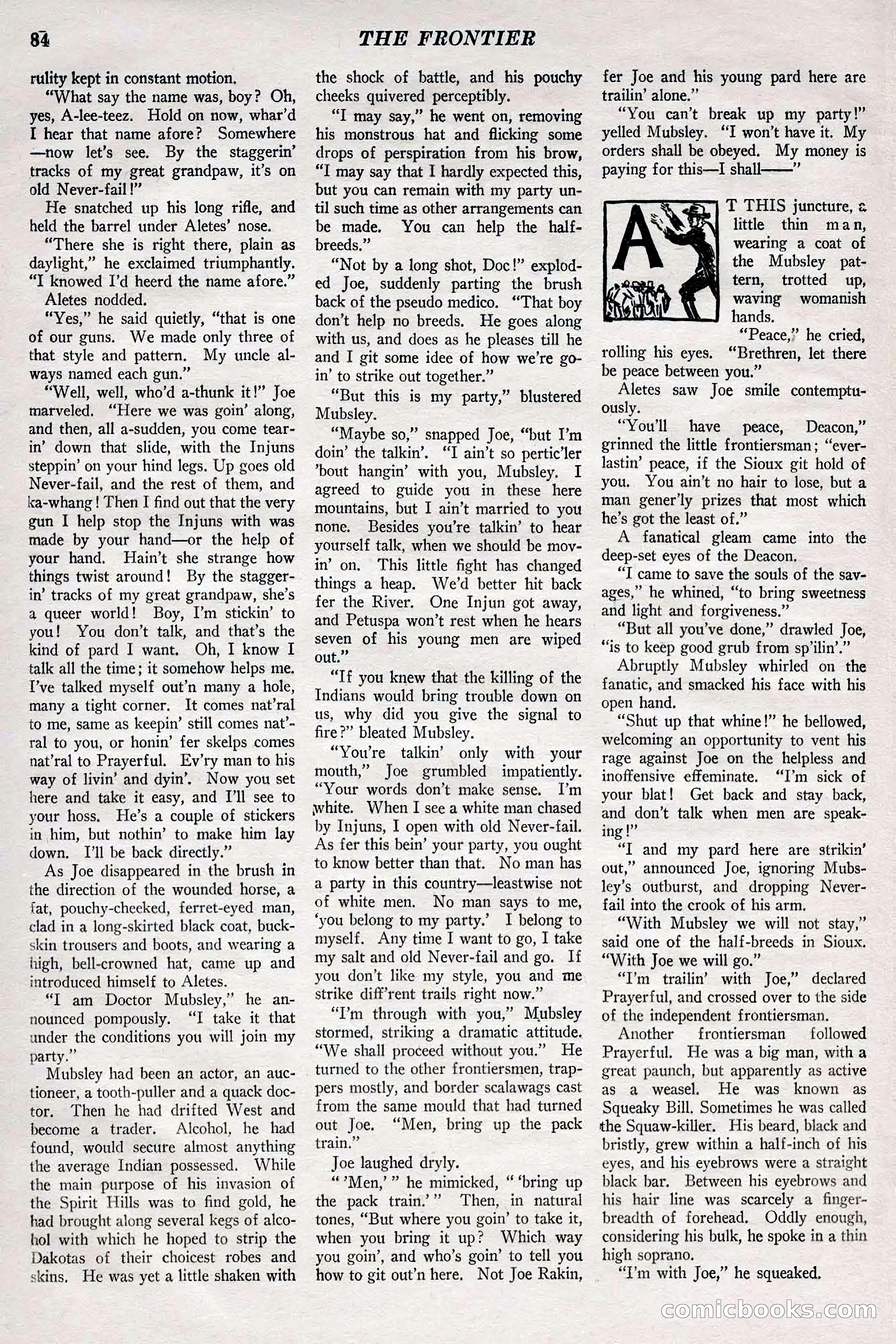
# Page 84 from "The Frontier" This is a story prose page from what appears to be a Western pulp magazine. The visible text depicts a confrontation between frontier characters, including Joe, Aletes, Musbley (described as a former actor and trader), and others. The narrative involves disagreement over party membership and loyalty, with Joe and his companion apparently planning to leave Musbley's group to strike out independently in the mountains. There's tension regarding the treatment of Native Americans and references to gold-seeking. A small illustration near the top shows a thin man in a coat of Musbley pattern. The page number is 84, with the magazine title "THE FRONTIER" at the header.
📄 Transcribed text from this page (OCR, searchable)
Machine-transcribed from the original scan — historical spelling and the odd misread are preserved.
84 rulity kept in constant motion. “What say the name was, boy? Oh, yes, A-lee-teez. Hold on now, whar’d I hear that name afore? Somewhere —now let’s see. By the staggerin’ tracks of my great grandpaw, it’s on old Never-fail !” He snatched up his long rifle, and held the barrel under Aletes’ nose. “There she is right there, plain as daylight,” he exclaimed triumphantly. “I knowed I’d heerd the name afore.” Aletes nodded. Ves,” he said quietly, “that is one of our guns. We made only three of that style and pattern. My uncle al- ways named each gun.” “Well, well, who’d a-thunk it!” Joe marveled. ‘Here we was goin’ along, and then, all a-sudden, you come tear- in’ down that slide, with the Injuns steppin’ on your hind legs. Up goes old Never-fail, and the rest of them, and ka-whang ! Then I find out that the very gun I help stop the Injuns with was made by your hand—or the help of your hand. MHain’t she strange how things twist around! By the stagger- in’ tracks of my great grandpaw, she’s a queer world! Boy, I’m stickin’ to you! You don’t talk, and that’s the kind of pard I want. Oh, I know I talk all the time; it somehow helps me. I've talked myself out’n many a hole, many a tight corner. It comes nat’ral to me, same as keepin’ still comes nat’- ral to you, or honin’ fer skelps comes nat’ral to Prayerful. Ev’ry man to his way of livin’ and dyin’, Now you set here and take it easy, and I'll see to your hoss. He’s a couple of stickers in him, but nothin’ to make him lay down. Ill be back directly.” As Joe disappeared in the brush in the direction of the wounded horse, a fat, pouchy-cheeked, ferret-eyed man, clad in a long-skirted black coat, buck- skin trousers and boots, and wearing a high, bell-crowned hat, came up and introduced himself to Aletes. “IT am Doctor Mubsley,” he an- nounced pompously. “I take it that under the conditions you will join my party.” Mubsley had been an actor, an atuc- tioneer, a tooth-puller and a quack doc- tor. Then he had drifted West and become a trader. Alcohol, he had found, would secure almost anything the average Indian possessed. While the main purpose of his invasion of the Spirit Hills was to find gold, he had brought along several kegs of alco- hol with which he hoped to strip the Dakotas of their choicest robes and skins. He was yet a little shaken with THE FRONTIER the shock of battle, and his pouchy cheeks quivered perceptibly. “I may say,” he went on, removing his monstrous hat and flicking some drops of perspiration from his brow, “I may say that I hardly expected this, but you can remain with my party un- til such time as other arrangements can be made. You can help the half- breeds,” “Not by a long shot, Doc!” explod- ed Joe, suddenly parting the brush back of the pseudo medico. “That boy don’t help no breeds. He goes along with us, and does as he pleases till he and I git some idee of how we’re go- in’ to strike out together.” “But this is my party,” blustered Mubsley. “Maybe so,” snapped Joe, “but I’m doin’ the talkin’. “TI ain’t so pertic’ler bout hangin’ with you, Mubsley. I agreed to guide you in these here mountains, but I ain’t married to you none. JBesides you're talkin’ to hear yourself talk, when we should be mov- in’ on, This little fight has changed things a heap. We'd better hit back fer the River, One Injun got away, and Petuspa won’t rest when he hears seven of his young men are wiped out.” “If you knew that the killing of the Indians would bring trouble down on us, why did you give the signal to fire?” bleated Mubsley. “You're talkin’ only with your mouth,” Joe grumbled impatiently. “Your words don’t make sense. I’m white. When I see a white man chased by Injuns, I open with old Never-fail. As fer this bein’ your party, you ought to know better than that. No man has a party in this country—leastwise not of white men. No man says to me, ‘you belong to my party.’ I belong to myself, Any time I want to go, I take my salt and old Never-fail and go. If you don’t like my style, you and me strike diff’rent trails right now.” “T’m through with you,” Mubsley stormed, striking a dramatic attitude. “We shall proceed without you.” He turned to the other frontiersmen, trap- pers mostly, and border scalawags cast from the same mould that had turned out Joe. “Men, bring up the pack train,” Joe laughed dryly. “?Men,’” he mimicked, “ ‘bring up the pack train.” Then, in natural tones, “But where you goin’ to take it, when you bring it up? Which way you goin’, and who’s goin’ to tell you how to git out’n here, Not Joe Rakin, fer Joe and his young pard here are trailin’ alone.” “You can’t break up my party!” yelled Mubsley. “I won't have it. My orders shall be obeyed. My money is paying for this—I shall——” T THIS juncture, < little thin man, wearing a coat of the Mubsley pat- tern, trotted up, waving womanish hands. “Peace,” he cried, rolling his eyes. “Brethren, let there be peace between you.” Aletes saw Joe smile contemptu- ously. “You'll have peace, Deacon,” grinned the little frontiersman; “ever- lastin’ peace, if the Sioux git hold of you. You ain’t no hair to lose, but a man gener’ly prizes that most which he’s got the least of.” A fanatical gleam came into the deep-set eyes of the Deacon. “I came to save the souls of the sav- ages,” he whined, “to bring sweetness and light and forgiveness.” “But all you’ve done,” drawled Joe, “is to keep good grub from sp’ilin’.” Abruptly Mubsley whirled on the fanatic, and smacked his face with his open hand. “Shut up that whine!” he bellowed, welcoming an opportunity to vent his rage against Joe on the helpless and inoffensive effeminate. “I’m sick of your blat! Get back and stay back, and don’t talk when men are speak- ing!” “I and my pard here are strikin’ out,” announced Joe, ignoring Mubs- ley’s outburst, and dropping Never- fail into the crook of his arm. “With Mubsley we will not stay,” said one of the hali-breeds in Sioux. “With Joe we will go.” “I’m trailin’ with Joe,” declared Prayerful, and crossed over to the side of the independent frontiersman. Another frontiersman followed Prayerful. He was a big man, with a great paunch, but apparently as active as a weasel. He was known as Squeaky Bill. Sometimes he was called the Squaw-killer. His beard, black and bristly, grew within a half-inch of his eyes, and his eyebrows were a straight black bar. Between his eyebrows and his hair line was scarcely a finger- breadth of forehead. Oddly enough, considering his bulk, he spoke in a thin high soprano, “I’m with Joe,” he squeaked. Gomicbooksncom