
Pulp Fiction, 1926 · page 75 of 114
The Frontier, May 1926 — page 75: what you’re looking at
What you’re looking at
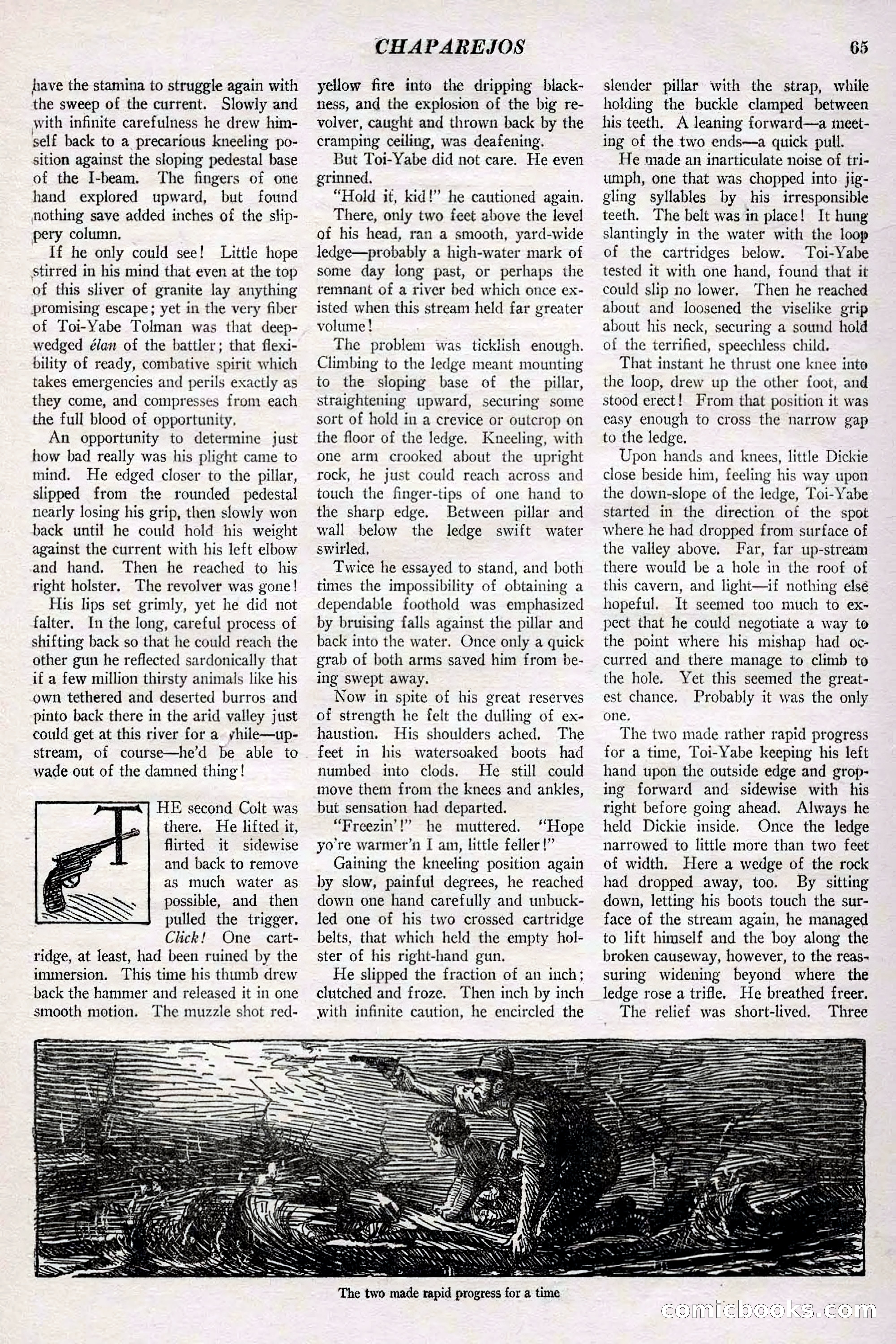
# Page Analysis: "Chaparejos" This is a **story page with illustration** from page 65 of what appears to be a Western pulp fiction magazine. The text describes two characters—Toi-Yabe and a boy named Dickie—navigating a treacherous cave passage beside a river. They're attempting to climb across a narrow ledge while water swirls below, with Toi-Yabe having lost his revolver and now trying to retrieve it. The passage emphasizes physical danger, exhaustion, and determination. The black-and-white illustration at page bottom shows the two figures making their way across the perilous terrain, matching the narrative's tense climbing sequence.
📄 Transcribed text from this page (OCR, searchable)
Machine-transcribed from the original scan — historical spelling and the odd misread are preserved.
have the stamina to struggle again with the sweep of the current. Slowly and with infinite carefulness he drew him- self back to a precarious kneeling po- sition against the sloping pedestal base of the I-beam. The fingers of one hand explored upward, but found nothing save added inches of the slip- pery column. If he only could see! Little hope stirred in his mind that even at the top of this sliver of granite lay anything promising escape; yet in the very fiber of Toi-Yabe Tolman was that deep- wedged élan of the battler; that flexi- bility of ready, combative spirit which takes emergencies and perils exactly as they come, and compresses from each the full blood of opportunity, An opportunity to determine just how bad really was his plight came to mind. He edged closer to the pillar, slipped from the rounded pedestal nearly losing his grip, then slowly won back until he could hold his weight against the current with his left elbow and hand. Then he reached to his right holster. The revolver was gone! His lips set grimly, yet he did not falter. In the long, careful process of shifting back so that he could reach the other gun he reflected sardonically that if a few million thirsty animals like his own tethered and deserted burros and pinto back there in the arid valley just could get at this river for a yhile—up- stream, of course—he’d be able to wade out of the damned thing! HE second Colt was there. He lifted it, flirted it sidewise and back to remove as much water as possible, and then pulled the trigger. Click! One cart- ridge, at least, had been ruined by the immersion. This time his thumb drew back the hammer and released it in one smooth motion. The muzzle shot red- / ead 63) 4) aie te ve } myn ani V) \ \ hey i\)' Hy id, { ; “J 1 i ‘ i} ' dé i SOARS f J}, “ “lh CHAPAREJOS yellow fire into the dripping black- ness, and the explosion of the big re- volver, caught and thrown back by the cramping ceiling, was deafening. But Toi-Yabe did not care. He even grinned, “Hold it, kid!” he cautioned again. There, only two feet above the level of his head, ran a smooth, yard-wide ledge—probably a high-water mark of some day long past, or perhaps the remnant of a river bed which once ex- isted when this stream held far greater volume! The problem was ticklish enough. Climbing to the ledge meant mounting to the sloping base of the pillar, straightening upward, securing some sort of hold in a crevice or outcrop on the floor of the ledge. Kneeling, with one arm crooked about the upright rock, he just could reach across and touch the finger-tips of one hand to the sharp edge. Between pillar and wall below the ledge swift water swirled, Twice he essayed to stand, and both times the impossibility of obtaining a dependable foothold was emphasized by bruising falls against the pillar and back into the water. Once only a quick grab of both arms saved him from be- ing swept away. Now in spite of his great reserves of strength he felt the dulling of ex- haustion. His shoulders ached, The feet in his watersoaked boots had numbed into clods. He still could move them from the knees and ankles, but sensation had departed. “Freezin’!” he muttered. “Hope yore warmer’n [ am, little feller!” Gaining the kneeling position again by slow, painful degrees, he reached down one hand carefully and unbuck- led one of his two crossed cartridge belts, that which held the empty hol- ster of his right-hand gun. He slipped the fraction of an inch; clutched and froze. Then inch by inch with infinite caution, he encircled the _— : ~—aN Ny TH 3 < uy S re MM ANMt —— SR SS SANS AOA Wess . : » * 65 slender pillar with the strap, while holding the buckle clamped between his teeth. A leaning forward—a meet- ing of the two ends—a quick pull. He made an inarticulate noise of tri- umph, one that was chopped into jig- gling syllables by his irresponsible teeth. The belt was in place! It hung slantingly in the water with the loop of the cartridges below. Toi-Yabe tested it with one hand, found that it could slip no lower. Then he reached about and loosened the viselike grip about his neck, securing a sound hold of the terrified, speechless child. That instant he thrust one knee into the loop, drew up the other foot, and stood erect! From that position it was easy enough to cross the narrow gap to the ledge. Upon hands and knees, little Dickie close beside him, feeling his way upon the down-slope of the ledge, Toi-Yabe started in the direction of the spot where he had dropped from surface of the valley above, Far, far up-stream there would be a hole in the roof of this cavern, and light—if nothing elsé hopeful. It seemed too much to ex- pect that he could negotiate a way to the point where his mishap had oc- curred and there manage to climb to the hole. Yet this seemed the great- est chance. Probably it was the only one. The two made rather rapid progress for a time, Toi-Yabe keeping his left hand upon the outside edge and grop- ing forward and sidewise with his right before going ahead. Always he held Dickie inside. Once the ledge narrowed to little more than two feet of width. Here a wedge of the rock had dropped away, too. By sitting down, letting his boots touch the sur- face of the stream again, he managed to lift himself and the boy along the broken causeway, however, to the reas- suring widening beyond where the ledge rose a trifle. He breathed freer. The relief was short-lived. Three