
Pulp Fiction, 1926 · page 42 of 114
The Frontier, May 1926 — page 42: what you’re looking at
What you’re looking at
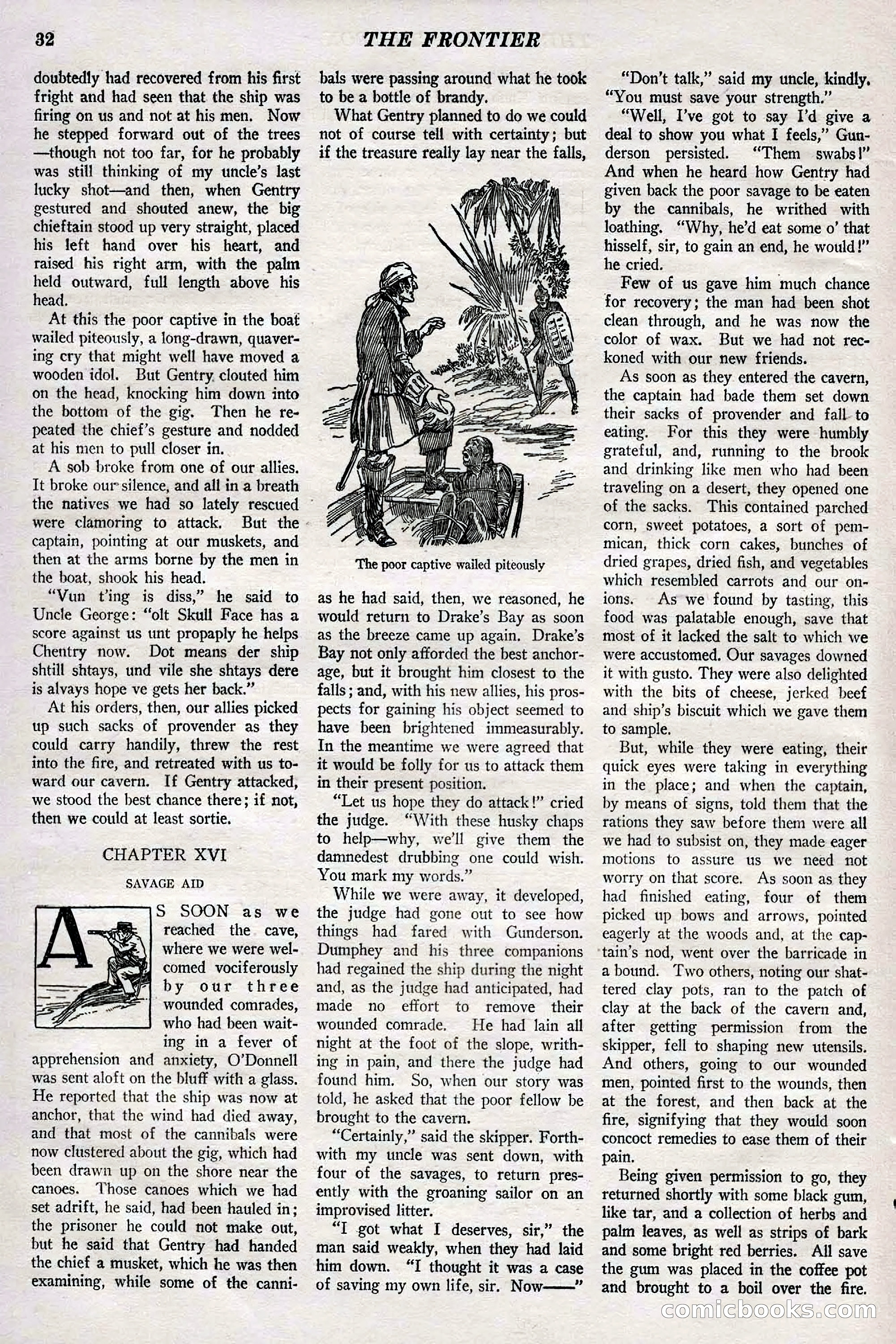
# Page Analysis This is a text page from a pulp fiction story titled "THE FRONTIER" (Chapter XVI: "Savage Aid"). The page contains narrative prose alongside a single black-and-white illustration depicting several figures near what appears to be a shoreline or camp setting. The visible text describes a group of castaways or soldiers who have retreated to a cave for shelter. The narrative discusses their discovery of provisions in sacks—including parched corn, corn cakes, dried grapes, and fish—and their subsequent recovery efforts. The text also references interactions with native peoples and plans to treat wounded companions using herbs and other remedies. The illustration shows figures in period dress (appears to be colonial or early exploration era) gathered near a boat or camp area.
📄 Transcribed text from this page (OCR, searchable)
Machine-transcribed from the original scan — historical spelling and the odd misread are preserved.
32 doubtedly had recovered from his first fright and had seen that the ship was firing on us and not at his men. Now he stepped forward out of the trees —though not too far, for he probably was still thinking of my wncle’s last lucky shot—and then, when Gentry gestured and shouted anew, the big chieftain stood up very straight, placed his left hand over his heart, and raised his right arm, with the palm held outward, full length above his head, At this the poor captive in the boat wailed piteously, a long-drawn, quaver- ing cry that might well have moved a wooden idol. But Gentry. clouted him on the head, knocking him down into the bottom of the gig. Then he re- peated the chief’s gesture and nodded at his men to pull closer in. A sob broke from one of our allies. It broke our silence, and all in a breath the natives we had so lately rescued © were clamoring to attack. But the - captain, pointing at our muskets, and then at the arms borne by the men in the boat, shook his head. “Vun ting is diss,” he said to Uncle George: “olt Skull Face has a score against us tint propaply he helps Chentry now. Dot means der ship shtill shtays, und vile she shtays dere is alvays hope ve gets her back.” At his orders, then, our allies picked up stich sacks of provender as they could carry handily, threw the rest into the fire, and retreated with us to- ward our cavern. If Gentry attacked, we stood the best chance there; if not, then we could at least sortie. CHAPTER XVI SAVAGE AID 7S SOON as we reached the cave, where we were wel- comed vociferously by our three wounded comrades, } who had been wait- ing in a fever of apprehension and anxiety, O’Donnell was sent aloft on the bluff with a glass. He reported that the ship was now at anchor, that the wind had died away, and that most of the cannibals were now clustered about the gig, which had been drawn up on the shore near the canoes. ‘Those canoes which we had set adrift, he said, had been hauled in; the prisoner he could not make out, but he said that Gentry had handed the chief a musket, which he was then examining, while some of the canni- THE FRONTIER bals were passing around what he took to be a bottle of brandy. What Gentry planned to do we could not of course tell with certainty; but if the treasure really lay near the falls, ohh ated ; Lea iy +, ah a ee —— Ee, ae Zo ff ia i= fe A fp | The poor captive wailed piteously as he had said, then, we reasoned, he would return to Drake’s Bay as soon as the breeze came up again. Drake’s Bay not only afforded the best anchor- age, but it brought him closest to the falls ; and, with his new allies, his pros- pects for gaining his object seemed to have been brightened immeasurably. In the meantime we were agreed that it would be folly for us to attack them in their present position. “Let us hope they do attack!” cried the judge. “With these husky chaps to help—why, we'll give them the damnedest drubbing one could wish. You mark my words.” While we were away, it developed, the judge had gone out to see how things had fared with Gunderson. Dumphey and his three companions had regained the ship during the night and, as the judge had anticipated, had made no effort to remove their wounded comrade. He had lain all night at the foot of the slope, writh- ing in pain, and there the judge had found him. So, when our story was told, he asked that the poor fellow be brought to the cavern. “Certainly,” said the skipper. Forth- with my uncle was sent down, with four of the savages, to return pres- ently with the groaning sailor on an improvised litter. “I got what I deserves, sir,” the man said weakly, when they had laid him down. “I thought it was a case of saving my own life, sir. Now——” “Don’t talk,” said my uncle, kindly, “You must save your strength.” “Well, I’ve got to say I’d give a deal to show you what I feels,” Gun- derson persisted. “Them swabs!” And when he heard how Gentry had given back the poor savage to be eaten by the cannibals, he writhed with loathing, ‘Why, he’d eat some o’ that hisself, sir, to gain an end, he would!” he cried. , Few of us gave him much chance for recovery; the man had been shot clean through, and he was now the color of wax. But we had not rec- koned with our new friends. As soon as they entered the cavern, the captain had bade them set down their sacks of provender and fall- to eating. For this they were humbly grateful, and, running to the brook and drinking like men who had been traveling on a desert, they opened one of the sacks. This contained parched corn, sweet potatoes, a sort of pem- mican, thick corn cakes, bunches of dried grapes, dried fish, and vegetables which resembled carrots and our on- ions. As we found by tasting, this food was palatable enough, save that most of it lacked the salt to which we were accustomed. Our savages downed it with gusto. They were also delighted with the bits of cheese, jerked beef and ship’s biscuit which we gave them to sample. But, while they were eating, their quick eyes were taking in everything in the place; and when the captain, by means of signs, told them that the rations they saw before them were all we had to subsist on, they made eager motions to assure us we need not worry on that score. As soon as they had finished eating, four of them picked up bows and arrows, pointed eagerly at the woods and, at the cap- tain’s nod, went over the barricade in abound. Two others, noting our shat- tered clay pots, ran to the patch of clay at the back of the cavern and, after getting permission from the skipper, fell to shaping new utensils. And others, going to our wounded men, pointed first to the wounds, then at the forest, and then back at the fire, signifying that they would soon concoct remedies to ease them of their pain. Being given permission to go, they returned shortly with some black gum, like tar, and a collection of herbs and palm leaves, as well as strips of bark and some bright red berries. All save the gum was placed in the coffee pot and brought to a boil over the fire. Gomicbooksncom