
Pulp Fiction, 1926 · page 39 of 114
The Frontier, May 1926 — page 39: what you’re looking at
What you’re looking at
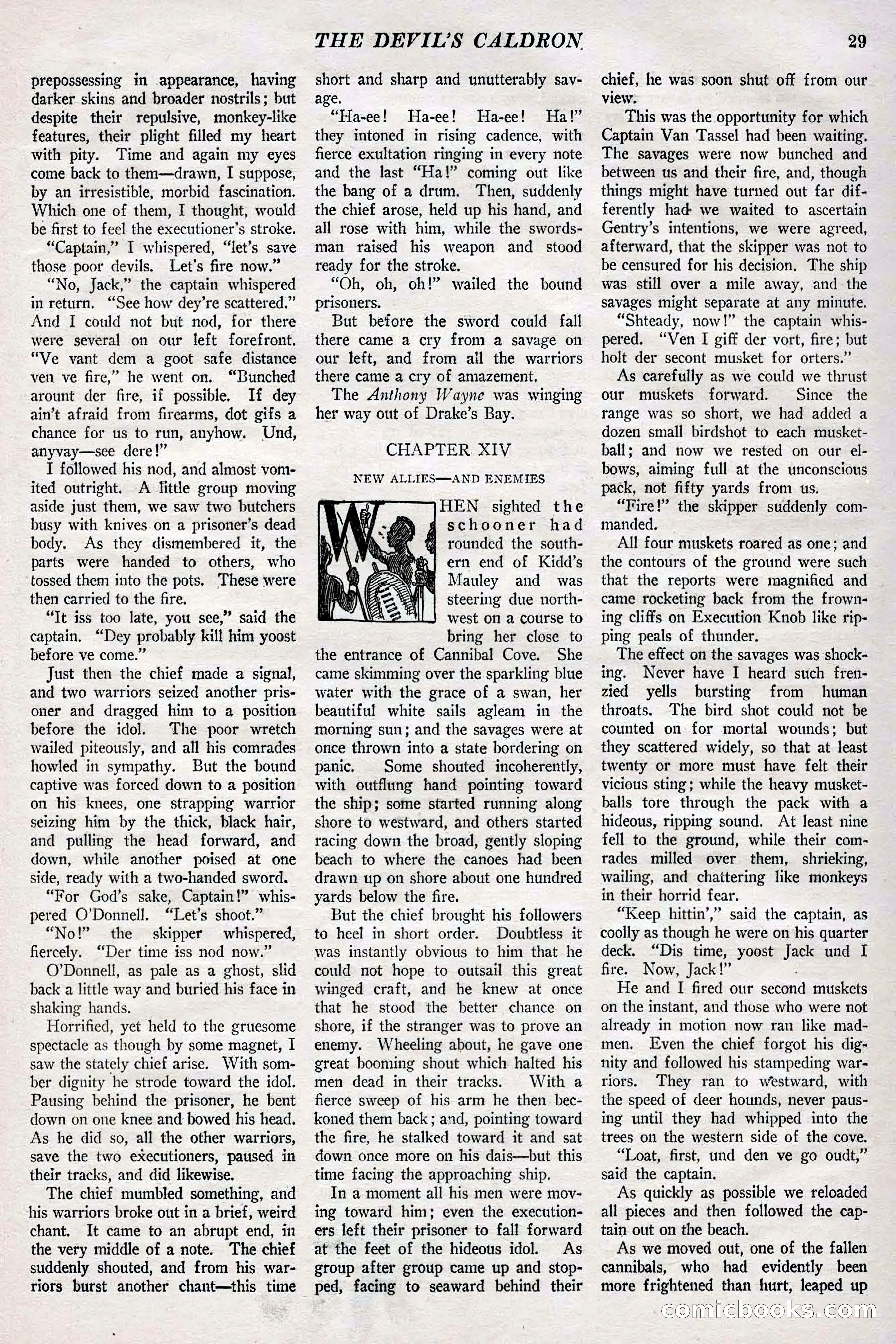
# Page 29: Story Prose from "The Devil's Caldron" This page contains story prose from a narrative titled "The Devil's Caldron." The text describes an action sequence involving what appears to be a confrontation between sailors or military personnel and indigenous warriors. The passage details combat, including musket fire, the approach of a ship called the *Anthony Wayne*, and strategic maneuvering on a beach near what's called Cannibal Cove. A chapter break occurs mid-page, introducing "Chapter XIV: New Allies—and Enemies," which continues the narrative. The prose employs dramatic dialogue and vivid description typical of early-20th-century adventure pulp fiction.
📄 Transcribed text from this page (OCR, searchable)
Machine-transcribed from the original scan — historical spelling and the odd misread are preserved.
prepossessing in appearance, having darker skins and broader nostrils; but despite their repulsive, monkey-like features, their plight filled my heart with pity. Time and again my eyes come back to them—drawn, I suppose, by an irresistible, morbid fascination. Which one of them, I thought, would be first to feel the executioner’s stroke. “Captain,” I whispered, “let’s save those poor devils. Let's fire now.” “No, Jack,” the captain whispered in return. “See how dey’re scattered.” And I could not but nod, for there were several on our left forefront. “Ve vant dem a goot safe distance ven ve fire,” he went on. “Bunched arount der fire, if possible. If dey ain’t afraid from firearms, dot gifs a chance for us to run, anyhow. Und, anyvay—see dere!” I followed his nod, and almost vom- ited outright. A little group moving aside just them, we saw two butchers busy with knives on a prisoner’s dead body. As they dismembered it, the parts were handed to others, who tossed them into the pots. These were then carried to the fire. “It iss too late, you see,” said the captain, “Dey probably kill him yoost before ve come.” Just then the chief made a signal, and two warriors seized another pris- oner and dragged him to a position before the idol. The poor wretch wailed piteously, and all his comrades howled in sympathy. But the bound captive was forced down to a position on his knees, one strapping warrior seizing him by the thick, black hair, and pulling the head forward, and down, while another poised at one side, ready with a two-handed sword. “Tor God’s sake, Captain!” whis- pered O’Donnell. “Let’s shoot.” “No!” the skipper whispered, fiercely. “Der time iss nod now.” O'Donnell, as pale as a ghost, slid back a little way and buried his face in shaking hands, Horrified, yet held to the gruesome spectacle as though by some magnet, I saw the stately chief arise. With som- ber dignity he strode toward the idol. Pausing behind the prisoner, he bent down on one knee and bowed his head. As he did so, all the other warriors, save the two executioners, paused in their tracks, and did likewise. The chief mumbled something, and his warriors broke out in a brief, weird chant. It came to an abrupt end, in the very middle of a note. The chief suddenly shouted, and from his war- riors burst another chant—this time THE DEVIL'S CALDRON short and sharp and unutterably sav- age. “Ha-ee! Ha-ee! Ha-ee! Ha!” they intoned in rising cadence, with fierce exultation ringing in every note and the last “Ha!” coming out like the bang of a drum. Then, suddenly the chief arose, held up his hand, and all rose with him, while the swords- man raised his weapon and_ stood ready for the stroke. “Oh, oh, oh!” wailed the bound prisoners. But before the sword could fall there came a cry from a savage on our left, and from ail the warriors there came a cry of amazement. The Anthony Wayne was winging her way out of Drake’s Bay. CHAPTER XIV NEW ALLIES—AND ENEMIES HEN sighted the g schooner had rounded the south- ern end of Kidd’s ® Mauley and was steering due north- west on a course to bring her close to the entrance of Cannibal Cove. She came skimming over the sparkling blue water with the grace of a swan, her beautiful white sails agleam in the morning sun; and the savages were at once thrown into a state bordering on panic. | Some shouted incoherently, with outflung hand pointing toward the ship; some started running along shore to westward, and others started racing down the broad, gently sloping beach to where the canoes had been drawn up on shore about one hundred yards below the fire. But the chief brought his followers to heel in short order. Doubtless it was instantly obvious to him that he could not hope to outsail this great winged craft, and he knew at once that he stood the better chance on shore, if the stranger was to prove an enemy. Wheeling about, he gave one great booming shout which halted his men dead in their tracks. With a fierce sweep of his arm he then bec- koned them back; and, pointing toward the fire, he stalked toward it and sat down once more on his dais—but this time facing the approaching ship. In a moment all his men were mov- ing toward him; even the execution- ers left their prisoner to fall forward at the feet of the hideous idol. As group after group came up and stop- ped, facing to seaward behind their 29 chief, he was soon shut off from our view. This was the opportunity for which Captain Van Tassel had been waiting. The savages were now bunched and between us and their fire, and, though things might have turned out far dif- ferently had we waited to ascertain Gentry’s intentions, we were agreed, afterward, that the skipper was not to be censured for his decision, The ship was still over a mile away, and the savages might separate at any minute. “Shteady, now!” the captain whis- pered. “Ven [ giff der vort, fire; but holt der secont musket for orters.” As carefully as we could we thrust our muskets forward. Since the range was so short, we had added a dozen small birdshot to each musket- ball; and now we rested on our el- bows, aiming full at the unconscious pack, not fifty yards from us. “Fire!” the skipper suddenly com- manded. All four muskets roared as one; and the contours of the ground were such that the reports were magnified and came rocketing back from the frown- ing cliffs on Execution Knob like rip- ping peals of thunder. The effect on the savages was shock- ing. Never have I heard such fren- zied yells bursting from human throats. The bird shot could not be counted on for mortal wounds; but they scattered widely, so that at least twenty or more must have felt their vicious sting; while the heavy musket- balls tore through the pack with a hideous, ripping sound. At least nine fell to the ground, while their com- rades milled over them, shrieking, wailing, and chattering like monkeys in their horrid fear, “Keep hittin’,” said the captain, as coolly as though he were on his quarter deck. “Dis time, yoost Jack und I fire. Now, Jack!” He and I fired our second muskets on the instant, and those who were not already in motion now ran like mad- men. Even the chief forgot his dig- nity and followed his stampeding war- riors. They ran to westward, with the speed of deer hounds, never paus- ing until they had whipped into the trees on the western side of the cove. “Loat, first, und den ve go oudt,” said the captain. As quickly as possible we reloaded all pieces and then followed the cap- tain out on the beach. As we moved out, one of the fallen cannibals, who had evidently been more frightened than hurt, leaped up COnnicloooKkS. com