
Pulp Fiction, 1926 · page 27 of 114
The Frontier, May 1926 — page 27: what you’re looking at
What you’re looking at
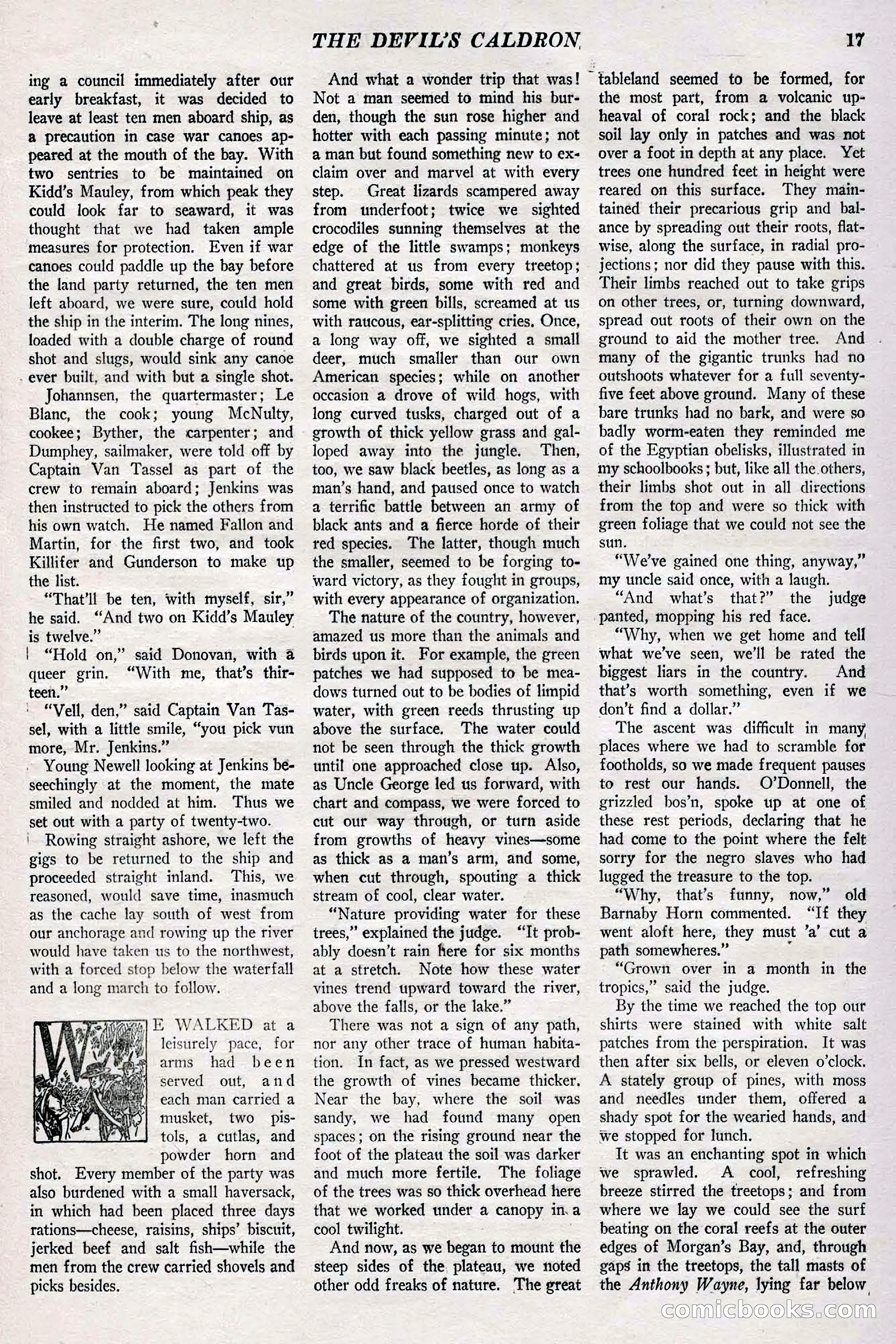
# Page Analysis This is a prose story page from *The Devil's Caldron*, numbered page 17. The text describes an expedition inland from a ship, with the narrator and companions exploring a tropical or subtropical landscape. They encounter exotic wildlife (crocodiles, wild hogs, great birds), navigate dense vegetation and vines, and eventually climb a plateau. The passage includes dialogue between characters—including Captain Van Tassel, Uncle George, a judge, and others—as they discuss their discoveries and the difficulty of the terrain. The narrative focuses on the natural environment and the group's observations of unusual flora and fauna during their inland journey.
📄 Transcribed text from this page (OCR, searchable)
Machine-transcribed from the original scan — historical spelling and the odd misread are preserved.
ing a council immediately after our early breakfast, it was decided to leave at least ten men aboard ship, as a precaution in case war canoes ap- peared at the mouth of the bay. With two sentries to be maintained on Kidd’s Mauley, from which peak they could look far to seaward, it was thought that we had taken ample measures for protection. Even 1f war canoes could paddle up the bay before the land party returned, the ten men left aboard, we were sure, could hold the ship in the interim. The long nines, loaded with a double charge of round shot and slugs, would sink any canoe _ ever built, and with but a single shot. Johannsen, the quartermaster; Le Blanc, the cook; young McNulty, cookee; Byther, the carpenter; and Dumphey, sailmaker, were told off by Captain Van Tassel as part of the crew to remain aboard; Jenkins was then instructed to pick the others from his own watch. He named Fallon and Martin, for the first two, and took Killifer and Gunderson to make up the list. “That'll be ten, with myself, sir,” he said. “And two on Kidd’s Mauley is twelve.” | | “Hold on,” said Donovan, with 4 queer grin. “With me, that’s thir- teen.” “Vell, den,” said Captain Van Tas- sel, with a little smile, “you pick vun more, Mr. Jenkins.” Young Newell looking at Jenkins be- seechingly at the moment, the mate smiled and nodded at him. Thus we set out with a party of twenty-two. ' Rowing straight ashore, we left the gigs to be returned to the ship and proceeded straight inland. This, we reasoned, would save time, inasmuch as the cache lay south of west from our anchorage and rowing up the river would have taken us to the northwest, with a forced stop below the waterfall and a long march to follow. Rees) WALKED at a | leisurely pace, for arms had been served out, and each man carried a musket, two pis- tols, a cutlas, and powder horn and shot, Every member of the party was also burdened with a small haversack, in which had been placed three days rations—cheese, raisins, ships’ biscuit, jerked beef and salt fish—while the men from the crew carried shovels and picks besides. THE DEVIL'S CALDRON And what a wonder trip that was! Not a man seemed to mind his bur- den, though the sun rose higher and hotter with each passing minute; not a man but found something new to ex- claim over and marvel at with every step. Great lizards scampered away from underfoot; twice we sighted crocodiles sunning themselves at the edge of the little swamps; monkeys chattered at us from every treetop; and great birds, some with red and some with green bills, screamed at us with raucous, ear-splitting cries, Once, a long way off, we sighted a small deer, much smaller than our own American species; while on another occasion a drove of wild hogs, with long curved tusks, charged out of a erowth of thick yellow grass and gal- loped away into the jungle. Then, too, we saw black beetles, as long as a man’s hand, and paused once to watch a terrific battle between an army of black ants and a fierce horde of their red species. The latter, though much the smaller, seemed to be forging to- ward victory, as they fought in groups, with every appearance of organization. The nature of the country, however, amazed us more than the animals and birds upon it. For example, the green patches we had supposed to be mea- dows turned out to be bodies of limpid water, with green reeds thrusting up above the surface. The water could not be seen through the thick growth until one approached close up. Also, as Uncle George led us forward, with chart and compass, we were forced to cut our way through, or turn aside from growths of heavy vines—some as thick as a man’s arm, and some, when cut through, spouting a thick stream of cool, clear water. “Nature providing water for these trees,” explained the judge. “It prob- ably doesn’t rain flere for six months at a stretch. Note how these water vines trend upward toward the river, above the falls, or the lake.” There was not a sign of any path, nor any other trace of human habita- tion. In fact, as we pressed westward the growth of vines became thicker. Near the bay, where the soil was sandy, we had found many open spaces; on the rising ground near the foot of the plateau the soil was darker and much more fertile. The foliage of the trees was so thick overhead here that we worked under a canopy ina cool twilight. And now, as we began to mount the steep sides of the plateau, we noted other odd freaks of nature. The great 17 ~fableland seemed to be formed, for the most part, from a volcanic up- heaval of coral rock; and the black soil lay only in patches and was not over a foot in depth at any place. Yet trees one hundred feet in height were reared on this surface. They main- tained their precarious grip and bal- ance by spreading out their roots, flat- wise, along the surface, in radial pro- jections; nor did they pause with this. Their limbs reached out to take grips on other trees, or, turning downward, spread out roots of their own on the ground to aid the mother tree. And many of the gigantic trunks had no outshoots whatever for a full seventy- five feet above ground. Many of these bare trunks had no bark, and were so badly worm-eaten they reminded me of the Egyptian obelisks, illustrated in my schoolbooks ; but, like all the others, their limbs shot out in all directions from the top and were so thick with green foliage that we could not see the sun. “We've gained one thing, anyway,” my uncle said once, with a laugh. “And what’s that?” the judge panted, mopping his red face. “Why, when we get home and tell what we've seen, we'll be rated the biggest liars in the country. And that’s worth something, even if we don’t find a dollar.” The ascent was difficult in many places where we had to scramble for footholds, so we made frequent pauses to rest our hands. O’Donnell, the grizzled bos’n, spoke up at one of these rest periods, declaring that he had come to the point where the felt sorry for the negro slaves who had lugged the treasure to the top. “Why, that’s funny, now,” old Barnaby Horn commented. “If they went aloft here, they must ’a’ cut a path somewheres.” ; “Grown over in a month in the tropics,” said the judge. By the time we reached the top our shirts were stained with white salt patches from the perspiration. It was then after six bells, or eleven o'clock. A stately group of pines, with moss and needles tunder them, offered a shady spot for the wearied hands, and we stopped for lunch. It was an enchanting spot in which we sprawled. <A _ cool, refreshing breeze stirred the treetops; and from where we lay we could see the surf beating on the coral reefs at the outer edges of Morgan’s Bay, and, through gaps in the treetops, the tall masts of the Anthony Wayne, lying far below Gomicbooksacom