
Pulp Fiction, 1926 · page 46 of 114
The Frontier, May 1926 — page 46: what you’re looking at
What you’re looking at
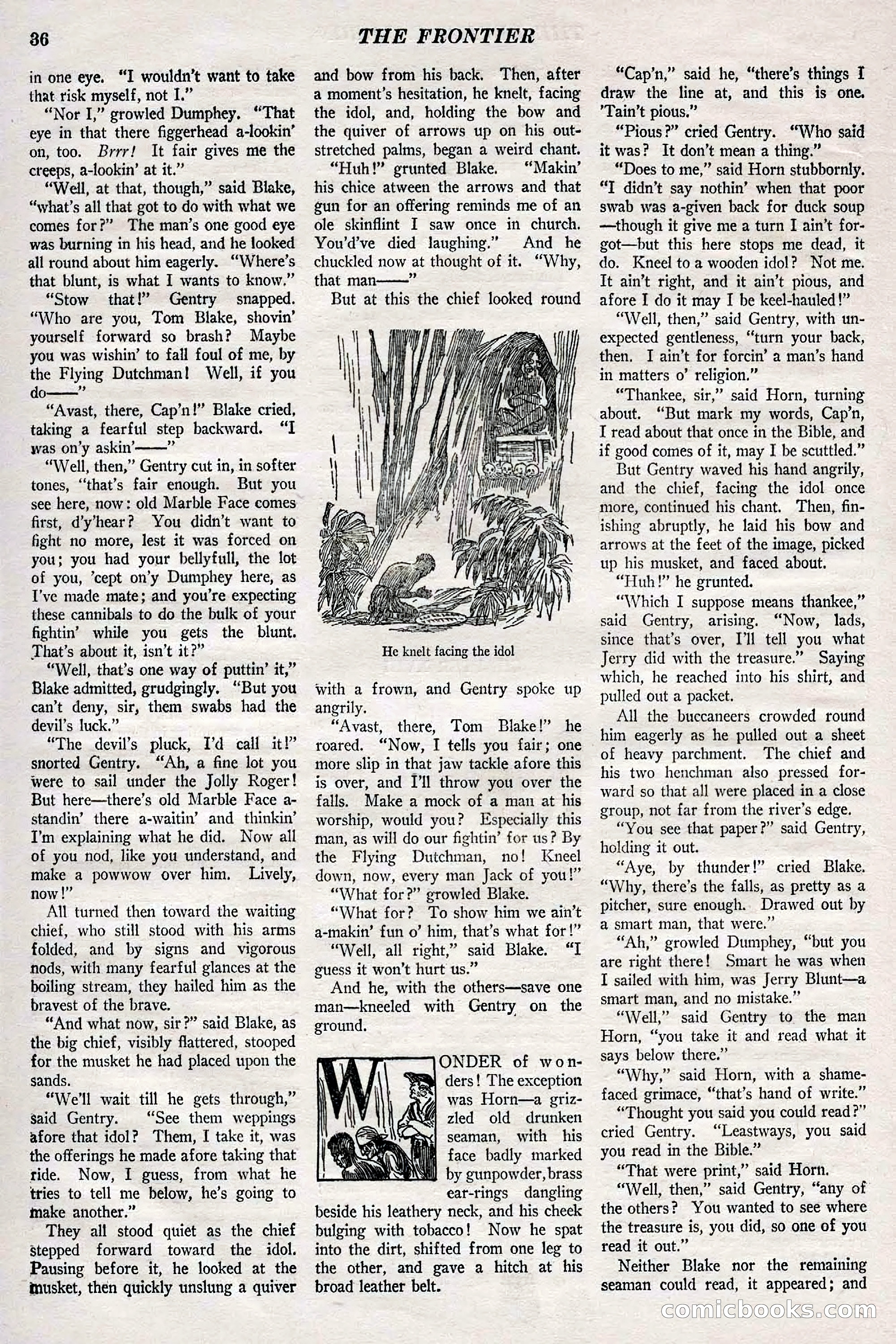
# Page Analysis This is page 36 from *The Frontier*, a pulp magazine. The page contains story prose with one illustration embedded within the text. The narrative depicts what appears to be a tense encounter involving a character named Blake, Gentry, and a Native American chief. Blake confronts Gentry about his brashness, while the chief performs some kind of ritualistic chanting before a wooden idol. The scene involves discussion of weapons, an offering, and apparent conflict resolution. The embedded illustration shows a kneeling figure facing an idol in what appears to be a natural setting with vegetation. The text discusses period-typical frontier adventure themes, though the exact plot context remains unclear from this single page.
📄 Transcribed text from this page (OCR, searchable)
Machine-transcribed from the original scan — historical spelling and the odd misread are preserved.
36 in one eye. “I wouldn’t want to take that risk myself, not I.” “Nor I,” growled Dumphey, “That eye in that there figgerhead a-lookin’ on, too. Brrr! It fair gives me the creeps, a-lookin’ at it.” “Weill, at that, though,” said Biake, “what’s all that got to do with what we comes for?” The man’s one good eye was burning in his head, and he looked all round about him eagerly. “Where’s that blunt, is what I wants to know.” “Stow that!’ Gentry snapped. “Who are you, Tom Blake, shovin’ yourself forward so brash? Maybe you was wishin’ to fall foul of me, by the Flying Dutchman! Well, if you do——” “Avast, there, Cap’n!” Blake cried, taking a fearful step backward. “I was on’y askin’——” “Well, then,’ Gentry cut in, in softer tones, ‘‘that’s fair enough. But you see here, now: old Marble Face comes first, d’y’hear? You didn’t want to fight no more, lest it was forced on you; you had your bellyfull, the lot of you, cept on’y Dumphey here, as I’ve made mate; and you’re expecting these cannibals to do the bulk of your fightin’ while you gets the blunt. That’s about it, isn’t it?” “Well, that’s one way of puttin’ it,” Blake admitted, grudgingly, “But you can’t deny, sir, them swabs had the devil’s luck.” “The devil’s pluck, I’d call it!” snorted Gentry. “Ah, a fine lot you were to sail under the Jolly Roger! But here—there’s old Marble Face a- standin’ there a-waitin’ and thinkin’ I’m explaining what he did. Now all of you nod, like you understand, and make a powwow over him. Lively, now!” All turned then toward the waiting chief, who still stood with his arms folded, and by signs and vigorous nods, with many fearful glances at the boiling stream, they hailed him as the bravest of the brave. “And what now, sir?” said Blake, as the big chief, visibly flattered, stooped for the musket he had placed upon the sands. “We'll wait till he gets through,” said Gentry. “See them weppings afore that idol? Them, [ take it, was the offerings he made afore taking that tide. Now, I guess, from what he tries to tell me below, he’s going to make another.” They all stood quiet as the chief stepped forward toward the idol. Pausing before it, he looked at the musket, then quickly unslung a quiver THE FRONTIER and bow from his back. Then, after a moment’s hesitation, he knelt, facing the idol, and, holding the bow and the quiver of arrows up on his out- stretched palms, began a weird chant. “Huh!” grunted Blake. “Makin’ his chice atween the arrows and that gun for an offering reminds me of an ole skinflint I saw once in church. You'd’ve died laughing.” And he chuckled now at thought of it. “Why, that man——” But at this the chief looked round ie SS *) j Hy) 4 .) * y, Ge Za =a ee : He knelt facing the idol LuleoNp = Vo with a frown, and Gentry spoke up angrily. “Avast, there, Tom Blake!” he roared. “Now, I tells you fair; one more slip in that jaw tackle afore this is over, and I'll throw you over the falls. Make a mock of a man at his worship, would you? Especially this man, as will do our fightin’ for us? By the Flying Dutchman, no! Kneel down, now, every man Jack of you!” “What for?” growled Blake. “What for? To show him we ain’t a-makin’ fun o’ him, that’s what for!” “Well, all right,” said Blake. “I guess it won’t hurt us.” And he, with the others—save one man—kneeled with Gentry on the ground. ONDER of won- My ders! The exception *4| was Horn—a griz- Mi zled old drunken seaman, with his 7 face badly marked Ai gunpowder, brass eat-rings dangling beside his leathery neck, and his cheek bulging with tobacco! Now he spat into the dirt, shifted from one leg to the other, and gave a hitch at his broad leather belt. “Cap’n,” said he, “there’s things i draw the line at, and this is one. ’Tain’t pious.” “Pious?” cried Gentry. “Who said it was? It don’t mean a thing.” “Does to me,” said Horn stubbornly. “T didn’t say nothin’ when that poor swab was a-given back for duck soup —though it give me a turn I ain’t for- got—but this here stops me dead, it do. Kneel to a wooden idol? Not me. It ain’t right, and it ain’t pious, and afore I do it may I be keel-hauled!” “Well, then,” said Gentry, with un- expected gentleness, “turn your back, then. I ain’t for forcin’ a man’s hand in matters o’ religion.” “Thankee, sir,” said Horn, turning about. “But mark my words, Cap’n, I read about that once in the Bible, and if good comes of it, may I be scuttled.” But Gentry waved his hand angrily, and the chief, facing the idol once more, continued his chant. Then, fin- ishing abruptly, he laid his bow and arrows at the feet of the image, picked up his musket, and faced about. “Huh!” he grunted. “Which I suppose means thankee,” said Gentry, arising. “Now, lads, since that’s over, Tl tell you what Jerry did with the treasure.” Saying which, he reached into his shirt, and pulled out a packet. All the buccaneers crowded round him eagerly as he pulled out a sheet of heavy parchment. The chief and his two henchman also pressed for- ward so that all were placed in a close group, not far from the river’s edge. “You see that paper?” said Gentry, holding it out. “Aye, by thunder!” cried Blake. “Why, there’s the falls, as pretty as a pitcher, sure enough. Drawed out by a smart man, that were.”’ “Ah,” growled Dumphey, “but you are right there! Smart he was when I sailed with him, was Jerry Blunt—a smart man, and no mistake.” “Well,” said Gentry to the man Horn, “you take it and read what it says below there.” “Why,” said Horn, with a shame- faced grimace, “that’s hand of write.” “Thought you said you could read?” cried Gentry. “Leastways, you said you read in the Bible.” “That were print,” said Horn. “Well, then,” said Gentry, “any of the others? You wanted to see where the treasure is, you did, so one of you read it out.” Neither Blake nor the remaining seaman could read, it appeared; and COnniclboookKkS. CORN