
Pulp Fiction, 1926 · page 71 of 114
The Frontier, May 1926 — page 71: what you’re looking at
What you’re looking at
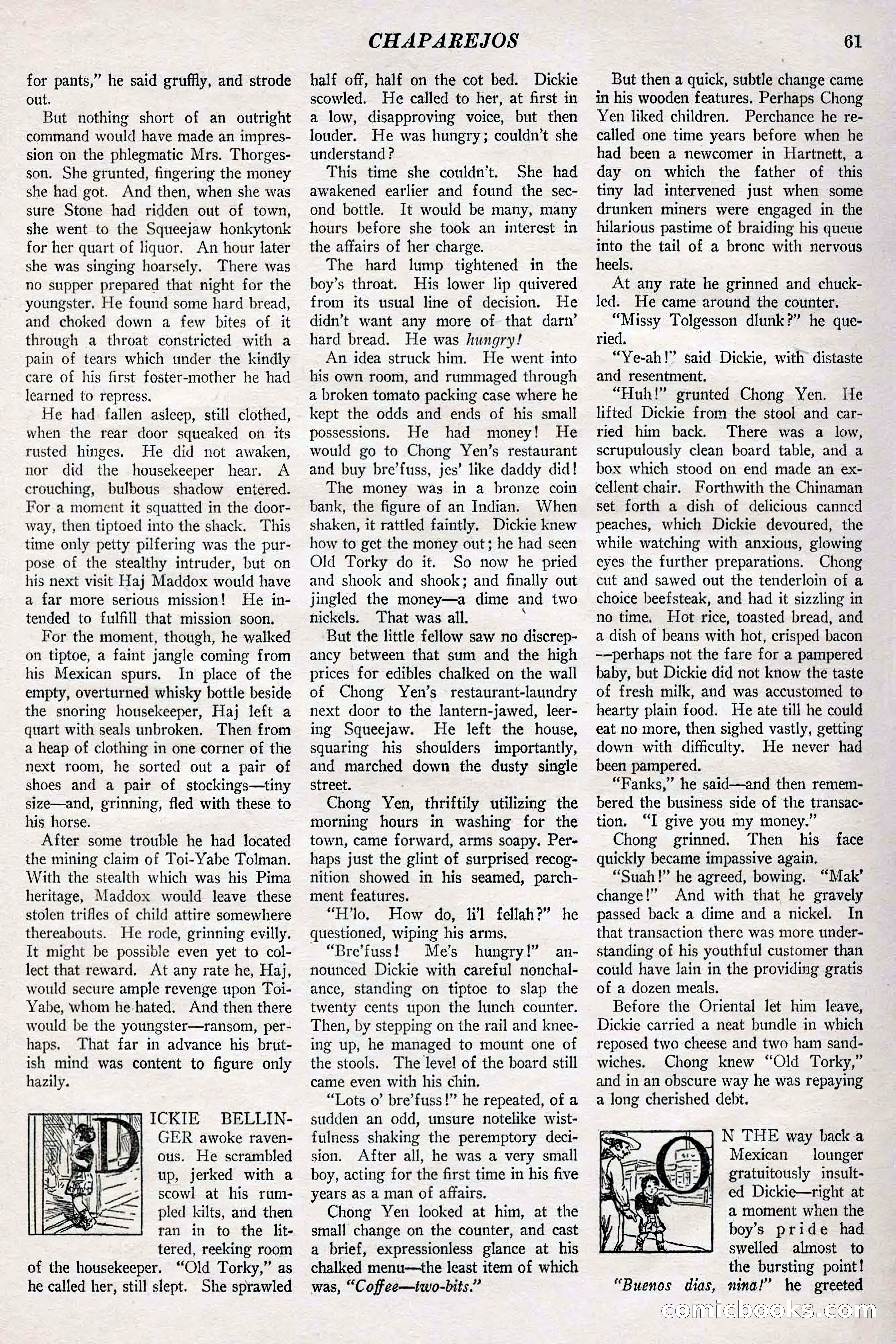
# Page Analysis This page contains story prose from a pulp fiction magazine, specifically from a section titled "CHAPAREJOS" (page 61). The text describes a scene involving a young boy named Dickie who, hungry and desperate, steals money from a broken tomato packing case and ventures to Chong Yen's restaurant to buy food. The narrative follows Dickie's interactions with the Chinese restaurant owner Chong Yen, detailing the meal preparation and their transaction. The page includes two small illustrations—decorative initial letters—but is predominantly prose text. The story appears to be an adventure or crime-oriented pulp narrative set in what seems to be a frontier or settlement town.
📄 Transcribed text from this page (OCR, searchable)
Machine-transcribed from the original scan — historical spelling and the odd misread are preserved.
for pants,” he said gruffly, and strode out. But nothing short of an outright command would have made an impres- sion on the phlegmatic Mrs. Thorges- son. She grunted, fingering the money she had got. And then, when she was sure Stone had ridden out of town, she went to the Squeejaw honkytonk for her quart of liquor. An hour later she was singing hoarsely. There was no supper prepared that night for the youngster. He found some hard bread, and choked down a few bites of it through a throat constricted with a pain of tears which under the kindly care of his first foster-mother he had learned to repress. He had fallen asleep, still clothed, when the rear door squeaked on its rusted hinges. He did not awaken, nor did the housekeeper hear. A crouching, bulbous shadow entered. For a moment it squatted in the door- way, then tiptoed into the shack, This time only petty pilfering was the pur- pose of the stealthy intruder, but on his next visit Haj Maddox would have a far more serious mission! He in- tended to fulfill that mission soon. For the moment, though, he walked on tiptoe, a faint jangle coming from his Mexican spurs. In place of the empty, overturned whisky bottle beside the snoring housekeeper, Haj left a quart with seals unbroken. Then from a heap of clothing in one corner of the next room, he sorted out a pair of shoes and a pair of stockings—tiny size—and, grinning, fled with these to his horse. After some trouble he had located the mining claim of Toi-Yabe Tolman. With the stealth which was his Pima heritage, Maddox would leave these stolen trifles of child attire somewhere thereabouts. He rode, grinning evilly. It might be possible even yet to col- lect that reward. At any rate he, Haj, would secure ample revenge upon Toi- Yabe, whom he hated, And then there would be the youngster—ransom, per- haps. That far in advance his brut- ish mind was content to figure only hazily. ICKIE BELLIN- GER awoke raven- ous. He scrambled up, jerked with a scowl at his rum- pled kilts, and then ran in to the lit- tered, reeking room of the housekeeper. “Old Torky,” as he called her, still slept. She sprawled CHAPAREJOS half off, half on the cot bed. Dickie scowled. He called to her, at first in a low, disapproving voice, but then louder. He was hungry; couldn’t she understand ? This time she couldn’t. She had awakened earlier and found the sec- ond bottle. It would be many, many hours before she took an interest in the affairs of her charge. The hard lump tightened in the boy’s throat. His lower lip quivered from its usual line of decision. He didn’t want any more of that darn’ hard bread. He was hungry! An idea struck him. He went into his own room, and rummaged through a broken tomato packing case where he kept the odds and ends of his small possessions. He had money! He would go to Chong Yen’s restaurant and buy bre’fuss, jes’ like daddy did! The money was in a bronze coin bank, the figure of an Indian. When shaken, it rattled faintly. Dickie knew how to get the money out; he had seen Old Torky do it. So now he pried and shook and shook; and finally out jingled the money—a dime and two nickels. That was all. But the little fellow saw no discrep- ancy between that sum and the high prices for edibles chalked on the wall of Chong Yen’s restaurant-laundry next door to the lantern-jawed, leer- ing Squeejaw. He left the house, squaring his shoulders importantly, and marched down the dusty single street. Chong Yen, thriitily utilizing the morning hours in washing for the town, came forward, arms soapy. Per- haps just the glint of surprised recog- nition showed in his seamed, parch- ment features. “H'lo. How do, li'l fellah?”’ he questioned, wiping his arms. “Bre’fuss! Me’s hungry!” an- nounced Dickie with careful nonchal- ance, standing on tiptoe to slap the twenty cents upon the lunch counter. Then, by stepping on the rail and knee- ing up, he managed to mount one of the stools. The level of the board still came even with his chin. “Lots o’ bre’fuss!” he repeated, of a sudden an odd, unsure notelike wist- fulness shaking the peremptory deci- sion. After all, he was a very small boy, acting for the first time in his five years as a man of affairs. Chong Yen looked at him, at the small change on the counter, and cast a brief, expressionless glance at his chalked menu—the least item of which was, “Coffee—iwo-bits.” 61 But then a quick, subtle change came in his wooden features. Perhaps Chong Yen liked children. Perchance he re- called one time years before when he had been a newcomer in Hartnett, a day on which the father of this tiny lad intervened just when some drunken miners were engaged in the hilarious pastime of braiding his queue into the tail of a brone with nervous heels. At any rate he grinned and chuck- led. He came around the counter. “Missy Tolgesson dlunk?” he que- ried. “Ve-ah!” said Dickie, with distaste and resentment. “Huh!” grunted Chong Yen. He lifted Dickie from the stool and car- ried him back. There was a low, scrupulously clean board table, and a box which stood on end made an ex- cellent chair. Forthwith the Chinaman set forth a dish of delicious canned peaches, which Dickie devoured, the while watching with anxious, glowing eyes the further preparations. Chong cut and sawed out the tenderloin of a choice beefsteak, and had it sizzling in no time. Hot rice, toasted bread, and a dish of beans with hot, crisped bacon —perhaps not the fare for a pampered baby, but Dickie did not know the taste of fresh milk, and was accustomed to hearty plain food. He ate till he could eat no more, then sighed vastly, getting down with difficulty. He never had been pampered. “Fanks,” he said—and then remem- bered the business side of the transac- tion. “I give you my money.” Chong grinned. Then his face quickly became impassive again, “Suah!” he agreed, bowing, “Mak’ change!” And with that he gravely passed back a dime and a nickel. In that transaction there was more under- standing of his youthful customer than could have lain in the providing gratis of a dozen meals. Before the Oriental let him leave, Dickie carried a neat bundle in which reposed two cheese and two ham sand- wiches. Chong knew “Old Torky,” and in an obscure way he was repaying a long cherished debt. N THE way back a Mexican _ lounger gratuitously insult- ed Dickie—right at a moment when the boy’s pride had swelled almost to the bursting point! “Buenos dias, nina!” he greeted CONiicoookxs.COm